SUBSCRIBE TO OUR FREE NEWSLETTER
Daily news & progressive opinion—funded by the people, not the corporations—delivered straight to your inbox.
5
#000000
#FFFFFF
To donate by check, phone, or other method, see our More Ways to Give page.
Daily news & progressive opinion—funded by the people, not the corporations—delivered straight to your inbox.
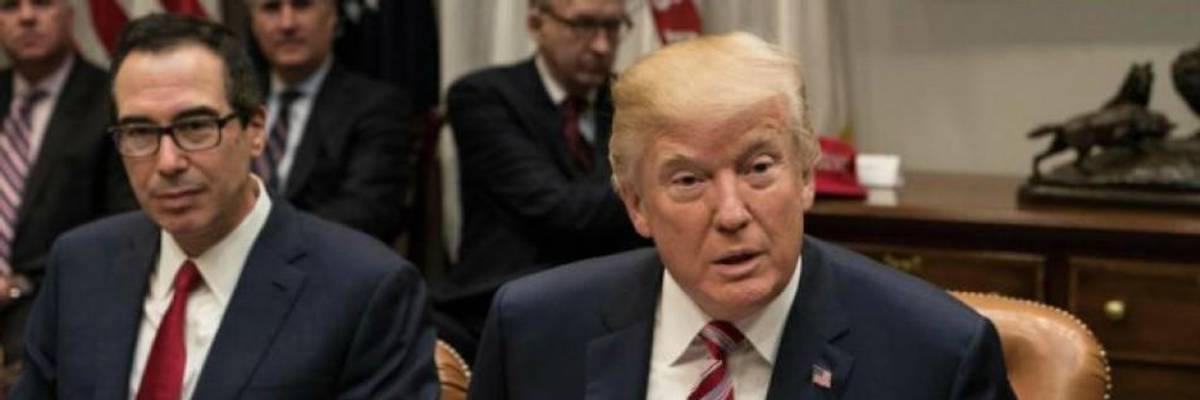
President Donald Trump speaks at a meeting with business leaders at the White House in Washington, D.C. on October 31, 2017. (Photo: Nicholas Kamm/AFP/Getty Images)
The news is filled with stories about President Trump and his predecessors imposing sanctions on other countries, their officials, and other prominent persons. But the media rarely spells out exactly what these sanctions are, the intermediaries who enforce them, the impacts they have on innocent civilians - women, men and children - how they are countered or evaded, and whether they fulfill or undermine their diplomatic, military, or economic purposes.
For example, sanctions against Iran by Trump increase by the year. They force banks and other financial institutions to cut off all decreed transactions, such as exports from Iran or purchase by Iran of critical spare parts, raw materials, even medical devices. Years ago, sanctions against Iraq under Saddam Hussein prohibited Iraq from purchasing chlorine to purify drinking water and children's catheters. These sanctions produced deadly results for innocents. Iran's economy is now in ruins and the brunt of the pain is suffered by innocent families. Under international law, disproportionate harm on civilians from sanctions is a serious violation.
Presently, from Trump there are sanctions on individuals in numerous countries, restricting their travel, their purchases and more. When banks like Citigroup and Bank of America are told by Washington to cut off any financial transactions from any companies doing business with a sanctioned country, do the banks receive payment for their trouble, or are there other quid pro quo rewards? We do not know. Secret government actions are pervasive, though sometimes a freedom of information request, followed by litigation, may pry open what is hidden.
Media alert! Sanctions are potential hotbeds for corruption and illegalities.
A little told story relates the tariffs Trump is imposing on imports from other countries, especially China. There are serious questions as to whether presidents have the constitutional authority or whether Congress must maintain authority on tariffs. Veteran constitutional law litigator Alan Morrison is now contesting sweeping executive tariff power in the federal courts. Reporting on this overreaching by the President is scarce.
Digging deeper, reporters should be asking what standards control presidential discretion or whims on imposing tariffs. The "national security flag" can't just be waved arbitrarily.
Trump passes out many waivers for certain U.S. companies. Why, for example, did Trump give Apple CEO Tim Cook a waiver on tens of billions of dollars in iPhones imported from China, but not provide waivers to any number of smaller U.S. companies who buy products from China for their manufacturing or retail/wholesale sales?
Constitutional law specialist, Bruce Fein, says the absence of standards for giving waivers raises fundamental questions of unlawful delegation by Congress.
Media alert! Potential incentives for corruption and lawlessness in these burgeoning behind the scenes intrigues are huge.
The third hotbed of abuses relates to the charges by Washington that countries abroad tolerate "corruption," and that security and economic relations with them are either jeopardized or unworkable. Such charges are regularly made against the governments of Afghanistan and Iraq - both militarily occupied by the U.S.
Corruption involves more than high-level officials taking bribes. Low-level public servants, so woefully underpaid, take money under the table to survive. As it happens, Ashraf Ghani, the elected president of Afghanistan, a former professor at Johns Hopkins University, was a leading expert on the nuances and functions of bribery in third-world countries. He can be a worthy source of knowledge on corruption.
U.S. agencies are a major generator of secret corruption in countries like Afghanistan. For example, cargo planes full of crisp one hundred dollar bills are shipped to Kabul and then trans-shipped to places like Kandahar. It doesn't take much imagination to frame a reporter's investigation--of what happens to cash in occupied, desperate societies.
Books and articles on the intelligence agencies note that cash handouts, big and small, are critical to achieve their purposes. There is so much bribery cash in Afghanistan that to stop the flow would seriously affect their shaky economy.
Bribery is a two way street - the briber and the bribee. Secret payments and bribes have often backfired against U.S. foreign policies in many undesirable ways.
Bribes to get what Washington and giant multinational corporations want from fragile countries merits more reporting, if only to show that a good deal of the bribery is under our control and within our power to reverse.
Media Alert!
Dear Common Dreams reader, It’s been nearly 30 years since I co-founded Common Dreams with my late wife, Lina Newhouser. We had the radical notion that journalism should serve the public good, not corporate profits. It was clear to us from the outset what it would take to build such a project. No paid advertisements. No corporate sponsors. No millionaire publisher telling us what to think or do. Many people said we wouldn't last a year, but we proved those doubters wrong. Together with a tremendous team of journalists and dedicated staff, we built an independent media outlet free from the constraints of profits and corporate control. Our mission has always been simple: To inform. To inspire. To ignite change for the common good. Building Common Dreams was not easy. Our survival was never guaranteed. When you take on the most powerful forces—Wall Street greed, fossil fuel industry destruction, Big Tech lobbyists, and uber-rich oligarchs who have spent billions upon billions rigging the economy and democracy in their favor—the only bulwark you have is supporters who believe in your work. But here’s the urgent message from me today. It's never been this bad out there. And it's never been this hard to keep us going. At the very moment Common Dreams is most needed, the threats we face are intensifying. We need your support now more than ever. We don't accept corporate advertising and never will. We don't have a paywall because we don't think people should be blocked from critical news based on their ability to pay. Everything we do is funded by the donations of readers like you. When everyone does the little they can afford, we are strong. But if that support retreats or dries up, so do we. Will you donate now to make sure Common Dreams not only survives but thrives? —Craig Brown, Co-founder |
The news is filled with stories about President Trump and his predecessors imposing sanctions on other countries, their officials, and other prominent persons. But the media rarely spells out exactly what these sanctions are, the intermediaries who enforce them, the impacts they have on innocent civilians - women, men and children - how they are countered or evaded, and whether they fulfill or undermine their diplomatic, military, or economic purposes.
For example, sanctions against Iran by Trump increase by the year. They force banks and other financial institutions to cut off all decreed transactions, such as exports from Iran or purchase by Iran of critical spare parts, raw materials, even medical devices. Years ago, sanctions against Iraq under Saddam Hussein prohibited Iraq from purchasing chlorine to purify drinking water and children's catheters. These sanctions produced deadly results for innocents. Iran's economy is now in ruins and the brunt of the pain is suffered by innocent families. Under international law, disproportionate harm on civilians from sanctions is a serious violation.
Presently, from Trump there are sanctions on individuals in numerous countries, restricting their travel, their purchases and more. When banks like Citigroup and Bank of America are told by Washington to cut off any financial transactions from any companies doing business with a sanctioned country, do the banks receive payment for their trouble, or are there other quid pro quo rewards? We do not know. Secret government actions are pervasive, though sometimes a freedom of information request, followed by litigation, may pry open what is hidden.
Media alert! Sanctions are potential hotbeds for corruption and illegalities.
A little told story relates the tariffs Trump is imposing on imports from other countries, especially China. There are serious questions as to whether presidents have the constitutional authority or whether Congress must maintain authority on tariffs. Veteran constitutional law litigator Alan Morrison is now contesting sweeping executive tariff power in the federal courts. Reporting on this overreaching by the President is scarce.
Digging deeper, reporters should be asking what standards control presidential discretion or whims on imposing tariffs. The "national security flag" can't just be waved arbitrarily.
Trump passes out many waivers for certain U.S. companies. Why, for example, did Trump give Apple CEO Tim Cook a waiver on tens of billions of dollars in iPhones imported from China, but not provide waivers to any number of smaller U.S. companies who buy products from China for their manufacturing or retail/wholesale sales?
Constitutional law specialist, Bruce Fein, says the absence of standards for giving waivers raises fundamental questions of unlawful delegation by Congress.
Media alert! Potential incentives for corruption and lawlessness in these burgeoning behind the scenes intrigues are huge.
The third hotbed of abuses relates to the charges by Washington that countries abroad tolerate "corruption," and that security and economic relations with them are either jeopardized or unworkable. Such charges are regularly made against the governments of Afghanistan and Iraq - both militarily occupied by the U.S.
Corruption involves more than high-level officials taking bribes. Low-level public servants, so woefully underpaid, take money under the table to survive. As it happens, Ashraf Ghani, the elected president of Afghanistan, a former professor at Johns Hopkins University, was a leading expert on the nuances and functions of bribery in third-world countries. He can be a worthy source of knowledge on corruption.
U.S. agencies are a major generator of secret corruption in countries like Afghanistan. For example, cargo planes full of crisp one hundred dollar bills are shipped to Kabul and then trans-shipped to places like Kandahar. It doesn't take much imagination to frame a reporter's investigation--of what happens to cash in occupied, desperate societies.
Books and articles on the intelligence agencies note that cash handouts, big and small, are critical to achieve their purposes. There is so much bribery cash in Afghanistan that to stop the flow would seriously affect their shaky economy.
Bribery is a two way street - the briber and the bribee. Secret payments and bribes have often backfired against U.S. foreign policies in many undesirable ways.
Bribes to get what Washington and giant multinational corporations want from fragile countries merits more reporting, if only to show that a good deal of the bribery is under our control and within our power to reverse.
Media Alert!
The news is filled with stories about President Trump and his predecessors imposing sanctions on other countries, their officials, and other prominent persons. But the media rarely spells out exactly what these sanctions are, the intermediaries who enforce them, the impacts they have on innocent civilians - women, men and children - how they are countered or evaded, and whether they fulfill or undermine their diplomatic, military, or economic purposes.
For example, sanctions against Iran by Trump increase by the year. They force banks and other financial institutions to cut off all decreed transactions, such as exports from Iran or purchase by Iran of critical spare parts, raw materials, even medical devices. Years ago, sanctions against Iraq under Saddam Hussein prohibited Iraq from purchasing chlorine to purify drinking water and children's catheters. These sanctions produced deadly results for innocents. Iran's economy is now in ruins and the brunt of the pain is suffered by innocent families. Under international law, disproportionate harm on civilians from sanctions is a serious violation.
Presently, from Trump there are sanctions on individuals in numerous countries, restricting their travel, their purchases and more. When banks like Citigroup and Bank of America are told by Washington to cut off any financial transactions from any companies doing business with a sanctioned country, do the banks receive payment for their trouble, or are there other quid pro quo rewards? We do not know. Secret government actions are pervasive, though sometimes a freedom of information request, followed by litigation, may pry open what is hidden.
Media alert! Sanctions are potential hotbeds for corruption and illegalities.
A little told story relates the tariffs Trump is imposing on imports from other countries, especially China. There are serious questions as to whether presidents have the constitutional authority or whether Congress must maintain authority on tariffs. Veteran constitutional law litigator Alan Morrison is now contesting sweeping executive tariff power in the federal courts. Reporting on this overreaching by the President is scarce.
Digging deeper, reporters should be asking what standards control presidential discretion or whims on imposing tariffs. The "national security flag" can't just be waved arbitrarily.
Trump passes out many waivers for certain U.S. companies. Why, for example, did Trump give Apple CEO Tim Cook a waiver on tens of billions of dollars in iPhones imported from China, but not provide waivers to any number of smaller U.S. companies who buy products from China for their manufacturing or retail/wholesale sales?
Constitutional law specialist, Bruce Fein, says the absence of standards for giving waivers raises fundamental questions of unlawful delegation by Congress.
Media alert! Potential incentives for corruption and lawlessness in these burgeoning behind the scenes intrigues are huge.
The third hotbed of abuses relates to the charges by Washington that countries abroad tolerate "corruption," and that security and economic relations with them are either jeopardized or unworkable. Such charges are regularly made against the governments of Afghanistan and Iraq - both militarily occupied by the U.S.
Corruption involves more than high-level officials taking bribes. Low-level public servants, so woefully underpaid, take money under the table to survive. As it happens, Ashraf Ghani, the elected president of Afghanistan, a former professor at Johns Hopkins University, was a leading expert on the nuances and functions of bribery in third-world countries. He can be a worthy source of knowledge on corruption.
U.S. agencies are a major generator of secret corruption in countries like Afghanistan. For example, cargo planes full of crisp one hundred dollar bills are shipped to Kabul and then trans-shipped to places like Kandahar. It doesn't take much imagination to frame a reporter's investigation--of what happens to cash in occupied, desperate societies.
Books and articles on the intelligence agencies note that cash handouts, big and small, are critical to achieve their purposes. There is so much bribery cash in Afghanistan that to stop the flow would seriously affect their shaky economy.
Bribery is a two way street - the briber and the bribee. Secret payments and bribes have often backfired against U.S. foreign policies in many undesirable ways.
Bribes to get what Washington and giant multinational corporations want from fragile countries merits more reporting, if only to show that a good deal of the bribery is under our control and within our power to reverse.
Media Alert!