SUBSCRIBE TO OUR FREE NEWSLETTER
Daily news & progressive opinion—funded by the people, not the corporations—delivered straight to your inbox.
5
#000000
#FFFFFF
To donate by check, phone, or other method, see our More Ways to Give page.
Daily news & progressive opinion—funded by the people, not the corporations—delivered straight to your inbox.
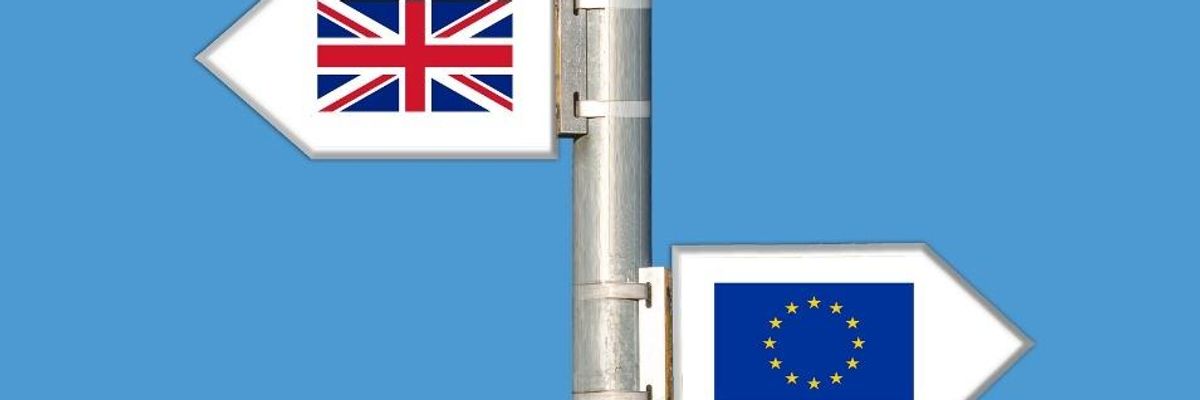
Among UK citizens aged 45-54, 56% voted to leave the EU, with those aged 55-64 (57%) and 65+ (60%) remarkably close. Compare this to 73% in the 18-24 age group, and 62% in the 25-34 age group, who voted to remain in the EU. (Photo: Pixabay/Public Domain)
By this time tomorrow, the UK will be out of the European Union. To those who say the UK is better out than in, I beg to differ.
In 1979, I moved to England. This was the year Margaret Thatcher was elected, and just seven years after Conservative Prime Minister Ted Heath - an advocate for EC membership - signed the Accession Treaty that put the UK into what would become the European Union. Make no mistake, the EU has largely been an economic free-trade project, and so claims that that being anti-Europe is a default right-wing position are tinged with more than a little irony. With that economic project, however, have also come certain notions of solidarity and expanded horizons that have proved to be valuable.
1979 UK was a far more insular, parochial place than the UK we see today. The idea of a nation not just cut off from Europe, but happily cut off, was a powerful vein that ran through the popular imagination. It fueled the fires of both British Exceptionalism and national individualism. The idea would sometimes morph into the palpable. "The Continent" (as many in Britain liked to call Europe) felt much further away than the mere 21 miles of water separating English Dover from French Calais.
We need to remember that 1979 UK was still nine years away from the start of the construction of the Channel Tunnel, and 15 years away from its opening. For someone from the UK to get to even the closest point on continental Europe took some effort. A boat. A plane. And this was before low-cost airlines. The psychological impact of that separation - again, a separation that was not always lamented, and often celebrated - can't be underestimated.
In 1979 UK, most young people didn't define themselves as "European." To call someone that was a mild insult. It carried with it the distinct whiff of Otherness. European-ness was about strikes, laziness, odd food, strong cigarettes, weird languages and strange customs. It was also about outright xenophobia, crystallized in the representations of southern Europe and southern Europeans.
Europe in the late 70s also carried the after-shocks of war. When I moved to the UK in the 1979, there were people walking around in the cities, towns and villages who had fought in World War II. And some of these people were still only in their mid-50s. Basil Fawlty's "Don't Mention The War" line wasn't some arcane joke. It was still very much real. This was also residual animosity between formerly competing colonial empires.
Then, things began to change.
The dour 70s and brutal Thatcherite 80s gave way to a vision of the UK as a nation not separated from, but a part of, Europe. This change was not seismic, but gradual. The opposition to Europe was slowly-but-clearly eroding with the winds of history. As time passed, younger UK citizens embraced what it meant to be European. The London of 1999 was a long way from the London of 1979. Europe was now part of the future, not the past. Jokes about "The French" and World War II largely relegated to sad acts of ageing D-list comics.
Nationalist notions of "going it alone" and "bulldog spirit" had lost ground to the simple idea that there was value in solidarity and commonality. This, of course, set off alarm bells for those who considered the UK to be culturally superior. It also, perhaps, helped those in favor of the nationalist project to map out the core strategies for regaining power.
To argue that Britain was better than Europe. That rugged individualism trumps broader solidarity. That there is beauty and purity in isolation. And, perhaps most importantly, that it is "foreigners" - inside of the UK in the form of "immigrants" and "refugees" and outside in the form of Brussels bureaucrats - who had destroyed what had put the "Great" into "Great Britain."
Refugees from Syria fleeing for their lives provided the perfect scapegoats for media and politicians itching to portray, in the most bigoted of fashions, the European project as driven by "multiculturalism" and "diversity." The complicity of the media in the service of this anti-immigrant agenda was blunt, crude and disgraceful. It also hearkened back to the worst days of political disinformation spread by a compromised and weaponized UK tabloid press (with Murdoch's The Sun at the sharp end).
The strategy worked, but mainly with those who grew up in the UK in the years before I arrived. Among UK citizens aged 45-54, 56% voted to leave the EU, with those aged 55-64 (57%) and 65+ (60%) remarkably close. Compare this to 73% in the 18-24 age group, and 62% in the 25-34 age group, who voted to remain in the EU.
As the UK leaves the EU, I think back to 41 years ago when I moved to the UK, what has changed, and how quickly it has been undone. I also think of those who now live in the UK with family backgrounds from other parts of the world, or younger UK citizens wishing for a broader future, who must wake up in an environment of increased hostility and uncertainty.
The future swallowed by the past. That's a sad legacy.
Dear Common Dreams reader, It’s been nearly 30 years since I co-founded Common Dreams with my late wife, Lina Newhouser. We had the radical notion that journalism should serve the public good, not corporate profits. It was clear to us from the outset what it would take to build such a project. No paid advertisements. No corporate sponsors. No millionaire publisher telling us what to think or do. Many people said we wouldn't last a year, but we proved those doubters wrong. Together with a tremendous team of journalists and dedicated staff, we built an independent media outlet free from the constraints of profits and corporate control. Our mission has always been simple: To inform. To inspire. To ignite change for the common good. Building Common Dreams was not easy. Our survival was never guaranteed. When you take on the most powerful forces—Wall Street greed, fossil fuel industry destruction, Big Tech lobbyists, and uber-rich oligarchs who have spent billions upon billions rigging the economy and democracy in their favor—the only bulwark you have is supporters who believe in your work. But here’s the urgent message from me today. It's never been this bad out there. And it's never been this hard to keep us going. At the very moment Common Dreams is most needed, the threats we face are intensifying. We need your support now more than ever. We don't accept corporate advertising and never will. We don't have a paywall because we don't think people should be blocked from critical news based on their ability to pay. Everything we do is funded by the donations of readers like you. When everyone does the little they can afford, we are strong. But if that support retreats or dries up, so do we. Will you donate now to make sure Common Dreams not only survives but thrives? —Craig Brown, Co-founder |
By this time tomorrow, the UK will be out of the European Union. To those who say the UK is better out than in, I beg to differ.
In 1979, I moved to England. This was the year Margaret Thatcher was elected, and just seven years after Conservative Prime Minister Ted Heath - an advocate for EC membership - signed the Accession Treaty that put the UK into what would become the European Union. Make no mistake, the EU has largely been an economic free-trade project, and so claims that that being anti-Europe is a default right-wing position are tinged with more than a little irony. With that economic project, however, have also come certain notions of solidarity and expanded horizons that have proved to be valuable.
1979 UK was a far more insular, parochial place than the UK we see today. The idea of a nation not just cut off from Europe, but happily cut off, was a powerful vein that ran through the popular imagination. It fueled the fires of both British Exceptionalism and national individualism. The idea would sometimes morph into the palpable. "The Continent" (as many in Britain liked to call Europe) felt much further away than the mere 21 miles of water separating English Dover from French Calais.
We need to remember that 1979 UK was still nine years away from the start of the construction of the Channel Tunnel, and 15 years away from its opening. For someone from the UK to get to even the closest point on continental Europe took some effort. A boat. A plane. And this was before low-cost airlines. The psychological impact of that separation - again, a separation that was not always lamented, and often celebrated - can't be underestimated.
In 1979 UK, most young people didn't define themselves as "European." To call someone that was a mild insult. It carried with it the distinct whiff of Otherness. European-ness was about strikes, laziness, odd food, strong cigarettes, weird languages and strange customs. It was also about outright xenophobia, crystallized in the representations of southern Europe and southern Europeans.
Europe in the late 70s also carried the after-shocks of war. When I moved to the UK in the 1979, there were people walking around in the cities, towns and villages who had fought in World War II. And some of these people were still only in their mid-50s. Basil Fawlty's "Don't Mention The War" line wasn't some arcane joke. It was still very much real. This was also residual animosity between formerly competing colonial empires.
Then, things began to change.
The dour 70s and brutal Thatcherite 80s gave way to a vision of the UK as a nation not separated from, but a part of, Europe. This change was not seismic, but gradual. The opposition to Europe was slowly-but-clearly eroding with the winds of history. As time passed, younger UK citizens embraced what it meant to be European. The London of 1999 was a long way from the London of 1979. Europe was now part of the future, not the past. Jokes about "The French" and World War II largely relegated to sad acts of ageing D-list comics.
Nationalist notions of "going it alone" and "bulldog spirit" had lost ground to the simple idea that there was value in solidarity and commonality. This, of course, set off alarm bells for those who considered the UK to be culturally superior. It also, perhaps, helped those in favor of the nationalist project to map out the core strategies for regaining power.
To argue that Britain was better than Europe. That rugged individualism trumps broader solidarity. That there is beauty and purity in isolation. And, perhaps most importantly, that it is "foreigners" - inside of the UK in the form of "immigrants" and "refugees" and outside in the form of Brussels bureaucrats - who had destroyed what had put the "Great" into "Great Britain."
Refugees from Syria fleeing for their lives provided the perfect scapegoats for media and politicians itching to portray, in the most bigoted of fashions, the European project as driven by "multiculturalism" and "diversity." The complicity of the media in the service of this anti-immigrant agenda was blunt, crude and disgraceful. It also hearkened back to the worst days of political disinformation spread by a compromised and weaponized UK tabloid press (with Murdoch's The Sun at the sharp end).
The strategy worked, but mainly with those who grew up in the UK in the years before I arrived. Among UK citizens aged 45-54, 56% voted to leave the EU, with those aged 55-64 (57%) and 65+ (60%) remarkably close. Compare this to 73% in the 18-24 age group, and 62% in the 25-34 age group, who voted to remain in the EU.
As the UK leaves the EU, I think back to 41 years ago when I moved to the UK, what has changed, and how quickly it has been undone. I also think of those who now live in the UK with family backgrounds from other parts of the world, or younger UK citizens wishing for a broader future, who must wake up in an environment of increased hostility and uncertainty.
The future swallowed by the past. That's a sad legacy.
By this time tomorrow, the UK will be out of the European Union. To those who say the UK is better out than in, I beg to differ.
In 1979, I moved to England. This was the year Margaret Thatcher was elected, and just seven years after Conservative Prime Minister Ted Heath - an advocate for EC membership - signed the Accession Treaty that put the UK into what would become the European Union. Make no mistake, the EU has largely been an economic free-trade project, and so claims that that being anti-Europe is a default right-wing position are tinged with more than a little irony. With that economic project, however, have also come certain notions of solidarity and expanded horizons that have proved to be valuable.
1979 UK was a far more insular, parochial place than the UK we see today. The idea of a nation not just cut off from Europe, but happily cut off, was a powerful vein that ran through the popular imagination. It fueled the fires of both British Exceptionalism and national individualism. The idea would sometimes morph into the palpable. "The Continent" (as many in Britain liked to call Europe) felt much further away than the mere 21 miles of water separating English Dover from French Calais.
We need to remember that 1979 UK was still nine years away from the start of the construction of the Channel Tunnel, and 15 years away from its opening. For someone from the UK to get to even the closest point on continental Europe took some effort. A boat. A plane. And this was before low-cost airlines. The psychological impact of that separation - again, a separation that was not always lamented, and often celebrated - can't be underestimated.
In 1979 UK, most young people didn't define themselves as "European." To call someone that was a mild insult. It carried with it the distinct whiff of Otherness. European-ness was about strikes, laziness, odd food, strong cigarettes, weird languages and strange customs. It was also about outright xenophobia, crystallized in the representations of southern Europe and southern Europeans.
Europe in the late 70s also carried the after-shocks of war. When I moved to the UK in the 1979, there were people walking around in the cities, towns and villages who had fought in World War II. And some of these people were still only in their mid-50s. Basil Fawlty's "Don't Mention The War" line wasn't some arcane joke. It was still very much real. This was also residual animosity between formerly competing colonial empires.
Then, things began to change.
The dour 70s and brutal Thatcherite 80s gave way to a vision of the UK as a nation not separated from, but a part of, Europe. This change was not seismic, but gradual. The opposition to Europe was slowly-but-clearly eroding with the winds of history. As time passed, younger UK citizens embraced what it meant to be European. The London of 1999 was a long way from the London of 1979. Europe was now part of the future, not the past. Jokes about "The French" and World War II largely relegated to sad acts of ageing D-list comics.
Nationalist notions of "going it alone" and "bulldog spirit" had lost ground to the simple idea that there was value in solidarity and commonality. This, of course, set off alarm bells for those who considered the UK to be culturally superior. It also, perhaps, helped those in favor of the nationalist project to map out the core strategies for regaining power.
To argue that Britain was better than Europe. That rugged individualism trumps broader solidarity. That there is beauty and purity in isolation. And, perhaps most importantly, that it is "foreigners" - inside of the UK in the form of "immigrants" and "refugees" and outside in the form of Brussels bureaucrats - who had destroyed what had put the "Great" into "Great Britain."
Refugees from Syria fleeing for their lives provided the perfect scapegoats for media and politicians itching to portray, in the most bigoted of fashions, the European project as driven by "multiculturalism" and "diversity." The complicity of the media in the service of this anti-immigrant agenda was blunt, crude and disgraceful. It also hearkened back to the worst days of political disinformation spread by a compromised and weaponized UK tabloid press (with Murdoch's The Sun at the sharp end).
The strategy worked, but mainly with those who grew up in the UK in the years before I arrived. Among UK citizens aged 45-54, 56% voted to leave the EU, with those aged 55-64 (57%) and 65+ (60%) remarkably close. Compare this to 73% in the 18-24 age group, and 62% in the 25-34 age group, who voted to remain in the EU.
As the UK leaves the EU, I think back to 41 years ago when I moved to the UK, what has changed, and how quickly it has been undone. I also think of those who now live in the UK with family backgrounds from other parts of the world, or younger UK citizens wishing for a broader future, who must wake up in an environment of increased hostility and uncertainty.
The future swallowed by the past. That's a sad legacy.