SUBSCRIBE TO OUR FREE NEWSLETTER
Daily news & progressive opinion—funded by the people, not the corporations—delivered straight to your inbox.
5
#000000
#FFFFFF
To donate by check, phone, or other method, see our More Ways to Give page.
Daily news & progressive opinion—funded by the people, not the corporations—delivered straight to your inbox.
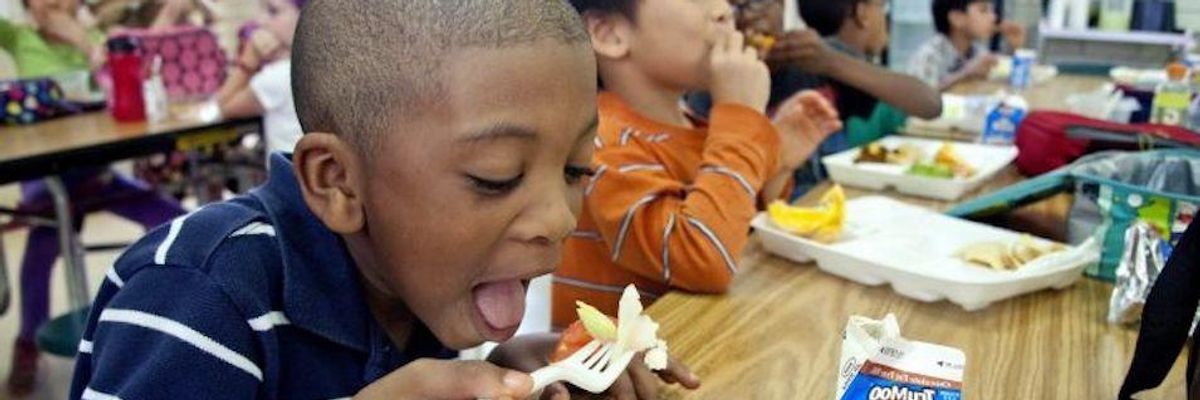
School lunch programs have been critical for feeding kids. (Photo: Amanda Mills/USCDCP)
Nearly half of America's children live in low-income and poor families, and the majority of public school students qualify for free breakfast and lunch programs. Nearly 30 million children--more than the population of Texas -- benefit from the National School Lunch Program.
In low-income households, it's often food that gets sacrificed to pay rent, utilities, and health bills. Parents or older siblings will go without so the youngest can eat. Or cheap non-nutritious food may be the only affordable option.
School lunch programs, linked to household income and eligibility to receive Supplemental Nutrition Assistance Program (known as SNAP, or food stamps), have been critical for feeding kids. And the Healthy, Hunger-free Kids Act, which enjoyed bipartisan support when it passed in 2010, has made school lunches healthier by reducing sodium and saturated fats, and adding whole grains.
However, the Trump administration began a rollback of the nutrition standards in the Healthy, Hunger-free Kids Act over a year ago. And now, as part of a proposed new rule that would knock 3 million struggling families off SNAP, over half a million children would lose access to the free and reduced lunch program.
There's virtually no debate that kids need nutritious food to stay healthy and learn at school. Numerous and broad studies have shown that school meal programs reduce obesity, poor health and food insecurity.
So one might wonder why politicians would want to literally take healthy food out of the mouths of hungry school children. Great question.
The rollback of nutrition standards, for starters, appears to be a naked giveaway to the dairy industry, which complained that their profits were affected when school meals started cutting back on saturated fat.
For the school lunch cuts, the Trump administration is using the phony justification that SNAP is rife with fraud. In reality, advocates say SNAP hasthe most rigorous standards of any federal program. Less than 1 percent of SNAP spending is estimated to be fraudulent--likely much lower than the Pentagon, which can't pass an audit, yet whose far bigger budget Trump keeps increasing.
This proposed rule change seems a barely veiled attempt to take more money from effective safety net programs for those in need--while no expense is spared to ensure the extremely wealthy get tax breaks.
"If you are human, please continue to feed other humans," writes Houston, Texas resident Kaura Webb. Former school teacher Barbara McCarty from Palm Desert California says, "Do NOT diminish this vital program for OUR families in need. As a former school teacher and mother, I know personally how important nutrition is for young minds to grow."
Seventy mayors also sent a letter to the Trump administration chastising it for this proposed change.
They point out that "this far-reaching executive action will escalate food insecurity and hunger for an estimated 3.1 million individuals--including children, seniors, and people with disabilities." It will also "put children's health and development at risk" and "harm our economy by reducing the amount of SNAP dollars available to spur regional and local economic activity."
As children head back to school this year, at the very least they deserve access to hot and nutritious meals. It's a moral imperative. There should be no other choice in the wealthiest country in the world.
Dear Common Dreams reader, It’s been nearly 30 years since I co-founded Common Dreams with my late wife, Lina Newhouser. We had the radical notion that journalism should serve the public good, not corporate profits. It was clear to us from the outset what it would take to build such a project. No paid advertisements. No corporate sponsors. No millionaire publisher telling us what to think or do. Many people said we wouldn't last a year, but we proved those doubters wrong. Together with a tremendous team of journalists and dedicated staff, we built an independent media outlet free from the constraints of profits and corporate control. Our mission has always been simple: To inform. To inspire. To ignite change for the common good. Building Common Dreams was not easy. Our survival was never guaranteed. When you take on the most powerful forces—Wall Street greed, fossil fuel industry destruction, Big Tech lobbyists, and uber-rich oligarchs who have spent billions upon billions rigging the economy and democracy in their favor—the only bulwark you have is supporters who believe in your work. But here’s the urgent message from me today. It's never been this bad out there. And it's never been this hard to keep us going. At the very moment Common Dreams is most needed, the threats we face are intensifying. We need your support now more than ever. We don't accept corporate advertising and never will. We don't have a paywall because we don't think people should be blocked from critical news based on their ability to pay. Everything we do is funded by the donations of readers like you. When everyone does the little they can afford, we are strong. But if that support retreats or dries up, so do we. Will you donate now to make sure Common Dreams not only survives but thrives? —Craig Brown, Co-founder |
Nearly half of America's children live in low-income and poor families, and the majority of public school students qualify for free breakfast and lunch programs. Nearly 30 million children--more than the population of Texas -- benefit from the National School Lunch Program.
In low-income households, it's often food that gets sacrificed to pay rent, utilities, and health bills. Parents or older siblings will go without so the youngest can eat. Or cheap non-nutritious food may be the only affordable option.
School lunch programs, linked to household income and eligibility to receive Supplemental Nutrition Assistance Program (known as SNAP, or food stamps), have been critical for feeding kids. And the Healthy, Hunger-free Kids Act, which enjoyed bipartisan support when it passed in 2010, has made school lunches healthier by reducing sodium and saturated fats, and adding whole grains.
However, the Trump administration began a rollback of the nutrition standards in the Healthy, Hunger-free Kids Act over a year ago. And now, as part of a proposed new rule that would knock 3 million struggling families off SNAP, over half a million children would lose access to the free and reduced lunch program.
There's virtually no debate that kids need nutritious food to stay healthy and learn at school. Numerous and broad studies have shown that school meal programs reduce obesity, poor health and food insecurity.
So one might wonder why politicians would want to literally take healthy food out of the mouths of hungry school children. Great question.
The rollback of nutrition standards, for starters, appears to be a naked giveaway to the dairy industry, which complained that their profits were affected when school meals started cutting back on saturated fat.
For the school lunch cuts, the Trump administration is using the phony justification that SNAP is rife with fraud. In reality, advocates say SNAP hasthe most rigorous standards of any federal program. Less than 1 percent of SNAP spending is estimated to be fraudulent--likely much lower than the Pentagon, which can't pass an audit, yet whose far bigger budget Trump keeps increasing.
This proposed rule change seems a barely veiled attempt to take more money from effective safety net programs for those in need--while no expense is spared to ensure the extremely wealthy get tax breaks.
"If you are human, please continue to feed other humans," writes Houston, Texas resident Kaura Webb. Former school teacher Barbara McCarty from Palm Desert California says, "Do NOT diminish this vital program for OUR families in need. As a former school teacher and mother, I know personally how important nutrition is for young minds to grow."
Seventy mayors also sent a letter to the Trump administration chastising it for this proposed change.
They point out that "this far-reaching executive action will escalate food insecurity and hunger for an estimated 3.1 million individuals--including children, seniors, and people with disabilities." It will also "put children's health and development at risk" and "harm our economy by reducing the amount of SNAP dollars available to spur regional and local economic activity."
As children head back to school this year, at the very least they deserve access to hot and nutritious meals. It's a moral imperative. There should be no other choice in the wealthiest country in the world.
Nearly half of America's children live in low-income and poor families, and the majority of public school students qualify for free breakfast and lunch programs. Nearly 30 million children--more than the population of Texas -- benefit from the National School Lunch Program.
In low-income households, it's often food that gets sacrificed to pay rent, utilities, and health bills. Parents or older siblings will go without so the youngest can eat. Or cheap non-nutritious food may be the only affordable option.
School lunch programs, linked to household income and eligibility to receive Supplemental Nutrition Assistance Program (known as SNAP, or food stamps), have been critical for feeding kids. And the Healthy, Hunger-free Kids Act, which enjoyed bipartisan support when it passed in 2010, has made school lunches healthier by reducing sodium and saturated fats, and adding whole grains.
However, the Trump administration began a rollback of the nutrition standards in the Healthy, Hunger-free Kids Act over a year ago. And now, as part of a proposed new rule that would knock 3 million struggling families off SNAP, over half a million children would lose access to the free and reduced lunch program.
There's virtually no debate that kids need nutritious food to stay healthy and learn at school. Numerous and broad studies have shown that school meal programs reduce obesity, poor health and food insecurity.
So one might wonder why politicians would want to literally take healthy food out of the mouths of hungry school children. Great question.
The rollback of nutrition standards, for starters, appears to be a naked giveaway to the dairy industry, which complained that their profits were affected when school meals started cutting back on saturated fat.
For the school lunch cuts, the Trump administration is using the phony justification that SNAP is rife with fraud. In reality, advocates say SNAP hasthe most rigorous standards of any federal program. Less than 1 percent of SNAP spending is estimated to be fraudulent--likely much lower than the Pentagon, which can't pass an audit, yet whose far bigger budget Trump keeps increasing.
This proposed rule change seems a barely veiled attempt to take more money from effective safety net programs for those in need--while no expense is spared to ensure the extremely wealthy get tax breaks.
"If you are human, please continue to feed other humans," writes Houston, Texas resident Kaura Webb. Former school teacher Barbara McCarty from Palm Desert California says, "Do NOT diminish this vital program for OUR families in need. As a former school teacher and mother, I know personally how important nutrition is for young minds to grow."
Seventy mayors also sent a letter to the Trump administration chastising it for this proposed change.
They point out that "this far-reaching executive action will escalate food insecurity and hunger for an estimated 3.1 million individuals--including children, seniors, and people with disabilities." It will also "put children's health and development at risk" and "harm our economy by reducing the amount of SNAP dollars available to spur regional and local economic activity."
As children head back to school this year, at the very least they deserve access to hot and nutritious meals. It's a moral imperative. There should be no other choice in the wealthiest country in the world.