SUBSCRIBE TO OUR FREE NEWSLETTER
Daily news & progressive opinion—funded by the people, not the corporations—delivered straight to your inbox.
5
#000000
#FFFFFF
To donate by check, phone, or other method, see our More Ways to Give page.
Daily news & progressive opinion—funded by the people, not the corporations—delivered straight to your inbox.
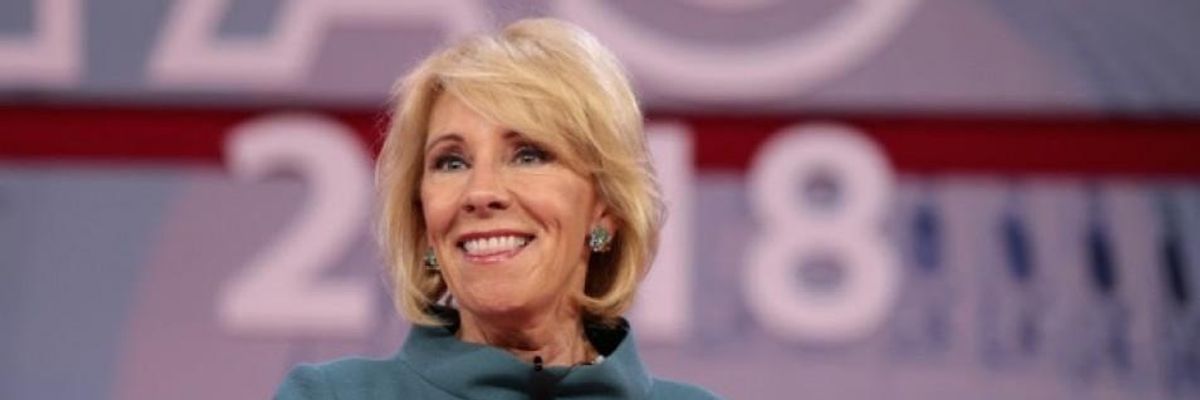
Education Secretary Betsy DeVos. (Photo: Gage Skidmore/flickr/cc)
They're back--the folks in the Education Department.
Remember Betsy DeVos? Trump made her Secretary of Education. She had no experience in education but was a big fan and supporter of charter schools in Michigan. Those schools were, by most measures, less successful than their public school counterparts and scored much lower on various comparative measures than schools in other states. Nonetheless, she was very wealthy and that, as we have learned over the years, is all that is required for someone to be invited to play in the Trump playground.
Remember Diane Auer Jones? She is a senior adviser to the Department of Education on post-secondary education. She was an early hire by Betsy. Before starting work there she spent five years as a senior vice-president at Career Education Corporation.
Career Education Corporation was a company in the for-profit education world that in early 2019 agreed to forgive $494 million in student debt as a result of an investigation into its practices by 49 State Attorneys General. The Attorneys General concluded that Ms. Jones' employer had engaged in deceptive tactics in order to recruit students. Among other things, the students were charged for vocational programs that did not have the proper accreditation for students to obtain licenses to work in their fields of study. The forgiven loans were for money owed to the institution. The practices in question had all occurred during the time Ms. Jones was a senior vice president at the company.
Now, Mesdames Jones and DeVos are at it again. On August 30, 2019 , the Education Department announced that it was making it more difficult for students who had been defrauded by for-profit institutions to receive relief from their debts. They were reforming rules known as the "borrower defense to repayment" rules. Those rules had enabled recipients of educational loans to avoid repayment under certain circumstances.
The new rules apply to loans made after July 2020. The loans significantly tighten up the ability of a student to get a loan discharged when, for example, the for-profit institution closes its doors before the student has graduated. Under the Obama era rule there was something called the "automatic closed school discharge." That rule provided that, if a for-profit school, such as Ms. Auer's, closed its doors before a student had gotten a degree, the student could apply to have the loan discharged. Under the Obama era rules, there was no time limit on when the student had to apply for debt relief.
Under the DeVos rule the student must apply for relief within three years after the school closing. As Ms. Auer explained: "We believe that within three years, the borrower will know whether or not there has been misrepresentation." In masking that assertion she is probably drawing on her own experience while working at Career Education Corporation.
Under the Obama rules, the student debt was automatically discharged if the student did not enroll elsewhere within three years. Approximately 20,000 borrowers availed themselves of that provision resulting in the discharge of close to $222 million in student loans. That will no longer be permitted.
The burden of proof on the student seeking loan forgiveness has been increased. A student seeking relief will have to prove that the college made a deceptive statement "with knowledge of its false, misleading or deceptive nature or with reckless disregard for the truth" and that the student relied on the statement in deciding to enroll or stay in the school.
The burden the new rules place on students seeking relief from for-profit schools that scammed them, is offset by the benefit received by the taxpayer. As Ms. Devos said when announcing the new rules, fraud in higher education "will not be tolerated." But, she went on to explain, the rules include "carefully crafted reforms that hold colleges and universities accountable and treat students and taxpayers fairly." The "fairness" means that the amount of student debt being forgiven will be reduced by more than $500 million annually. Over the next ten years it is estimated that the taxpayers will save more than $11 billion. The savings to the taxpayers will, of course, rest on the backs of the defrauded students.
Commenting on the new rules, Senator Dick Durbin of Illinois said: "This rule is another Trump-DeVos giveaway to their for-profit college cronies at the expense of defrauded student borrowers." Rep. Bobby Scott (D.Va.) said that "the Trump administration is sending an alarming message: Schools can cheat [their] student borrowers and still reap the rewards of federal student aid."
Betsy DeVos is pleased with the new rule. So is Diane Auer Jones. So is Ms. Jones' former employer. It is pleased because the new rule makes it less likely that it will be on the hook for paying back students it scammed. Ms. Jones is pleased because her new position enabled her to do a favor for her former employer and other companies in the student loan business she got to know when working in the business. Ms. DeVos is pleased because she could do a favor for taxpayers like herself. It's a win-win for everyone but the defrauded students.
Dear Common Dreams reader, It’s been nearly 30 years since I co-founded Common Dreams with my late wife, Lina Newhouser. We had the radical notion that journalism should serve the public good, not corporate profits. It was clear to us from the outset what it would take to build such a project. No paid advertisements. No corporate sponsors. No millionaire publisher telling us what to think or do. Many people said we wouldn't last a year, but we proved those doubters wrong. Together with a tremendous team of journalists and dedicated staff, we built an independent media outlet free from the constraints of profits and corporate control. Our mission has always been simple: To inform. To inspire. To ignite change for the common good. Building Common Dreams was not easy. Our survival was never guaranteed. When you take on the most powerful forces—Wall Street greed, fossil fuel industry destruction, Big Tech lobbyists, and uber-rich oligarchs who have spent billions upon billions rigging the economy and democracy in their favor—the only bulwark you have is supporters who believe in your work. But here’s the urgent message from me today. It's never been this bad out there. And it's never been this hard to keep us going. At the very moment Common Dreams is most needed, the threats we face are intensifying. We need your support now more than ever. We don't accept corporate advertising and never will. We don't have a paywall because we don't think people should be blocked from critical news based on their ability to pay. Everything we do is funded by the donations of readers like you. When everyone does the little they can afford, we are strong. But if that support retreats or dries up, so do we. Will you donate now to make sure Common Dreams not only survives but thrives? —Craig Brown, Co-founder |
They're back--the folks in the Education Department.
Remember Betsy DeVos? Trump made her Secretary of Education. She had no experience in education but was a big fan and supporter of charter schools in Michigan. Those schools were, by most measures, less successful than their public school counterparts and scored much lower on various comparative measures than schools in other states. Nonetheless, she was very wealthy and that, as we have learned over the years, is all that is required for someone to be invited to play in the Trump playground.
Remember Diane Auer Jones? She is a senior adviser to the Department of Education on post-secondary education. She was an early hire by Betsy. Before starting work there she spent five years as a senior vice-president at Career Education Corporation.
Career Education Corporation was a company in the for-profit education world that in early 2019 agreed to forgive $494 million in student debt as a result of an investigation into its practices by 49 State Attorneys General. The Attorneys General concluded that Ms. Jones' employer had engaged in deceptive tactics in order to recruit students. Among other things, the students were charged for vocational programs that did not have the proper accreditation for students to obtain licenses to work in their fields of study. The forgiven loans were for money owed to the institution. The practices in question had all occurred during the time Ms. Jones was a senior vice president at the company.
Now, Mesdames Jones and DeVos are at it again. On August 30, 2019 , the Education Department announced that it was making it more difficult for students who had been defrauded by for-profit institutions to receive relief from their debts. They were reforming rules known as the "borrower defense to repayment" rules. Those rules had enabled recipients of educational loans to avoid repayment under certain circumstances.
The new rules apply to loans made after July 2020. The loans significantly tighten up the ability of a student to get a loan discharged when, for example, the for-profit institution closes its doors before the student has graduated. Under the Obama era rule there was something called the "automatic closed school discharge." That rule provided that, if a for-profit school, such as Ms. Auer's, closed its doors before a student had gotten a degree, the student could apply to have the loan discharged. Under the Obama era rules, there was no time limit on when the student had to apply for debt relief.
Under the DeVos rule the student must apply for relief within three years after the school closing. As Ms. Auer explained: "We believe that within three years, the borrower will know whether or not there has been misrepresentation." In masking that assertion she is probably drawing on her own experience while working at Career Education Corporation.
Under the Obama rules, the student debt was automatically discharged if the student did not enroll elsewhere within three years. Approximately 20,000 borrowers availed themselves of that provision resulting in the discharge of close to $222 million in student loans. That will no longer be permitted.
The burden of proof on the student seeking loan forgiveness has been increased. A student seeking relief will have to prove that the college made a deceptive statement "with knowledge of its false, misleading or deceptive nature or with reckless disregard for the truth" and that the student relied on the statement in deciding to enroll or stay in the school.
The burden the new rules place on students seeking relief from for-profit schools that scammed them, is offset by the benefit received by the taxpayer. As Ms. Devos said when announcing the new rules, fraud in higher education "will not be tolerated." But, she went on to explain, the rules include "carefully crafted reforms that hold colleges and universities accountable and treat students and taxpayers fairly." The "fairness" means that the amount of student debt being forgiven will be reduced by more than $500 million annually. Over the next ten years it is estimated that the taxpayers will save more than $11 billion. The savings to the taxpayers will, of course, rest on the backs of the defrauded students.
Commenting on the new rules, Senator Dick Durbin of Illinois said: "This rule is another Trump-DeVos giveaway to their for-profit college cronies at the expense of defrauded student borrowers." Rep. Bobby Scott (D.Va.) said that "the Trump administration is sending an alarming message: Schools can cheat [their] student borrowers and still reap the rewards of federal student aid."
Betsy DeVos is pleased with the new rule. So is Diane Auer Jones. So is Ms. Jones' former employer. It is pleased because the new rule makes it less likely that it will be on the hook for paying back students it scammed. Ms. Jones is pleased because her new position enabled her to do a favor for her former employer and other companies in the student loan business she got to know when working in the business. Ms. DeVos is pleased because she could do a favor for taxpayers like herself. It's a win-win for everyone but the defrauded students.
They're back--the folks in the Education Department.
Remember Betsy DeVos? Trump made her Secretary of Education. She had no experience in education but was a big fan and supporter of charter schools in Michigan. Those schools were, by most measures, less successful than their public school counterparts and scored much lower on various comparative measures than schools in other states. Nonetheless, she was very wealthy and that, as we have learned over the years, is all that is required for someone to be invited to play in the Trump playground.
Remember Diane Auer Jones? She is a senior adviser to the Department of Education on post-secondary education. She was an early hire by Betsy. Before starting work there she spent five years as a senior vice-president at Career Education Corporation.
Career Education Corporation was a company in the for-profit education world that in early 2019 agreed to forgive $494 million in student debt as a result of an investigation into its practices by 49 State Attorneys General. The Attorneys General concluded that Ms. Jones' employer had engaged in deceptive tactics in order to recruit students. Among other things, the students were charged for vocational programs that did not have the proper accreditation for students to obtain licenses to work in their fields of study. The forgiven loans were for money owed to the institution. The practices in question had all occurred during the time Ms. Jones was a senior vice president at the company.
Now, Mesdames Jones and DeVos are at it again. On August 30, 2019 , the Education Department announced that it was making it more difficult for students who had been defrauded by for-profit institutions to receive relief from their debts. They were reforming rules known as the "borrower defense to repayment" rules. Those rules had enabled recipients of educational loans to avoid repayment under certain circumstances.
The new rules apply to loans made after July 2020. The loans significantly tighten up the ability of a student to get a loan discharged when, for example, the for-profit institution closes its doors before the student has graduated. Under the Obama era rule there was something called the "automatic closed school discharge." That rule provided that, if a for-profit school, such as Ms. Auer's, closed its doors before a student had gotten a degree, the student could apply to have the loan discharged. Under the Obama era rules, there was no time limit on when the student had to apply for debt relief.
Under the DeVos rule the student must apply for relief within three years after the school closing. As Ms. Auer explained: "We believe that within three years, the borrower will know whether or not there has been misrepresentation." In masking that assertion she is probably drawing on her own experience while working at Career Education Corporation.
Under the Obama rules, the student debt was automatically discharged if the student did not enroll elsewhere within three years. Approximately 20,000 borrowers availed themselves of that provision resulting in the discharge of close to $222 million in student loans. That will no longer be permitted.
The burden of proof on the student seeking loan forgiveness has been increased. A student seeking relief will have to prove that the college made a deceptive statement "with knowledge of its false, misleading or deceptive nature or with reckless disregard for the truth" and that the student relied on the statement in deciding to enroll or stay in the school.
The burden the new rules place on students seeking relief from for-profit schools that scammed them, is offset by the benefit received by the taxpayer. As Ms. Devos said when announcing the new rules, fraud in higher education "will not be tolerated." But, she went on to explain, the rules include "carefully crafted reforms that hold colleges and universities accountable and treat students and taxpayers fairly." The "fairness" means that the amount of student debt being forgiven will be reduced by more than $500 million annually. Over the next ten years it is estimated that the taxpayers will save more than $11 billion. The savings to the taxpayers will, of course, rest on the backs of the defrauded students.
Commenting on the new rules, Senator Dick Durbin of Illinois said: "This rule is another Trump-DeVos giveaway to their for-profit college cronies at the expense of defrauded student borrowers." Rep. Bobby Scott (D.Va.) said that "the Trump administration is sending an alarming message: Schools can cheat [their] student borrowers and still reap the rewards of federal student aid."
Betsy DeVos is pleased with the new rule. So is Diane Auer Jones. So is Ms. Jones' former employer. It is pleased because the new rule makes it less likely that it will be on the hook for paying back students it scammed. Ms. Jones is pleased because her new position enabled her to do a favor for her former employer and other companies in the student loan business she got to know when working in the business. Ms. DeVos is pleased because she could do a favor for taxpayers like herself. It's a win-win for everyone but the defrauded students.