
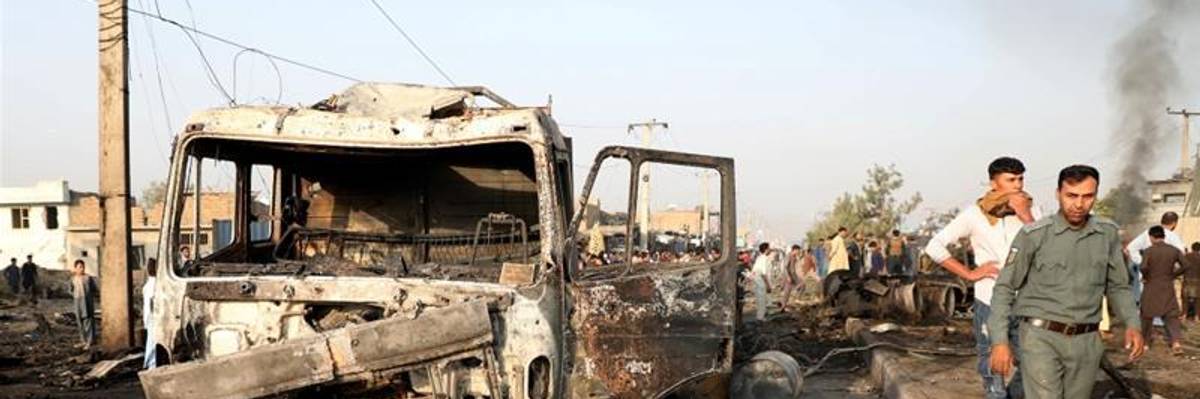
Afghan policemen inspect the site of a blast in Kabul, Afghanistan, September 3, 2019 (Photo: Omar Sobhani/Reuters)
The Afghan 'Peace' Deal Will Not Bring Peace to the Afghan People
While rushing to strike an agreement with the Taliban ahead of the 2020 election, Washington is ignoring Afghan demands.
In 2001, The United States government invaded Afghanistan with the explicit aim to remove the Islamic fundamentalist group, the Taliban, from power. Some 18 years later, the US government is negotiating a peace deal with the same violent group.
Since the US began talks in January with the Taliban, ostensibly to negotiate a "peace" deal and to withdraw their troops from Afghanistan, the people of Afghanistan have been left in the dark about both the process and the details of those dealings. Seven months and nine rounds of talks later, they are still no wiser.
On Monday, news spread across social media that the announcement of a deal was imminent. Afghans, on tenterhooks as to what decisions had been made about their future, had little choice but to refresh Twitter. This latest chapter, taking place in secrecy and uncertainty, is symptomatic of the entire process thus far, spreading fear and anxiety in the country.
Nearly 4,000 civilians have been killed in Afghanistan in the first half of this year, with a 27 percent increase in war-related civilian deaths in the second quarter.
The public-facing narrative of the talks has been inconsistent at best, and a major gaslighting exercise at worst. The US peace envoy, Zalmay Khalilzad, has spoken at length about the negotiations in many interviews, has insisted that he "feels very good" about the negotiations and that "substantive progress" has been made, but has revealed little about the substance of the discussions taking place behind closed doors.
Pressed on why it believes that the Taliban will hold up their end of the bargain, which must include assurances regarding counter-terrorism and a comprehensive ceasefire, the Trump administration has responded "trust, but verify". For Afghans living through the daily slaughter and oppression of war, largely perpetrated by the Taliban, this means nothing.
Nearly 4,000 civilians have been killed in Afghanistan in the first half of this year, with a 27 percent increase in war-related civilian deaths in the second quarter. Many of these deaths were claimed by the Taliban, although it is of note that Afghan security forces and their American allies killed a greater number of civilians in the first quarter. But a consistent pattern of increased attacks by the Taliban has emerged in recent weeks. The so-called "peace" talks fuel more violence as the Taliban use military force to maintain their negotiating position.
Since the talks were announced, civilians across Afghanistan and the diaspora mobilised and expressed their significant concerns about the exclusionary nature of the negotiations: in particular around the exclusion of the Afghan government, minority groups and women representatives who were barred at the Taliban's insistence.
Some of these civil activists have argued that agreeing to the demands of the armed group would legitimise its position and embolden it to use the lives of Afghan civilians as leverage in the talks, but these voices have been excluded from the peace talks and silenced by the many threats the Taliban has made against anyone who dares to speak against them.
These activists warned that ignoring women and minority groups would further validate the Taliban position that the interests of these groups were secondary, but no one listened. Quite the opposite: Women who spoke out about their fears of living under Taliban rule, and who urged the US not to trade their freedoms and safety by elevating the position of the Taliban were dismissed as lazy.
The one constant factor in these talks has been to ignore and dismiss voices of those who stand to lose the most from a deal made in secret.
Cheryl Benard, the US Peace envoy's wife, wrote an opinion piece in which she criticised Afghan women for speaking out with their concerns in Western media. She wrote: "Emancipation and equality aren't the product of pity or guilt, and [Afghan women] aren't owed them by someone else's army", arguing that Afghan women needed to work for themselves and demand a seat at the table.
She appeared to ignore the fact that what had provoked her article was Afghan women doing just that. The fact that her husband is one of the key players in deciding who participated in discussions appeared, to Benard, to be a negligible detail. She succeeded only in blaming Afghan women for their oppression.
The one constant factor in these talks has been to ignore and dismiss voices of those who stand to lose the most from a deal made in secret. Violent actors on one side hash out a crude and exclusionary deal with a negotiating team tasked with finding a speedy exit strategy for the sake of President Donald Trump's re-election campaign.
If and when the intra-Afghan talks begin, with the new power dynamic favouring the Taliban and the continued delegitimisation of the elected representatives, the odds are stacked against the Afghan government.
Yesterday, as Khalilzad sat to give his first interview on Afghan national television to announce the broader strokes of an "in principle" agreement with the Taliban, the group launched a deadly attack in the capital, Kabul, killing at least 16 people and injuring over 100 civilians.
The past few months of US-Taliban negotiations have demonstrated to the Afghan people that all those around the negotiating table do not feel the need to hear their voices and consider their lives cheap.
Many Afghans are left wondering whether their sacrifices for women's rights, democracy and freedom were made in vain. With so much suffering and death associated with Afghanistan, what's a little more?
An Urgent Message From Our Co-Founder
Dear Common Dreams reader, It’s been nearly 30 years since I co-founded Common Dreams with my late wife, Lina Newhouser. We had the radical notion that journalism should serve the public good, not corporate profits. It was clear to us from the outset what it would take to build such a project. No paid advertisements. No corporate sponsors. No millionaire publisher telling us what to think or do. Many people said we wouldn't last a year, but we proved those doubters wrong. Together with a tremendous team of journalists and dedicated staff, we built an independent media outlet free from the constraints of profits and corporate control. Our mission has always been simple: To inform. To inspire. To ignite change for the common good. Building Common Dreams was not easy. Our survival was never guaranteed. When you take on the most powerful forces—Wall Street greed, fossil fuel industry destruction, Big Tech lobbyists, and uber-rich oligarchs who have spent billions upon billions rigging the economy and democracy in their favor—the only bulwark you have is supporters who believe in your work. But here’s the urgent message from me today. It's never been this bad out there. And it's never been this hard to keep us going. At the very moment Common Dreams is most needed, the threats we face are intensifying. We need your support now more than ever. We don't accept corporate advertising and never will. We don't have a paywall because we don't think people should be blocked from critical news based on their ability to pay. Everything we do is funded by the donations of readers like you. When everyone does the little they can afford, we are strong. But if that support retreats or dries up, so do we. Will you donate now to make sure Common Dreams not only survives but thrives? —Craig Brown, Co-founder |
In 2001, The United States government invaded Afghanistan with the explicit aim to remove the Islamic fundamentalist group, the Taliban, from power. Some 18 years later, the US government is negotiating a peace deal with the same violent group.
Since the US began talks in January with the Taliban, ostensibly to negotiate a "peace" deal and to withdraw their troops from Afghanistan, the people of Afghanistan have been left in the dark about both the process and the details of those dealings. Seven months and nine rounds of talks later, they are still no wiser.
On Monday, news spread across social media that the announcement of a deal was imminent. Afghans, on tenterhooks as to what decisions had been made about their future, had little choice but to refresh Twitter. This latest chapter, taking place in secrecy and uncertainty, is symptomatic of the entire process thus far, spreading fear and anxiety in the country.
Nearly 4,000 civilians have been killed in Afghanistan in the first half of this year, with a 27 percent increase in war-related civilian deaths in the second quarter.
The public-facing narrative of the talks has been inconsistent at best, and a major gaslighting exercise at worst. The US peace envoy, Zalmay Khalilzad, has spoken at length about the negotiations in many interviews, has insisted that he "feels very good" about the negotiations and that "substantive progress" has been made, but has revealed little about the substance of the discussions taking place behind closed doors.
Pressed on why it believes that the Taliban will hold up their end of the bargain, which must include assurances regarding counter-terrorism and a comprehensive ceasefire, the Trump administration has responded "trust, but verify". For Afghans living through the daily slaughter and oppression of war, largely perpetrated by the Taliban, this means nothing.
Nearly 4,000 civilians have been killed in Afghanistan in the first half of this year, with a 27 percent increase in war-related civilian deaths in the second quarter. Many of these deaths were claimed by the Taliban, although it is of note that Afghan security forces and their American allies killed a greater number of civilians in the first quarter. But a consistent pattern of increased attacks by the Taliban has emerged in recent weeks. The so-called "peace" talks fuel more violence as the Taliban use military force to maintain their negotiating position.
Since the talks were announced, civilians across Afghanistan and the diaspora mobilised and expressed their significant concerns about the exclusionary nature of the negotiations: in particular around the exclusion of the Afghan government, minority groups and women representatives who were barred at the Taliban's insistence.
Some of these civil activists have argued that agreeing to the demands of the armed group would legitimise its position and embolden it to use the lives of Afghan civilians as leverage in the talks, but these voices have been excluded from the peace talks and silenced by the many threats the Taliban has made against anyone who dares to speak against them.
These activists warned that ignoring women and minority groups would further validate the Taliban position that the interests of these groups were secondary, but no one listened. Quite the opposite: Women who spoke out about their fears of living under Taliban rule, and who urged the US not to trade their freedoms and safety by elevating the position of the Taliban were dismissed as lazy.
The one constant factor in these talks has been to ignore and dismiss voices of those who stand to lose the most from a deal made in secret.
Cheryl Benard, the US Peace envoy's wife, wrote an opinion piece in which she criticised Afghan women for speaking out with their concerns in Western media. She wrote: "Emancipation and equality aren't the product of pity or guilt, and [Afghan women] aren't owed them by someone else's army", arguing that Afghan women needed to work for themselves and demand a seat at the table.
She appeared to ignore the fact that what had provoked her article was Afghan women doing just that. The fact that her husband is one of the key players in deciding who participated in discussions appeared, to Benard, to be a negligible detail. She succeeded only in blaming Afghan women for their oppression.
The one constant factor in these talks has been to ignore and dismiss voices of those who stand to lose the most from a deal made in secret. Violent actors on one side hash out a crude and exclusionary deal with a negotiating team tasked with finding a speedy exit strategy for the sake of President Donald Trump's re-election campaign.
If and when the intra-Afghan talks begin, with the new power dynamic favouring the Taliban and the continued delegitimisation of the elected representatives, the odds are stacked against the Afghan government.
Yesterday, as Khalilzad sat to give his first interview on Afghan national television to announce the broader strokes of an "in principle" agreement with the Taliban, the group launched a deadly attack in the capital, Kabul, killing at least 16 people and injuring over 100 civilians.
The past few months of US-Taliban negotiations have demonstrated to the Afghan people that all those around the negotiating table do not feel the need to hear their voices and consider their lives cheap.
Many Afghans are left wondering whether their sacrifices for women's rights, democracy and freedom were made in vain. With so much suffering and death associated with Afghanistan, what's a little more?
In 2001, The United States government invaded Afghanistan with the explicit aim to remove the Islamic fundamentalist group, the Taliban, from power. Some 18 years later, the US government is negotiating a peace deal with the same violent group.
Since the US began talks in January with the Taliban, ostensibly to negotiate a "peace" deal and to withdraw their troops from Afghanistan, the people of Afghanistan have been left in the dark about both the process and the details of those dealings. Seven months and nine rounds of talks later, they are still no wiser.
On Monday, news spread across social media that the announcement of a deal was imminent. Afghans, on tenterhooks as to what decisions had been made about their future, had little choice but to refresh Twitter. This latest chapter, taking place in secrecy and uncertainty, is symptomatic of the entire process thus far, spreading fear and anxiety in the country.
Nearly 4,000 civilians have been killed in Afghanistan in the first half of this year, with a 27 percent increase in war-related civilian deaths in the second quarter.
The public-facing narrative of the talks has been inconsistent at best, and a major gaslighting exercise at worst. The US peace envoy, Zalmay Khalilzad, has spoken at length about the negotiations in many interviews, has insisted that he "feels very good" about the negotiations and that "substantive progress" has been made, but has revealed little about the substance of the discussions taking place behind closed doors.
Pressed on why it believes that the Taliban will hold up their end of the bargain, which must include assurances regarding counter-terrorism and a comprehensive ceasefire, the Trump administration has responded "trust, but verify". For Afghans living through the daily slaughter and oppression of war, largely perpetrated by the Taliban, this means nothing.
Nearly 4,000 civilians have been killed in Afghanistan in the first half of this year, with a 27 percent increase in war-related civilian deaths in the second quarter. Many of these deaths were claimed by the Taliban, although it is of note that Afghan security forces and their American allies killed a greater number of civilians in the first quarter. But a consistent pattern of increased attacks by the Taliban has emerged in recent weeks. The so-called "peace" talks fuel more violence as the Taliban use military force to maintain their negotiating position.
Since the talks were announced, civilians across Afghanistan and the diaspora mobilised and expressed their significant concerns about the exclusionary nature of the negotiations: in particular around the exclusion of the Afghan government, minority groups and women representatives who were barred at the Taliban's insistence.
Some of these civil activists have argued that agreeing to the demands of the armed group would legitimise its position and embolden it to use the lives of Afghan civilians as leverage in the talks, but these voices have been excluded from the peace talks and silenced by the many threats the Taliban has made against anyone who dares to speak against them.
These activists warned that ignoring women and minority groups would further validate the Taliban position that the interests of these groups were secondary, but no one listened. Quite the opposite: Women who spoke out about their fears of living under Taliban rule, and who urged the US not to trade their freedoms and safety by elevating the position of the Taliban were dismissed as lazy.
The one constant factor in these talks has been to ignore and dismiss voices of those who stand to lose the most from a deal made in secret.
Cheryl Benard, the US Peace envoy's wife, wrote an opinion piece in which she criticised Afghan women for speaking out with their concerns in Western media. She wrote: "Emancipation and equality aren't the product of pity or guilt, and [Afghan women] aren't owed them by someone else's army", arguing that Afghan women needed to work for themselves and demand a seat at the table.
She appeared to ignore the fact that what had provoked her article was Afghan women doing just that. The fact that her husband is one of the key players in deciding who participated in discussions appeared, to Benard, to be a negligible detail. She succeeded only in blaming Afghan women for their oppression.
The one constant factor in these talks has been to ignore and dismiss voices of those who stand to lose the most from a deal made in secret. Violent actors on one side hash out a crude and exclusionary deal with a negotiating team tasked with finding a speedy exit strategy for the sake of President Donald Trump's re-election campaign.
If and when the intra-Afghan talks begin, with the new power dynamic favouring the Taliban and the continued delegitimisation of the elected representatives, the odds are stacked against the Afghan government.
Yesterday, as Khalilzad sat to give his first interview on Afghan national television to announce the broader strokes of an "in principle" agreement with the Taliban, the group launched a deadly attack in the capital, Kabul, killing at least 16 people and injuring over 100 civilians.
The past few months of US-Taliban negotiations have demonstrated to the Afghan people that all those around the negotiating table do not feel the need to hear their voices and consider their lives cheap.
Many Afghans are left wondering whether their sacrifices for women's rights, democracy and freedom were made in vain. With so much suffering and death associated with Afghanistan, what's a little more?