

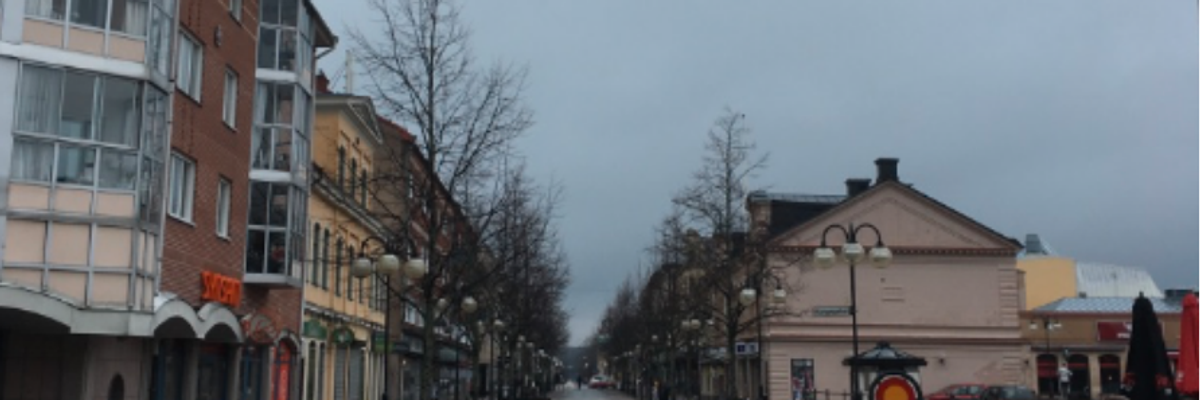
Most arguments about immigrants and lost small-town utopias are meant to make us yearn for something that never existed. (Photo: Christian Christensen)
How Immigration Changed A Small-Town Sweden That Never Existed
Now that these towns are dying, the immigrants who are helping to prop them up with their labor and citizenship are accused of undermining local culture by their mere presence
How far can you stretch nostalgia before warm, harmless exaggeration transforms into weaponized dishonesty?
This question is at the heart of a great deal of discussion on immigration in Europe, where the presence of new residents is often pitched by those opposed to immigration as ultimately undermining (and even eradicating) local history, cultures and traditions. Precisely what those local histories, cultures and traditions looked like before the arrival of immigrants, however, is far from agreed upon, and are very often altered and romanticized in the service of an anti-immigration agenda.
Nothing better illustrates this dynamic than an opinion piece published a few days ago in the Swedish newspaper Goteborgs-Posten. In the article, the author recounted the tale of searching late one dark winter night (in the relatively small Swedish town of Gavle) for an open food store. She eventually managed to find a shop run by an immigrant, and noted that the store sold meat marked "Halal" in Swedish and Arabic, had "small animals" in the meat freezer and pickled vegetables she considered "inedible". She ended up buying the only thing she felt comfortable eating: a box of instant macaroni.
The author's reaction to this entire incident?
"I am in Sweden, a Sweden that doesn't feel Swedish. And I don't like it."
The piece played on the familiar cliches of lost local cultures and feeling like a stranger in your own land. But, it also touched upon nostalgia over the death of small-town community and identity: the "Mom 'n' Pop" corner store selling local food being replaced by stores selling supposedly "exotic" foreign food; and, small communities, once bustling with people and businesses, now reduced to ghost towns housing immigrants.
But, as many Swedes on social media noted in reaction to the piece, when had shops ever been open in smaller towns Swedish late at night? Why pick on an immigrant who was so hard working as to have the only shop open late in the evening? Why should the mere presence of foreign food in one shop signal the demise of "traditional" Sweden? Where were all of the "native" shop owners? And, when were these smaller towns last bustling and vibrant?
This one article had hit a number of raw nerves.
This was about the loss of a country that never really existed. Or, if it did exist in some form, it had begun to disintegrate long, long before the arrival of immigrants and refugees from places like Iraq and Syria.
Anyone who had spent any time in small Swedish towns in the 70s, 80s and 90s -- and similar small towns throughout Europe and the United States -- would remember how many of them were going through a long, slow, post-industrial death. When work dried up after companies moved out in search of cheaper labor, shops would close, along with banks and post offices. Schools would not have enough students to keep going. Local medical offices would disappear. Train and bus connections would be reduced, and often eliminated. Young people, faced with no possibility to find work, would leave for larger cities, leaving the oldest residents behind to fend for themselves. It was a powerful downward spiral.
Yet, what has saved some of these dying towns and regions? The arrival of immigrants who stimulated the local economy, contributed the tax revenue needed to pay for a rapidly ageing population and provided the labor needed to care for that same ageing population. All of this, it should be noted, on top of keeping things such as banks, schools and public transportation alive. I've been to numerous smaller towns in Sweden where many of the businesses in the centers were owned or staffed by immigrants, and where buses coming from schools were filled with students from a wide variety of backgrounds. It was abundantly clear that without this injection of new residents these towns would already be dead.
It was often a corporate drive for profits that punched local towns and local cultures in the face. Now that these towns are dying, the immigrants who are helping to prop them up with their labor and citizenship are accused of undermining local culture by their mere presence. How local cultural hubs like libraries or theaters, for example, can stay open without residents is conveniently forgotten. Given that so-called "native Swedes" aren't exactly rushing back to live in these small towns to save them, the hypocrisy of the criticism is pretty thick.
Most arguments about immigrants and lost small-town utopias are meant to make us yearn for something that never existed. The irony is, by using a mythological past as a weapon against immigrants, those who make these arguments encourage us to ignore actual history.
An Urgent Message From Our Co-Founder
Dear Common Dreams reader, It’s been nearly 30 years since I co-founded Common Dreams with my late wife, Lina Newhouser. We had the radical notion that journalism should serve the public good, not corporate profits. It was clear to us from the outset what it would take to build such a project. No paid advertisements. No corporate sponsors. No millionaire publisher telling us what to think or do. Many people said we wouldn't last a year, but we proved those doubters wrong. Together with a tremendous team of journalists and dedicated staff, we built an independent media outlet free from the constraints of profits and corporate control. Our mission has always been simple: To inform. To inspire. To ignite change for the common good. Building Common Dreams was not easy. Our survival was never guaranteed. When you take on the most powerful forces—Wall Street greed, fossil fuel industry destruction, Big Tech lobbyists, and uber-rich oligarchs who have spent billions upon billions rigging the economy and democracy in their favor—the only bulwark you have is supporters who believe in your work. But here’s the urgent message from me today. It's never been this bad out there. And it's never been this hard to keep us going. At the very moment Common Dreams is most needed, the threats we face are intensifying. We need your support now more than ever. We don't accept corporate advertising and never will. We don't have a paywall because we don't think people should be blocked from critical news based on their ability to pay. Everything we do is funded by the donations of readers like you. When everyone does the little they can afford, we are strong. But if that support retreats or dries up, so do we. Will you donate now to make sure Common Dreams not only survives but thrives? —Craig Brown, Co-founder |
How far can you stretch nostalgia before warm, harmless exaggeration transforms into weaponized dishonesty?
This question is at the heart of a great deal of discussion on immigration in Europe, where the presence of new residents is often pitched by those opposed to immigration as ultimately undermining (and even eradicating) local history, cultures and traditions. Precisely what those local histories, cultures and traditions looked like before the arrival of immigrants, however, is far from agreed upon, and are very often altered and romanticized in the service of an anti-immigration agenda.
Nothing better illustrates this dynamic than an opinion piece published a few days ago in the Swedish newspaper Goteborgs-Posten. In the article, the author recounted the tale of searching late one dark winter night (in the relatively small Swedish town of Gavle) for an open food store. She eventually managed to find a shop run by an immigrant, and noted that the store sold meat marked "Halal" in Swedish and Arabic, had "small animals" in the meat freezer and pickled vegetables she considered "inedible". She ended up buying the only thing she felt comfortable eating: a box of instant macaroni.
The author's reaction to this entire incident?
"I am in Sweden, a Sweden that doesn't feel Swedish. And I don't like it."
The piece played on the familiar cliches of lost local cultures and feeling like a stranger in your own land. But, it also touched upon nostalgia over the death of small-town community and identity: the "Mom 'n' Pop" corner store selling local food being replaced by stores selling supposedly "exotic" foreign food; and, small communities, once bustling with people and businesses, now reduced to ghost towns housing immigrants.
But, as many Swedes on social media noted in reaction to the piece, when had shops ever been open in smaller towns Swedish late at night? Why pick on an immigrant who was so hard working as to have the only shop open late in the evening? Why should the mere presence of foreign food in one shop signal the demise of "traditional" Sweden? Where were all of the "native" shop owners? And, when were these smaller towns last bustling and vibrant?
This one article had hit a number of raw nerves.
This was about the loss of a country that never really existed. Or, if it did exist in some form, it had begun to disintegrate long, long before the arrival of immigrants and refugees from places like Iraq and Syria.
Anyone who had spent any time in small Swedish towns in the 70s, 80s and 90s -- and similar small towns throughout Europe and the United States -- would remember how many of them were going through a long, slow, post-industrial death. When work dried up after companies moved out in search of cheaper labor, shops would close, along with banks and post offices. Schools would not have enough students to keep going. Local medical offices would disappear. Train and bus connections would be reduced, and often eliminated. Young people, faced with no possibility to find work, would leave for larger cities, leaving the oldest residents behind to fend for themselves. It was a powerful downward spiral.
Yet, what has saved some of these dying towns and regions? The arrival of immigrants who stimulated the local economy, contributed the tax revenue needed to pay for a rapidly ageing population and provided the labor needed to care for that same ageing population. All of this, it should be noted, on top of keeping things such as banks, schools and public transportation alive. I've been to numerous smaller towns in Sweden where many of the businesses in the centers were owned or staffed by immigrants, and where buses coming from schools were filled with students from a wide variety of backgrounds. It was abundantly clear that without this injection of new residents these towns would already be dead.
It was often a corporate drive for profits that punched local towns and local cultures in the face. Now that these towns are dying, the immigrants who are helping to prop them up with their labor and citizenship are accused of undermining local culture by their mere presence. How local cultural hubs like libraries or theaters, for example, can stay open without residents is conveniently forgotten. Given that so-called "native Swedes" aren't exactly rushing back to live in these small towns to save them, the hypocrisy of the criticism is pretty thick.
Most arguments about immigrants and lost small-town utopias are meant to make us yearn for something that never existed. The irony is, by using a mythological past as a weapon against immigrants, those who make these arguments encourage us to ignore actual history.
How far can you stretch nostalgia before warm, harmless exaggeration transforms into weaponized dishonesty?
This question is at the heart of a great deal of discussion on immigration in Europe, where the presence of new residents is often pitched by those opposed to immigration as ultimately undermining (and even eradicating) local history, cultures and traditions. Precisely what those local histories, cultures and traditions looked like before the arrival of immigrants, however, is far from agreed upon, and are very often altered and romanticized in the service of an anti-immigration agenda.
Nothing better illustrates this dynamic than an opinion piece published a few days ago in the Swedish newspaper Goteborgs-Posten. In the article, the author recounted the tale of searching late one dark winter night (in the relatively small Swedish town of Gavle) for an open food store. She eventually managed to find a shop run by an immigrant, and noted that the store sold meat marked "Halal" in Swedish and Arabic, had "small animals" in the meat freezer and pickled vegetables she considered "inedible". She ended up buying the only thing she felt comfortable eating: a box of instant macaroni.
The author's reaction to this entire incident?
"I am in Sweden, a Sweden that doesn't feel Swedish. And I don't like it."
The piece played on the familiar cliches of lost local cultures and feeling like a stranger in your own land. But, it also touched upon nostalgia over the death of small-town community and identity: the "Mom 'n' Pop" corner store selling local food being replaced by stores selling supposedly "exotic" foreign food; and, small communities, once bustling with people and businesses, now reduced to ghost towns housing immigrants.
But, as many Swedes on social media noted in reaction to the piece, when had shops ever been open in smaller towns Swedish late at night? Why pick on an immigrant who was so hard working as to have the only shop open late in the evening? Why should the mere presence of foreign food in one shop signal the demise of "traditional" Sweden? Where were all of the "native" shop owners? And, when were these smaller towns last bustling and vibrant?
This one article had hit a number of raw nerves.
This was about the loss of a country that never really existed. Or, if it did exist in some form, it had begun to disintegrate long, long before the arrival of immigrants and refugees from places like Iraq and Syria.
Anyone who had spent any time in small Swedish towns in the 70s, 80s and 90s -- and similar small towns throughout Europe and the United States -- would remember how many of them were going through a long, slow, post-industrial death. When work dried up after companies moved out in search of cheaper labor, shops would close, along with banks and post offices. Schools would not have enough students to keep going. Local medical offices would disappear. Train and bus connections would be reduced, and often eliminated. Young people, faced with no possibility to find work, would leave for larger cities, leaving the oldest residents behind to fend for themselves. It was a powerful downward spiral.
Yet, what has saved some of these dying towns and regions? The arrival of immigrants who stimulated the local economy, contributed the tax revenue needed to pay for a rapidly ageing population and provided the labor needed to care for that same ageing population. All of this, it should be noted, on top of keeping things such as banks, schools and public transportation alive. I've been to numerous smaller towns in Sweden where many of the businesses in the centers were owned or staffed by immigrants, and where buses coming from schools were filled with students from a wide variety of backgrounds. It was abundantly clear that without this injection of new residents these towns would already be dead.
It was often a corporate drive for profits that punched local towns and local cultures in the face. Now that these towns are dying, the immigrants who are helping to prop them up with their labor and citizenship are accused of undermining local culture by their mere presence. How local cultural hubs like libraries or theaters, for example, can stay open without residents is conveniently forgotten. Given that so-called "native Swedes" aren't exactly rushing back to live in these small towns to save them, the hypocrisy of the criticism is pretty thick.
Most arguments about immigrants and lost small-town utopias are meant to make us yearn for something that never existed. The irony is, by using a mythological past as a weapon against immigrants, those who make these arguments encourage us to ignore actual history.