SUBSCRIBE TO OUR FREE NEWSLETTER
Daily news & progressive opinion—funded by the people, not the corporations—delivered straight to your inbox.
5
#000000
#FFFFFF
To donate by check, phone, or other method, see our More Ways to Give page.
Daily news & progressive opinion—funded by the people, not the corporations—delivered straight to your inbox.
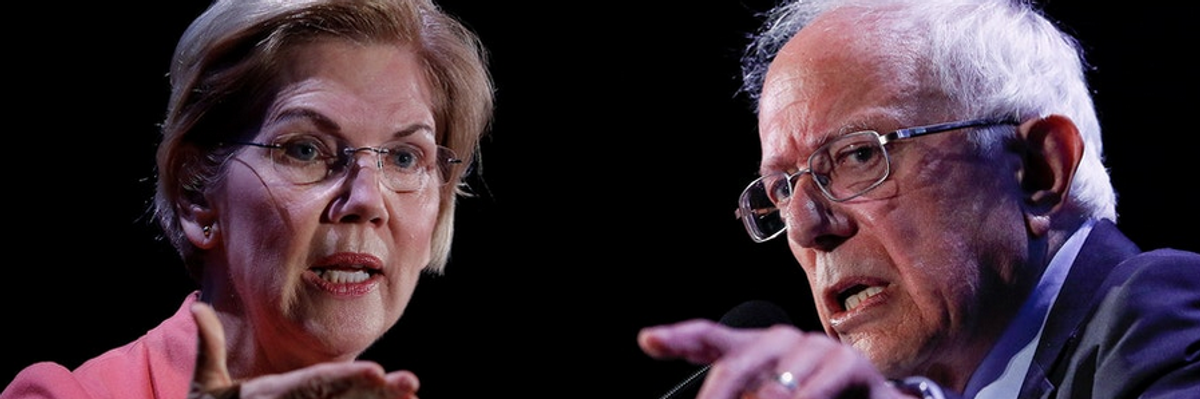
Sens. Elizabeth Warren, left, and Bernie Sanders speak at the NALEO Candidate Forum in Miami, Fla., on June 21, 2019. (Photo: Joe Skipper/Getty Images)
A few days ago, I shared what I thought was a fairly innocuous observation about a fundamental difference between Elizabeth Warren and Bernie Sanders. Warren spends most of her campaign unpacking and explaining detailed policy proposals, many of them excellent, while Sanders splits his emphasis between his own strong plans and his calls for the political revolution he has consistently said will be required for any substantive progressive policy wins.
"Smart policies are very important," I tweeted. "But we don't lose because we lack smart policies, we lose because we lack sufficient power to win those policies up against entrenched elite forces that will do anything to defeat us."
Within seconds, I was in the grip of a full-on 2016 primary flashback. I was accused of being a shill for Bernie and an enemy of Warren (I'm neither). My feed filled up with partisans of both candidates hurling insults at each other: She gets things done, he is all talk; she's a pretender, he's the real deal; he has a gender problem, hers is with race; she's in the pocket of the arms industry, he's an easy mark for Donald Trump; he should back her because she's a woman, she should back him because he started this wave. And much more too venal to mention.
I immediately regretted saying anything (as is so often the case on that godforsaken platform). Not because the point about outside movement power is unimportant, but because I had been trying to put off getting sucked into the 2020 horserace for as long as possible.
Liberals in the U.S. often say the Trump presidency is Not Normal. And yeah, it's a killer-clown horror show. But the truth is that from most outsider perspectives, there is nothing about U.S. politics that is normal -- particularly the interminable length of campaigns. Normal countries have federal elections that consume two, maybe three months of people's political lives once every four to five years; Canada caps federal campaigns at 50 days, Japan at 12. In the U.S., on the other hand, there's a total of about nine months in every four-year cycle when politics is not consumed by either a presidential or midterm horserace.
The very last thing we need is for the two strongest left/progressive candidates and their supporters to tear each other apart for the next eight months.
It's a spectacle that comes at a steep price. The relentless process of picking electoral winners sucks up intellectual energy, media airtime, movement muscle, and boatloads of money that are badly needed elsewhere. Like organizing to stop war with Iran, for instance. Or supporting movements trying to free migrants from Trump's concentration camps. Or figuring out what a transformative Green New Deal should look like on the ground. Or building international alliances with people in countries facing their own hate-filled authoritarian strongmen.
There's another reason to resist attempts to turn Sanders vs. Warren into a redux of the 2016 primaries eight months before the first vote is cast. Today's electoral dynamics are absolutely nothing like 2016. That was a two-way race between two candidates with radically different records and ideas, in which one candidate's gain really was the other's loss. A winner-takes-all race like that pretty much always turns into some kind of death match.
Read full article here.
Dear Common Dreams reader, It’s been nearly 30 years since I co-founded Common Dreams with my late wife, Lina Newhouser. We had the radical notion that journalism should serve the public good, not corporate profits. It was clear to us from the outset what it would take to build such a project. No paid advertisements. No corporate sponsors. No millionaire publisher telling us what to think or do. Many people said we wouldn't last a year, but we proved those doubters wrong. Together with a tremendous team of journalists and dedicated staff, we built an independent media outlet free from the constraints of profits and corporate control. Our mission has always been simple: To inform. To inspire. To ignite change for the common good. Building Common Dreams was not easy. Our survival was never guaranteed. When you take on the most powerful forces—Wall Street greed, fossil fuel industry destruction, Big Tech lobbyists, and uber-rich oligarchs who have spent billions upon billions rigging the economy and democracy in their favor—the only bulwark you have is supporters who believe in your work. But here’s the urgent message from me today. It's never been this bad out there. And it's never been this hard to keep us going. At the very moment Common Dreams is most needed, the threats we face are intensifying. We need your support now more than ever. We don't accept corporate advertising and never will. We don't have a paywall because we don't think people should be blocked from critical news based on their ability to pay. Everything we do is funded by the donations of readers like you. When everyone does the little they can afford, we are strong. But if that support retreats or dries up, so do we. Will you donate now to make sure Common Dreams not only survives but thrives? —Craig Brown, Co-founder |
A few days ago, I shared what I thought was a fairly innocuous observation about a fundamental difference between Elizabeth Warren and Bernie Sanders. Warren spends most of her campaign unpacking and explaining detailed policy proposals, many of them excellent, while Sanders splits his emphasis between his own strong plans and his calls for the political revolution he has consistently said will be required for any substantive progressive policy wins.
"Smart policies are very important," I tweeted. "But we don't lose because we lack smart policies, we lose because we lack sufficient power to win those policies up against entrenched elite forces that will do anything to defeat us."
Within seconds, I was in the grip of a full-on 2016 primary flashback. I was accused of being a shill for Bernie and an enemy of Warren (I'm neither). My feed filled up with partisans of both candidates hurling insults at each other: She gets things done, he is all talk; she's a pretender, he's the real deal; he has a gender problem, hers is with race; she's in the pocket of the arms industry, he's an easy mark for Donald Trump; he should back her because she's a woman, she should back him because he started this wave. And much more too venal to mention.
I immediately regretted saying anything (as is so often the case on that godforsaken platform). Not because the point about outside movement power is unimportant, but because I had been trying to put off getting sucked into the 2020 horserace for as long as possible.
Liberals in the U.S. often say the Trump presidency is Not Normal. And yeah, it's a killer-clown horror show. But the truth is that from most outsider perspectives, there is nothing about U.S. politics that is normal -- particularly the interminable length of campaigns. Normal countries have federal elections that consume two, maybe three months of people's political lives once every four to five years; Canada caps federal campaigns at 50 days, Japan at 12. In the U.S., on the other hand, there's a total of about nine months in every four-year cycle when politics is not consumed by either a presidential or midterm horserace.
The very last thing we need is for the two strongest left/progressive candidates and their supporters to tear each other apart for the next eight months.
It's a spectacle that comes at a steep price. The relentless process of picking electoral winners sucks up intellectual energy, media airtime, movement muscle, and boatloads of money that are badly needed elsewhere. Like organizing to stop war with Iran, for instance. Or supporting movements trying to free migrants from Trump's concentration camps. Or figuring out what a transformative Green New Deal should look like on the ground. Or building international alliances with people in countries facing their own hate-filled authoritarian strongmen.
There's another reason to resist attempts to turn Sanders vs. Warren into a redux of the 2016 primaries eight months before the first vote is cast. Today's electoral dynamics are absolutely nothing like 2016. That was a two-way race between two candidates with radically different records and ideas, in which one candidate's gain really was the other's loss. A winner-takes-all race like that pretty much always turns into some kind of death match.
Read full article here.
A few days ago, I shared what I thought was a fairly innocuous observation about a fundamental difference between Elizabeth Warren and Bernie Sanders. Warren spends most of her campaign unpacking and explaining detailed policy proposals, many of them excellent, while Sanders splits his emphasis between his own strong plans and his calls for the political revolution he has consistently said will be required for any substantive progressive policy wins.
"Smart policies are very important," I tweeted. "But we don't lose because we lack smart policies, we lose because we lack sufficient power to win those policies up against entrenched elite forces that will do anything to defeat us."
Within seconds, I was in the grip of a full-on 2016 primary flashback. I was accused of being a shill for Bernie and an enemy of Warren (I'm neither). My feed filled up with partisans of both candidates hurling insults at each other: She gets things done, he is all talk; she's a pretender, he's the real deal; he has a gender problem, hers is with race; she's in the pocket of the arms industry, he's an easy mark for Donald Trump; he should back her because she's a woman, she should back him because he started this wave. And much more too venal to mention.
I immediately regretted saying anything (as is so often the case on that godforsaken platform). Not because the point about outside movement power is unimportant, but because I had been trying to put off getting sucked into the 2020 horserace for as long as possible.
Liberals in the U.S. often say the Trump presidency is Not Normal. And yeah, it's a killer-clown horror show. But the truth is that from most outsider perspectives, there is nothing about U.S. politics that is normal -- particularly the interminable length of campaigns. Normal countries have federal elections that consume two, maybe three months of people's political lives once every four to five years; Canada caps federal campaigns at 50 days, Japan at 12. In the U.S., on the other hand, there's a total of about nine months in every four-year cycle when politics is not consumed by either a presidential or midterm horserace.
The very last thing we need is for the two strongest left/progressive candidates and their supporters to tear each other apart for the next eight months.
It's a spectacle that comes at a steep price. The relentless process of picking electoral winners sucks up intellectual energy, media airtime, movement muscle, and boatloads of money that are badly needed elsewhere. Like organizing to stop war with Iran, for instance. Or supporting movements trying to free migrants from Trump's concentration camps. Or figuring out what a transformative Green New Deal should look like on the ground. Or building international alliances with people in countries facing their own hate-filled authoritarian strongmen.
There's another reason to resist attempts to turn Sanders vs. Warren into a redux of the 2016 primaries eight months before the first vote is cast. Today's electoral dynamics are absolutely nothing like 2016. That was a two-way race between two candidates with radically different records and ideas, in which one candidate's gain really was the other's loss. A winner-takes-all race like that pretty much always turns into some kind of death match.
Read full article here.