SUBSCRIBE TO OUR FREE NEWSLETTER
Daily news & progressive opinion—funded by the people, not the corporations—delivered straight to your inbox.
5
#000000
#FFFFFF
To donate by check, phone, or other method, see our More Ways to Give page.
Daily news & progressive opinion—funded by the people, not the corporations—delivered straight to your inbox.
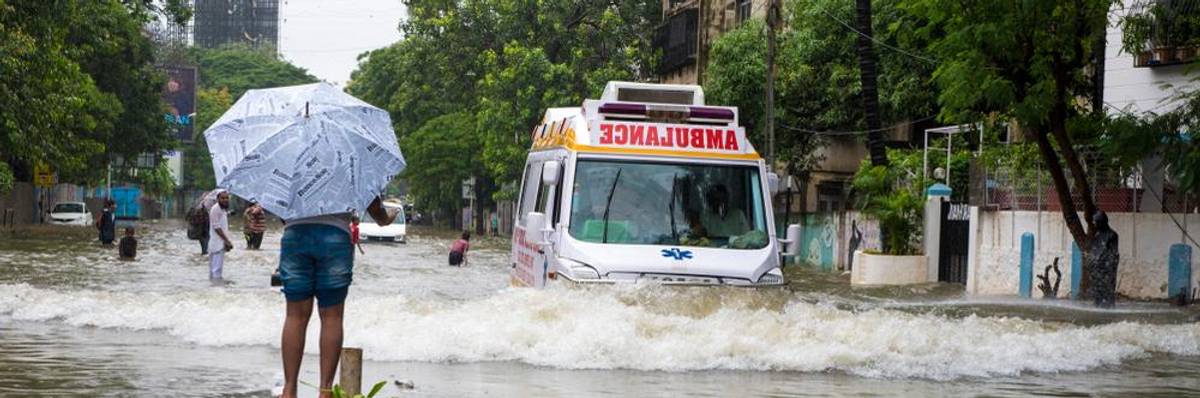
An ambulance races through a flood in Mumbai, India (Photo: Shutterstock)
Rising global temperatures are intensifying the effects of extreme weather events across the United States and around the world. Wildfires, hurricanes, tornadoes, tsunamis, floods, and severe storms are becoming the norm, not the exception.
Extreme weather events don't just hurt people with blunt force--they also spread disease and other serious health impacts. For already vulnerable populations, the health risks can be deadly.
Extreme heat can cause cardiovascular, cerebrovascular, and respiratory effects, and even death. Urban heat islands amplify impacts on cities, while long hours in the heat put farm workers and other outdoor laborers at severe risk too.
Extreme cold can cause hypothermia, cardiovascular and respiratory illnesses, and (as with heat) death. Prolonged exposure due to homelessness or housing insecurity puts transient populations at extreme risk for cold exposure in particular.
Then there's hunger, which twice as many people are at risk of suffering by 2050, due to droughts and infectious diseases.
Then there's hunger, which twice as many people are at risk of suffering by 2050, due to droughts and infectious diseases.
" Climate change is already contributing to the burden of disease and premature mortality," reports the European Academies Scientific Advisory Council. "Without prompt and effective action, the problems are forecast to worsen considerably."
Too many communities are still recovering from extreme weather events, only to get hit again--and again, and again. From flooded farmlands in the Midwest to rising sea levels on the coasts, communities across America face the loss of their livelihoods, homes, and lives, with little time to recover before the next disaster strikes.
The challenges are starker still in places already facing limited access to health and medical resources. A lack of health insurance and local doctors, plus poverty and remote locations, makes access to care particularly difficult for the majority of rural Americans, who may have to travel several hours to the nearest provider.
Many of these areas are highly vulnerable to natural disasters. In California alone, according to McClatchy, more than 2.7 million residents live in "very high fire hazard severity zones," at risk of devastating wildfires like the Woolsey Fire or Camp Fire.
When weather-related disasters strike, accessing health services--particularly emergency services--can become almost impossible. When roads close due to floods or fires, mild health scares can become life-threatening emergencies.
Indeed, thanks to climate change, natural disasters are claiming even more lives. Who gets hit hardest?
Rural communities. Farmers and farm workers. Island communities. Coastal communities. Towns in low-lying areas in flood country and flat-area towns in tornado country, but also towns that haven't experienced so-called "100 year storms" until now.
Particularly at risk are low-income communities, who already have limited resources to respond. So are people of color, who disproportionately experience not only the impacts of climate change, but also exposure to pollution, methane emissions, and toxins.
LGBTQ people on the margins of society, particularly LGBTQ youth--who face discrimination and violence at high rates--are more likely to experience homelessness, exposing them disproportionately to extreme heat and cold.
In short, the climate crisis is a health crisis. That's why organizations like Physicians for Social Responsibility are mobilizing with everything we've got to tackle this like any other health emergency.
With a coordinated mass response from everyone from health care providers to policy makers to ordinary citizens, we can save our future. Our communities are already paying the price every second we fail to act swiftly and comprehensively.
This threat is literally in our backyards.
Dear Common Dreams reader, It’s been nearly 30 years since I co-founded Common Dreams with my late wife, Lina Newhouser. We had the radical notion that journalism should serve the public good, not corporate profits. It was clear to us from the outset what it would take to build such a project. No paid advertisements. No corporate sponsors. No millionaire publisher telling us what to think or do. Many people said we wouldn't last a year, but we proved those doubters wrong. Together with a tremendous team of journalists and dedicated staff, we built an independent media outlet free from the constraints of profits and corporate control. Our mission has always been simple: To inform. To inspire. To ignite change for the common good. Building Common Dreams was not easy. Our survival was never guaranteed. When you take on the most powerful forces—Wall Street greed, fossil fuel industry destruction, Big Tech lobbyists, and uber-rich oligarchs who have spent billions upon billions rigging the economy and democracy in their favor—the only bulwark you have is supporters who believe in your work. But here’s the urgent message from me today. It's never been this bad out there. And it's never been this hard to keep us going. At the very moment Common Dreams is most needed, the threats we face are intensifying. We need your support now more than ever. We don't accept corporate advertising and never will. We don't have a paywall because we don't think people should be blocked from critical news based on their ability to pay. Everything we do is funded by the donations of readers like you. When everyone does the little they can afford, we are strong. But if that support retreats or dries up, so do we. Will you donate now to make sure Common Dreams not only survives but thrives? —Craig Brown, Co-founder |
Rising global temperatures are intensifying the effects of extreme weather events across the United States and around the world. Wildfires, hurricanes, tornadoes, tsunamis, floods, and severe storms are becoming the norm, not the exception.
Extreme weather events don't just hurt people with blunt force--they also spread disease and other serious health impacts. For already vulnerable populations, the health risks can be deadly.
Extreme heat can cause cardiovascular, cerebrovascular, and respiratory effects, and even death. Urban heat islands amplify impacts on cities, while long hours in the heat put farm workers and other outdoor laborers at severe risk too.
Extreme cold can cause hypothermia, cardiovascular and respiratory illnesses, and (as with heat) death. Prolonged exposure due to homelessness or housing insecurity puts transient populations at extreme risk for cold exposure in particular.
Then there's hunger, which twice as many people are at risk of suffering by 2050, due to droughts and infectious diseases.
Then there's hunger, which twice as many people are at risk of suffering by 2050, due to droughts and infectious diseases.
" Climate change is already contributing to the burden of disease and premature mortality," reports the European Academies Scientific Advisory Council. "Without prompt and effective action, the problems are forecast to worsen considerably."
Too many communities are still recovering from extreme weather events, only to get hit again--and again, and again. From flooded farmlands in the Midwest to rising sea levels on the coasts, communities across America face the loss of their livelihoods, homes, and lives, with little time to recover before the next disaster strikes.
The challenges are starker still in places already facing limited access to health and medical resources. A lack of health insurance and local doctors, plus poverty and remote locations, makes access to care particularly difficult for the majority of rural Americans, who may have to travel several hours to the nearest provider.
Many of these areas are highly vulnerable to natural disasters. In California alone, according to McClatchy, more than 2.7 million residents live in "very high fire hazard severity zones," at risk of devastating wildfires like the Woolsey Fire or Camp Fire.
When weather-related disasters strike, accessing health services--particularly emergency services--can become almost impossible. When roads close due to floods or fires, mild health scares can become life-threatening emergencies.
Indeed, thanks to climate change, natural disasters are claiming even more lives. Who gets hit hardest?
Rural communities. Farmers and farm workers. Island communities. Coastal communities. Towns in low-lying areas in flood country and flat-area towns in tornado country, but also towns that haven't experienced so-called "100 year storms" until now.
Particularly at risk are low-income communities, who already have limited resources to respond. So are people of color, who disproportionately experience not only the impacts of climate change, but also exposure to pollution, methane emissions, and toxins.
LGBTQ people on the margins of society, particularly LGBTQ youth--who face discrimination and violence at high rates--are more likely to experience homelessness, exposing them disproportionately to extreme heat and cold.
In short, the climate crisis is a health crisis. That's why organizations like Physicians for Social Responsibility are mobilizing with everything we've got to tackle this like any other health emergency.
With a coordinated mass response from everyone from health care providers to policy makers to ordinary citizens, we can save our future. Our communities are already paying the price every second we fail to act swiftly and comprehensively.
This threat is literally in our backyards.
Rising global temperatures are intensifying the effects of extreme weather events across the United States and around the world. Wildfires, hurricanes, tornadoes, tsunamis, floods, and severe storms are becoming the norm, not the exception.
Extreme weather events don't just hurt people with blunt force--they also spread disease and other serious health impacts. For already vulnerable populations, the health risks can be deadly.
Extreme heat can cause cardiovascular, cerebrovascular, and respiratory effects, and even death. Urban heat islands amplify impacts on cities, while long hours in the heat put farm workers and other outdoor laborers at severe risk too.
Extreme cold can cause hypothermia, cardiovascular and respiratory illnesses, and (as with heat) death. Prolonged exposure due to homelessness or housing insecurity puts transient populations at extreme risk for cold exposure in particular.
Then there's hunger, which twice as many people are at risk of suffering by 2050, due to droughts and infectious diseases.
Then there's hunger, which twice as many people are at risk of suffering by 2050, due to droughts and infectious diseases.
" Climate change is already contributing to the burden of disease and premature mortality," reports the European Academies Scientific Advisory Council. "Without prompt and effective action, the problems are forecast to worsen considerably."
Too many communities are still recovering from extreme weather events, only to get hit again--and again, and again. From flooded farmlands in the Midwest to rising sea levels on the coasts, communities across America face the loss of their livelihoods, homes, and lives, with little time to recover before the next disaster strikes.
The challenges are starker still in places already facing limited access to health and medical resources. A lack of health insurance and local doctors, plus poverty and remote locations, makes access to care particularly difficult for the majority of rural Americans, who may have to travel several hours to the nearest provider.
Many of these areas are highly vulnerable to natural disasters. In California alone, according to McClatchy, more than 2.7 million residents live in "very high fire hazard severity zones," at risk of devastating wildfires like the Woolsey Fire or Camp Fire.
When weather-related disasters strike, accessing health services--particularly emergency services--can become almost impossible. When roads close due to floods or fires, mild health scares can become life-threatening emergencies.
Indeed, thanks to climate change, natural disasters are claiming even more lives. Who gets hit hardest?
Rural communities. Farmers and farm workers. Island communities. Coastal communities. Towns in low-lying areas in flood country and flat-area towns in tornado country, but also towns that haven't experienced so-called "100 year storms" until now.
Particularly at risk are low-income communities, who already have limited resources to respond. So are people of color, who disproportionately experience not only the impacts of climate change, but also exposure to pollution, methane emissions, and toxins.
LGBTQ people on the margins of society, particularly LGBTQ youth--who face discrimination and violence at high rates--are more likely to experience homelessness, exposing them disproportionately to extreme heat and cold.
In short, the climate crisis is a health crisis. That's why organizations like Physicians for Social Responsibility are mobilizing with everything we've got to tackle this like any other health emergency.
With a coordinated mass response from everyone from health care providers to policy makers to ordinary citizens, we can save our future. Our communities are already paying the price every second we fail to act swiftly and comprehensively.
This threat is literally in our backyards.