SUBSCRIBE TO OUR FREE NEWSLETTER
Daily news & progressive opinion—funded by the people, not the corporations—delivered straight to your inbox.
5
#000000
#FFFFFF
To donate by check, phone, or other method, see our More Ways to Give page.
Daily news & progressive opinion—funded by the people, not the corporations—delivered straight to your inbox.
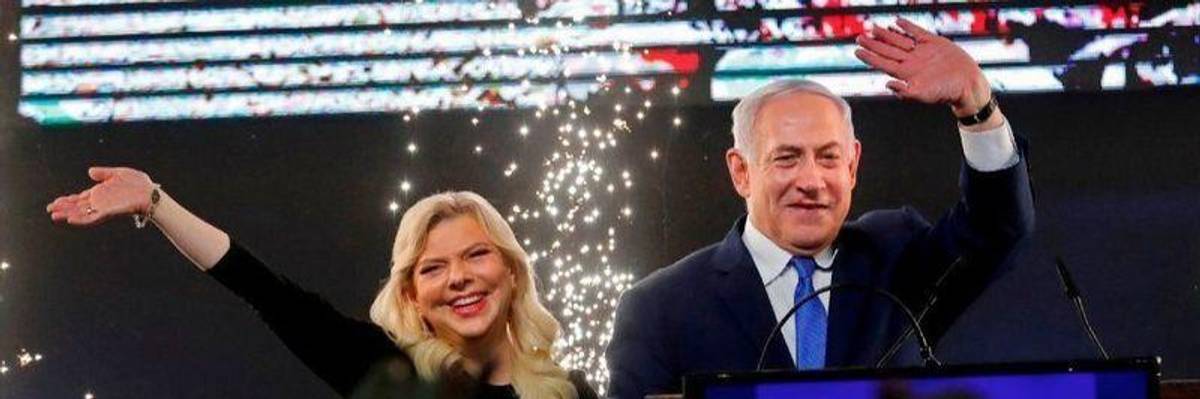
Israeli Prime Minister Benjamin Netanyahu, accompanied by his wife Sara, greets supporters at the Likud Party headquarters in Tel Aviv on election night early on April 10. (Photo: Thomas Coex / AFP / Getty Images)
Netanyahu ran a manifestly racist electoral campaign, reaching out to embrace politicians who openly espouse the desire to expel Palestinians from the state and promising to annex parts of the West Bank, dealing probably a final blow to the moribund two-state solution. What Israeli voters want, clearly, is precisely what is on offer: more dispossession of Palestinians, more home demolitions, more indiscriminate bombing campaigns, more shooting of protesters, more settlements, more restrictions on Gaza and on Palestinian life in general, and deeper and deeper inequality between Jews and non-Jews in Israel and in the territories over which it rules.
The bloc led by Benny Gantz hardly offered much of a difference. Gantz's own electoral campaign prominently featured a series of videos called "Only the Strong Survive," which gloated over how many Palestinians the former army chief of staff had killed and how proud he was to have bombed parts of Gaza "back to the Stone Age." One video limply offered, "It's not shameful to be striving for peace." In the end, Gantz's tough-guy claims were clearly not enough to convince Israeli voters to depart from a wily politician they knew for a fact -- because he's been doing it for so long -- would continue to subjugate the Palestinians.
International law has a word to describe a state that discriminates along racial lines like this: apartheid.
The voters reaffirmed the de facto or de jure realities Palestinians have long faced. Last year, Israel legally enshrined a Jewish nation-state law that formalized the superior status of Jews over non-Jews, officially relegating Arabic -- the language spoken by the 20% of the state's citizens who are Palestinian -- to a secondary status, elided Palestinians' ongoing presence in and claim to their ancestral land, directed the government to "encourage and promote" Jewish settlement and thereby further segregation, and declared that the right to self-determination in the state is reserved for Jews alone. Netanyahu himself announced on Instagram in March that Israel is "the nation state not of all its citizens but only of the Jewish people."
International law has a word to describe a state that discriminates along racial lines like this: apartheid.
When you add to these shameful figures the millions of registered Palestinian refugees living outside Israel and the occupied territories, in enforced exile solely because Israel refuses to allow them to return home, the reality becomes even more stark: Israel's elections, far from being legitimately democratic, are in fact a manifestation of minority rule. Millions of disenfranchised Palestinians have no say over the structures and patterns of their everyday lives. They are subject to whatever Jewish Israeli voters think they deserve, which is essentially further dehumanization.
But if the Palestinians had the right to vote, what would they vote for? They may not have elections, but opinion polls consistently show that when asked which Palestinian leader they trust the most, the overwhelming winner (48% in the most recent poll conducted by the reputable Jerusalem Media and Communications Centre) is "none of the above." And when asked which party they support, the answer is consistently neither Fatah, which controls the Palestinian Authority, (28%) nor Hamas (10%), but "don't trust anyone" (41%). A solid majority prefer negotiations to armed struggle and an increasing number want a single state, shared with Jews. (Only 0.4% want an Islamic state to replace Jewish state of Israel.)
The takeaway from Israel's election is simple: The two-state solution is dead. What remains is a single racist state whose beneficiaries are satisfied with their government and whose victims are deeply unhappy and desperate for something new: a transition from an apartheid state to a genuinely democratic one in which Palestinians are treated as equal citizens with Israeli Jews, not disenfranchised brutes.
Two sets of numbers indicate how institutionalized this apartheid is. First, although Israel exerts control over territory (including the occupied West Bank, East Jerusalem and Gaza) inhabited by around 13 million people, only 5.8 million -- 80% of them Jews, according to Israel's Central Election Committee -- are eligible voters.
Dear Common Dreams reader, It’s been nearly 30 years since I co-founded Common Dreams with my late wife, Lina Newhouser. We had the radical notion that journalism should serve the public good, not corporate profits. It was clear to us from the outset what it would take to build such a project. No paid advertisements. No corporate sponsors. No millionaire publisher telling us what to think or do. Many people said we wouldn't last a year, but we proved those doubters wrong. Together with a tremendous team of journalists and dedicated staff, we built an independent media outlet free from the constraints of profits and corporate control. Our mission has always been simple: To inform. To inspire. To ignite change for the common good. Building Common Dreams was not easy. Our survival was never guaranteed. When you take on the most powerful forces—Wall Street greed, fossil fuel industry destruction, Big Tech lobbyists, and uber-rich oligarchs who have spent billions upon billions rigging the economy and democracy in their favor—the only bulwark you have is supporters who believe in your work. But here’s the urgent message from me today. It's never been this bad out there. And it's never been this hard to keep us going. At the very moment Common Dreams is most needed, the threats we face are intensifying. We need your support now more than ever. We don't accept corporate advertising and never will. We don't have a paywall because we don't think people should be blocked from critical news based on their ability to pay. Everything we do is funded by the donations of readers like you. When everyone does the little they can afford, we are strong. But if that support retreats or dries up, so do we. Will you donate now to make sure Common Dreams not only survives but thrives? —Craig Brown, Co-founder |
Netanyahu ran a manifestly racist electoral campaign, reaching out to embrace politicians who openly espouse the desire to expel Palestinians from the state and promising to annex parts of the West Bank, dealing probably a final blow to the moribund two-state solution. What Israeli voters want, clearly, is precisely what is on offer: more dispossession of Palestinians, more home demolitions, more indiscriminate bombing campaigns, more shooting of protesters, more settlements, more restrictions on Gaza and on Palestinian life in general, and deeper and deeper inequality between Jews and non-Jews in Israel and in the territories over which it rules.
The bloc led by Benny Gantz hardly offered much of a difference. Gantz's own electoral campaign prominently featured a series of videos called "Only the Strong Survive," which gloated over how many Palestinians the former army chief of staff had killed and how proud he was to have bombed parts of Gaza "back to the Stone Age." One video limply offered, "It's not shameful to be striving for peace." In the end, Gantz's tough-guy claims were clearly not enough to convince Israeli voters to depart from a wily politician they knew for a fact -- because he's been doing it for so long -- would continue to subjugate the Palestinians.
International law has a word to describe a state that discriminates along racial lines like this: apartheid.
The voters reaffirmed the de facto or de jure realities Palestinians have long faced. Last year, Israel legally enshrined a Jewish nation-state law that formalized the superior status of Jews over non-Jews, officially relegating Arabic -- the language spoken by the 20% of the state's citizens who are Palestinian -- to a secondary status, elided Palestinians' ongoing presence in and claim to their ancestral land, directed the government to "encourage and promote" Jewish settlement and thereby further segregation, and declared that the right to self-determination in the state is reserved for Jews alone. Netanyahu himself announced on Instagram in March that Israel is "the nation state not of all its citizens but only of the Jewish people."
International law has a word to describe a state that discriminates along racial lines like this: apartheid.
When you add to these shameful figures the millions of registered Palestinian refugees living outside Israel and the occupied territories, in enforced exile solely because Israel refuses to allow them to return home, the reality becomes even more stark: Israel's elections, far from being legitimately democratic, are in fact a manifestation of minority rule. Millions of disenfranchised Palestinians have no say over the structures and patterns of their everyday lives. They are subject to whatever Jewish Israeli voters think they deserve, which is essentially further dehumanization.
But if the Palestinians had the right to vote, what would they vote for? They may not have elections, but opinion polls consistently show that when asked which Palestinian leader they trust the most, the overwhelming winner (48% in the most recent poll conducted by the reputable Jerusalem Media and Communications Centre) is "none of the above." And when asked which party they support, the answer is consistently neither Fatah, which controls the Palestinian Authority, (28%) nor Hamas (10%), but "don't trust anyone" (41%). A solid majority prefer negotiations to armed struggle and an increasing number want a single state, shared with Jews. (Only 0.4% want an Islamic state to replace Jewish state of Israel.)
The takeaway from Israel's election is simple: The two-state solution is dead. What remains is a single racist state whose beneficiaries are satisfied with their government and whose victims are deeply unhappy and desperate for something new: a transition from an apartheid state to a genuinely democratic one in which Palestinians are treated as equal citizens with Israeli Jews, not disenfranchised brutes.
Two sets of numbers indicate how institutionalized this apartheid is. First, although Israel exerts control over territory (including the occupied West Bank, East Jerusalem and Gaza) inhabited by around 13 million people, only 5.8 million -- 80% of them Jews, according to Israel's Central Election Committee -- are eligible voters.
Netanyahu ran a manifestly racist electoral campaign, reaching out to embrace politicians who openly espouse the desire to expel Palestinians from the state and promising to annex parts of the West Bank, dealing probably a final blow to the moribund two-state solution. What Israeli voters want, clearly, is precisely what is on offer: more dispossession of Palestinians, more home demolitions, more indiscriminate bombing campaigns, more shooting of protesters, more settlements, more restrictions on Gaza and on Palestinian life in general, and deeper and deeper inequality between Jews and non-Jews in Israel and in the territories over which it rules.
The bloc led by Benny Gantz hardly offered much of a difference. Gantz's own electoral campaign prominently featured a series of videos called "Only the Strong Survive," which gloated over how many Palestinians the former army chief of staff had killed and how proud he was to have bombed parts of Gaza "back to the Stone Age." One video limply offered, "It's not shameful to be striving for peace." In the end, Gantz's tough-guy claims were clearly not enough to convince Israeli voters to depart from a wily politician they knew for a fact -- because he's been doing it for so long -- would continue to subjugate the Palestinians.
International law has a word to describe a state that discriminates along racial lines like this: apartheid.
The voters reaffirmed the de facto or de jure realities Palestinians have long faced. Last year, Israel legally enshrined a Jewish nation-state law that formalized the superior status of Jews over non-Jews, officially relegating Arabic -- the language spoken by the 20% of the state's citizens who are Palestinian -- to a secondary status, elided Palestinians' ongoing presence in and claim to their ancestral land, directed the government to "encourage and promote" Jewish settlement and thereby further segregation, and declared that the right to self-determination in the state is reserved for Jews alone. Netanyahu himself announced on Instagram in March that Israel is "the nation state not of all its citizens but only of the Jewish people."
International law has a word to describe a state that discriminates along racial lines like this: apartheid.
When you add to these shameful figures the millions of registered Palestinian refugees living outside Israel and the occupied territories, in enforced exile solely because Israel refuses to allow them to return home, the reality becomes even more stark: Israel's elections, far from being legitimately democratic, are in fact a manifestation of minority rule. Millions of disenfranchised Palestinians have no say over the structures and patterns of their everyday lives. They are subject to whatever Jewish Israeli voters think they deserve, which is essentially further dehumanization.
But if the Palestinians had the right to vote, what would they vote for? They may not have elections, but opinion polls consistently show that when asked which Palestinian leader they trust the most, the overwhelming winner (48% in the most recent poll conducted by the reputable Jerusalem Media and Communications Centre) is "none of the above." And when asked which party they support, the answer is consistently neither Fatah, which controls the Palestinian Authority, (28%) nor Hamas (10%), but "don't trust anyone" (41%). A solid majority prefer negotiations to armed struggle and an increasing number want a single state, shared with Jews. (Only 0.4% want an Islamic state to replace Jewish state of Israel.)
The takeaway from Israel's election is simple: The two-state solution is dead. What remains is a single racist state whose beneficiaries are satisfied with their government and whose victims are deeply unhappy and desperate for something new: a transition from an apartheid state to a genuinely democratic one in which Palestinians are treated as equal citizens with Israeli Jews, not disenfranchised brutes.
Two sets of numbers indicate how institutionalized this apartheid is. First, although Israel exerts control over territory (including the occupied West Bank, East Jerusalem and Gaza) inhabited by around 13 million people, only 5.8 million -- 80% of them Jews, according to Israel's Central Election Committee -- are eligible voters.