

SUBSCRIBE TO OUR FREE NEWSLETTER
Daily news & progressive opinion—funded by the people, not the corporations—delivered straight to your inbox.
5
#000000
#FFFFFF
To donate by check, phone, or other method, see our More Ways to Give page.
Daily news & progressive opinion—funded by the people, not the corporations—delivered straight to your inbox.
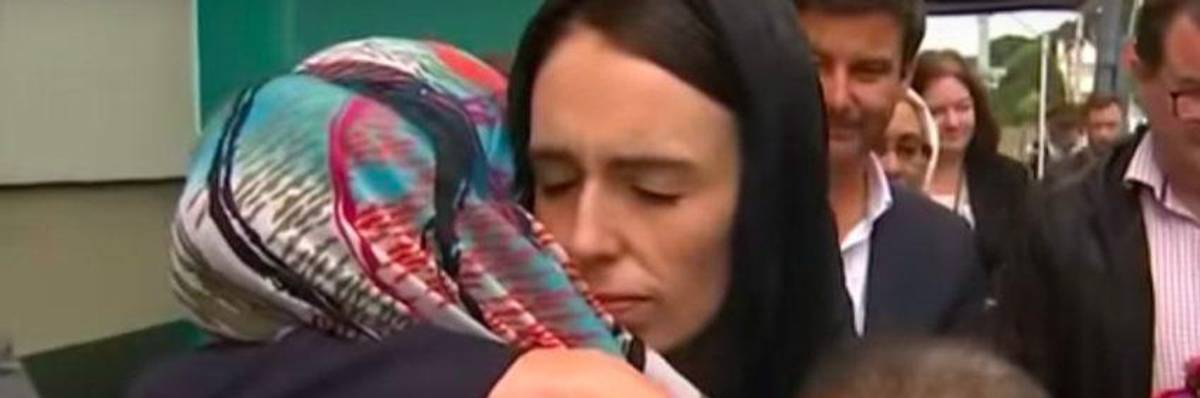
Jacinda Ardern embraces a mourner at the Kilbirnie mosque in Wellington, New Zealand. (Photo: Screen shot / YouTube)
Another mass shooting has gripped world attention. Fifty Muslim worshippers in Christchurch, New Zealand, were brutally gunned down in two mosques by a single gunman armed with an arsenal of legally purchased semi-automatic weapons. In a sick modern twist, the alleged killer, 28-year-old Australian Brenton Tarrant, livestreamed his rampage on Facebook. The killer, arrested apparently unharmed, published a manifesto online before his murder spree in which he defined himself in rambling prose as a committed white supremacist. He said he was a supporter of President Donald Trump as "a symbol of renewed white identity and common purpose," and condemned nonwhite immigrants, using the words "invaders" and "invasion" over 80 times.
On the same day of the attack, Trump issued the first veto of his administration, overturning Congress' rejection of the national emergency declaration he is using to unilaterally fund his border wall. At the signing, Trump, like the Christchurch shooter, also used the word "invasion." Trump said, "It's an invasion of drugs and criminals and people." He added, "And in many cases, they're stone cold criminals ... you have killers coming in and murderers coming in."
Trump did call New Zealand Prime Minister Jacinda Ardern to express condolences. Ardern said of the call: "He asked what offer of support the United States could provide. My message was sympathy and love for all Muslim communities." Her pointed reply was clear. That day, when addressing her nation in response to the massacre, Ardern, at 38 the youngest female head of state, said: "Many of those who will have been directly affected by this shooting may be migrants to New Zealand, they may even be refugees here. They have chosen to make New Zealand their home, and it is their home. They are us. The person who has perpetuated this violence against us is not. They have no place in New Zealand."
Contrast her remarks with those made by Trump after the white supremacist/neo-Nazi rally in Charlottesville, Virginia, in August 2017, where anti-racist activist Heather Heyer was killed and scores were injured. Trump said to reporters, several days later, "You also had people that were very fine people on both sides."
The weekend following the Christchurch mass shooting, Trump tweeted over 20 times, never mentioning the massacre again, but rather attacking everyone from the late Sen. John McCain to his own favorite network, the Fox News Channel. Trump was upset that Fox had suspended program host Jeanine Pirro after Pirro attacked Minnesota Congressmember Ilhan Omar for wearing a hijab. She is the first member of Congress to wear one.
Khaled Beydoun is the author of "American Islamophobia: Understanding the Roots and Rise of Fear." He said on the "Democracy Now!" news hour, "This kind of rhetoric that we see from white supremacists at the very top, like President Trump, whether it be words like 'Islam hates us,' or using dog whistles like 'invasion,' this is emboldening terrorists like the terrorist in New Zealand, in Christchurch."
Beydoun wanted to redirect the media attention from the shooter to the victims. He began putting out names, photographs and personal details of some of the victims on Twitter. "These were individuals who led lives. They were young kids, 3 years old ... Mucad Ibrahim. They were individuals who were as old as 72, somebody like [Haji-Daoud] Nabi, who was the first identified victim, standing at the door, who welcomed in the terrorist into the mosque," he said on "Democracy Now!" "I tried as much as possible to really put a face on who these people were, illustrating stories that showed that these people were far more than just statistics."
As Prime Minister Ardern went out to comfort the mourners, she wore a hijab. She also promised swift action to change the nation's gun laws. As New Zealand mourns, she strives to place the focus on the 50 victims, on their names, on their lives. Speaking in the New Zealand Parliament Tuesday, she said of the shooter, "You will never hear me speak his name." She opened her remarks, "As-salamu alaykum. Peace be upon you, and peace be upon all of us."
Dear Common Dreams reader, It’s been nearly 30 years since I co-founded Common Dreams with my late wife, Lina Newhouser. We had the radical notion that journalism should serve the public good, not corporate profits. It was clear to us from the outset what it would take to build such a project. No paid advertisements. No corporate sponsors. No millionaire publisher telling us what to think or do. Many people said we wouldn't last a year, but we proved those doubters wrong. Together with a tremendous team of journalists and dedicated staff, we built an independent media outlet free from the constraints of profits and corporate control. Our mission has always been simple: To inform. To inspire. To ignite change for the common good. Building Common Dreams was not easy. Our survival was never guaranteed. When you take on the most powerful forces—Wall Street greed, fossil fuel industry destruction, Big Tech lobbyists, and uber-rich oligarchs who have spent billions upon billions rigging the economy and democracy in their favor—the only bulwark you have is supporters who believe in your work. But here’s the urgent message from me today. It's never been this bad out there. And it's never been this hard to keep us going. At the very moment Common Dreams is most needed, the threats we face are intensifying. We need your support now more than ever. We don't accept corporate advertising and never will. We don't have a paywall because we don't think people should be blocked from critical news based on their ability to pay. Everything we do is funded by the donations of readers like you. When everyone does the little they can afford, we are strong. But if that support retreats or dries up, so do we. Will you donate now to make sure Common Dreams not only survives but thrives? —Craig Brown, Co-founder |
Another mass shooting has gripped world attention. Fifty Muslim worshippers in Christchurch, New Zealand, were brutally gunned down in two mosques by a single gunman armed with an arsenal of legally purchased semi-automatic weapons. In a sick modern twist, the alleged killer, 28-year-old Australian Brenton Tarrant, livestreamed his rampage on Facebook. The killer, arrested apparently unharmed, published a manifesto online before his murder spree in which he defined himself in rambling prose as a committed white supremacist. He said he was a supporter of President Donald Trump as "a symbol of renewed white identity and common purpose," and condemned nonwhite immigrants, using the words "invaders" and "invasion" over 80 times.
On the same day of the attack, Trump issued the first veto of his administration, overturning Congress' rejection of the national emergency declaration he is using to unilaterally fund his border wall. At the signing, Trump, like the Christchurch shooter, also used the word "invasion." Trump said, "It's an invasion of drugs and criminals and people." He added, "And in many cases, they're stone cold criminals ... you have killers coming in and murderers coming in."
Trump did call New Zealand Prime Minister Jacinda Ardern to express condolences. Ardern said of the call: "He asked what offer of support the United States could provide. My message was sympathy and love for all Muslim communities." Her pointed reply was clear. That day, when addressing her nation in response to the massacre, Ardern, at 38 the youngest female head of state, said: "Many of those who will have been directly affected by this shooting may be migrants to New Zealand, they may even be refugees here. They have chosen to make New Zealand their home, and it is their home. They are us. The person who has perpetuated this violence against us is not. They have no place in New Zealand."
Contrast her remarks with those made by Trump after the white supremacist/neo-Nazi rally in Charlottesville, Virginia, in August 2017, where anti-racist activist Heather Heyer was killed and scores were injured. Trump said to reporters, several days later, "You also had people that were very fine people on both sides."
The weekend following the Christchurch mass shooting, Trump tweeted over 20 times, never mentioning the massacre again, but rather attacking everyone from the late Sen. John McCain to his own favorite network, the Fox News Channel. Trump was upset that Fox had suspended program host Jeanine Pirro after Pirro attacked Minnesota Congressmember Ilhan Omar for wearing a hijab. She is the first member of Congress to wear one.
Khaled Beydoun is the author of "American Islamophobia: Understanding the Roots and Rise of Fear." He said on the "Democracy Now!" news hour, "This kind of rhetoric that we see from white supremacists at the very top, like President Trump, whether it be words like 'Islam hates us,' or using dog whistles like 'invasion,' this is emboldening terrorists like the terrorist in New Zealand, in Christchurch."
Beydoun wanted to redirect the media attention from the shooter to the victims. He began putting out names, photographs and personal details of some of the victims on Twitter. "These were individuals who led lives. They were young kids, 3 years old ... Mucad Ibrahim. They were individuals who were as old as 72, somebody like [Haji-Daoud] Nabi, who was the first identified victim, standing at the door, who welcomed in the terrorist into the mosque," he said on "Democracy Now!" "I tried as much as possible to really put a face on who these people were, illustrating stories that showed that these people were far more than just statistics."
As Prime Minister Ardern went out to comfort the mourners, she wore a hijab. She also promised swift action to change the nation's gun laws. As New Zealand mourns, she strives to place the focus on the 50 victims, on their names, on their lives. Speaking in the New Zealand Parliament Tuesday, she said of the shooter, "You will never hear me speak his name." She opened her remarks, "As-salamu alaykum. Peace be upon you, and peace be upon all of us."
Another mass shooting has gripped world attention. Fifty Muslim worshippers in Christchurch, New Zealand, were brutally gunned down in two mosques by a single gunman armed with an arsenal of legally purchased semi-automatic weapons. In a sick modern twist, the alleged killer, 28-year-old Australian Brenton Tarrant, livestreamed his rampage on Facebook. The killer, arrested apparently unharmed, published a manifesto online before his murder spree in which he defined himself in rambling prose as a committed white supremacist. He said he was a supporter of President Donald Trump as "a symbol of renewed white identity and common purpose," and condemned nonwhite immigrants, using the words "invaders" and "invasion" over 80 times.
On the same day of the attack, Trump issued the first veto of his administration, overturning Congress' rejection of the national emergency declaration he is using to unilaterally fund his border wall. At the signing, Trump, like the Christchurch shooter, also used the word "invasion." Trump said, "It's an invasion of drugs and criminals and people." He added, "And in many cases, they're stone cold criminals ... you have killers coming in and murderers coming in."
Trump did call New Zealand Prime Minister Jacinda Ardern to express condolences. Ardern said of the call: "He asked what offer of support the United States could provide. My message was sympathy and love for all Muslim communities." Her pointed reply was clear. That day, when addressing her nation in response to the massacre, Ardern, at 38 the youngest female head of state, said: "Many of those who will have been directly affected by this shooting may be migrants to New Zealand, they may even be refugees here. They have chosen to make New Zealand their home, and it is their home. They are us. The person who has perpetuated this violence against us is not. They have no place in New Zealand."
Contrast her remarks with those made by Trump after the white supremacist/neo-Nazi rally in Charlottesville, Virginia, in August 2017, where anti-racist activist Heather Heyer was killed and scores were injured. Trump said to reporters, several days later, "You also had people that were very fine people on both sides."
The weekend following the Christchurch mass shooting, Trump tweeted over 20 times, never mentioning the massacre again, but rather attacking everyone from the late Sen. John McCain to his own favorite network, the Fox News Channel. Trump was upset that Fox had suspended program host Jeanine Pirro after Pirro attacked Minnesota Congressmember Ilhan Omar for wearing a hijab. She is the first member of Congress to wear one.
Khaled Beydoun is the author of "American Islamophobia: Understanding the Roots and Rise of Fear." He said on the "Democracy Now!" news hour, "This kind of rhetoric that we see from white supremacists at the very top, like President Trump, whether it be words like 'Islam hates us,' or using dog whistles like 'invasion,' this is emboldening terrorists like the terrorist in New Zealand, in Christchurch."
Beydoun wanted to redirect the media attention from the shooter to the victims. He began putting out names, photographs and personal details of some of the victims on Twitter. "These were individuals who led lives. They were young kids, 3 years old ... Mucad Ibrahim. They were individuals who were as old as 72, somebody like [Haji-Daoud] Nabi, who was the first identified victim, standing at the door, who welcomed in the terrorist into the mosque," he said on "Democracy Now!" "I tried as much as possible to really put a face on who these people were, illustrating stories that showed that these people were far more than just statistics."
As Prime Minister Ardern went out to comfort the mourners, she wore a hijab. She also promised swift action to change the nation's gun laws. As New Zealand mourns, she strives to place the focus on the 50 victims, on their names, on their lives. Speaking in the New Zealand Parliament Tuesday, she said of the shooter, "You will never hear me speak his name." She opened her remarks, "As-salamu alaykum. Peace be upon you, and peace be upon all of us."

