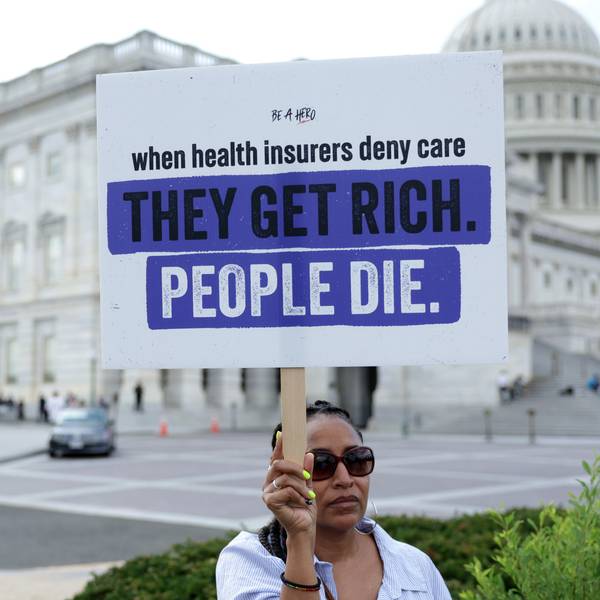
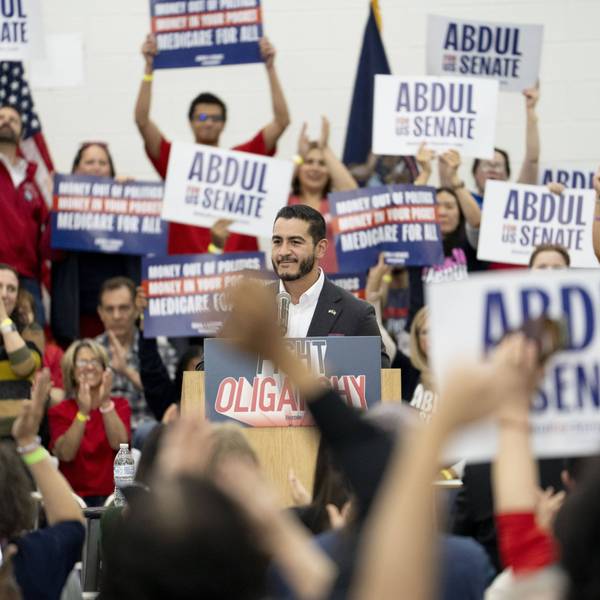
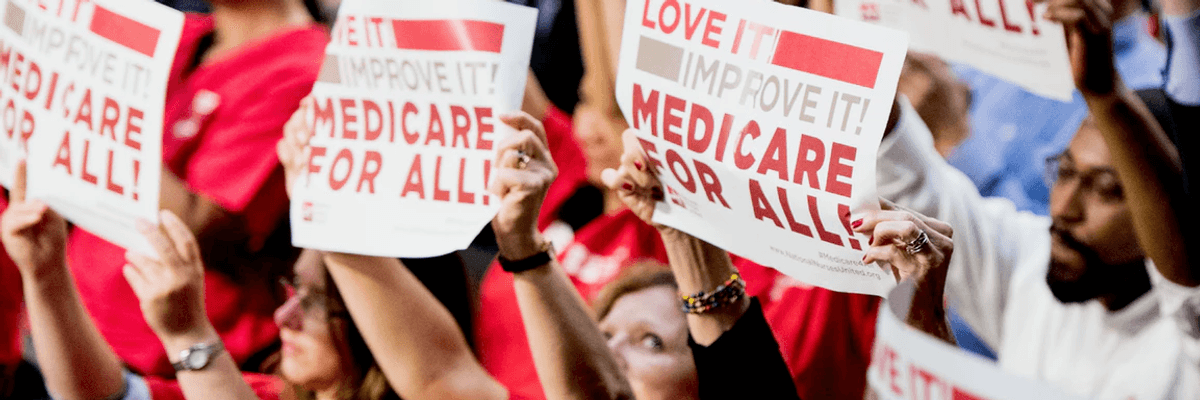
"Fixing our broken commercial health insurance system," writes Archer, "is too important to leave to the politicians or to the insurance industry." (Photo: Bill Clark/CQ Roll Call via AP)
Why Medicare for Some Is the Wrong Idea
Let's get real: Commercial insurance is the biggest threat to health care choices and our freedom to receive the health care we need.
If you're following the health care debate, you've already heard quite a bit about "Medicare for all," the proposal to improve and expand Medicare, the government health insurance program for older adults and people with disabilities, to all Americans. As proposed by Sen. Bernie Sanders (I-Vt.) and others, Medicare for all provides all Americans the right to use physicians and hospitals of their choice anywhere in the country, eliminates premiums, deductibles and co-payments, and is projected to drive down national health care spending by $2 trillion to $5 trillion over the next 10 years.
For most Americans, this sounds like a pretty good idea. And it looks even better when compared against the failures of our commercial health insurance system. Commercial insurance forces Americans to spend nearly twice as much on health care as our peers in Europe and Japan for significantly worse health care outcomes. Commercial insurance creates an estimated $500 billion a year in administrative waste, enables excessive and irrational provider rates, and forces one in four Americans under 65 to forgo necessary health care because they cannot afford their out-of-pocket costs.
"No one loves Aetna, Anthem or any other insurance company. What we love - and what we need - is the freedom to get care from the doctors we want to see at a price we can afford. Medicare for all guarantees all Americans access to health care, with freedom to see the doctors we want, throughout our lives, wherever we live, wherever we work and whenever we are out of work."
Nonetheless, a number of thoughtful commentators and well-intentioned politicians are telling us that Medicare for All is not a practical approach to health care reform - that it's just not doable given the political context and the country's long history with employer-based health insurance. These self-described "pragmatists" would offer Medicare as an additional option alongside commercial insurance, proposing a Medicare buy-in or Medicare for some.
By any measure, Medicare for some would deliver very little for the American people. At best, it would capture a fraction of the health care savings created under Medicare for all. It would not address the unaffordable premiums, deductibles and coinsurance that keep millions of Americans from getting needed health care. And it would leave tens of millions of Americans uninsured or underinsured.
So, too, Medicare for some does not address the most basic questions about our health care system: Why do we trust health insurers to determine the doctors and hospitals we can see? Why should a knee replacement cost anywhere between $16,000 and $61,000? Why should Americans pay twice as much for prescription drugs as our peers in Europe and Japan? And, why should our health coverage depend on where we work?
The "pragmatists" argue that we have to live with this crazy system because Americans want "choices" in health care, and most are not willing to give up their current insurance. As a result, they say, the best we can do today is to support Medicare for some and hope for real reform in the future. However sincere or politically fashionable, this view makes no sense.
Let's get real: Commercial insurance is the biggest threat to health care choices and our freedom to receive the health care we need. Employers choose our insurers, and the insurers restrict the providers we can use, the treatments we can receive, and the prescription drugs we can take. Every year, we can be forced to change provider networks, benefits, out-of-pocket costs and, often, insurers. If we change jobs, every aspect of our health insurance changes. And, we are left to fend for ourselves if we leave the job market.
No one loves Aetna, Anthem or any other insurance company. What we love - and what we need - is the freedom to get care from the doctors we want to see at a price we can afford. Medicare for all guarantees all Americans access to health care, with freedom to see the doctors we want, throughout our lives, wherever we live, wherever we work and whenever we are out of work. That's about as pragmatic as it gets.
Maybe the "pragmatists" are concerned that we lack the votes in Congress to pass Medicare for all or that the commercial interests with a stake in maintaining the status quo are too powerful to overcome. That might be right. The health care industry is flush with cash, and insurers use campaign contributions to wield substantial influence in Congress. As we learned in 2009 and 2010, the health insurance industry will fight hard to retain its place in the health care system.
But fixing our broken commercial health insurance system is too important to leave to the politicians or to the insurance industry. The American people deserve a frank conversation about how we can guarantee access to health care as a right in this country. That conversation does not begin with Medicare for some. It begins - and ends - with Medicare for all.
An Urgent Message From Our Co-Founder
Dear Common Dreams reader, It’s been nearly 30 years since I co-founded Common Dreams with my late wife, Lina Newhouser. We had the radical notion that journalism should serve the public good, not corporate profits. It was clear to us from the outset what it would take to build such a project. No paid advertisements. No corporate sponsors. No millionaire publisher telling us what to think or do. Many people said we wouldn't last a year, but we proved those doubters wrong. Together with a tremendous team of journalists and dedicated staff, we built an independent media outlet free from the constraints of profits and corporate control. Our mission has always been simple: To inform. To inspire. To ignite change for the common good. Building Common Dreams was not easy. Our survival was never guaranteed. When you take on the most powerful forces—Wall Street greed, fossil fuel industry destruction, Big Tech lobbyists, and uber-rich oligarchs who have spent billions upon billions rigging the economy and democracy in their favor—the only bulwark you have is supporters who believe in your work. But here’s the urgent message from me today. It's never been this bad out there. And it's never been this hard to keep us going. At the very moment Common Dreams is most needed, the threats we face are intensifying. We need your support now more than ever. We don't accept corporate advertising and never will. We don't have a paywall because we don't think people should be blocked from critical news based on their ability to pay. Everything we do is funded by the donations of readers like you. When everyone does the little they can afford, we are strong. But if that support retreats or dries up, so do we. Will you donate now to make sure Common Dreams not only survives but thrives? —Craig Brown, Co-founder |
If you're following the health care debate, you've already heard quite a bit about "Medicare for all," the proposal to improve and expand Medicare, the government health insurance program for older adults and people with disabilities, to all Americans. As proposed by Sen. Bernie Sanders (I-Vt.) and others, Medicare for all provides all Americans the right to use physicians and hospitals of their choice anywhere in the country, eliminates premiums, deductibles and co-payments, and is projected to drive down national health care spending by $2 trillion to $5 trillion over the next 10 years.
For most Americans, this sounds like a pretty good idea. And it looks even better when compared against the failures of our commercial health insurance system. Commercial insurance forces Americans to spend nearly twice as much on health care as our peers in Europe and Japan for significantly worse health care outcomes. Commercial insurance creates an estimated $500 billion a year in administrative waste, enables excessive and irrational provider rates, and forces one in four Americans under 65 to forgo necessary health care because they cannot afford their out-of-pocket costs.
"No one loves Aetna, Anthem or any other insurance company. What we love - and what we need - is the freedom to get care from the doctors we want to see at a price we can afford. Medicare for all guarantees all Americans access to health care, with freedom to see the doctors we want, throughout our lives, wherever we live, wherever we work and whenever we are out of work."
Nonetheless, a number of thoughtful commentators and well-intentioned politicians are telling us that Medicare for All is not a practical approach to health care reform - that it's just not doable given the political context and the country's long history with employer-based health insurance. These self-described "pragmatists" would offer Medicare as an additional option alongside commercial insurance, proposing a Medicare buy-in or Medicare for some.
By any measure, Medicare for some would deliver very little for the American people. At best, it would capture a fraction of the health care savings created under Medicare for all. It would not address the unaffordable premiums, deductibles and coinsurance that keep millions of Americans from getting needed health care. And it would leave tens of millions of Americans uninsured or underinsured.
So, too, Medicare for some does not address the most basic questions about our health care system: Why do we trust health insurers to determine the doctors and hospitals we can see? Why should a knee replacement cost anywhere between $16,000 and $61,000? Why should Americans pay twice as much for prescription drugs as our peers in Europe and Japan? And, why should our health coverage depend on where we work?
The "pragmatists" argue that we have to live with this crazy system because Americans want "choices" in health care, and most are not willing to give up their current insurance. As a result, they say, the best we can do today is to support Medicare for some and hope for real reform in the future. However sincere or politically fashionable, this view makes no sense.
Let's get real: Commercial insurance is the biggest threat to health care choices and our freedom to receive the health care we need. Employers choose our insurers, and the insurers restrict the providers we can use, the treatments we can receive, and the prescription drugs we can take. Every year, we can be forced to change provider networks, benefits, out-of-pocket costs and, often, insurers. If we change jobs, every aspect of our health insurance changes. And, we are left to fend for ourselves if we leave the job market.
No one loves Aetna, Anthem or any other insurance company. What we love - and what we need - is the freedom to get care from the doctors we want to see at a price we can afford. Medicare for all guarantees all Americans access to health care, with freedom to see the doctors we want, throughout our lives, wherever we live, wherever we work and whenever we are out of work. That's about as pragmatic as it gets.
Maybe the "pragmatists" are concerned that we lack the votes in Congress to pass Medicare for all or that the commercial interests with a stake in maintaining the status quo are too powerful to overcome. That might be right. The health care industry is flush with cash, and insurers use campaign contributions to wield substantial influence in Congress. As we learned in 2009 and 2010, the health insurance industry will fight hard to retain its place in the health care system.
But fixing our broken commercial health insurance system is too important to leave to the politicians or to the insurance industry. The American people deserve a frank conversation about how we can guarantee access to health care as a right in this country. That conversation does not begin with Medicare for some. It begins - and ends - with Medicare for all.
If you're following the health care debate, you've already heard quite a bit about "Medicare for all," the proposal to improve and expand Medicare, the government health insurance program for older adults and people with disabilities, to all Americans. As proposed by Sen. Bernie Sanders (I-Vt.) and others, Medicare for all provides all Americans the right to use physicians and hospitals of their choice anywhere in the country, eliminates premiums, deductibles and co-payments, and is projected to drive down national health care spending by $2 trillion to $5 trillion over the next 10 years.
For most Americans, this sounds like a pretty good idea. And it looks even better when compared against the failures of our commercial health insurance system. Commercial insurance forces Americans to spend nearly twice as much on health care as our peers in Europe and Japan for significantly worse health care outcomes. Commercial insurance creates an estimated $500 billion a year in administrative waste, enables excessive and irrational provider rates, and forces one in four Americans under 65 to forgo necessary health care because they cannot afford their out-of-pocket costs.
"No one loves Aetna, Anthem or any other insurance company. What we love - and what we need - is the freedom to get care from the doctors we want to see at a price we can afford. Medicare for all guarantees all Americans access to health care, with freedom to see the doctors we want, throughout our lives, wherever we live, wherever we work and whenever we are out of work."
Nonetheless, a number of thoughtful commentators and well-intentioned politicians are telling us that Medicare for All is not a practical approach to health care reform - that it's just not doable given the political context and the country's long history with employer-based health insurance. These self-described "pragmatists" would offer Medicare as an additional option alongside commercial insurance, proposing a Medicare buy-in or Medicare for some.
By any measure, Medicare for some would deliver very little for the American people. At best, it would capture a fraction of the health care savings created under Medicare for all. It would not address the unaffordable premiums, deductibles and coinsurance that keep millions of Americans from getting needed health care. And it would leave tens of millions of Americans uninsured or underinsured.
So, too, Medicare for some does not address the most basic questions about our health care system: Why do we trust health insurers to determine the doctors and hospitals we can see? Why should a knee replacement cost anywhere between $16,000 and $61,000? Why should Americans pay twice as much for prescription drugs as our peers in Europe and Japan? And, why should our health coverage depend on where we work?
The "pragmatists" argue that we have to live with this crazy system because Americans want "choices" in health care, and most are not willing to give up their current insurance. As a result, they say, the best we can do today is to support Medicare for some and hope for real reform in the future. However sincere or politically fashionable, this view makes no sense.
Let's get real: Commercial insurance is the biggest threat to health care choices and our freedom to receive the health care we need. Employers choose our insurers, and the insurers restrict the providers we can use, the treatments we can receive, and the prescription drugs we can take. Every year, we can be forced to change provider networks, benefits, out-of-pocket costs and, often, insurers. If we change jobs, every aspect of our health insurance changes. And, we are left to fend for ourselves if we leave the job market.
No one loves Aetna, Anthem or any other insurance company. What we love - and what we need - is the freedom to get care from the doctors we want to see at a price we can afford. Medicare for all guarantees all Americans access to health care, with freedom to see the doctors we want, throughout our lives, wherever we live, wherever we work and whenever we are out of work. That's about as pragmatic as it gets.
Maybe the "pragmatists" are concerned that we lack the votes in Congress to pass Medicare for all or that the commercial interests with a stake in maintaining the status quo are too powerful to overcome. That might be right. The health care industry is flush with cash, and insurers use campaign contributions to wield substantial influence in Congress. As we learned in 2009 and 2010, the health insurance industry will fight hard to retain its place in the health care system.
But fixing our broken commercial health insurance system is too important to leave to the politicians or to the insurance industry. The American people deserve a frank conversation about how we can guarantee access to health care as a right in this country. That conversation does not begin with Medicare for some. It begins - and ends - with Medicare for all.