SUBSCRIBE TO OUR FREE NEWSLETTER
Daily news & progressive opinion—funded by the people, not the corporations—delivered straight to your inbox.
5
#000000
#FFFFFF
To donate by check, phone, or other method, see our More Ways to Give page.
Daily news & progressive opinion—funded by the people, not the corporations—delivered straight to your inbox.
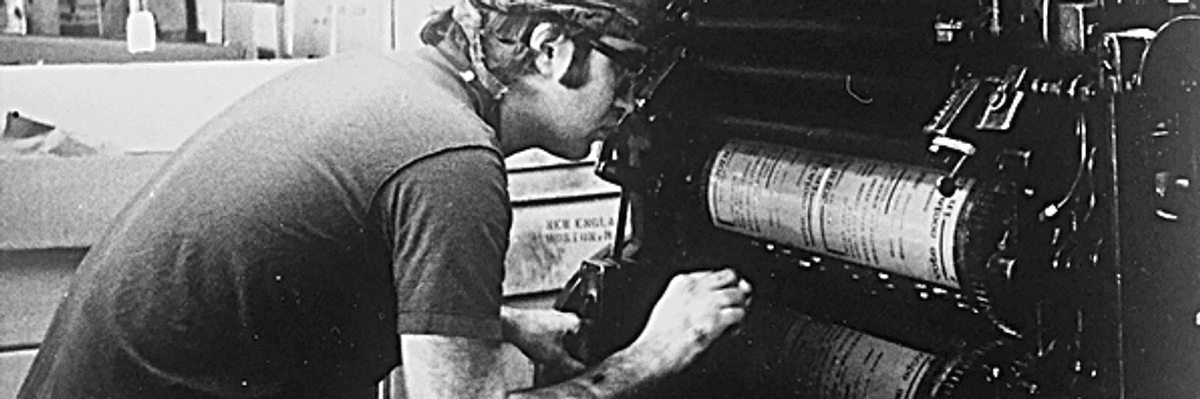
Author and editor Tom Engelhardt operating the Chief 22 printing press at the New England Free Press circa 1970. (Photo: Courtesy of the NEFP)
Sometimes your past returns in the strangest of ways, as happened to me when today's article from TomDispatch regular Rebecca Gordon first crossed my doorstep. As you'll see, its subject would not be one on which this almost 75-year-old guy would consider himself to have the slightest expertise: women discovering their bodies in complex ways in the 1970s--and mutilating them now.
I almost always write little intros for TomDispatch pieces, but this time, fascinated as I was by Gordon's account, my heart sank... until, that is, I made my way ever deeper into the piece and discovered something odd and wondrous. I had, however indirectly, been associated with each of the key documents from the late 1960s and early 1970s that she cites as crucial to her growing understanding of herself in those years.
In 1969, in the midst of the turbulent anti-Vietnam War movement, I was swept out of graduate school and found myself -- I don't quite remember how -- working as a printer at what we then, romantically enough, called an "underground print shop" (though it wasn't in any way "underground"). It went by the name of the New England Free Press (NEFP) and we spent our time printing up anti-Vietnam War leaflets, strike posters, and all sorts of other subversive creations of that moment.
Just in case you doubt my memory, above is a photo of me (yes, I swear it's me!), circa 1969, working at that very print shop on an old Chief 22 press. The NEFP became known for its pathbreaking literature program, a remarkable and still-fascinating set of movement writings that we often (but not always) printed up ourselves and sent around widely. Fortunately, some old NEFP staff members have recently begun creating an NEFP website in memory of that long-gone moment and of some of those pamphlets, especially a remarkable catalogue of the women's liberation materials we then distributed. As it happens, they included the three pieces mentioned by Gordon today as crucial to her own development: the famed Our Bodies, Ourselves (when it was still a pamphlet, not a book), Barbara Ehrenreich and Deirdre English's Witches, Midwives, and Nurses, and Anne Koedt's The Myth of the Vaginal Orgasm.
I certainly can take no credit for the fact that we were distributing such now-classic materials (though I do recognize one article that I did bring to that long list), but I can still take pride in the fact that I was there when it all happened. (The NEFP even distributed the first piece I ever wrote for publication, "Ambush at Kamikaze Pass," which would, a quarter of a century later, become the basis for my book The End of Victory Culture.) Anyway, enough about me, as they say. Now, consider the remarkable memories of Rebecca Gordon
Dear Common Dreams reader, It’s been nearly 30 years since I co-founded Common Dreams with my late wife, Lina Newhouser. We had the radical notion that journalism should serve the public good, not corporate profits. It was clear to us from the outset what it would take to build such a project. No paid advertisements. No corporate sponsors. No millionaire publisher telling us what to think or do. Many people said we wouldn't last a year, but we proved those doubters wrong. Together with a tremendous team of journalists and dedicated staff, we built an independent media outlet free from the constraints of profits and corporate control. Our mission has always been simple: To inform. To inspire. To ignite change for the common good. Building Common Dreams was not easy. Our survival was never guaranteed. When you take on the most powerful forces—Wall Street greed, fossil fuel industry destruction, Big Tech lobbyists, and uber-rich oligarchs who have spent billions upon billions rigging the economy and democracy in their favor—the only bulwark you have is supporters who believe in your work. But here’s the urgent message from me today. It's never been this bad out there. And it's never been this hard to keep us going. At the very moment Common Dreams is most needed, the threats we face are intensifying. We need your support now more than ever. We don't accept corporate advertising and never will. We don't have a paywall because we don't think people should be blocked from critical news based on their ability to pay. Everything we do is funded by the donations of readers like you. When everyone does the little they can afford, we are strong. But if that support retreats or dries up, so do we. Will you donate now to make sure Common Dreams not only survives but thrives? —Craig Brown, Co-founder |
The above piece, published here with permission, first appeared at Tom Engelhardt's substack page, where you can find more of his writing.
Engelhardt, was editor-in-chief of TomDispatch.com for over 24 years, is the author of numerous books, including: "A Nation Unmade by War" (2018, Dispatch Books), "Shadow Government: Surveillance, Secret Wars, and a Global Security State in a Single-Superpower World" (2014, with an introduction by Glenn Greenwald), "Terminator Planet: The First History of Drone Warfare, 2001-2050"(co-authored with Nick Turse), "The United States of Fear" (2011), "The American Way of War: How Bush's Wars Became Obama's" (2010), and "The End of Victory Culture: a History of the Cold War and Beyond" (2007).
Sometimes your past returns in the strangest of ways, as happened to me when today's article from TomDispatch regular Rebecca Gordon first crossed my doorstep. As you'll see, its subject would not be one on which this almost 75-year-old guy would consider himself to have the slightest expertise: women discovering their bodies in complex ways in the 1970s--and mutilating them now.
I almost always write little intros for TomDispatch pieces, but this time, fascinated as I was by Gordon's account, my heart sank... until, that is, I made my way ever deeper into the piece and discovered something odd and wondrous. I had, however indirectly, been associated with each of the key documents from the late 1960s and early 1970s that she cites as crucial to her growing understanding of herself in those years.
In 1969, in the midst of the turbulent anti-Vietnam War movement, I was swept out of graduate school and found myself -- I don't quite remember how -- working as a printer at what we then, romantically enough, called an "underground print shop" (though it wasn't in any way "underground"). It went by the name of the New England Free Press (NEFP) and we spent our time printing up anti-Vietnam War leaflets, strike posters, and all sorts of other subversive creations of that moment.
Just in case you doubt my memory, above is a photo of me (yes, I swear it's me!), circa 1969, working at that very print shop on an old Chief 22 press. The NEFP became known for its pathbreaking literature program, a remarkable and still-fascinating set of movement writings that we often (but not always) printed up ourselves and sent around widely. Fortunately, some old NEFP staff members have recently begun creating an NEFP website in memory of that long-gone moment and of some of those pamphlets, especially a remarkable catalogue of the women's liberation materials we then distributed. As it happens, they included the three pieces mentioned by Gordon today as crucial to her own development: the famed Our Bodies, Ourselves (when it was still a pamphlet, not a book), Barbara Ehrenreich and Deirdre English's Witches, Midwives, and Nurses, and Anne Koedt's The Myth of the Vaginal Orgasm.
I certainly can take no credit for the fact that we were distributing such now-classic materials (though I do recognize one article that I did bring to that long list), but I can still take pride in the fact that I was there when it all happened. (The NEFP even distributed the first piece I ever wrote for publication, "Ambush at Kamikaze Pass," which would, a quarter of a century later, become the basis for my book The End of Victory Culture.) Anyway, enough about me, as they say. Now, consider the remarkable memories of Rebecca Gordon
The above piece, published here with permission, first appeared at Tom Engelhardt's substack page, where you can find more of his writing.
Engelhardt, was editor-in-chief of TomDispatch.com for over 24 years, is the author of numerous books, including: "A Nation Unmade by War" (2018, Dispatch Books), "Shadow Government: Surveillance, Secret Wars, and a Global Security State in a Single-Superpower World" (2014, with an introduction by Glenn Greenwald), "Terminator Planet: The First History of Drone Warfare, 2001-2050"(co-authored with Nick Turse), "The United States of Fear" (2011), "The American Way of War: How Bush's Wars Became Obama's" (2010), and "The End of Victory Culture: a History of the Cold War and Beyond" (2007).
Sometimes your past returns in the strangest of ways, as happened to me when today's article from TomDispatch regular Rebecca Gordon first crossed my doorstep. As you'll see, its subject would not be one on which this almost 75-year-old guy would consider himself to have the slightest expertise: women discovering their bodies in complex ways in the 1970s--and mutilating them now.
I almost always write little intros for TomDispatch pieces, but this time, fascinated as I was by Gordon's account, my heart sank... until, that is, I made my way ever deeper into the piece and discovered something odd and wondrous. I had, however indirectly, been associated with each of the key documents from the late 1960s and early 1970s that she cites as crucial to her growing understanding of herself in those years.
In 1969, in the midst of the turbulent anti-Vietnam War movement, I was swept out of graduate school and found myself -- I don't quite remember how -- working as a printer at what we then, romantically enough, called an "underground print shop" (though it wasn't in any way "underground"). It went by the name of the New England Free Press (NEFP) and we spent our time printing up anti-Vietnam War leaflets, strike posters, and all sorts of other subversive creations of that moment.
Just in case you doubt my memory, above is a photo of me (yes, I swear it's me!), circa 1969, working at that very print shop on an old Chief 22 press. The NEFP became known for its pathbreaking literature program, a remarkable and still-fascinating set of movement writings that we often (but not always) printed up ourselves and sent around widely. Fortunately, some old NEFP staff members have recently begun creating an NEFP website in memory of that long-gone moment and of some of those pamphlets, especially a remarkable catalogue of the women's liberation materials we then distributed. As it happens, they included the three pieces mentioned by Gordon today as crucial to her own development: the famed Our Bodies, Ourselves (when it was still a pamphlet, not a book), Barbara Ehrenreich and Deirdre English's Witches, Midwives, and Nurses, and Anne Koedt's The Myth of the Vaginal Orgasm.
I certainly can take no credit for the fact that we were distributing such now-classic materials (though I do recognize one article that I did bring to that long list), but I can still take pride in the fact that I was there when it all happened. (The NEFP even distributed the first piece I ever wrote for publication, "Ambush at Kamikaze Pass," which would, a quarter of a century later, become the basis for my book The End of Victory Culture.) Anyway, enough about me, as they say. Now, consider the remarkable memories of Rebecca Gordon