SUBSCRIBE TO OUR FREE NEWSLETTER
Daily news & progressive opinion—funded by the people, not the corporations—delivered straight to your inbox.
5
#000000
#FFFFFF
To donate by check, phone, or other method, see our More Ways to Give page.
Daily news & progressive opinion—funded by the people, not the corporations—delivered straight to your inbox.
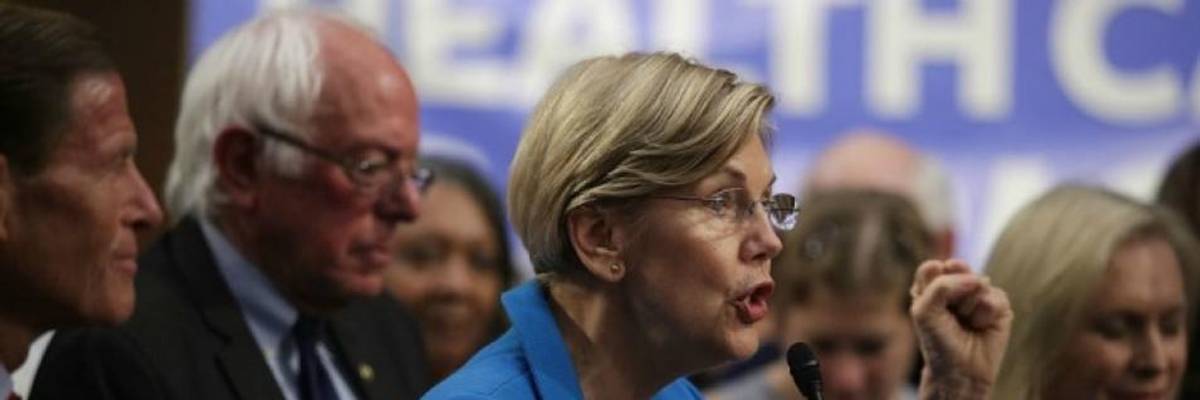
Sen. Elizabeth Warren (D-Mass.) speaks on healthcare as Sen. Bernie Sanders (I-Vt.) listens during an event September 13, 2017. (Photo: Alex Wong/Getty Images)
US Senator Bernie Sanders (I-VT) has said, "If the pharmaceutical industry will not end its greed, which is literally killing Americans, then we will end it for them."
US Senator Elizabeth Warren (D-MA) has said we need to fix markets because giant drug companies are lining "their pockets at the expense of American families."
Sanders introduced three bills in January 2019 to lower prescription drug prices. The bills are for importation price limits in the U.S. based on what companies charge in other countries, and Medicare negotiation. Warren co-sponsored each of these bills.
In December 2018, Warren introduced a bill for the federal government to manufacture prescription drugs. Her bill didn't get any co-sponsors, probably because of the timing. The Congressional term was almost over, and it's impossible to co-sponsor a bill from a previous term. But Sanders supports Warren's pharmaceutical manufacturing bill and he will co-sponsor her bill when she re-introduces it, says Warren Gunnels, his policy director.
Sanders' importation bill is S.97 The Affordable and Safe Prescription Drug Importation Act, which would "allow patients, pharmacists and wholesalers to import...from Canada and other major countries." In 2007, similar legislation passed the Senate 63 to 28. Sanders noted at the time that millions of "Americans were going across the Canadian border to purchase safe and affordable medicine. The American people want action."
Sanders' international price-indexing bill is S.102 The Prescription Drug Price Relief Act, which would require that drug companies charge similar prices in America as in other developed countries. Otherwise, "the drugmaker's monopoly would be ended" and other companies could sell generic versions. According to Dean Baker, senior economist at the Center for Economic and Policy Research, this would lower drug prices in the U.S. by 50%.
Sanders' Medicare negotiation bill is S.99 The Medicare Drug Price Negotiation Act. Under current law, Medicaid and the Veterans Administration are allowed to negotiate. Medicare Part D isn't. The result is that "Medicare Part D pays on average 73% more than Medicaid and 80% more than VA for brand name drugs." The bill would fix that disparity.
Warren's bill for the federal government to manufacture prescription drugs is S.3775 Affordable Drug Manufacturing Act of 2018. It would establish a federal "Office of Drug Manufacturing." The office could manufacture pharmaceuticals when no company is making a needed pharmaceutical, and when only one or two companies are making a needed pharmaceutical and "the price is a barrier to patient access."
There is a crisis in recent price increases for insulin and, as Reuters reports, "costs per patient nearly doubled from 2012 to 2016." Warren's Affordable Drug Manufacturing Act specifically addresses insulin, saying: "Not later than 1 year after the date of enactment of this section, the Secretary (of Health and Human Services) shall begin the public manufacturing of insulin."
Sanders and Warren both support the bills described above to address drug prices. Are there any differences between these Senators on drug pricing? Yes. Sanders is the only U.S. Senator who supports replacing drug patents with prizes for innovation. A company would be paid by the federal government for coming up with a new prescription drug. The amount of money would be based on how much the drug improves treatment and how many people would benefit. Then any company would be allowed to manufacture the drug.
Another difference between Sanders and Warren involves Medicare-for-All, which would have a tremendous effect on lowering drug prices by giving the government leverage to negotiate lower prices for everyone in the country. They both support Medicare-for-All Single-Payer healthcare. But Sanders talked about it in his stump speech for the 2016 presidential primary. Warren has yet to talk about it in her stump speech for the 2020 presidential primary, suggesting that Medicare-for-All, overall, is a bigger priority for Sanders than for Warren.
Dear Common Dreams reader, It’s been nearly 30 years since I co-founded Common Dreams with my late wife, Lina Newhouser. We had the radical notion that journalism should serve the public good, not corporate profits. It was clear to us from the outset what it would take to build such a project. No paid advertisements. No corporate sponsors. No millionaire publisher telling us what to think or do. Many people said we wouldn't last a year, but we proved those doubters wrong. Together with a tremendous team of journalists and dedicated staff, we built an independent media outlet free from the constraints of profits and corporate control. Our mission has always been simple: To inform. To inspire. To ignite change for the common good. Building Common Dreams was not easy. Our survival was never guaranteed. When you take on the most powerful forces—Wall Street greed, fossil fuel industry destruction, Big Tech lobbyists, and uber-rich oligarchs who have spent billions upon billions rigging the economy and democracy in their favor—the only bulwark you have is supporters who believe in your work. But here’s the urgent message from me today. It's never been this bad out there. And it's never been this hard to keep us going. At the very moment Common Dreams is most needed, the threats we face are intensifying. We need your support now more than ever. We don't accept corporate advertising and never will. We don't have a paywall because we don't think people should be blocked from critical news based on their ability to pay. Everything we do is funded by the donations of readers like you. When everyone does the little they can afford, we are strong. But if that support retreats or dries up, so do we. Will you donate now to make sure Common Dreams not only survives but thrives? —Craig Brown, Co-founder |
US Senator Bernie Sanders (I-VT) has said, "If the pharmaceutical industry will not end its greed, which is literally killing Americans, then we will end it for them."
US Senator Elizabeth Warren (D-MA) has said we need to fix markets because giant drug companies are lining "their pockets at the expense of American families."
Sanders introduced three bills in January 2019 to lower prescription drug prices. The bills are for importation price limits in the U.S. based on what companies charge in other countries, and Medicare negotiation. Warren co-sponsored each of these bills.
In December 2018, Warren introduced a bill for the federal government to manufacture prescription drugs. Her bill didn't get any co-sponsors, probably because of the timing. The Congressional term was almost over, and it's impossible to co-sponsor a bill from a previous term. But Sanders supports Warren's pharmaceutical manufacturing bill and he will co-sponsor her bill when she re-introduces it, says Warren Gunnels, his policy director.
Sanders' importation bill is S.97 The Affordable and Safe Prescription Drug Importation Act, which would "allow patients, pharmacists and wholesalers to import...from Canada and other major countries." In 2007, similar legislation passed the Senate 63 to 28. Sanders noted at the time that millions of "Americans were going across the Canadian border to purchase safe and affordable medicine. The American people want action."
Sanders' international price-indexing bill is S.102 The Prescription Drug Price Relief Act, which would require that drug companies charge similar prices in America as in other developed countries. Otherwise, "the drugmaker's monopoly would be ended" and other companies could sell generic versions. According to Dean Baker, senior economist at the Center for Economic and Policy Research, this would lower drug prices in the U.S. by 50%.
Sanders' Medicare negotiation bill is S.99 The Medicare Drug Price Negotiation Act. Under current law, Medicaid and the Veterans Administration are allowed to negotiate. Medicare Part D isn't. The result is that "Medicare Part D pays on average 73% more than Medicaid and 80% more than VA for brand name drugs." The bill would fix that disparity.
Warren's bill for the federal government to manufacture prescription drugs is S.3775 Affordable Drug Manufacturing Act of 2018. It would establish a federal "Office of Drug Manufacturing." The office could manufacture pharmaceuticals when no company is making a needed pharmaceutical, and when only one or two companies are making a needed pharmaceutical and "the price is a barrier to patient access."
There is a crisis in recent price increases for insulin and, as Reuters reports, "costs per patient nearly doubled from 2012 to 2016." Warren's Affordable Drug Manufacturing Act specifically addresses insulin, saying: "Not later than 1 year after the date of enactment of this section, the Secretary (of Health and Human Services) shall begin the public manufacturing of insulin."
Sanders and Warren both support the bills described above to address drug prices. Are there any differences between these Senators on drug pricing? Yes. Sanders is the only U.S. Senator who supports replacing drug patents with prizes for innovation. A company would be paid by the federal government for coming up with a new prescription drug. The amount of money would be based on how much the drug improves treatment and how many people would benefit. Then any company would be allowed to manufacture the drug.
Another difference between Sanders and Warren involves Medicare-for-All, which would have a tremendous effect on lowering drug prices by giving the government leverage to negotiate lower prices for everyone in the country. They both support Medicare-for-All Single-Payer healthcare. But Sanders talked about it in his stump speech for the 2016 presidential primary. Warren has yet to talk about it in her stump speech for the 2020 presidential primary, suggesting that Medicare-for-All, overall, is a bigger priority for Sanders than for Warren.
US Senator Bernie Sanders (I-VT) has said, "If the pharmaceutical industry will not end its greed, which is literally killing Americans, then we will end it for them."
US Senator Elizabeth Warren (D-MA) has said we need to fix markets because giant drug companies are lining "their pockets at the expense of American families."
Sanders introduced three bills in January 2019 to lower prescription drug prices. The bills are for importation price limits in the U.S. based on what companies charge in other countries, and Medicare negotiation. Warren co-sponsored each of these bills.
In December 2018, Warren introduced a bill for the federal government to manufacture prescription drugs. Her bill didn't get any co-sponsors, probably because of the timing. The Congressional term was almost over, and it's impossible to co-sponsor a bill from a previous term. But Sanders supports Warren's pharmaceutical manufacturing bill and he will co-sponsor her bill when she re-introduces it, says Warren Gunnels, his policy director.
Sanders' importation bill is S.97 The Affordable and Safe Prescription Drug Importation Act, which would "allow patients, pharmacists and wholesalers to import...from Canada and other major countries." In 2007, similar legislation passed the Senate 63 to 28. Sanders noted at the time that millions of "Americans were going across the Canadian border to purchase safe and affordable medicine. The American people want action."
Sanders' international price-indexing bill is S.102 The Prescription Drug Price Relief Act, which would require that drug companies charge similar prices in America as in other developed countries. Otherwise, "the drugmaker's monopoly would be ended" and other companies could sell generic versions. According to Dean Baker, senior economist at the Center for Economic and Policy Research, this would lower drug prices in the U.S. by 50%.
Sanders' Medicare negotiation bill is S.99 The Medicare Drug Price Negotiation Act. Under current law, Medicaid and the Veterans Administration are allowed to negotiate. Medicare Part D isn't. The result is that "Medicare Part D pays on average 73% more than Medicaid and 80% more than VA for brand name drugs." The bill would fix that disparity.
Warren's bill for the federal government to manufacture prescription drugs is S.3775 Affordable Drug Manufacturing Act of 2018. It would establish a federal "Office of Drug Manufacturing." The office could manufacture pharmaceuticals when no company is making a needed pharmaceutical, and when only one or two companies are making a needed pharmaceutical and "the price is a barrier to patient access."
There is a crisis in recent price increases for insulin and, as Reuters reports, "costs per patient nearly doubled from 2012 to 2016." Warren's Affordable Drug Manufacturing Act specifically addresses insulin, saying: "Not later than 1 year after the date of enactment of this section, the Secretary (of Health and Human Services) shall begin the public manufacturing of insulin."
Sanders and Warren both support the bills described above to address drug prices. Are there any differences between these Senators on drug pricing? Yes. Sanders is the only U.S. Senator who supports replacing drug patents with prizes for innovation. A company would be paid by the federal government for coming up with a new prescription drug. The amount of money would be based on how much the drug improves treatment and how many people would benefit. Then any company would be allowed to manufacture the drug.
Another difference between Sanders and Warren involves Medicare-for-All, which would have a tremendous effect on lowering drug prices by giving the government leverage to negotiate lower prices for everyone in the country. They both support Medicare-for-All Single-Payer healthcare. But Sanders talked about it in his stump speech for the 2016 presidential primary. Warren has yet to talk about it in her stump speech for the 2020 presidential primary, suggesting that Medicare-for-All, overall, is a bigger priority for Sanders than for Warren.