SUBSCRIBE TO OUR FREE NEWSLETTER
Daily news & progressive opinion—funded by the people, not the corporations—delivered straight to your inbox.
5
#000000
#FFFFFF
To donate by check, phone, or other method, see our More Ways to Give page.
Daily news & progressive opinion—funded by the people, not the corporations—delivered straight to your inbox.
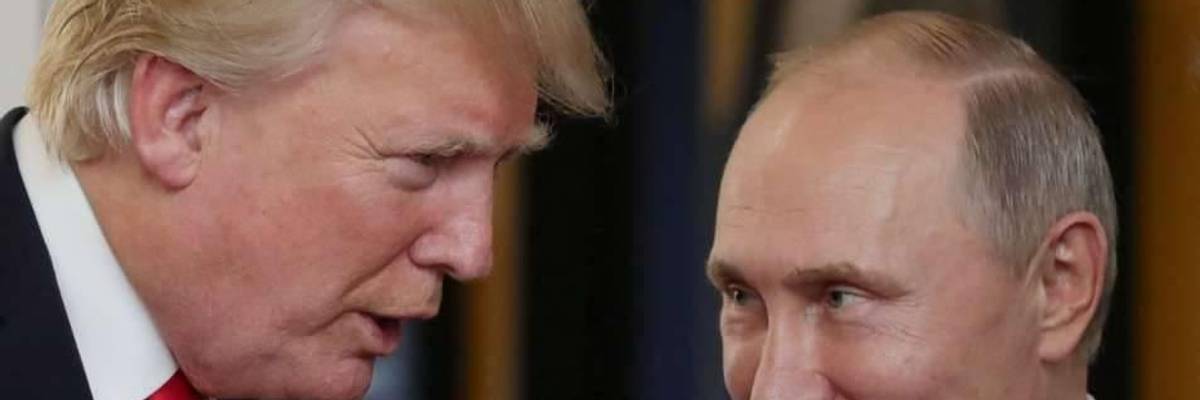
President Donald Trump chats with Russia's President Vladimir Putin as they attend the APEC Economic Leaders' Meeting, part of the Asia-Pacific Economic Cooperation (APEC) leaders' summit in the central Vietnamese city of Danang on Nov. 11, 2017. (Photo: Mikhail Klimentyev/Getty Images)
Watching the way that Vladimir Putin has bent the American government through his agents in the White House and the conservative movement, it is unsurprising that many leading thinkers recoil at the vision of the United States becoming in many ways a client state of Russia. Any patriotic American or (more importantly) anyone concerned with global justice and human rights should be equally revolted.
But it's also important to understand how and why this happened so that we can fix what went wrong and avoid similar missteps in the future. Dana Milbank's latest piece titled "It's official. We lost the Cold War" does the discourse no favors in this regard. Milbank cites all the ways in which U.S. policy has bent in a manner convenient to Russian interests to suggest that the U.S. lost the nearly century-old struggle with its adversary. A typical passage reads below:
The TV series "The Man in the High Castle" imagines a world in which Nazis won World War II. But we don't need an alternative-history show to imagine a Soviet victory in the Cold War. We have Trump.
This is extremely misguided, and ironically plays right into Trump's Westphalian nationalist worldview. It ignores historical and ideological context. And it conveniently forgets how Putin rose to power, what his interests are, why they align perfectly with Trump's, and how bipartisan American policy toward Russia led us to this pass.
First, the obvious: the Soviets did not win the Cold War. Stalinism collapsed mostly of its own weight, unable to sustain a battle for global dominance against a more economically dynamic and structurally open foe. Capitalism won the day on the world stage.
But American capitalists were not gracious winners. As the Soviets struggled to transition from total state control of the economy, American interests insisted (as they often have) on rapid and near-total privatization of government resources. As Naomi Klein explains at length in her excellent book The Shock Doctrine, many in Europe and in Russia were working toward a gradual offramp into a gentler democratic socialism in Russia, maintaining a protective welfare state while opening the government to democratic reforms and privatizing only the non-essential goods and services to which the free market is better adapted, rather than the core utilities to which it is not. But the U.S. was insistent on radical privatization, which-as it has done in so many other countries-caused massive social and political unrest in Russia.
The eventual winner of the coups and calamities in Russia was Vladimir Putin, an ex-KGB agent who proceeded to do the worst of all worlds: privatize the core functions of the Russian economy, but deliver them entirely into the hands of his immediate friends and mob connections. Russia is now run as a right-wing kleptocratic dictatorship in which all gains are privatized and all losses are socialized, where the people suffer increasingly while all profits accrue to the very rich.
In order to pacify the populace during this process, Putin and allies used the standard timeless conservative tactics: they allied themselves with rural and socially conservative religious elements, ramped up hostile rhetoric toward supposedly corrupt outsiders, leveraged racist and sexist sentiments against domestic minorities and women's rights groups, and portrayed themselves as the only ones who could make Russia great again.
It was unsurprising, then, that a Russian government aligned with racist, sexist and plutocratic principles would find an easy friend in Donald Trump and the American Republican Party. They are natural allies. It is less that America became Russia's client state, than that the conservative movements in both America and Russia made a semi-secret criminal global compact that neither could acknowledge publicly. Since Trump's election, their wealthy patriarchal white supremacist movement has sought and encouraged allies in Britain, Europe, Brazil and elsewhere, seeking to align the world against socially inclusive economic progressivism in favor of plutocratic ethnonationalism.
Eventually Trump will be gone from the American stage via resignation, removal or electoral accountability. When decent Americans try to set things right, it will be essential to acknowledge how all of this happened.
It didn't happen because a nation-state called America allowed itself to be controlled by a nation-state called Russia. It happened because American insistence on corrupted privatization policy destabilized an entire country and threw it into the arms of an ethnonationlist right-wing dictator. Then that dictator used his influence to put a would-be right-wing ethnonationlist dictator in charge of America itself-an eventuality that the Republican Party of right-wing ethnonationalism accepted with scarcely a whimper, and now seeks aggressively to defend.
America does not need a renewal of jingoistic Cold War sentiment against Russia. It needs to reject both the economic and social agenda that brought both countries to their knees in an unholy alliance.
Dear Common Dreams reader, It’s been nearly 30 years since I co-founded Common Dreams with my late wife, Lina Newhouser. We had the radical notion that journalism should serve the public good, not corporate profits. It was clear to us from the outset what it would take to build such a project. No paid advertisements. No corporate sponsors. No millionaire publisher telling us what to think or do. Many people said we wouldn't last a year, but we proved those doubters wrong. Together with a tremendous team of journalists and dedicated staff, we built an independent media outlet free from the constraints of profits and corporate control. Our mission has always been simple: To inform. To inspire. To ignite change for the common good. Building Common Dreams was not easy. Our survival was never guaranteed. When you take on the most powerful forces—Wall Street greed, fossil fuel industry destruction, Big Tech lobbyists, and uber-rich oligarchs who have spent billions upon billions rigging the economy and democracy in their favor—the only bulwark you have is supporters who believe in your work. But here’s the urgent message from me today. It's never been this bad out there. And it's never been this hard to keep us going. At the very moment Common Dreams is most needed, the threats we face are intensifying. We need your support now more than ever. We don't accept corporate advertising and never will. We don't have a paywall because we don't think people should be blocked from critical news based on their ability to pay. Everything we do is funded by the donations of readers like you. When everyone does the little they can afford, we are strong. But if that support retreats or dries up, so do we. Will you donate now to make sure Common Dreams not only survives but thrives? —Craig Brown, Co-founder |
Watching the way that Vladimir Putin has bent the American government through his agents in the White House and the conservative movement, it is unsurprising that many leading thinkers recoil at the vision of the United States becoming in many ways a client state of Russia. Any patriotic American or (more importantly) anyone concerned with global justice and human rights should be equally revolted.
But it's also important to understand how and why this happened so that we can fix what went wrong and avoid similar missteps in the future. Dana Milbank's latest piece titled "It's official. We lost the Cold War" does the discourse no favors in this regard. Milbank cites all the ways in which U.S. policy has bent in a manner convenient to Russian interests to suggest that the U.S. lost the nearly century-old struggle with its adversary. A typical passage reads below:
The TV series "The Man in the High Castle" imagines a world in which Nazis won World War II. But we don't need an alternative-history show to imagine a Soviet victory in the Cold War. We have Trump.
This is extremely misguided, and ironically plays right into Trump's Westphalian nationalist worldview. It ignores historical and ideological context. And it conveniently forgets how Putin rose to power, what his interests are, why they align perfectly with Trump's, and how bipartisan American policy toward Russia led us to this pass.
First, the obvious: the Soviets did not win the Cold War. Stalinism collapsed mostly of its own weight, unable to sustain a battle for global dominance against a more economically dynamic and structurally open foe. Capitalism won the day on the world stage.
But American capitalists were not gracious winners. As the Soviets struggled to transition from total state control of the economy, American interests insisted (as they often have) on rapid and near-total privatization of government resources. As Naomi Klein explains at length in her excellent book The Shock Doctrine, many in Europe and in Russia were working toward a gradual offramp into a gentler democratic socialism in Russia, maintaining a protective welfare state while opening the government to democratic reforms and privatizing only the non-essential goods and services to which the free market is better adapted, rather than the core utilities to which it is not. But the U.S. was insistent on radical privatization, which-as it has done in so many other countries-caused massive social and political unrest in Russia.
The eventual winner of the coups and calamities in Russia was Vladimir Putin, an ex-KGB agent who proceeded to do the worst of all worlds: privatize the core functions of the Russian economy, but deliver them entirely into the hands of his immediate friends and mob connections. Russia is now run as a right-wing kleptocratic dictatorship in which all gains are privatized and all losses are socialized, where the people suffer increasingly while all profits accrue to the very rich.
In order to pacify the populace during this process, Putin and allies used the standard timeless conservative tactics: they allied themselves with rural and socially conservative religious elements, ramped up hostile rhetoric toward supposedly corrupt outsiders, leveraged racist and sexist sentiments against domestic minorities and women's rights groups, and portrayed themselves as the only ones who could make Russia great again.
It was unsurprising, then, that a Russian government aligned with racist, sexist and plutocratic principles would find an easy friend in Donald Trump and the American Republican Party. They are natural allies. It is less that America became Russia's client state, than that the conservative movements in both America and Russia made a semi-secret criminal global compact that neither could acknowledge publicly. Since Trump's election, their wealthy patriarchal white supremacist movement has sought and encouraged allies in Britain, Europe, Brazil and elsewhere, seeking to align the world against socially inclusive economic progressivism in favor of plutocratic ethnonationalism.
Eventually Trump will be gone from the American stage via resignation, removal or electoral accountability. When decent Americans try to set things right, it will be essential to acknowledge how all of this happened.
It didn't happen because a nation-state called America allowed itself to be controlled by a nation-state called Russia. It happened because American insistence on corrupted privatization policy destabilized an entire country and threw it into the arms of an ethnonationlist right-wing dictator. Then that dictator used his influence to put a would-be right-wing ethnonationlist dictator in charge of America itself-an eventuality that the Republican Party of right-wing ethnonationalism accepted with scarcely a whimper, and now seeks aggressively to defend.
America does not need a renewal of jingoistic Cold War sentiment against Russia. It needs to reject both the economic and social agenda that brought both countries to their knees in an unholy alliance.
Watching the way that Vladimir Putin has bent the American government through his agents in the White House and the conservative movement, it is unsurprising that many leading thinkers recoil at the vision of the United States becoming in many ways a client state of Russia. Any patriotic American or (more importantly) anyone concerned with global justice and human rights should be equally revolted.
But it's also important to understand how and why this happened so that we can fix what went wrong and avoid similar missteps in the future. Dana Milbank's latest piece titled "It's official. We lost the Cold War" does the discourse no favors in this regard. Milbank cites all the ways in which U.S. policy has bent in a manner convenient to Russian interests to suggest that the U.S. lost the nearly century-old struggle with its adversary. A typical passage reads below:
The TV series "The Man in the High Castle" imagines a world in which Nazis won World War II. But we don't need an alternative-history show to imagine a Soviet victory in the Cold War. We have Trump.
This is extremely misguided, and ironically plays right into Trump's Westphalian nationalist worldview. It ignores historical and ideological context. And it conveniently forgets how Putin rose to power, what his interests are, why they align perfectly with Trump's, and how bipartisan American policy toward Russia led us to this pass.
First, the obvious: the Soviets did not win the Cold War. Stalinism collapsed mostly of its own weight, unable to sustain a battle for global dominance against a more economically dynamic and structurally open foe. Capitalism won the day on the world stage.
But American capitalists were not gracious winners. As the Soviets struggled to transition from total state control of the economy, American interests insisted (as they often have) on rapid and near-total privatization of government resources. As Naomi Klein explains at length in her excellent book The Shock Doctrine, many in Europe and in Russia were working toward a gradual offramp into a gentler democratic socialism in Russia, maintaining a protective welfare state while opening the government to democratic reforms and privatizing only the non-essential goods and services to which the free market is better adapted, rather than the core utilities to which it is not. But the U.S. was insistent on radical privatization, which-as it has done in so many other countries-caused massive social and political unrest in Russia.
The eventual winner of the coups and calamities in Russia was Vladimir Putin, an ex-KGB agent who proceeded to do the worst of all worlds: privatize the core functions of the Russian economy, but deliver them entirely into the hands of his immediate friends and mob connections. Russia is now run as a right-wing kleptocratic dictatorship in which all gains are privatized and all losses are socialized, where the people suffer increasingly while all profits accrue to the very rich.
In order to pacify the populace during this process, Putin and allies used the standard timeless conservative tactics: they allied themselves with rural and socially conservative religious elements, ramped up hostile rhetoric toward supposedly corrupt outsiders, leveraged racist and sexist sentiments against domestic minorities and women's rights groups, and portrayed themselves as the only ones who could make Russia great again.
It was unsurprising, then, that a Russian government aligned with racist, sexist and plutocratic principles would find an easy friend in Donald Trump and the American Republican Party. They are natural allies. It is less that America became Russia's client state, than that the conservative movements in both America and Russia made a semi-secret criminal global compact that neither could acknowledge publicly. Since Trump's election, their wealthy patriarchal white supremacist movement has sought and encouraged allies in Britain, Europe, Brazil and elsewhere, seeking to align the world against socially inclusive economic progressivism in favor of plutocratic ethnonationalism.
Eventually Trump will be gone from the American stage via resignation, removal or electoral accountability. When decent Americans try to set things right, it will be essential to acknowledge how all of this happened.
It didn't happen because a nation-state called America allowed itself to be controlled by a nation-state called Russia. It happened because American insistence on corrupted privatization policy destabilized an entire country and threw it into the arms of an ethnonationlist right-wing dictator. Then that dictator used his influence to put a would-be right-wing ethnonationlist dictator in charge of America itself-an eventuality that the Republican Party of right-wing ethnonationalism accepted with scarcely a whimper, and now seeks aggressively to defend.
America does not need a renewal of jingoistic Cold War sentiment against Russia. It needs to reject both the economic and social agenda that brought both countries to their knees in an unholy alliance.