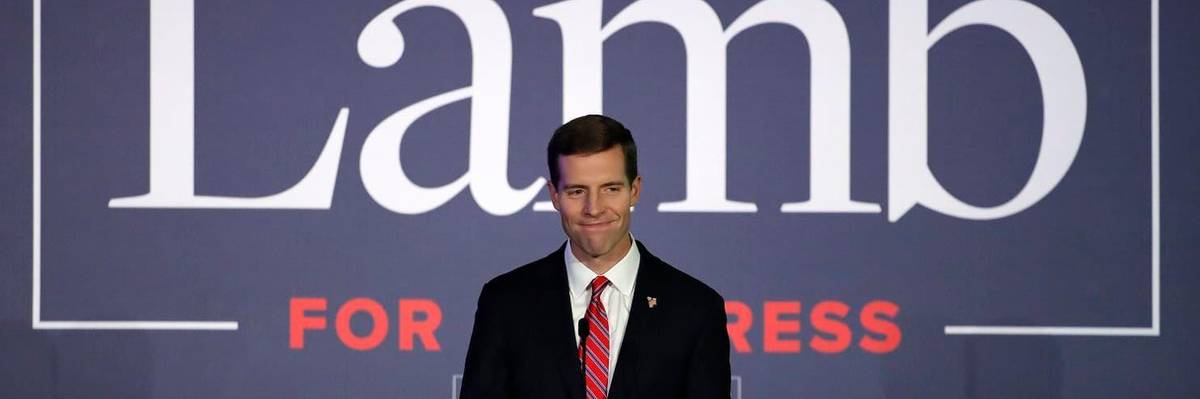
Rep. Conor Lamb (D-Pa.) greets supporters after claiming victory in Pennsylvania's 17th Congressional District at his election-night party in Cranberry, Pa., on Nov. 6. (Photo: Gene J. Puskar/AP)
The Midterms Prove It: Progressive Ideas Are Now Mainstream
Candidates who promised to stand up for working people, challenge powerful interests and shake up a rigged political and economic system won up and down the ballot
Americans marched to the polls last week and validated a Democratic message that is a sea change from where the party stood just a few election cycles ago. The center of gravity within the Democratic Party and the general electorate has dramatically shifted in the direction of bold economic populism.
Up and down the ballot, Democrats won by positioning themselves as advocates for working people -- willing to challenge power and shake up a rigged political and economic system in order to make a tangible difference in the lives of their constituents. This reveals a clear path to victory for any Democrat thinking about running for president in 2020.
Gone are the days of 2013, when a respected Democratic president could propose cutting Social Security benefits by decreasing promised cost-of-living adjustments for seniors. Gone are the days when the Democratic solution to the disastrous Citizens United decision was merely a Disclose Act that would make more transparent the corporate buying of our democracy. And gone are the days when those proposing to fundamentally challenge Big Insurance company power were laughed out of the room.
Researchers from the Progressive Change Institute analyzed how every winning Democratic candidate for the House campaigned in 2018 -- including their campaign ads, websites, social media and many debate performances. The resulting data shows that 65 percent of the incoming House freshman class embraced some version of Medicare-for-all or expanding Social Security benefits. Almost 80 percent embraced lowering prescription drug costs by challenging Big Pharma. And 82 percent favored challenging corporate power in our political system by rejecting corporate PAC money, passing a constitutional amendment to overturn Citizens United or passing campaign finance reform such as public financing of elections.
As Vox's Matthew Yglesias reported, this stands in stark contrast to "what a moderate Democrat looked like in the very recent past." In 2014,a typical moderate Democrat "bragged about voting with John Boehner a majority of the time, and ran against cap and trade and the Affordable Care Act."
Nothing better encapsulates this change than the shifting Democratic consensus on Social Security.
In 2013, President Barack Obama proposed a "grand bargain" with Republicans that would reduce future Social Security payments to seniors in exchange for higher taxes on the wealthy. Many congressional Democrats were willing to go along, despite the fact that the Republican positions on both Social Security and taxes were unpopular.
Progressives realized that if the entire scope of debate on Social Security was cutting benefits or doing nothing, the most we would ever win is nothing. So instead, we worked with former senators Tom Harkin (D-Iowa) and Mark Begich (D-Alaska) on legislation that would expand benefits. Sen. Elizabeth Warren (D-Mass.) delivered a shot in the arm for the idea in November 2013 with an impassioned speech that endorsed expanding Social Security.
Corporate-backed Democrats immediately lashed out. Leaders at Third Way, a think tank predominantly funded by Wall Street executives, took to the pages of the Wall Street Journal to warn Democrats not to follow Warren "over the populist cliff." They called expanding Social Security "exhibit A of this populist political and economic fantasy."
But they were too late -- a seismic shift was happening. Warren partnered with Sen. Joe Manchin (D-W.Va.) on legislation to expand Social Security benefits in March 2015 that won support from 42 of 44 Democratic or Independent senators who voted. In 2016, Hillary Clinton called for expanding Social Security in debates and in her national convention speech -- and many House and Senate Democratic candidates followed suit.
This year, Rep. Conor Lamb (D-Pa.) was perceived as a "moderate" when he won a special election in a nearly 20-point Trump district. But his TV ads focused on protecting Social Security and Medicare from cuts, rejecting corporate PAC money and fighting for workers. In September, he led 150 congressional Democrats in launching the Expand Social Security Caucus -- serving as co-chair with Warren and others.
Even Third Way did an about-face -- recently calling for the government to supplement Social Security with private savings accounts. (Of course, this proposal helps Wall Street, but this nonetheless cedes the shift from cuts to expanded benefits.)
The trajectory is clear, and corporate Democrats are in denial, arguing in a Post op-ed that progressive populism was "close to shut out" in last week's midterms and that "mainstream Democrats" won. They are right about one thing, though: Mainstream Democrats did win in 2018.
Candidates who promised to stand up for working people, challenge powerful interests and shake up a rigged political and economic system won up and down the ballot -- including more than 300 candidates supported by the Progressive Change Campaign Committee. Bold, progressive, economic-populist ideas are the mainstream. They won. And they are key to defeating President Trump in 2020.
An Urgent Message From Our Co-Founder
Dear Common Dreams reader, It’s been nearly 30 years since I co-founded Common Dreams with my late wife, Lina Newhouser. We had the radical notion that journalism should serve the public good, not corporate profits. It was clear to us from the outset what it would take to build such a project. No paid advertisements. No corporate sponsors. No millionaire publisher telling us what to think or do. Many people said we wouldn't last a year, but we proved those doubters wrong. Together with a tremendous team of journalists and dedicated staff, we built an independent media outlet free from the constraints of profits and corporate control. Our mission has always been simple: To inform. To inspire. To ignite change for the common good. Building Common Dreams was not easy. Our survival was never guaranteed. When you take on the most powerful forces—Wall Street greed, fossil fuel industry destruction, Big Tech lobbyists, and uber-rich oligarchs who have spent billions upon billions rigging the economy and democracy in their favor—the only bulwark you have is supporters who believe in your work. But here’s the urgent message from me today. It's never been this bad out there. And it's never been this hard to keep us going. At the very moment Common Dreams is most needed, the threats we face are intensifying. We need your support now more than ever. We don't accept corporate advertising and never will. We don't have a paywall because we don't think people should be blocked from critical news based on their ability to pay. Everything we do is funded by the donations of readers like you. When everyone does the little they can afford, we are strong. But if that support retreats or dries up, so do we. Will you donate now to make sure Common Dreams not only survives but thrives? —Craig Brown, Co-founder |
Americans marched to the polls last week and validated a Democratic message that is a sea change from where the party stood just a few election cycles ago. The center of gravity within the Democratic Party and the general electorate has dramatically shifted in the direction of bold economic populism.
Up and down the ballot, Democrats won by positioning themselves as advocates for working people -- willing to challenge power and shake up a rigged political and economic system in order to make a tangible difference in the lives of their constituents. This reveals a clear path to victory for any Democrat thinking about running for president in 2020.
Gone are the days of 2013, when a respected Democratic president could propose cutting Social Security benefits by decreasing promised cost-of-living adjustments for seniors. Gone are the days when the Democratic solution to the disastrous Citizens United decision was merely a Disclose Act that would make more transparent the corporate buying of our democracy. And gone are the days when those proposing to fundamentally challenge Big Insurance company power were laughed out of the room.
Researchers from the Progressive Change Institute analyzed how every winning Democratic candidate for the House campaigned in 2018 -- including their campaign ads, websites, social media and many debate performances. The resulting data shows that 65 percent of the incoming House freshman class embraced some version of Medicare-for-all or expanding Social Security benefits. Almost 80 percent embraced lowering prescription drug costs by challenging Big Pharma. And 82 percent favored challenging corporate power in our political system by rejecting corporate PAC money, passing a constitutional amendment to overturn Citizens United or passing campaign finance reform such as public financing of elections.
As Vox's Matthew Yglesias reported, this stands in stark contrast to "what a moderate Democrat looked like in the very recent past." In 2014,a typical moderate Democrat "bragged about voting with John Boehner a majority of the time, and ran against cap and trade and the Affordable Care Act."
Nothing better encapsulates this change than the shifting Democratic consensus on Social Security.
In 2013, President Barack Obama proposed a "grand bargain" with Republicans that would reduce future Social Security payments to seniors in exchange for higher taxes on the wealthy. Many congressional Democrats were willing to go along, despite the fact that the Republican positions on both Social Security and taxes were unpopular.
Progressives realized that if the entire scope of debate on Social Security was cutting benefits or doing nothing, the most we would ever win is nothing. So instead, we worked with former senators Tom Harkin (D-Iowa) and Mark Begich (D-Alaska) on legislation that would expand benefits. Sen. Elizabeth Warren (D-Mass.) delivered a shot in the arm for the idea in November 2013 with an impassioned speech that endorsed expanding Social Security.
Corporate-backed Democrats immediately lashed out. Leaders at Third Way, a think tank predominantly funded by Wall Street executives, took to the pages of the Wall Street Journal to warn Democrats not to follow Warren "over the populist cliff." They called expanding Social Security "exhibit A of this populist political and economic fantasy."
But they were too late -- a seismic shift was happening. Warren partnered with Sen. Joe Manchin (D-W.Va.) on legislation to expand Social Security benefits in March 2015 that won support from 42 of 44 Democratic or Independent senators who voted. In 2016, Hillary Clinton called for expanding Social Security in debates and in her national convention speech -- and many House and Senate Democratic candidates followed suit.
This year, Rep. Conor Lamb (D-Pa.) was perceived as a "moderate" when he won a special election in a nearly 20-point Trump district. But his TV ads focused on protecting Social Security and Medicare from cuts, rejecting corporate PAC money and fighting for workers. In September, he led 150 congressional Democrats in launching the Expand Social Security Caucus -- serving as co-chair with Warren and others.
Even Third Way did an about-face -- recently calling for the government to supplement Social Security with private savings accounts. (Of course, this proposal helps Wall Street, but this nonetheless cedes the shift from cuts to expanded benefits.)
The trajectory is clear, and corporate Democrats are in denial, arguing in a Post op-ed that progressive populism was "close to shut out" in last week's midterms and that "mainstream Democrats" won. They are right about one thing, though: Mainstream Democrats did win in 2018.
Candidates who promised to stand up for working people, challenge powerful interests and shake up a rigged political and economic system won up and down the ballot -- including more than 300 candidates supported by the Progressive Change Campaign Committee. Bold, progressive, economic-populist ideas are the mainstream. They won. And they are key to defeating President Trump in 2020.
Americans marched to the polls last week and validated a Democratic message that is a sea change from where the party stood just a few election cycles ago. The center of gravity within the Democratic Party and the general electorate has dramatically shifted in the direction of bold economic populism.
Up and down the ballot, Democrats won by positioning themselves as advocates for working people -- willing to challenge power and shake up a rigged political and economic system in order to make a tangible difference in the lives of their constituents. This reveals a clear path to victory for any Democrat thinking about running for president in 2020.
Gone are the days of 2013, when a respected Democratic president could propose cutting Social Security benefits by decreasing promised cost-of-living adjustments for seniors. Gone are the days when the Democratic solution to the disastrous Citizens United decision was merely a Disclose Act that would make more transparent the corporate buying of our democracy. And gone are the days when those proposing to fundamentally challenge Big Insurance company power were laughed out of the room.
Researchers from the Progressive Change Institute analyzed how every winning Democratic candidate for the House campaigned in 2018 -- including their campaign ads, websites, social media and many debate performances. The resulting data shows that 65 percent of the incoming House freshman class embraced some version of Medicare-for-all or expanding Social Security benefits. Almost 80 percent embraced lowering prescription drug costs by challenging Big Pharma. And 82 percent favored challenging corporate power in our political system by rejecting corporate PAC money, passing a constitutional amendment to overturn Citizens United or passing campaign finance reform such as public financing of elections.
As Vox's Matthew Yglesias reported, this stands in stark contrast to "what a moderate Democrat looked like in the very recent past." In 2014,a typical moderate Democrat "bragged about voting with John Boehner a majority of the time, and ran against cap and trade and the Affordable Care Act."
Nothing better encapsulates this change than the shifting Democratic consensus on Social Security.
In 2013, President Barack Obama proposed a "grand bargain" with Republicans that would reduce future Social Security payments to seniors in exchange for higher taxes on the wealthy. Many congressional Democrats were willing to go along, despite the fact that the Republican positions on both Social Security and taxes were unpopular.
Progressives realized that if the entire scope of debate on Social Security was cutting benefits or doing nothing, the most we would ever win is nothing. So instead, we worked with former senators Tom Harkin (D-Iowa) and Mark Begich (D-Alaska) on legislation that would expand benefits. Sen. Elizabeth Warren (D-Mass.) delivered a shot in the arm for the idea in November 2013 with an impassioned speech that endorsed expanding Social Security.
Corporate-backed Democrats immediately lashed out. Leaders at Third Way, a think tank predominantly funded by Wall Street executives, took to the pages of the Wall Street Journal to warn Democrats not to follow Warren "over the populist cliff." They called expanding Social Security "exhibit A of this populist political and economic fantasy."
But they were too late -- a seismic shift was happening. Warren partnered with Sen. Joe Manchin (D-W.Va.) on legislation to expand Social Security benefits in March 2015 that won support from 42 of 44 Democratic or Independent senators who voted. In 2016, Hillary Clinton called for expanding Social Security in debates and in her national convention speech -- and many House and Senate Democratic candidates followed suit.
This year, Rep. Conor Lamb (D-Pa.) was perceived as a "moderate" when he won a special election in a nearly 20-point Trump district. But his TV ads focused on protecting Social Security and Medicare from cuts, rejecting corporate PAC money and fighting for workers. In September, he led 150 congressional Democrats in launching the Expand Social Security Caucus -- serving as co-chair with Warren and others.
Even Third Way did an about-face -- recently calling for the government to supplement Social Security with private savings accounts. (Of course, this proposal helps Wall Street, but this nonetheless cedes the shift from cuts to expanded benefits.)
The trajectory is clear, and corporate Democrats are in denial, arguing in a Post op-ed that progressive populism was "close to shut out" in last week's midterms and that "mainstream Democrats" won. They are right about one thing, though: Mainstream Democrats did win in 2018.
Candidates who promised to stand up for working people, challenge powerful interests and shake up a rigged political and economic system won up and down the ballot -- including more than 300 candidates supported by the Progressive Change Campaign Committee. Bold, progressive, economic-populist ideas are the mainstream. They won. And they are key to defeating President Trump in 2020.