SUBSCRIBE TO OUR FREE NEWSLETTER
Daily news & progressive opinion—funded by the people, not the corporations—delivered straight to your inbox.
5
#000000
#FFFFFF
To donate by check, phone, or other method, see our More Ways to Give page.
Daily news & progressive opinion—funded by the people, not the corporations—delivered straight to your inbox.
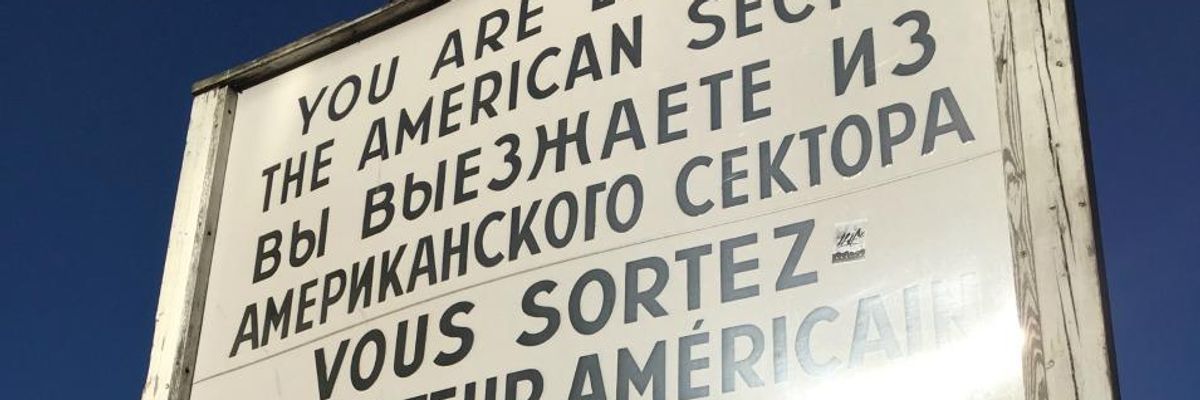
There are constant reminders in Berlin of Germany's violent history, like the white crosses honoring East Berliners shot while trying to escape or the big sign at Checkpoint Charlie announcing, "You are leaving the American sector" in four languages. (Photo: Michael Winship/CD)
BERLIN--On the last full day of two weeks spent in this city, the requisite visit was paid to Checkpoint Charlie, the spot at the Berlin Wall where, from 1961 to 1989, allied forces and other foreigners crossed the uneasy border between East and West Berlin. (Germans had designated checkpoints of their own.)
The wall once split this city in two with concrete and barbed wire, dividing people into those ruled by democratic West Germany or communist East Germany. Now, capitalism rules. Big time.
"When your moral universe is limited to a belief that the ends always justify the means it's a short trip to oppression and tyranny."
The scene of so many spy novels and movies, Checkpoint Charlie's original wooden shed is long gone, replaced by a replica with role players dressed up as US military personnel posing for tourist photos. At the place where American and Soviet tanks once confronted each other from just 100 yards apart, there now are coffee bars, souvenir shops and a Kentucky Fried Chicken. Sidewalk vendors peddle Red Army hats and badges along with chunks of what they say are pieces of the original wall. Nearby there's even a high-rise building of upscale apartments going up, to be called, I'm not making this up, "Charlie."
Once this place was Ground Zero in the Cold War and tensions teetered on the proverbial razor's edge. While three short sections of the wall still stand, in most places a thin line of cobblestones marks where it once was. Traffic and commerce flow freely, and to an outsider it can feel as if the heavily armed barrier never was there. But to those who lived here, the memory is never far away. There are constant reminders, like the white crosses honoring East Berliners shot while trying to escape or the big sign at Checkpoint Charlie announcing, "You are leaving the American sector" in four languages.
Not far from the checkpoint, a different wall is memorialized. It's near one of the remaining portions of the Berlin Wall but this one wasn't used to divide citizens one from another. Instead it helped hide acts of torture and murder, stifling the screams of the damned.
The wall and pieces of a main doorway are what remain of Adolf Hitler's Gestapo headquarters. Cells held fifty at a time for interrogation. Political prisoners were kept there, as well as Jews, Roma, trade unionists and members of the resistance - between the years 1933 and 1945 an estimated 15,000 in all. For many, if they survived, it was a way station on the way to the concentration camps of the SS.
Today the area is designated as the Topography of Terror Documentation Center, a museum of shame and horror documenting the rise of Hitler and the Third Reich, along with the unspeakable crimes against humanity committed in their names.
Right now, the center has an exhibit titled "Berlin 1933: The Path to Dictatorship." It features documents, photographs and texts chronicling the year that Hitler and the Nazi party consolidated power.
On January 30, 1933, Hitler became Germany's chancellor, taking over with the support of conservatives who believed they could keep him under control. His soon-to-be propaganda minister Joseph Goebbels organized a celebratory torchlight march that night of some 50,000 - although in an ironic foreshadowing of the Trump inauguration, Goebbels claimed it was a million.
To those who still claim it odious or unjust to compare our current White House and the Republican Party to what happened in Germany 85 years ago, I would urge them to come see "Berlin 1933." Here are the all-too-familiar seeds of a nascent totalitarian regime: the denigration and condemnation of rival political parties, the disintegration of the courts, attacks on organized labor while claiming massive job creation, the dismissal of public servants unwilling to swear undying allegiance to the leader, verbal and written slurs and smears flung against the press and opponents, inciting and legitimizing violence against anyone who dares to disagree.
By the following year, Hitler's cult of personality, "had reached new levels of idolatry and made millions of new converts," biographer Ian Kershaw wrote. "Disdain and detestation for a parliamentary system generally perceived to have failed miserably had resulted in willingness to entrust monopoly control over the state to a leader claiming a unique sense of mission and invested by his mass following with heroic, almost messianic, qualities. Conventional forms of government were, as a consequence, increasingly exposed to the arbitrary inroads of personalized power. It was a recipe for disaster."
This, too, sounds familiar. Yes, many, like Harvard legal scholar Cass R. Sunstein maintain that our system of checks and balances and the Constitution will keep us from sliding into the abyss that was Nazi Germany. National conditions are not the same--we have not hit the economic depths of the Wiemar Republic--nor have actual physical attacks on those perceived as adversaries been as widespread or violent. Yet.
Even Sunstein admits, as he noted earlier this year in The New York Review of Books, "It would be foolish to ignore the risks that Trump and his administration pose to established norms and institutions, which help preserve both order and liberty. Those risks will grow if opposition to violations of long-standing norms is limited to Democrats, and if Republicans laugh, applaud, agree with, or make excuses for Trump--if they howl with the wolf."
Do you see our Republican Congress doing anything to counter Trump's authoritarian tendencies? "Whatever secret reservations McConnell and other traditional Republican leaders have about Trump's character, governing style, and possible criminality," historian Christopher Browning writes, "they openly rejoice in the payoff they have received from their alliance with him and his base."
Merely look to Trump's eagerness to cover up Saudi Arabia's torture and murder of a Washington Post journalist as the president seeks to protect an arms deal that largely exists in his imagination. Or, as evinced in his 60 Minutes interview with Lesley Stahl, his continued warm embrace of the Saudis and the world's other dictators.
Sorry, but when your moral universe is limited to a belief that the ends always justify the means it's a short trip to oppression and tyranny. To those who think it can't happen here? Let them come to Berlin. The city has seen it all before.
Dear Common Dreams reader, It’s been nearly 30 years since I co-founded Common Dreams with my late wife, Lina Newhouser. We had the radical notion that journalism should serve the public good, not corporate profits. It was clear to us from the outset what it would take to build such a project. No paid advertisements. No corporate sponsors. No millionaire publisher telling us what to think or do. Many people said we wouldn't last a year, but we proved those doubters wrong. Together with a tremendous team of journalists and dedicated staff, we built an independent media outlet free from the constraints of profits and corporate control. Our mission has always been simple: To inform. To inspire. To ignite change for the common good. Building Common Dreams was not easy. Our survival was never guaranteed. When you take on the most powerful forces—Wall Street greed, fossil fuel industry destruction, Big Tech lobbyists, and uber-rich oligarchs who have spent billions upon billions rigging the economy and democracy in their favor—the only bulwark you have is supporters who believe in your work. But here’s the urgent message from me today. It's never been this bad out there. And it's never been this hard to keep us going. At the very moment Common Dreams is most needed, the threats we face are intensifying. We need your support now more than ever. We don't accept corporate advertising and never will. We don't have a paywall because we don't think people should be blocked from critical news based on their ability to pay. Everything we do is funded by the donations of readers like you. When everyone does the little they can afford, we are strong. But if that support retreats or dries up, so do we. Will you donate now to make sure Common Dreams not only survives but thrives? —Craig Brown, Co-founder |
BERLIN--On the last full day of two weeks spent in this city, the requisite visit was paid to Checkpoint Charlie, the spot at the Berlin Wall where, from 1961 to 1989, allied forces and other foreigners crossed the uneasy border between East and West Berlin. (Germans had designated checkpoints of their own.)
The wall once split this city in two with concrete and barbed wire, dividing people into those ruled by democratic West Germany or communist East Germany. Now, capitalism rules. Big time.
"When your moral universe is limited to a belief that the ends always justify the means it's a short trip to oppression and tyranny."
The scene of so many spy novels and movies, Checkpoint Charlie's original wooden shed is long gone, replaced by a replica with role players dressed up as US military personnel posing for tourist photos. At the place where American and Soviet tanks once confronted each other from just 100 yards apart, there now are coffee bars, souvenir shops and a Kentucky Fried Chicken. Sidewalk vendors peddle Red Army hats and badges along with chunks of what they say are pieces of the original wall. Nearby there's even a high-rise building of upscale apartments going up, to be called, I'm not making this up, "Charlie."
Once this place was Ground Zero in the Cold War and tensions teetered on the proverbial razor's edge. While three short sections of the wall still stand, in most places a thin line of cobblestones marks where it once was. Traffic and commerce flow freely, and to an outsider it can feel as if the heavily armed barrier never was there. But to those who lived here, the memory is never far away. There are constant reminders, like the white crosses honoring East Berliners shot while trying to escape or the big sign at Checkpoint Charlie announcing, "You are leaving the American sector" in four languages.
Not far from the checkpoint, a different wall is memorialized. It's near one of the remaining portions of the Berlin Wall but this one wasn't used to divide citizens one from another. Instead it helped hide acts of torture and murder, stifling the screams of the damned.
The wall and pieces of a main doorway are what remain of Adolf Hitler's Gestapo headquarters. Cells held fifty at a time for interrogation. Political prisoners were kept there, as well as Jews, Roma, trade unionists and members of the resistance - between the years 1933 and 1945 an estimated 15,000 in all. For many, if they survived, it was a way station on the way to the concentration camps of the SS.
Today the area is designated as the Topography of Terror Documentation Center, a museum of shame and horror documenting the rise of Hitler and the Third Reich, along with the unspeakable crimes against humanity committed in their names.
Right now, the center has an exhibit titled "Berlin 1933: The Path to Dictatorship." It features documents, photographs and texts chronicling the year that Hitler and the Nazi party consolidated power.
On January 30, 1933, Hitler became Germany's chancellor, taking over with the support of conservatives who believed they could keep him under control. His soon-to-be propaganda minister Joseph Goebbels organized a celebratory torchlight march that night of some 50,000 - although in an ironic foreshadowing of the Trump inauguration, Goebbels claimed it was a million.
To those who still claim it odious or unjust to compare our current White House and the Republican Party to what happened in Germany 85 years ago, I would urge them to come see "Berlin 1933." Here are the all-too-familiar seeds of a nascent totalitarian regime: the denigration and condemnation of rival political parties, the disintegration of the courts, attacks on organized labor while claiming massive job creation, the dismissal of public servants unwilling to swear undying allegiance to the leader, verbal and written slurs and smears flung against the press and opponents, inciting and legitimizing violence against anyone who dares to disagree.
By the following year, Hitler's cult of personality, "had reached new levels of idolatry and made millions of new converts," biographer Ian Kershaw wrote. "Disdain and detestation for a parliamentary system generally perceived to have failed miserably had resulted in willingness to entrust monopoly control over the state to a leader claiming a unique sense of mission and invested by his mass following with heroic, almost messianic, qualities. Conventional forms of government were, as a consequence, increasingly exposed to the arbitrary inroads of personalized power. It was a recipe for disaster."
This, too, sounds familiar. Yes, many, like Harvard legal scholar Cass R. Sunstein maintain that our system of checks and balances and the Constitution will keep us from sliding into the abyss that was Nazi Germany. National conditions are not the same--we have not hit the economic depths of the Wiemar Republic--nor have actual physical attacks on those perceived as adversaries been as widespread or violent. Yet.
Even Sunstein admits, as he noted earlier this year in The New York Review of Books, "It would be foolish to ignore the risks that Trump and his administration pose to established norms and institutions, which help preserve both order and liberty. Those risks will grow if opposition to violations of long-standing norms is limited to Democrats, and if Republicans laugh, applaud, agree with, or make excuses for Trump--if they howl with the wolf."
Do you see our Republican Congress doing anything to counter Trump's authoritarian tendencies? "Whatever secret reservations McConnell and other traditional Republican leaders have about Trump's character, governing style, and possible criminality," historian Christopher Browning writes, "they openly rejoice in the payoff they have received from their alliance with him and his base."
Merely look to Trump's eagerness to cover up Saudi Arabia's torture and murder of a Washington Post journalist as the president seeks to protect an arms deal that largely exists in his imagination. Or, as evinced in his 60 Minutes interview with Lesley Stahl, his continued warm embrace of the Saudis and the world's other dictators.
Sorry, but when your moral universe is limited to a belief that the ends always justify the means it's a short trip to oppression and tyranny. To those who think it can't happen here? Let them come to Berlin. The city has seen it all before.
BERLIN--On the last full day of two weeks spent in this city, the requisite visit was paid to Checkpoint Charlie, the spot at the Berlin Wall where, from 1961 to 1989, allied forces and other foreigners crossed the uneasy border between East and West Berlin. (Germans had designated checkpoints of their own.)
The wall once split this city in two with concrete and barbed wire, dividing people into those ruled by democratic West Germany or communist East Germany. Now, capitalism rules. Big time.
"When your moral universe is limited to a belief that the ends always justify the means it's a short trip to oppression and tyranny."
The scene of so many spy novels and movies, Checkpoint Charlie's original wooden shed is long gone, replaced by a replica with role players dressed up as US military personnel posing for tourist photos. At the place where American and Soviet tanks once confronted each other from just 100 yards apart, there now are coffee bars, souvenir shops and a Kentucky Fried Chicken. Sidewalk vendors peddle Red Army hats and badges along with chunks of what they say are pieces of the original wall. Nearby there's even a high-rise building of upscale apartments going up, to be called, I'm not making this up, "Charlie."
Once this place was Ground Zero in the Cold War and tensions teetered on the proverbial razor's edge. While three short sections of the wall still stand, in most places a thin line of cobblestones marks where it once was. Traffic and commerce flow freely, and to an outsider it can feel as if the heavily armed barrier never was there. But to those who lived here, the memory is never far away. There are constant reminders, like the white crosses honoring East Berliners shot while trying to escape or the big sign at Checkpoint Charlie announcing, "You are leaving the American sector" in four languages.
Not far from the checkpoint, a different wall is memorialized. It's near one of the remaining portions of the Berlin Wall but this one wasn't used to divide citizens one from another. Instead it helped hide acts of torture and murder, stifling the screams of the damned.
The wall and pieces of a main doorway are what remain of Adolf Hitler's Gestapo headquarters. Cells held fifty at a time for interrogation. Political prisoners were kept there, as well as Jews, Roma, trade unionists and members of the resistance - between the years 1933 and 1945 an estimated 15,000 in all. For many, if they survived, it was a way station on the way to the concentration camps of the SS.
Today the area is designated as the Topography of Terror Documentation Center, a museum of shame and horror documenting the rise of Hitler and the Third Reich, along with the unspeakable crimes against humanity committed in their names.
Right now, the center has an exhibit titled "Berlin 1933: The Path to Dictatorship." It features documents, photographs and texts chronicling the year that Hitler and the Nazi party consolidated power.
On January 30, 1933, Hitler became Germany's chancellor, taking over with the support of conservatives who believed they could keep him under control. His soon-to-be propaganda minister Joseph Goebbels organized a celebratory torchlight march that night of some 50,000 - although in an ironic foreshadowing of the Trump inauguration, Goebbels claimed it was a million.
To those who still claim it odious or unjust to compare our current White House and the Republican Party to what happened in Germany 85 years ago, I would urge them to come see "Berlin 1933." Here are the all-too-familiar seeds of a nascent totalitarian regime: the denigration and condemnation of rival political parties, the disintegration of the courts, attacks on organized labor while claiming massive job creation, the dismissal of public servants unwilling to swear undying allegiance to the leader, verbal and written slurs and smears flung against the press and opponents, inciting and legitimizing violence against anyone who dares to disagree.
By the following year, Hitler's cult of personality, "had reached new levels of idolatry and made millions of new converts," biographer Ian Kershaw wrote. "Disdain and detestation for a parliamentary system generally perceived to have failed miserably had resulted in willingness to entrust monopoly control over the state to a leader claiming a unique sense of mission and invested by his mass following with heroic, almost messianic, qualities. Conventional forms of government were, as a consequence, increasingly exposed to the arbitrary inroads of personalized power. It was a recipe for disaster."
This, too, sounds familiar. Yes, many, like Harvard legal scholar Cass R. Sunstein maintain that our system of checks and balances and the Constitution will keep us from sliding into the abyss that was Nazi Germany. National conditions are not the same--we have not hit the economic depths of the Wiemar Republic--nor have actual physical attacks on those perceived as adversaries been as widespread or violent. Yet.
Even Sunstein admits, as he noted earlier this year in The New York Review of Books, "It would be foolish to ignore the risks that Trump and his administration pose to established norms and institutions, which help preserve both order and liberty. Those risks will grow if opposition to violations of long-standing norms is limited to Democrats, and if Republicans laugh, applaud, agree with, or make excuses for Trump--if they howl with the wolf."
Do you see our Republican Congress doing anything to counter Trump's authoritarian tendencies? "Whatever secret reservations McConnell and other traditional Republican leaders have about Trump's character, governing style, and possible criminality," historian Christopher Browning writes, "they openly rejoice in the payoff they have received from their alliance with him and his base."
Merely look to Trump's eagerness to cover up Saudi Arabia's torture and murder of a Washington Post journalist as the president seeks to protect an arms deal that largely exists in his imagination. Or, as evinced in his 60 Minutes interview with Lesley Stahl, his continued warm embrace of the Saudis and the world's other dictators.
Sorry, but when your moral universe is limited to a belief that the ends always justify the means it's a short trip to oppression and tyranny. To those who think it can't happen here? Let them come to Berlin. The city has seen it all before.