SUBSCRIBE TO OUR FREE NEWSLETTER
Daily news & progressive opinion—funded by the people, not the corporations—delivered straight to your inbox.
5
#000000
#FFFFFF
To donate by check, phone, or other method, see our More Ways to Give page.
Daily news & progressive opinion—funded by the people, not the corporations—delivered straight to your inbox.

A Left Party official said its strategy for the Berlin election was "explicitly inspired... by Zohran Mamdani's campaign."
Germany's Left Party on Sunday made history by winning the 2026 Berlin state election, putting its lead candidate, socialist Elif Eralp, in position to become mayor of the country's largest city.
In all, the Left Party won 26% of the overall vote in the election, with the center-right Christian Democratic Union capturing 19% and the far-right Alternative for Germany winning 16% of the vote.
The two other center-left parties—the Greens and the Social Democratic Party of Germany (SPD)—won 14% and 12% of the vote, respectively.
A Sunday report from Bloomberg News described the Left Party's victory in Berlin as a "Mamdani moment," in reference to democratic socialist Zohran Mamdani's upset 2025 win in the New York City mayoral race.
Like Mamdani, Eralp and her party put affordability at the center of their campaign, with a particular emphasis on the rising cost of housing in the city.
As described by Euronews in a Monday report, Eralp "called for tighter regulation of rents, more social housing, and further moves towards bringing large housing portfolios into public ownership."
The Euronews report also noted the connection to Mamdani, citing a quote from Eralp last year arguing that "if a left-wing candidate can win in New York, then there's no reason it can't happen in Berlin."
According to a Saturday report in The Washington Post, the Left Party recently sent a delegation to New York City to learn about Mamdani's campaign and even met with some of the mayor's advisers to talk political strategy.
Liza Pflaum, the head of digital communications for the Left Party and a member of the delegation, told the Post that while her party had already embraced "a clear focus on issues relevant to affordable living" two years ago, it also was "explicitly inspired... by Zohran Mamdani's campaign."
While the Left Party received the most votes in the election, it did not receive enough to form an outright majority, meaning it will need coalition partners to form a government.
The Greens and SPD have indicated they are willing to form a coalition with the Left Party, but have claimed the party has allowed antisemitism to flourish in its ranks—an allegation that conservatives have made against left-wing candidates and political leaders in the US as well.
Progressives have warned against the conflation of antisemitism and criticism of Israel.
Eralp has disputed accusations of antisemitism in her party, which have focused on comments about the Israel Defense Forces at a campaign event and the presence of "an allegedly militant activist" at an election victory party.
"I will do everything to ensure that Jewish people—just like Muslims, queer people, and everyone in our city—can feel safe," said Eralp.
"People are trying to divide our society and set some people against others," said a spokesperson for the Christopher Street Day festival. "At the CSD in Berlin, we will not allow this."
One person was killed and at least 29 others injured on Saturday when a van plowed into a crowd near Berlin's annual LGBTQ+ Pride festival, with the attacker—who wounded some of his victims with a machete after crashing—later shot dead by police, who said he was a suspected Islamic extremist.
The attack occurred Saturday evening during the Christopher Street Day (CSD) celebration—named after where New York's Stonewall Inn is located—following the main parade near the Tiergarten area near the Brandeburg Gate. In what German authorities have officially designated a terrorist attack, police said a 21-year-old German-Lebanese man, identified as Abdul Ballout, drove his van into a crowd before assaulting people with a machete.
One woman, whose identity has not yet been publicly disclosed, was killed.
On Sunday, police located Ballout in the Berlin suburb of Spandau. Police said Ballout was fatally shot as he ran toward officers with a sharp object.
Berlin prosecutors said Ballout traveled to Syria last year while trying to join the so-called Islamic State militant group. According to The Associated Press, Ballout was arrested in Lebanon and sentenced to three months' imprisonment for incitement. He was arrested again upon returning to Germany, where he received a suspended sentence from a juvenile court for publishing pro-Islamic State messages on Instagram and preparing an act of serious violence threatening the state.
During a Sunday press conference, a CSD spokesperson implored people not to use the attack "for political ends."
"People are trying to divide our society and set some people against others," he said. "At the CSD in Berlin, we will not allow this."
However, far-right leaders in Germany and beyond blamed "Islamism." Tino Chrupalla, co-leader of the Alternative for Germany, said on X that “we will not allow religious extremists to divide our country with violence and intolerance."
Numerous X users pushed back, with one saying, "You constantly incite against queer people and are now exploiting the attack for your disgusting incitement!"
Andre Lehmann of LSVD+, Germany's largest LGBTQ+ advocacy organization, said, “We are simply stunned by what happened," adding that the attack "hits the heart of the queer community."
Berlin Mayor Kai Wegner said on social media that the assault was "an attack on our free and open society."
"After a peaceful and colorful CSD, the assembly for a tolerant and peaceful Berlin was attacked in the most brutal way," he continued. "Berlin is the city of freedom—and our freedom has been attacked in the most horrific way today."
German Chancellor Friedrich Merz told reporters at a Saturday press conference outside the Marienkirche in central Berlin: "What a heinous act in Berlin. This attack on peaceful Christopher Street Day celebrants is an assault on our open, tolerant society. We will investigate it with utmost severity."
"Our thoughts are with the victims of this Islamist terrorist attack," Merz continued. "I wish those who sustained injuries a swift recovery."
The Christian Democratic Union chancellor thanked first responders for "intervening as quickly as possible, which could well have prevented an even worse outcome last night."
"Let us not be intimidated by these crimes," Merz added. "They want to divide our society, they want to take the most important thing that we have: namely, our open society, our liberal society."
The climate action group Fridays for Future Germany posted on X: "We are devastated. Yesterday's attack on the Berlin CSD was an attack on all of us. Our thoughts are with the victims, their loved ones, and all those who had to witness this attack. Now is the time for solidarity with the queer community."
LGBTQ+ advocates and their allies around the world condemned the attack and offered their condolences and solidarity.
In the Slovakian capital Bratislava, the gay bar Tepláreň—where a far-right extremist teen shot and killed two people in 2022—posted on Instagram: "We are thinking of you, friends in Berlin. It is with great sadness that we are watching the terrible news. We express our deepest condolences to the victims, their loved ones, and everyone who has been affected by these events."
Extremism "is growing dangerously worldwide," the bar added. "People blinded by hate and lies threaten our communities, threatening our chance to coexist in peace."
"Prides are meant to be a place where all can feel safe, welcome, and seen," the rapid response team at the US group Human Rights Campaign said on social media. "We are sending our love to the victims, their families, and the entire city of Berlin today."
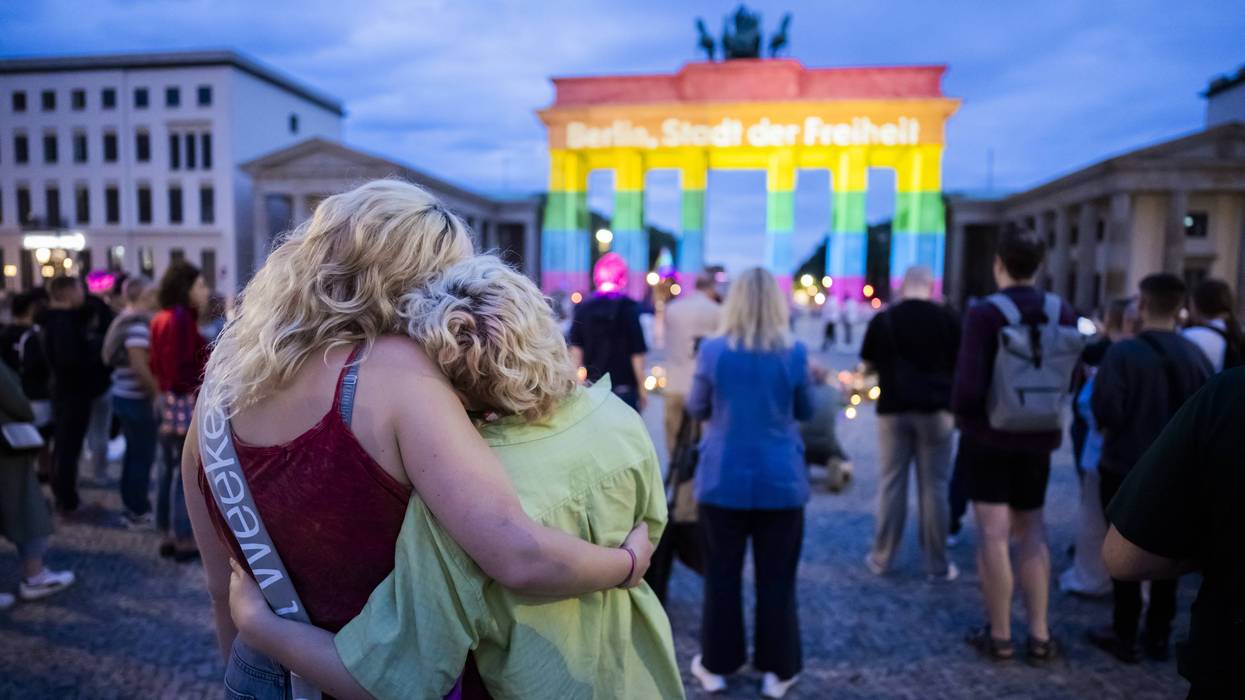
People gathered for vigils across Germany and around Europe and the world Sunday to mourn and condemn the attack. In Berlin, the Brandenburg Gate was illuminated in rainbow colors, with the message "Berlin, City of Freedom" projected beneath its Quadriga sculpture, as people took part in a candlelit vigil.
“There was so much joy here yesterday,” Luise V., who attended both CSD and a vigil near the site of the attack, told Berliner Zeitung. “Today I had to face it and come here, also to process what happened."
"You are being screwed, and that story is not a cultural one but a class one."
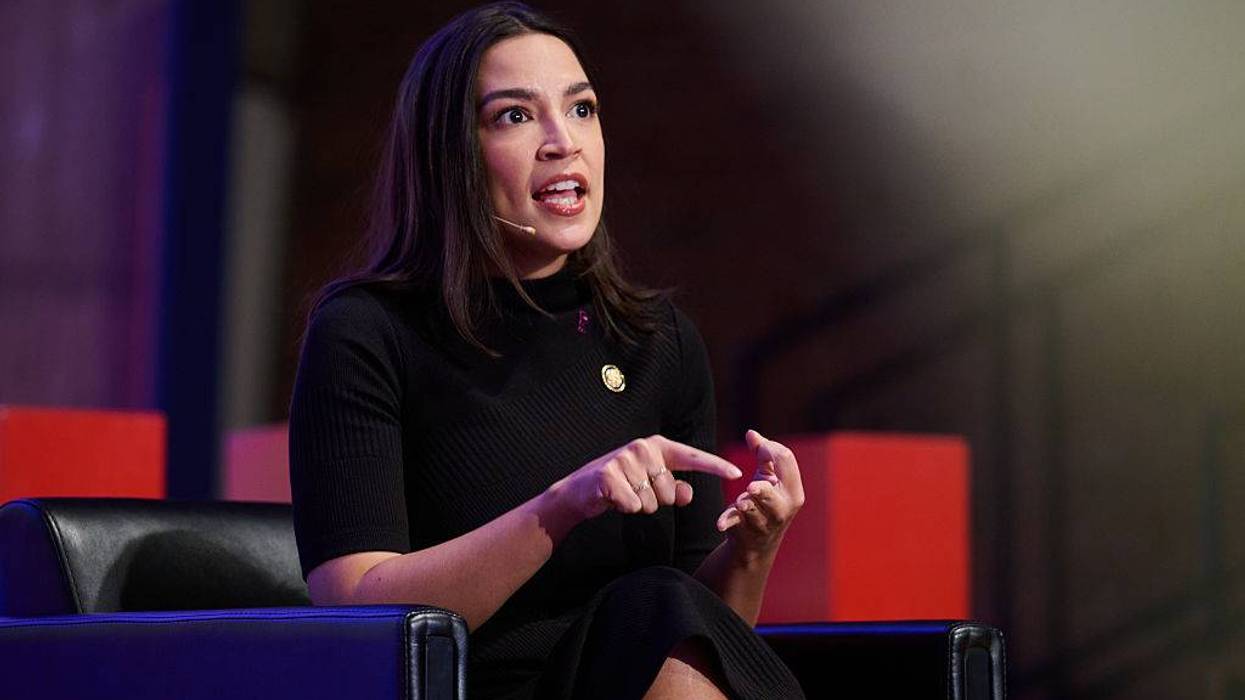
Rep. Alexandria Ocasio-Cortez on Sunday fleshed out her vision for progressive politics in the US during a town hall-style event at
Technical University Berlin in Germany.
While discussing the domestic political situation in the US, Ocasio-Cortez (D-NY) argued that enormous disparities in wealth inequality were leaving voters open to appeals from far-right movements that scapegoat immigrants and minorities for problems being caused by unchecked corporate power.
"When you have economic stagnation for the working class, especially in an environment where GDP is growing, that is the stuff of populist movements," said Ocasio-Cortez. "The choice is what direction those populist movements can go... One direction is, 'We are going to blame this on the vulnerable, on immigrants, on people of different gender identities."
The Rosetta Stone for AOC’s foreign policy right here: “...economic elites are taking the lion's share of growth for themselves and leaving crumbs for the working class...this is an injustice, you are being screwed, and that story is not a cultural one but a class one” pic.twitter.com/gK7kyVbONb
— Van Jackson (@RealVanJackson) February 15, 2026
The New York Democrat then argued that right-wing populism "is all done as a distraction from the truth, which is that economic elites have taken the lion's share of growth for themselves" while "leaving crumbs for the working class."
"The alternative is a populist movement that tells the truth," she continued. "That says, 'This is an injustice, you are being screwed over, and that story is not a cultural one, but a class one.'"
Elsewhere in the talk, Ocasio-Cortez downplayed speculation about potentially running for higher office in 2028, instead outlining her goals for reshaping the political environment.
"My ambition has always been about conditions," she said. "I remain ambitious, but my ambitions are in changing our political environment. That's why, when I was first elected, my ambition was to change the Democratic Party, and to make it more economically populist and responsive to working-class Americans... Frankly, I think the ambitions of a progressive movement go so far beyond an elected office. We are coming for power for working people."
Ocasio-Cortez also gave a shoutout to the resistance to federal immigration enforcement operations as an example of building community solidarity in the face of an external threat.
"Every one of us can be sand in the gears of an injustice," she said. "I think about how all the people in Minneapolis refused to let [US Immigration and Customs Enforcement] officers use the bathroom in their establishments. I mean, it’s a small thing, but it matters! It matters... We create a culture of protection of one another, a culture of solidarity with one another, and it's rebellious."
AOC: “There are more of us than them. Every one of us can be sand in the gears of injustice. All the people in Minneapolis refused to let ICE officers use the bathroom in their establishments. It’s a small thing, but it matters! We create a culture of protection of one another” pic.twitter.com/3y9IpRiS8m
— Marco Foster (@MarcoFoster_) February 15, 2026
Ocasio-Cortez's remarks on Sunday came after she participated in a panel discussion at the Munich Security Conference on Friday where she argued that "a working-class-centered politics" was the key to defeat "the scourges of authoritarianism, which provide political siren calls to allure people into finding scapegoats to blame for rising economic inequality, both domestically and globally."

"Friends, we are here because vengeance is a lazy form of grief. We are here to promote not vengeance but peace and coexistence across Israel-Palestine."
Prominent Greek leftist Yanis Varoufakis on Friday condemned the German government's complicity in Israel's ongoing genocidal attack on Gaza as well as its domestic crackdown on pro-Palestinian advocacy in an online speech originally meant to be delivered before a conference that was raided by Berlin police earlier in the day.
Varoufakis—a former Greek finance minister who heads the Democracy in Europe Movement 2025 (DiEM25)—was scheduled to address the Palestine Congress, which was slated to run through Sunday in the German capital. However, hundreds of police officers blockaded the event venue on Germaniastraße in Templehof before storming the building and demanding organizers cut the livestream and end the event. Several people including at least one Jewish participant were led away by police.
"This is what democracy in Europe right now really looks like!" DiEM25 said on social media.
In his speech, Varoufakis
lamented that "a decent people, the people of Germany, are led down a perilous road to a heartless society by being made to associate themselves with another genocide carried out in their name, with their complicity."
"You want to silence us. To ban us. To demonize us. To accuse us. You, therefore, leave us with no choice but to meet your accusations with our accusations," Varoufakis said, referring to the German political establishment—including the leftist Greens.
"So, let's be clear: We are here, in Berlin, with our Palestinian Congress because, unlike the German political system and the German media, we condemn genocide and war crimes regardless of who is perpetrating them," Varoufakis said. "Because we oppose apartheid in the land of Israel-Palestine no matter who has the upper hand—just as we opposed apartheid in the American South or in South Africa. Because we stand for universal human rights, freedom, and equality among Jews, Palestinians, Bedouins, and Christians in the ancient land of Palestine."
Varoufakis' speech comes as Germany faces an International Court of Justice case brought by Nicaragua and which accuses Berlin of complicity in the Israeli genocide in Gaza, where nearly 110,000 Palestinians—mostly innocent men, women, and children—have been killed or maimed by over the past six months.
The convening of the Palestine Congress, and the antagonism against it by authorities, coincides with a growing crackdown by German officials on pro-Palestinian voices in academic, artistic, literary, and other spaces.
Watch Varoufakis' speech:
The speech that I could not deliver because German police burst into our Berlin venue to disband our Palestine Congress (1930s style). Judge for yourselves the kind of society Germany is becoming when its police bans the following words:
Friends,
Congratulations, and heartfelt… pic.twitter.com/6Rnw2bwQPL
— Yanis Varoufakis (@yanisvaroufakis) April 12, 2024
Read Varoufakis' remarks as prepared for delivery:
Friends,
Congratulations, and heartfelt thanks, for being here, despite the threats, despite the ironclad police outside this venue, despite the panoply of the German press, despite the German state, despite the German political system that demonizes you for being here.
"Why a Palestinian Congress, Mr. Varoufakis?" a German journalist asked me recently. Because, as Hanan Asrawi once said: "We cannot rely on the silenced to tell us about their suffering."
Today, Asrawi's reason has grown depressingly stronger: Because we cannot rely on the silenced who are also massacred and starved to tell us about the massacres and the starvation.
But there is another reason too: Because a proud, a decent people, the people of Germany, are led down a perilous road to a heartless society by being made to associate themselves with another genocide carried out in their name, with their complicity.
I am neither Jewish nor Palestinian. But I am incredibly proud to be here amongst Jews and Palestinians—to blend my voice for peace and universal human rights with Jewish voices for peace and universal human rights—with Palestinian voices for peace and universal human rights. Being together, here, today, is proof that coexistence is not only possible—but that it is here! Already.
"Why not a Jewish Congress, Mr. Varoufakis?" the same German journalist asked me, imagining that he was being smart. I welcomed his question.
For if a single Jew is threatened, anywhere, just because she or he is Jewish, I shall wear the Star of David on my lapel and offer my solidarity—whatever the cost, whatever it takes.
So, let's be clear: If Jews were under attack, anywhere in the world, I would be the first to canvass for a Jewish Congress in which to register our solidarity. Similarly, when Palestinians are massacred because they are Palestinians—under a dogma that to be dead they must have been Hamas—I shall wear my keffiyeh and offer my solidarity whatever the cost, whatever it takes.
Universal human rights are either universal or they mean nothing.
With this in mind, I answered the German journalist's question with a few of my own:
If the answer to any of these questions was yes, I would be participating in a Jewish Solidarity Congress today.
Friends, today, we would have loved to have a decent, democratic, mutually respectful debate on how to bring peace and universal human rights for everyone, Jews and Palestinians, Bedouins and Christians, from the Jordan River to the Mediterranean Sea, with people who think differently to us.
Sadly, the whole of the German political system has decided not to allow this. In a joint statement including not just the CDU-CSU or the FDP but also the SPD, the Greens and, remarkably, two leaders of Die Linke, joined forces to ensure that such a civilized debate, in which we may disagree agreeably, never takes place in Germany.
I say to them: You want to silence us. To ban us. To demonize us. To accuse us. You, therefore, leave us with no choice but to meet your accusations with our accusations. You chose this. Not us. You accuse us of anti-Semitic hatred. We accuse you of being the antisemite's best friend by equating the right of Israel to commit war crimes with the right of Israeli Jews to defend themselves.
You accuse us of supporting terrorism. We accuse you of equating legitimate resistance to an apartheid state with atrocities against civilians which I have always and will always condemn, whomever commits them—Palestinians, Jewish settlers, my own family, whomever. We accuse you of not recognizing the duty of the people of Gaza to tear down the wall of the open prison they have been encased in for 80 years—and of equating this act of tearing down the Wall of Shame—which is no more defensible than the Berlin Wall was—with acts of terror.
You accuse us of trivializing Hamas' October 7 terror. We accuse you of trivializing the 80 years of Israel's ethnic cleansing of Palestinians and the erection of an ironclad apartheid system across Israel-Palestine. We accuse you of trivializing Netanyahu's long-term support of Hamas as a means of destroying the two-state-solution that you claim to favor. We accuse you of trivializing the unprecedented terror unleashed by the Israeli army on the people of Gaza, the West Bank, and Easr Jerusalem.
You accuse the organizers of today's Congress that we are, and I quote, "not interested in talking about possibilities for peaceful coexistence in the Middle East against the background of the war in Gaza." Are you serious? Have you lost your mind? We accuse you of supporting a German state that is, after the United States, the largest supplier of the weapons that the Netanyahu government uses to massacre Palestinians as part of a grand plan to make a two-state solution, and peaceful coexistence between Jews and Palestinians, impossible.
We accuse you of never answering the pertinent question that every German must answer: How much Palestinian blood must flow before your justified guilt over the Holocaust is washed away?
So, let' s be clear: We are here, in Berlin, with our Palestinian Congress because, unlike the German political system and the German media, we condemn genocide and war crimes regardless of who is perpetrating them. Because we oppose apartheid in the land of Israel-Palestine no matter who has the upper hand—just as we opposed apartheid in the American South or in South Africa. Because we stand for universal human rights, freedom, and equality among Jews, Palestinians, Bedouins, and Christians in the ancient land of Palestine.
And so that we are even clearer on the questions, legitimate and malignant, that we must always be ready to answer: Do I condemn Hamas' atrocities? I condemn every single atrocity, whomever is the perpetrator or the victim. What I do not condemn is armed resistance to an apartheid system designed as part of a slow-burning—but inexorable—ethnic cleansing program.
Put differently, I condemn every attack on civilians while, at the same time, I celebrate anyone who risks their life to TEAR DOWN THE WALL.
Is Israel not engaged in a war for its very existence? No, it is not. Israel is a nuclear-armed state with perhaps the most technologically advanced army in the world and the panoply of the U.S. military machine having its back. There is no symmetry with Hamas, a group which can cause serious damage to Israelis but which has no capacity whatsoever to defeat Israel's military, or even to prevent Israel from continuing to implement the slow genocide of Palestinians under the system of apartheid that has been erected with longstanding U.S. and E.U. support.
Are Israelis not justified to fear that Hamas wants to exterminate them? Of course they are! Jews have suffered a Holocaust that was preceded by pogroms and a deep-seated antisemitism permeating Europe and the Americas for centuries. It is only natural that Israelis live in fear of a new pogrom if the Israeli army folds. However, by imposing apartheid on their neighbors, by treating them like sub-humans, the Israeli state is stoking the fires of antisemitism, is strengthening Palestinians and Israelis who just want to annihilate each other, and, in the end, contributing to the awful insecurity consuming Jews in Israel and the diaspora.
Apartheid against the Palestinians is the Israelis' worst "self-defense."
What about antisemitism? It is always a clear and present danger. And it must be eradicated, especially amongst the ranks of the global Left and the Palestinians fighting for Palestinian civil liberties around the world.
Why don't Palestinians pursue their objectives by peaceful means? They did. The PLO recognized Israel and renounced armed struggle. And what did they get for it? Absolute humiliation and systematic ethnic cleansing. That is what nurtured Hamas and elevated it in the eyes of many Palestinians as the only alternative to a slow genocide under Israel's apartheid.
What should be done now? What might bring peace to Israel-Palestine? An immediate ceasefire. The release of all hostages: Hamas' and the thousands held by Israel. A peace process, under the U.N., supported by a commitment by the international community to end apartheid and to safeguard equal civil liberties for all.
As for what must replace apartheid, it is up to Israelis and Palestinians to decide between the two-state solution and the solution of a single federal secular state.
Friends, we are here because vengeance is a lazy form of grief. We are here to promote not vengeance but peace and coexistence across Israel-Palestine. We are here to tell German democrats, including our former comrades of Die Linke, that they have covered themselves in shame long enough—that two wrongs do not one right make—that allowing Israel to get away with war crimes is not going to ameliorate the legacy of Germany's crimes against the Jewish people.
Beyond today's congress, we have a duty, in Germany, to change the conversation. We have a duty to persuade the vast majority of decent Germans out there that universal human rights are what matters. That "never again" means never again. For anyone, Jew, Palestinian, Ukrainian, Russian, Yemeni, Sudanese, Rwandan—for everyone, everywhere.
In this context, I am pleased to announce that DiEM25's German political party MERA25 will be on the ballot paper in the European Parliament election this coming June—seeking the vote of German humanists who crave a member of European Parliament representing Germany and calling out the E.U.'s complicity in genocide—a complicity that is Europe's greatest gift to the antisemites in Europe and beyond.
I salute you all and suggest we never forget that none of us are free if one of us is in chains.

“All together against racism,” the crowd in Berlin shouts. Some held posters that said “Heart instead of hate” or “Racism is not an alternative.”
Up to 300,000 people took to the rainy streets of Berlin, Germany on Saturday as nationwide protests against the far-right Alternative for Germany (AfD) party. Protests were also taking place in dozens of other cities such as Freiburg, Dresden, Hannover, and Mainz, a sign of growing alarm at growing support for the AfD.
Under the slogan “We are the Firewall” — a reference to the longstanding taboo against collaborating with the far right in German politics — protesters turned the space next to the Bundestag, or national parliament, into a sea of signs, flags, and umbrellas.
“All together against racism,” the crowd in Berlin shouted. Some held posters that said “Heart instead of hate” or “Racism is not an alternative.”
The new wave of mobilization against Alternative for Germany (AfD) was ignited by a January report by investigative outlet Correctiv. It revealed that AfD members had discussed the expulsion of immigrants and “non-assimilated citizens” at a meeting with extremists.
The report sent shockwaves across Germany at a time when the AfD was soaring in opinion polls, months ahead of three major regional elections in eastern Germany where their support was strongest.
“We absolutely must not allow the stories that we experienced in 1930 or even back in the 1920s to happen again ... We must do everything we can to prevent that,” said Jonas Schmidt, who came from the western port city of Bremen told the Associated Press. “That’s why I’m here.”
Kathrin Zauter, another protester, called the strong attendance “really encouraging.”
“This encourages everyone and shows that we are more — we are many,” she said.
Jakob Springfeld, the spokesman for the NGO Solidarity Network Saxony, said he was shocked that it had taken such a long time for mass demonstrations against the far-right, given the AfD had been successful in many smaller communities already. "But there's a jolt now. And the fact that the jolt is coming provides hope, I believe."
German Chancellor Olaf Scholz praised the protests, writing in a Saturday post on the social media platform X that citizens’ presence at the gatherings is “a strong sign for democracy and our constitution.”
“In small and big cities across the country, citizens are coming together to demonstrate against forgetting, against hate and incitement,” he added.
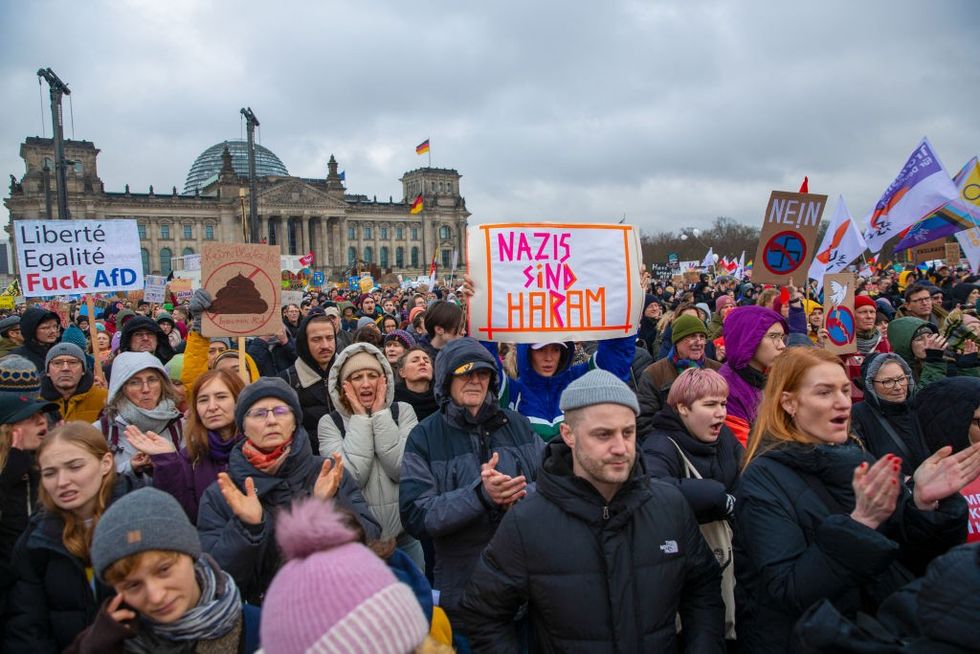 Saturday's protest was a collaboration involving more than one thousand entities, including leave none behind, Amnesty International, Echo Iran, and FridaysForFuture, initiated the call for action against right-wing extremism at the Reichstag building. (Photo by HAMI ROSHAN/Middle East Images/AFP via Getty Images)
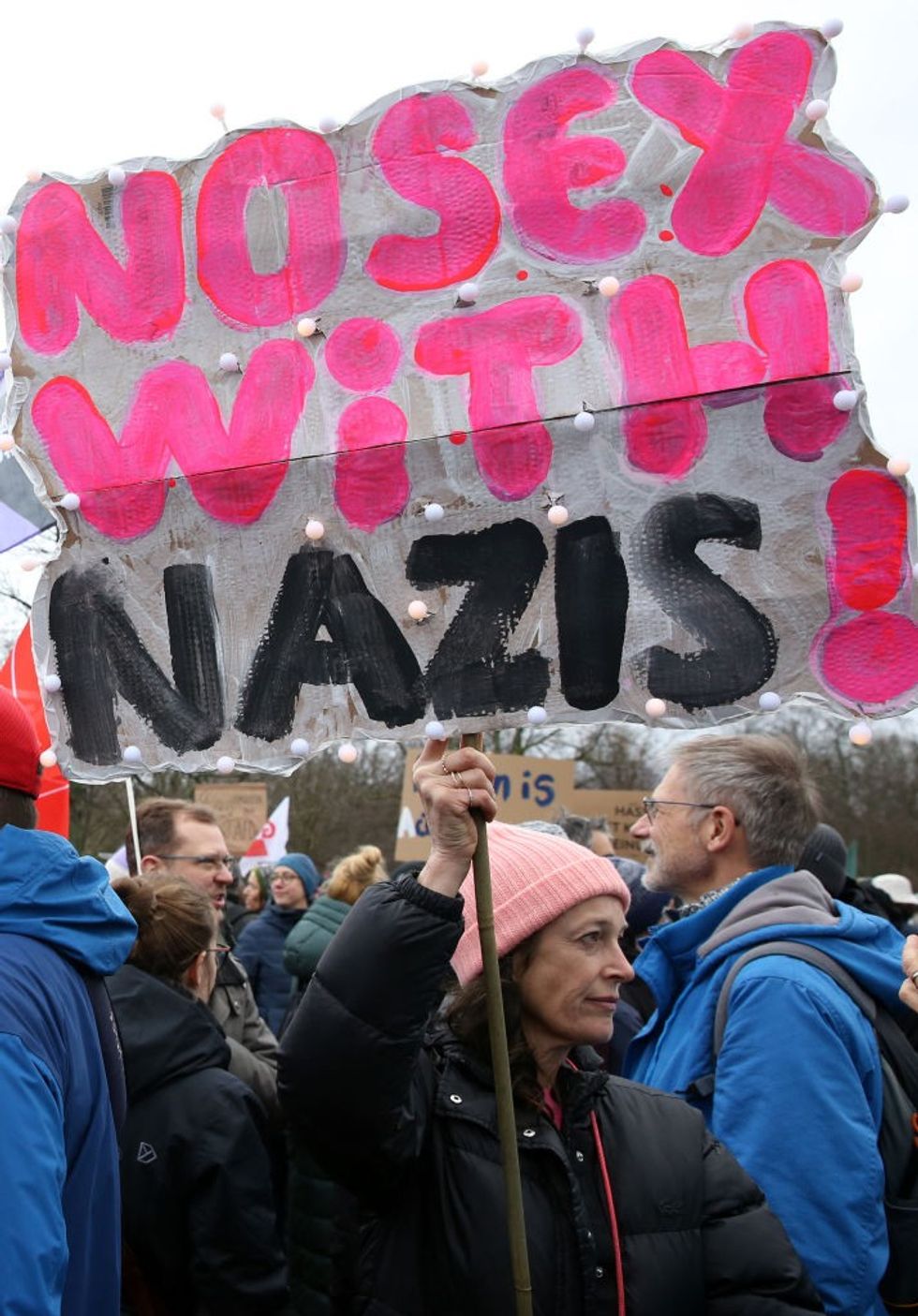 A participant holds up a placard reading 'No sex with Nazis' during a rally under the motto 'We are the firewall' called for by international non-profit organisation 'Hand in Hand' against right-wing politics in front of the Reichstag building in Berlin, Germany on February 3, 2024. (Photo by ADAM BERRY/AFP via Getty Images)
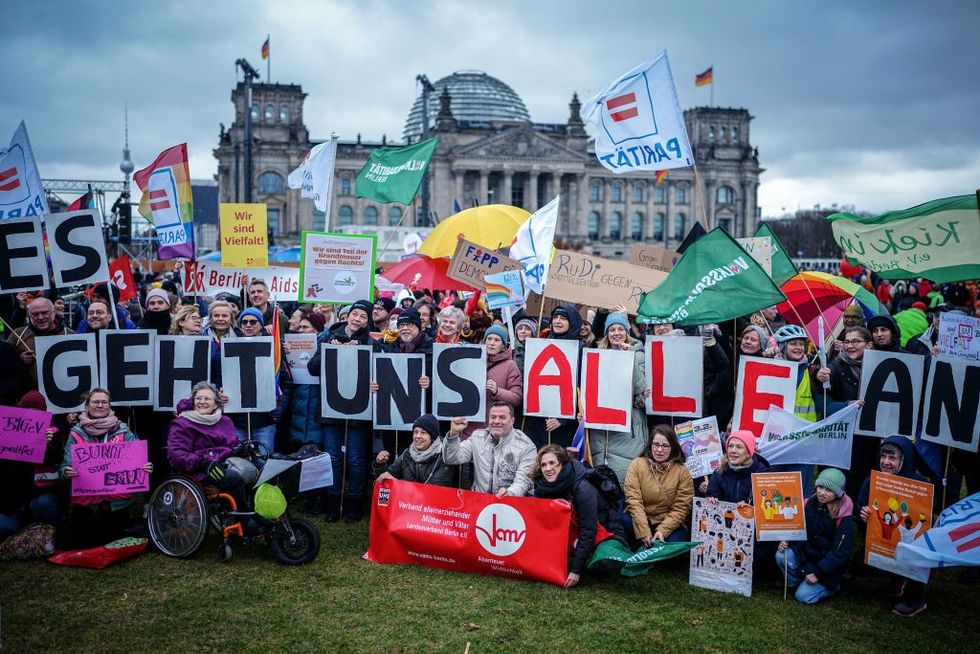 "We are the firewall" for democracy and against right-wing extremism. With the demonstration, the participants want to set an example of resistance against right-wing extremist activities. (Photo by Kay Nietfeld/picture alliance via Getty Images)

People in a number of international cities violated bans on large gatherings over the weekend to show solidarity with protests against police brutality that have exploded in at least 140 cities across the United States.
Political leaders overseas condemned the killing of Floyd, who died after now-former Minneapolis officer Derek Chauvin pressed his knee onto Floyd's neck for over eight minutes while the man was unarmed and handcuffed and as onlookers pleaded with Chauvin to stop.
An estimated 1,500 people in Berlin marched on Sunday to the ethnically and racially diverse neighborhood of Hermannplatz, a day after more than 2,000 people gathered outside the U.S. embassy where they chanted "Black Lives Matter" and held pictures of Floyd.
Other spontaneous gatherings were held in Copenhagen, London, Madrid, and Tokyo.
Political leaders overseas condemned the killing of Floyd, who died after now-former Minneapolis officer Derek Chauvin pressed his knee onto Floyd's neck for eight minutes while the man was unarmed and handcuffed and as onlookers pleaded with Chauvin to stop.
"Systematic racism caused his death, not just one bad apple in an institution," said Emma Sheerin, a lawmaker with the Irish Sinn Fein party in Northern Ireland. "In the north where our own freedom fighters and civil rights organizations were inspired by the demonstrations of the American civil rights movement of the 1960s, we stand in solidarity with those who struggle for equality."
In England, officials on Friday denounced the arrest of CNN correspondent Omar Jimenez and his camera crew as they reported on the protests in Minneapolis.
"Journalists all around the world must be free to do their job and hold authorities to account without fear of retribution," Britain's Foreign Office said in a statement.
Michelle Bachelet, the high commissioner for human rights at the United Nations, called on the U.S. to take "serious action" to end police killings of civilians, which happened nearly 1,100 times in 2019.
News agencies around the world registered shocked reactions to the protests which grew last week and over the weekend, spreading to U.S. cities both large and small and marked by law enforcement officers running vehicles into crowds of protesters, pepper spraying Rep. Joyce Beatty (D-Ohio) in Columbus, Ohio; and reportedly severely injuring Linda Tirado, a photojournalist in Minneapolis--among other acts of violence.
The German newspaper Bild wrote that the protests were "scenes like out of a civil war."
The Times of London, meanwhile, expressed no confidence in President Donald Trump's ability to--or interest in--taking steps to quell the anger brought on by Floyd's killing and those of other black civilians. The newspaper criticized Trump's threats of violence toward protesters and predicted he would continue to stoke outrage among his political opponents.
"Politically, identifying enemies puts Mr. Trump into his comfort zone," the Times' leading article read on Monday. "Rather than pouring oil on troubled waters, he has opted for petrol."
"Police brutality has created a flashpoint for unrest that was already simmering," the Times added. "President Trump must change his tone to avoid a violent summer."

BERLIN--On the last full day of two weeks spent in this city, the requisite visit was paid to Checkpoint Charlie, the spot at the Berlin Wall where, from 1961 to 1989, allied forces and other foreigners crossed the uneasy border between East and West Berlin. (Germans had designated checkpoints of their own.)
The wall once split this city in two with concrete and barbed wire, dividing people into those ruled by democratic West Germany or communist East Germany. Now, capitalism rules. Big time.
"When your moral universe is limited to a belief that the ends always justify the means it's a short trip to oppression and tyranny."
The scene of so many spy novels and movies, Checkpoint Charlie's original wooden shed is long gone, replaced by a replica with role players dressed up as US military personnel posing for tourist photos. At the place where American and Soviet tanks once confronted each other from just 100 yards apart, there now are coffee bars, souvenir shops and a Kentucky Fried Chicken. Sidewalk vendors peddle Red Army hats and badges along with chunks of what they say are pieces of the original wall. Nearby there's even a high-rise building of upscale apartments going up, to be called, I'm not making this up, "Charlie."
Once this place was Ground Zero in the Cold War and tensions teetered on the proverbial razor's edge. While three short sections of the wall still stand, in most places a thin line of cobblestones marks where it once was. Traffic and commerce flow freely, and to an outsider it can feel as if the heavily armed barrier never was there. But to those who lived here, the memory is never far away. There are constant reminders, like the white crosses honoring East Berliners shot while trying to escape or the big sign at Checkpoint Charlie announcing, "You are leaving the American sector" in four languages.
Not far from the checkpoint, a different wall is memorialized. It's near one of the remaining portions of the Berlin Wall but this one wasn't used to divide citizens one from another. Instead it helped hide acts of torture and murder, stifling the screams of the damned.
The wall and pieces of a main doorway are what remain of Adolf Hitler's Gestapo headquarters. Cells held fifty at a time for interrogation. Political prisoners were kept there, as well as Jews, Roma, trade unionists and members of the resistance - between the years 1933 and 1945 an estimated 15,000 in all. For many, if they survived, it was a way station on the way to the concentration camps of the SS.
Today the area is designated as the Topography of Terror Documentation Center, a museum of shame and horror documenting the rise of Hitler and the Third Reich, along with the unspeakable crimes against humanity committed in their names.
Right now, the center has an exhibit titled "Berlin 1933: The Path to Dictatorship." It features documents, photographs and texts chronicling the year that Hitler and the Nazi party consolidated power.
On January 30, 1933, Hitler became Germany's chancellor, taking over with the support of conservatives who believed they could keep him under control. His soon-to-be propaganda minister Joseph Goebbels organized a celebratory torchlight march that night of some 50,000 - although in an ironic foreshadowing of the Trump inauguration, Goebbels claimed it was a million.
To those who still claim it odious or unjust to compare our current White House and the Republican Party to what happened in Germany 85 years ago, I would urge them to come see "Berlin 1933." Here are the all-too-familiar seeds of a nascent totalitarian regime: the denigration and condemnation of rival political parties, the disintegration of the courts, attacks on organized labor while claiming massive job creation, the dismissal of public servants unwilling to swear undying allegiance to the leader, verbal and written slurs and smears flung against the press and opponents, inciting and legitimizing violence against anyone who dares to disagree.
By the following year, Hitler's cult of personality, "had reached new levels of idolatry and made millions of new converts," biographer Ian Kershaw wrote. "Disdain and detestation for a parliamentary system generally perceived to have failed miserably had resulted in willingness to entrust monopoly control over the state to a leader claiming a unique sense of mission and invested by his mass following with heroic, almost messianic, qualities. Conventional forms of government were, as a consequence, increasingly exposed to the arbitrary inroads of personalized power. It was a recipe for disaster."
This, too, sounds familiar. Yes, many, like Harvard legal scholar Cass R. Sunstein maintain that our system of checks and balances and the Constitution will keep us from sliding into the abyss that was Nazi Germany. National conditions are not the same--we have not hit the economic depths of the Wiemar Republic--nor have actual physical attacks on those perceived as adversaries been as widespread or violent. Yet.
Even Sunstein admits, as he noted earlier this year in The New York Review of Books, "It would be foolish to ignore the risks that Trump and his administration pose to established norms and institutions, which help preserve both order and liberty. Those risks will grow if opposition to violations of long-standing norms is limited to Democrats, and if Republicans laugh, applaud, agree with, or make excuses for Trump--if they howl with the wolf."
Do you see our Republican Congress doing anything to counter Trump's authoritarian tendencies? "Whatever secret reservations McConnell and other traditional Republican leaders have about Trump's character, governing style, and possible criminality," historian Christopher Browning writes, "they openly rejoice in the payoff they have received from their alliance with him and his base."
Merely look to Trump's eagerness to cover up Saudi Arabia's torture and murder of a Washington Post journalist as the president seeks to protect an arms deal that largely exists in his imagination. Or, as evinced in his 60 Minutes interview with Lesley Stahl, his continued warm embrace of the Saudis and the world's other dictators.
Sorry, but when your moral universe is limited to a belief that the ends always justify the means it's a short trip to oppression and tyranny. To those who think it can't happen here? Let them come to Berlin. The city has seen it all before.

Hundreds of thousands of people marched Saturday afternoon demonstrating against racism and calling for solidarity against the rise of the far-right across Germany and Europe.
On a hot and sunny fall day a 3-mile stretch of Berlin city's center, from Alexanderplatz through the Brandenburg Gate to the Victory Column, was closed to accommodate the huge parade, which was united under the hashtag #unteilbar ("indivisible").
A wide range of groups backed the "Indivisible" protest in the heart of the German capital under the slogan "For an Open and Free Society: Solidarity, not Exclusion!"
Here is the "Call to Action" that organizers issued last week:
For an Open and Free Society: Solidarity, not Exclusion!
A dramatic political shift is taking place: racism and discrimination are becoming socially acceptable. What yesterday was considered unthinkable and unutterable, has today become a reality. Humanity and human rights, religious freedom, and the rule of law are being openly attacked. This is an attack on all of us.
We will not allow the welfare state to be played off against asylum and migration. We will stand in resistance when fundamental rights and freedoms are in danger of being further restricted.
We are expected to accept the deaths of those seeking refuge in Europe as 'normal'. Europe is in a grip of an atmosphere of nationalistic antagonism and exclusion. However, any criticism of these inhumane conditions is dismissed as unrealistic.
While the State tightens its 'so-called' security laws and extends surveillance in a show of strength, the social system is increasingly characterised by weakness: millions suffer the impact of an underinvestment in basic care, healthcare, childcare, and education. Since 'Agenda 2010', the redistribution of wealth from below to above has advanced at an alarming rate. The billions in profit generated through tax incentives stand in stark contrast to one of the biggest low-wage sectors sectors in Europe and level of impoverished, disadvantaged people.
We are against this - we will resist!
We stand for an open and caring society, in which human rights are indivisible and in which diverse and self-determined ways of life, are undeniably respected.
We stand against all forms of hatred and discrimination. Together, we decidedly confront anti-Muslim racism, antisemitism, antiziganism, antifeminism and LGBTIQ-phobia.
There are already many of us.
Whether it's on Europe's external borders, or here within refugee organisations and in welcome initiatives; in queer-feminist and antiracist movements, migrant organisations, trade unions, associations, NGO's, religious communities, societies and neighbourhoods; whether it's through the fight against homelessness, displacement, or lack of care services, against surveillance and tightened security laws, or the stripping of rights from refugees -- in many places, people are actively defending themselves and others against discrimination, criminalisation and exclusion.
Together, we will make this caring society visible. On 13 October, a clear signal will be sent from Berlin.
#unteilbar
For an Open and Free Society: Solidarity, not Exclusion!
Demonstration: 13 October 2018 - 13:00 Berlin
For a Europe of human rights and social justice!
For a solidarity-based society rather than exclusion and racism!
For the right to protection and asylum - against the isolation of Europe!
For a free and diverse society!
Solidarity knows no borders!

Visiting Berlin for two weeks, and in the evening I go to bed in a small hotel room, tuning the radio to a German-language station. I understand barely a word but it features a strangely compelling, eclectic mix of Bach, Brubeck and Tim Buckley, unfortunately sometimes interrupted by electronic dance music, the dreaded EDM.
The news plays on the hour and from the torrent of words I cannot comprehend I still can pull the occasional bits and pieces: FBI, CNN, Kavanaugh, Trump. The entire Kavanaugh disaster has been much in the news here although it competes with headlines from the rest of the real world: tsunamis, Syria and Yemen.
Here in Germany, only one in ten expresses any confidence in Trump, and according to a new Pew Research Center poll, "It is the country with the highest percentage (80%) saying relations with the U.S. have deteriorated over the past year... [It's] also where the biggest declines have taken place in recent years regarding the belief that the U.S. respects personal freedom and that Washington listens to other countries in international affairs."
As was true at the United Nations two weeks ago, in Germany they are enraged by and laughing at our emperor without clothes, the Orange Julius condemning globalism and international cooperation. With his retinue of the shameless - yes, you, Mitch McConnell, Chuck Grassley, Susan Collins and Lindsey Graham, among too many others -- he defies public opinion, mocks the women of the United States, suppresses a proper investigation and rams through the nomination of a suspect judge just because he can and because it will hamstring American social progress for decades to come. Look to the White House, look to the Senate, look to our diplomats bereft of knowledge and experience: we are an international embarrassment.
All of which is beyond painful, but just as the clock strikes midnight over the radio in this Berlin hotel room comes an all-string ensemble playing a lovely version of the national anthem, Haydn's Deutschland uber Alles, followed immediately by Beethoven's Ode to Joy.
It's the perfect combination for our current world and this still-conflicted country of Germany, once officially divided into east and west. Each was written by a great German composer; the first a patriotic hymn, the words of which too often have been used to encourage war; the other a song that celebrates peace, now the anthem of the European Union. As a visitor to this country, such are the contradictions and ironies you run into every day.
Not far from this hotel is the DDR Museum, a somewhat bizarre institution dedicated to the days of Communist East Germany. Opened in 2006 by some scholars and entrepreneurs, it presents a slice of what life was like in the dreary years of Soviet-dominated rule. You can sit behind the wheel of a Trabant, a car of infamous notoriety manufactured there during the Cold War, the so-called "sparkplug with a roof" that at one time featured no fuel gauge, turn signals or headlights. There's a mock-up of what a block apartment in the drab worker's paradise was like as well as a secret police interrogation room and a jail cell. You can read copies of 39 different newspapers, all of which hewed to the party line, then see how in spite of it all, resistance slowly built and finally overcame the authoritarian regime.
The place was packed, with kids too young to remember and grown-ups who remembered all too well. You'd think they'd be adverse to the museum's mementos and the kitschy reminders sold in the gift shop, but they were transfixed, some thinking back to what their past lives in the east were like, others thankful they had never experienced the deprivations of the side that had been walled off from them with barbed wire and cement.
Wednesday, October 3, was German Reunification Day, the 28th anniversary of the day (nearly a year after the fall of the Berlin Wall) when East and West Germany officially became one country again. There were celebrations and fireworks reminiscent of the weeks when the physical barriers first were breached and people were brought back together and everything seemed possible.
But although no longer divided into separate nations, just a few years ago The Guardian reported on a German newspaper survey that found, "Three-quarters of the population think there are 'different mentalities' between east and west." Few from the west had visited the east and vice versa; only two-thirds of West Germans said they would marry someone from the east.
According to the latest report on the status of reunification, put out each year by the German government, the Berlin Wall is gone but an invisible wall remains. Leonid Bershidsky at Bloomberg writes that this year's analysis shows that both east and west have seen dramatic improvements in their respective economies but the east continues to lag behind.
What's more, he notes, "the political chasm is widening. The east is swinging to the far right because many of its people still feel like second-class citizens, and the recent arrival of hundreds of thousands of immigrants has only intensified their sense of being abandoned by reunified Germany's mostly western establishment." This despite a chancellor, Angela Merkel, who grew up in the east.
Anna Sauerbrey, an editor and writer at the German daily newspaper Der Tagesspiegel, says, "East and west are drifting apart again." There are far more right wing extremist crimes in the east - "it is a hotbed of far-right sympathy and outright hatred." In a recent New York Times op-ed, she observed that "Some also claim that eastern Germans, not having learned what democracy is like, are more easily frustrated with its tedious processes and often less-than-perfect results."
As in Trump's America and other European nations, whether it's the influx of immigrants or a lack of economic opportunity or insufficient representation in the government, the former East Germany increasingly favors a nationalist, populist political movement; in this case, the Alternative for Germany party.
Our American president would build a wall across the border with Mexico to squelch immigration but Berlin is a city that knows the horror of what such a barrier is really like. It lived with its wall for nearly three decades, the heart of a metropolis broken in two, splitting up families and friends and creating a nightmare of bureaucratic redundancy that's still being sorted. And yet Germany may be sliding back into the same bigotry and nativism that tore it apart less than a century ago, the xenophobia and prejudice that threaten our democracy as well.
This past week, watching events in Washington from an ocean and continent away did not create any sense of distance because this nation of Germany is a constant reminder of how easily a republic can slide into dictatorship. Ever since the end of World War II, both by edict and desire, the people here have struggled -- with much success -- to make sure it never happens again. But once again events and resentment may be moving it ever so dangerously back toward jingoism and hate.
Meanwhile, our homegrown, would-be Caesar shouts America First and sets a wretched, hurtful example for staunch allies like Germany and the rest of the world.
Turn up the radio, please, and drown out the news with Beethoven. I'm afraid to hear how it all turns out.
Hundreds of peace activists on Monday launched an on-foot march from Berlin, Germany to Aleppo, Syria in hopes of building political pressure to end the fighting and help refugees there.
The Civil March for Aleppo is expected to take a little over three months, and is set to stretch through the Czech Republic, Austria, Slovenia, Croatia, Serbia, the Former Yugoslav Republic of Macedonia, Greece, and Turkey, euronews reported. That's the so-called "refugee route," taken backwards, the group wrote on its website. More than a million people took that path in 2015 to escape from battlefields in the Middle East.
The group's end goal is to eventually reach the besieged city of Aleppo.
"The true purpose of the march is that the civilians in Syria get access to humanitarian aid," said organizer Anna Alboth, a Polish journalist. "We are marching to build pressure."
About 400 people set off from Berlin, hoisting white flags and dressed to shield themselves from a dreary winter day. The march began at the former Tempelhof Airport, which was shuttered in 2008 and now serves as a temporary shelter for thousands of refugees from Syria, Iraq, and other countries.
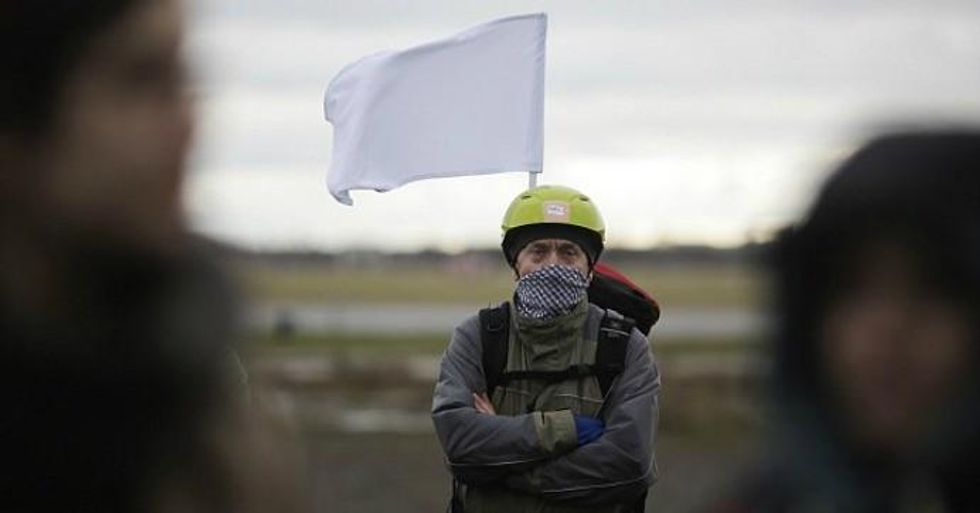
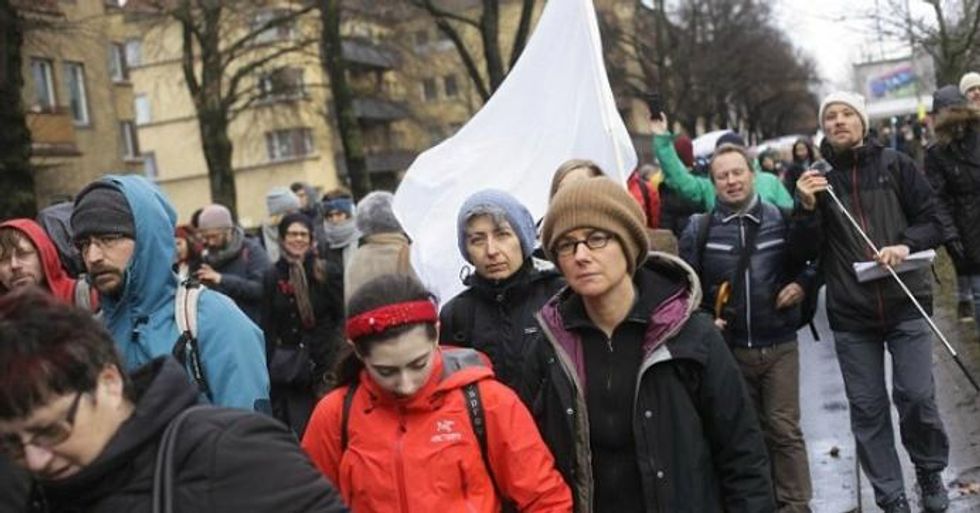
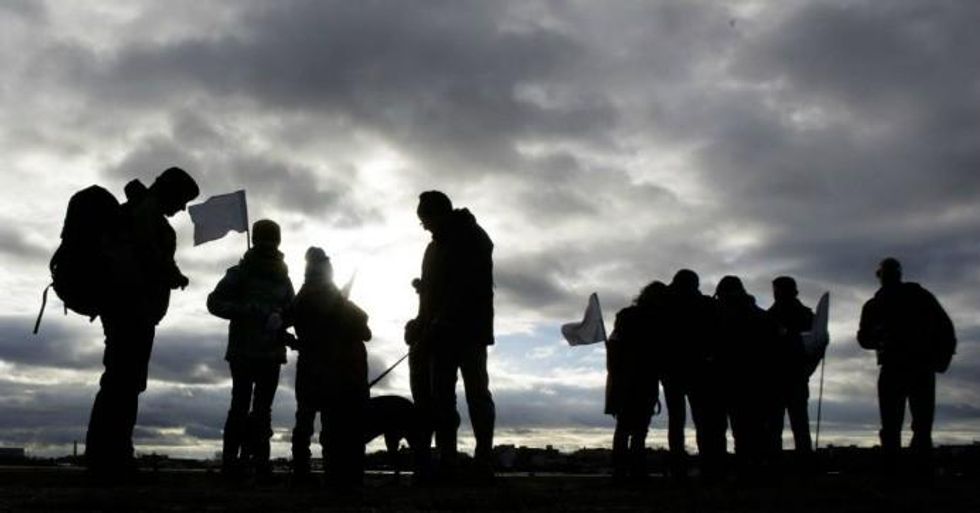
More activists are expected to join along the way.
The group's manifesto states, "It's time to act. We've had enough of clicking the sad or shocked faces on Facebook and writing, 'This is terrible.'"
"We demand help for civilians, protecting human rights and working out a peaceful solution for the people of Aleppo and other besieged cities in Syria and beyond," the group wrote. "Join us!"
One 28-year-old Syrian refugee now living in Germany said he was taking part in the action because "the march and the people here express their humanity and I want to contribute to it. Other people in the world need to know that the situation in Syria is terrible."