SUBSCRIBE TO OUR FREE NEWSLETTER
Daily news & progressive opinion—funded by the people, not the corporations—delivered straight to your inbox.
5
#000000
#FFFFFF
To donate by check, phone, or other method, see our More Ways to Give page.
Daily news & progressive opinion—funded by the people, not the corporations—delivered straight to your inbox.
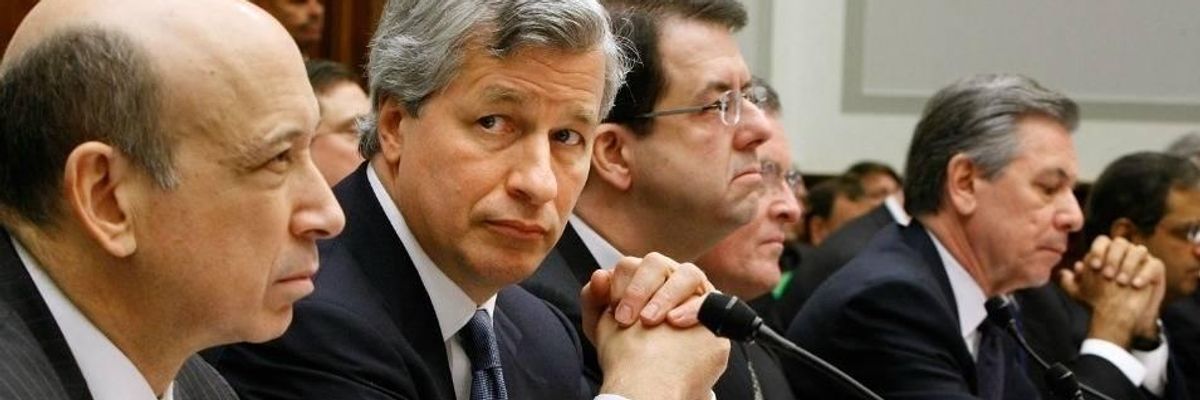
Executives from the financial institutions who received TARP funds, Goldman Sachs Chairman and CEO Lloyd Blankfein, JPMorgan Chase & Co Chairman and CEO Jamie Dimon, The Bank of New York Mellon CEO Robert P. Kelly, Bank of America CEO Ken Lewis and State Street Corporation CEO and Chairman Ronald Logue testify in Washington, DC. (Photo: Chip Somodevilla/Getty Images)
Ten years after Wall Street crashed the economy, costing millions of Americans their homes, the jobs and their savings, Wall Street is busily dismantling the safeguards Congress erected to prevent another catastrophe.
This war on regulation, documented in a recent report from the Coalition for Sensible Safeguards, has swept across Congress and the banking regulatory agencies.
"Sweeping attacks on financial and consumer protections won't make America greater. They'll make it crater, setting the stage for the next Wall Street crisis and very likely another round of taxpayer-funded bank bailouts."
These attacks stem from the corrupt connection between Wall Street political spending and compliant lawmakers, and from revolving-door regulators who came from--and may well return to--Wall Street jobs.
Every safeguard that is repealed or withdrawn, every standard that goes unenforced, every executive order that rigs the rules and every dedicated public servant replaced by a corporate ideologue is another payback to a regulated industry - usually one that has spent countless millions, or in Wall Street's case billions, to influence lawmakers and buy special favors.
Here's how Wall Street banks cashed in on their political spending and lobbying dollars over the past two years:
They staffed financial regulatory agencies with Goldman Sachs and other big bank alumni, who then used their positions to back sweeping financial deregulation.
They seated anti-government, anti-consumer radical Mick Mulvaney as the temporary head of the U.S. Consumer Financial Protection Bureau (CFPB) and arranged for one of his loyal foot soldiers, a completely unqualified political hack, to be the next permanent director.
They secured a sweeping retreat in our government's regulatory enforcement, especially enforcement targeting the financial industry, which is needed to deter and punish corporate crime.
They persuaded Congress to use the Congressional Review Act to repeal the CFPB's forced arbitration rule, blocking consumers' access to the courts and allowing banks and credit card companies to rip off customers with impunity.
They pushed half a dozen agencies to commit to weakening the Volcker Rule, which stops banks from recklessly gambling with deposits.
They won a massive tax handout benefitting the ultra-wealthy and big corporations, tens of billions of which went directly into the coffers of the largest Wall Street banks.
And to top it off, they got Congress to pass a major bank deregulation package rolling back important post-crisis reforms that protected consumers, curtailed lending discrimination and increased oversight of the financial system.
These sweeping attacks on financial and consumer protections won't make America greater. They'll make it crater, setting the stage for the next Wall Street crisis and very likely another round of taxpayer-funded bank bailouts.
Polls show that Americans of all political stripes do not want Wall Street safeguards removed, support strong public protections and tough enforcement, and want even stricter rules.
Congress must put real checks on corporate power in Washington and around the country. We need reforms to close the revolving door and rein in regulatory capture - legislation like U.S. Sen. Elizabeth Warren's (D-Mass.) Anti-Corruption and Public Integrity Act.
Major ethics reforms are needed to end the cycle of deregulatory corruption and ensure that lawmakers put Main Street Americans ahead of Wall Street banks.
Dear Common Dreams reader, It’s been nearly 30 years since I co-founded Common Dreams with my late wife, Lina Newhouser. We had the radical notion that journalism should serve the public good, not corporate profits. It was clear to us from the outset what it would take to build such a project. No paid advertisements. No corporate sponsors. No millionaire publisher telling us what to think or do. Many people said we wouldn't last a year, but we proved those doubters wrong. Together with a tremendous team of journalists and dedicated staff, we built an independent media outlet free from the constraints of profits and corporate control. Our mission has always been simple: To inform. To inspire. To ignite change for the common good. Building Common Dreams was not easy. Our survival was never guaranteed. When you take on the most powerful forces—Wall Street greed, fossil fuel industry destruction, Big Tech lobbyists, and uber-rich oligarchs who have spent billions upon billions rigging the economy and democracy in their favor—the only bulwark you have is supporters who believe in your work. But here’s the urgent message from me today. It's never been this bad out there. And it's never been this hard to keep us going. At the very moment Common Dreams is most needed, the threats we face are intensifying. We need your support now more than ever. We don't accept corporate advertising and never will. We don't have a paywall because we don't think people should be blocked from critical news based on their ability to pay. Everything we do is funded by the donations of readers like you. When everyone does the little they can afford, we are strong. But if that support retreats or dries up, so do we. Will you donate now to make sure Common Dreams not only survives but thrives? —Craig Brown, Co-founder |
Ten years after Wall Street crashed the economy, costing millions of Americans their homes, the jobs and their savings, Wall Street is busily dismantling the safeguards Congress erected to prevent another catastrophe.
This war on regulation, documented in a recent report from the Coalition for Sensible Safeguards, has swept across Congress and the banking regulatory agencies.
"Sweeping attacks on financial and consumer protections won't make America greater. They'll make it crater, setting the stage for the next Wall Street crisis and very likely another round of taxpayer-funded bank bailouts."
These attacks stem from the corrupt connection between Wall Street political spending and compliant lawmakers, and from revolving-door regulators who came from--and may well return to--Wall Street jobs.
Every safeguard that is repealed or withdrawn, every standard that goes unenforced, every executive order that rigs the rules and every dedicated public servant replaced by a corporate ideologue is another payback to a regulated industry - usually one that has spent countless millions, or in Wall Street's case billions, to influence lawmakers and buy special favors.
Here's how Wall Street banks cashed in on their political spending and lobbying dollars over the past two years:
They staffed financial regulatory agencies with Goldman Sachs and other big bank alumni, who then used their positions to back sweeping financial deregulation.
They seated anti-government, anti-consumer radical Mick Mulvaney as the temporary head of the U.S. Consumer Financial Protection Bureau (CFPB) and arranged for one of his loyal foot soldiers, a completely unqualified political hack, to be the next permanent director.
They secured a sweeping retreat in our government's regulatory enforcement, especially enforcement targeting the financial industry, which is needed to deter and punish corporate crime.
They persuaded Congress to use the Congressional Review Act to repeal the CFPB's forced arbitration rule, blocking consumers' access to the courts and allowing banks and credit card companies to rip off customers with impunity.
They pushed half a dozen agencies to commit to weakening the Volcker Rule, which stops banks from recklessly gambling with deposits.
They won a massive tax handout benefitting the ultra-wealthy and big corporations, tens of billions of which went directly into the coffers of the largest Wall Street banks.
And to top it off, they got Congress to pass a major bank deregulation package rolling back important post-crisis reforms that protected consumers, curtailed lending discrimination and increased oversight of the financial system.
These sweeping attacks on financial and consumer protections won't make America greater. They'll make it crater, setting the stage for the next Wall Street crisis and very likely another round of taxpayer-funded bank bailouts.
Polls show that Americans of all political stripes do not want Wall Street safeguards removed, support strong public protections and tough enforcement, and want even stricter rules.
Congress must put real checks on corporate power in Washington and around the country. We need reforms to close the revolving door and rein in regulatory capture - legislation like U.S. Sen. Elizabeth Warren's (D-Mass.) Anti-Corruption and Public Integrity Act.
Major ethics reforms are needed to end the cycle of deregulatory corruption and ensure that lawmakers put Main Street Americans ahead of Wall Street banks.
Ten years after Wall Street crashed the economy, costing millions of Americans their homes, the jobs and their savings, Wall Street is busily dismantling the safeguards Congress erected to prevent another catastrophe.
This war on regulation, documented in a recent report from the Coalition for Sensible Safeguards, has swept across Congress and the banking regulatory agencies.
"Sweeping attacks on financial and consumer protections won't make America greater. They'll make it crater, setting the stage for the next Wall Street crisis and very likely another round of taxpayer-funded bank bailouts."
These attacks stem from the corrupt connection between Wall Street political spending and compliant lawmakers, and from revolving-door regulators who came from--and may well return to--Wall Street jobs.
Every safeguard that is repealed or withdrawn, every standard that goes unenforced, every executive order that rigs the rules and every dedicated public servant replaced by a corporate ideologue is another payback to a regulated industry - usually one that has spent countless millions, or in Wall Street's case billions, to influence lawmakers and buy special favors.
Here's how Wall Street banks cashed in on their political spending and lobbying dollars over the past two years:
They staffed financial regulatory agencies with Goldman Sachs and other big bank alumni, who then used their positions to back sweeping financial deregulation.
They seated anti-government, anti-consumer radical Mick Mulvaney as the temporary head of the U.S. Consumer Financial Protection Bureau (CFPB) and arranged for one of his loyal foot soldiers, a completely unqualified political hack, to be the next permanent director.
They secured a sweeping retreat in our government's regulatory enforcement, especially enforcement targeting the financial industry, which is needed to deter and punish corporate crime.
They persuaded Congress to use the Congressional Review Act to repeal the CFPB's forced arbitration rule, blocking consumers' access to the courts and allowing banks and credit card companies to rip off customers with impunity.
They pushed half a dozen agencies to commit to weakening the Volcker Rule, which stops banks from recklessly gambling with deposits.
They won a massive tax handout benefitting the ultra-wealthy and big corporations, tens of billions of which went directly into the coffers of the largest Wall Street banks.
And to top it off, they got Congress to pass a major bank deregulation package rolling back important post-crisis reforms that protected consumers, curtailed lending discrimination and increased oversight of the financial system.
These sweeping attacks on financial and consumer protections won't make America greater. They'll make it crater, setting the stage for the next Wall Street crisis and very likely another round of taxpayer-funded bank bailouts.
Polls show that Americans of all political stripes do not want Wall Street safeguards removed, support strong public protections and tough enforcement, and want even stricter rules.
Congress must put real checks on corporate power in Washington and around the country. We need reforms to close the revolving door and rein in regulatory capture - legislation like U.S. Sen. Elizabeth Warren's (D-Mass.) Anti-Corruption and Public Integrity Act.
Major ethics reforms are needed to end the cycle of deregulatory corruption and ensure that lawmakers put Main Street Americans ahead of Wall Street banks.