SUBSCRIBE TO OUR FREE NEWSLETTER
Daily news & progressive opinion—funded by the people, not the corporations—delivered straight to your inbox.
5
#000000
#FFFFFF
To donate by check, phone, or other method, see our More Ways to Give page.
Daily news & progressive opinion—funded by the people, not the corporations—delivered straight to your inbox.
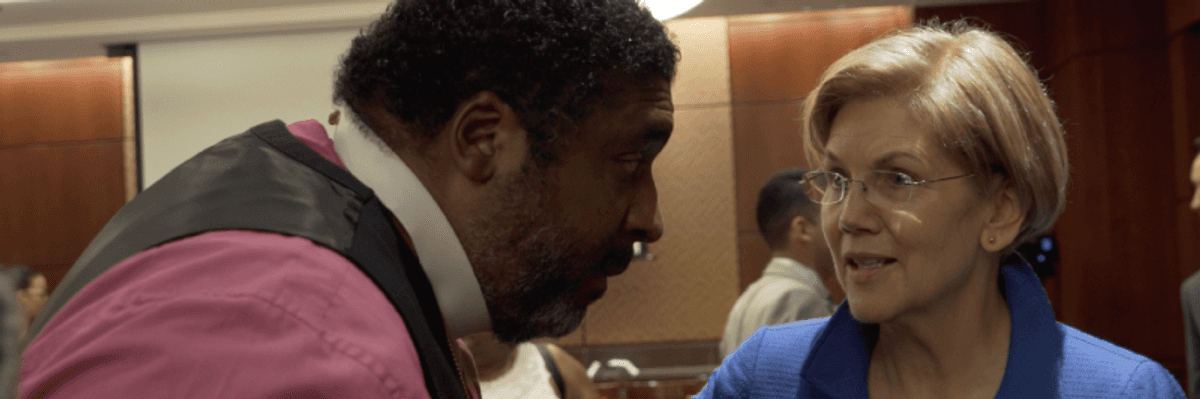
Reverend William J. Barber II and Elizabeth Warren. (Screengrab)
On June 12th, 2018, Reverend William J. Barber II hosted a discussion on poverty for members of Congress. People living in poverty across the United States -- from California to Kentucky to Michigan to West Virginia -- told us their stories. We heard from a victim of a predatory loan who lives in a trailer home infested with mold. We heard from an undocumented immigrant who struggles to afford rent in Los Angeles. We heard from a retired coal miner who is still fighting for fair benefits from greedy corporations.
As Americans struggle to pay their bills, the Trump Administration continues to spit in the face of poor people. Donald Trump has nominated Brett Kavanaugh to the Supreme Court -- a judge who poses a real threat to historically disadvantaged communities, including people of color, LGBTQ Americans, workers and the poor. The president has also crammed his administration with officials who care more about making money for themselves than protecting our environment, keeping our workers safe, and advocating for the rights of unions and consumers. Poor people are under attack from those in power, and the Poor People's Campaign is on the forefront of this fight.
"This is not a liberal or a conservative movement. It is a deeply moral movement. The people who are hurting the most have linked up to say, 'We won't be silent anymore.'" Reverend Barber launched the Poor People's Campaign: A National Call for Moral Revival to pick up where Rev. Martin Luther King Jr. left off 50 years ago.
"I think it's really easy for us as human beings to punish people or dismiss people because we don't love them. And we can't love them, we say, if we don't know them." Amy Jo Hutchinson told us about people living in poverty in West Virginia -- and the governor's immoral proposal to add work requirements to SNAP benefits.
Pamela Rush is a mother of two from Alabama. Her family lives in a mobile home that's falling apart. But as a victim of a predatory loan, she has no money for repairs. Her 10-year-old daughter has breathing problems because of the mold in the trailer. She joined the Poor People's campaign because she wants to fight back.
"There seems to be a lack of compassion and humility -- or at the very least a turning of a blind eye -- to problem areas in our society." Christopher Olive is a U.S. Air Force veteran. He suffered from opioid addiction and homelessness after his discharge. He's now fighting for affordable housing, rental assistance, and treatment facilities in his community, Grays Harbor County in Washington state.
Vanessa Nosie represents the San Carlos Apache tribe, from the Apache stronghold. She told us about the Elem Indian Colony in Clearlake, California. Cancer rates are increasingly high in the area after miners stripped mercury from the land, leaking heavy metal into the water. She's fighting to preserve the sacred land of indigenous people from corporate greed and environmental devastation.
"As long as we're divided, they can conquer." Nick Smith is the son of a coal miner's daughter. He's seen poverty grow worse and worse in Appalachia as coal mining jobs disappear and unions are weakened. Nick is fighting against corporate greed, anti-union legislation, and voter suppression.
"Unfortunately, today most immigrants are afraid. But we're not just afraid of getting deported, we're now afraid of having our children ripped from our arms while we're crossing borders." Kenia Alcocer is fighting for basic human rights for immigrants. She told us about her life in Los Angeles, and how she fears displacement because of high rents and stagnant wages. "This is not about a paper, this is not about citizenship, this is about human rights."
"We have an administration right now in place that's doing everything they can to set us back as much as they can." Stanley Sturgill told us about the devastation of "right-to-work" anti-union laws in Kentucky. After working 41 years in the coal mines, he continues to fight for the health care and pension rights of coal miners.
"Venus is supposed to be alive." Callie Greer's daughter, Venus Colley-Mims, died because she didn't have access to health care. While fighting for her life, she battled insurance companies who refused to pay for the medical care she needed. While waiting for the insurance company to approve a CAT scan and breathing equipment, she lapsed into a coma and died. Callie is fighting for every single person's right to health care.
Ariana spoke about the water crisis in Flint, Michigan. Her family and her community are still suffering without clean water and she demands to know why the government has still not adequately addressed this crisis.
"Everyone needs health care." Margie from North Carolina, told the story of her late brother-in-law, who died from kidney cancer because he did not have access to health care. She is advocating for Medicare for All because health care is a basic human right.
Dear Common Dreams reader, It’s been nearly 30 years since I co-founded Common Dreams with my late wife, Lina Newhouser. We had the radical notion that journalism should serve the public good, not corporate profits. It was clear to us from the outset what it would take to build such a project. No paid advertisements. No corporate sponsors. No millionaire publisher telling us what to think or do. Many people said we wouldn't last a year, but we proved those doubters wrong. Together with a tremendous team of journalists and dedicated staff, we built an independent media outlet free from the constraints of profits and corporate control. Our mission has always been simple: To inform. To inspire. To ignite change for the common good. Building Common Dreams was not easy. Our survival was never guaranteed. When you take on the most powerful forces—Wall Street greed, fossil fuel industry destruction, Big Tech lobbyists, and uber-rich oligarchs who have spent billions upon billions rigging the economy and democracy in their favor—the only bulwark you have is supporters who believe in your work. But here’s the urgent message from me today. It's never been this bad out there. And it's never been this hard to keep us going. At the very moment Common Dreams is most needed, the threats we face are intensifying. We need your support now more than ever. We don't accept corporate advertising and never will. We don't have a paywall because we don't think people should be blocked from critical news based on their ability to pay. Everything we do is funded by the donations of readers like you. When everyone does the little they can afford, we are strong. But if that support retreats or dries up, so do we. Will you donate now to make sure Common Dreams not only survives but thrives? —Craig Brown, Co-founder |
On June 12th, 2018, Reverend William J. Barber II hosted a discussion on poverty for members of Congress. People living in poverty across the United States -- from California to Kentucky to Michigan to West Virginia -- told us their stories. We heard from a victim of a predatory loan who lives in a trailer home infested with mold. We heard from an undocumented immigrant who struggles to afford rent in Los Angeles. We heard from a retired coal miner who is still fighting for fair benefits from greedy corporations.
As Americans struggle to pay their bills, the Trump Administration continues to spit in the face of poor people. Donald Trump has nominated Brett Kavanaugh to the Supreme Court -- a judge who poses a real threat to historically disadvantaged communities, including people of color, LGBTQ Americans, workers and the poor. The president has also crammed his administration with officials who care more about making money for themselves than protecting our environment, keeping our workers safe, and advocating for the rights of unions and consumers. Poor people are under attack from those in power, and the Poor People's Campaign is on the forefront of this fight.
"This is not a liberal or a conservative movement. It is a deeply moral movement. The people who are hurting the most have linked up to say, 'We won't be silent anymore.'" Reverend Barber launched the Poor People's Campaign: A National Call for Moral Revival to pick up where Rev. Martin Luther King Jr. left off 50 years ago.
"I think it's really easy for us as human beings to punish people or dismiss people because we don't love them. And we can't love them, we say, if we don't know them." Amy Jo Hutchinson told us about people living in poverty in West Virginia -- and the governor's immoral proposal to add work requirements to SNAP benefits.
Pamela Rush is a mother of two from Alabama. Her family lives in a mobile home that's falling apart. But as a victim of a predatory loan, she has no money for repairs. Her 10-year-old daughter has breathing problems because of the mold in the trailer. She joined the Poor People's campaign because she wants to fight back.
"There seems to be a lack of compassion and humility -- or at the very least a turning of a blind eye -- to problem areas in our society." Christopher Olive is a U.S. Air Force veteran. He suffered from opioid addiction and homelessness after his discharge. He's now fighting for affordable housing, rental assistance, and treatment facilities in his community, Grays Harbor County in Washington state.
Vanessa Nosie represents the San Carlos Apache tribe, from the Apache stronghold. She told us about the Elem Indian Colony in Clearlake, California. Cancer rates are increasingly high in the area after miners stripped mercury from the land, leaking heavy metal into the water. She's fighting to preserve the sacred land of indigenous people from corporate greed and environmental devastation.
"As long as we're divided, they can conquer." Nick Smith is the son of a coal miner's daughter. He's seen poverty grow worse and worse in Appalachia as coal mining jobs disappear and unions are weakened. Nick is fighting against corporate greed, anti-union legislation, and voter suppression.
"Unfortunately, today most immigrants are afraid. But we're not just afraid of getting deported, we're now afraid of having our children ripped from our arms while we're crossing borders." Kenia Alcocer is fighting for basic human rights for immigrants. She told us about her life in Los Angeles, and how she fears displacement because of high rents and stagnant wages. "This is not about a paper, this is not about citizenship, this is about human rights."
"We have an administration right now in place that's doing everything they can to set us back as much as they can." Stanley Sturgill told us about the devastation of "right-to-work" anti-union laws in Kentucky. After working 41 years in the coal mines, he continues to fight for the health care and pension rights of coal miners.
"Venus is supposed to be alive." Callie Greer's daughter, Venus Colley-Mims, died because she didn't have access to health care. While fighting for her life, she battled insurance companies who refused to pay for the medical care she needed. While waiting for the insurance company to approve a CAT scan and breathing equipment, she lapsed into a coma and died. Callie is fighting for every single person's right to health care.
Ariana spoke about the water crisis in Flint, Michigan. Her family and her community are still suffering without clean water and she demands to know why the government has still not adequately addressed this crisis.
"Everyone needs health care." Margie from North Carolina, told the story of her late brother-in-law, who died from kidney cancer because he did not have access to health care. She is advocating for Medicare for All because health care is a basic human right.
On June 12th, 2018, Reverend William J. Barber II hosted a discussion on poverty for members of Congress. People living in poverty across the United States -- from California to Kentucky to Michigan to West Virginia -- told us their stories. We heard from a victim of a predatory loan who lives in a trailer home infested with mold. We heard from an undocumented immigrant who struggles to afford rent in Los Angeles. We heard from a retired coal miner who is still fighting for fair benefits from greedy corporations.
As Americans struggle to pay their bills, the Trump Administration continues to spit in the face of poor people. Donald Trump has nominated Brett Kavanaugh to the Supreme Court -- a judge who poses a real threat to historically disadvantaged communities, including people of color, LGBTQ Americans, workers and the poor. The president has also crammed his administration with officials who care more about making money for themselves than protecting our environment, keeping our workers safe, and advocating for the rights of unions and consumers. Poor people are under attack from those in power, and the Poor People's Campaign is on the forefront of this fight.
"This is not a liberal or a conservative movement. It is a deeply moral movement. The people who are hurting the most have linked up to say, 'We won't be silent anymore.'" Reverend Barber launched the Poor People's Campaign: A National Call for Moral Revival to pick up where Rev. Martin Luther King Jr. left off 50 years ago.
"I think it's really easy for us as human beings to punish people or dismiss people because we don't love them. And we can't love them, we say, if we don't know them." Amy Jo Hutchinson told us about people living in poverty in West Virginia -- and the governor's immoral proposal to add work requirements to SNAP benefits.
Pamela Rush is a mother of two from Alabama. Her family lives in a mobile home that's falling apart. But as a victim of a predatory loan, she has no money for repairs. Her 10-year-old daughter has breathing problems because of the mold in the trailer. She joined the Poor People's campaign because she wants to fight back.
"There seems to be a lack of compassion and humility -- or at the very least a turning of a blind eye -- to problem areas in our society." Christopher Olive is a U.S. Air Force veteran. He suffered from opioid addiction and homelessness after his discharge. He's now fighting for affordable housing, rental assistance, and treatment facilities in his community, Grays Harbor County in Washington state.
Vanessa Nosie represents the San Carlos Apache tribe, from the Apache stronghold. She told us about the Elem Indian Colony in Clearlake, California. Cancer rates are increasingly high in the area after miners stripped mercury from the land, leaking heavy metal into the water. She's fighting to preserve the sacred land of indigenous people from corporate greed and environmental devastation.
"As long as we're divided, they can conquer." Nick Smith is the son of a coal miner's daughter. He's seen poverty grow worse and worse in Appalachia as coal mining jobs disappear and unions are weakened. Nick is fighting against corporate greed, anti-union legislation, and voter suppression.
"Unfortunately, today most immigrants are afraid. But we're not just afraid of getting deported, we're now afraid of having our children ripped from our arms while we're crossing borders." Kenia Alcocer is fighting for basic human rights for immigrants. She told us about her life in Los Angeles, and how she fears displacement because of high rents and stagnant wages. "This is not about a paper, this is not about citizenship, this is about human rights."
"We have an administration right now in place that's doing everything they can to set us back as much as they can." Stanley Sturgill told us about the devastation of "right-to-work" anti-union laws in Kentucky. After working 41 years in the coal mines, he continues to fight for the health care and pension rights of coal miners.
"Venus is supposed to be alive." Callie Greer's daughter, Venus Colley-Mims, died because she didn't have access to health care. While fighting for her life, she battled insurance companies who refused to pay for the medical care she needed. While waiting for the insurance company to approve a CAT scan and breathing equipment, she lapsed into a coma and died. Callie is fighting for every single person's right to health care.
Ariana spoke about the water crisis in Flint, Michigan. Her family and her community are still suffering without clean water and she demands to know why the government has still not adequately addressed this crisis.
"Everyone needs health care." Margie from North Carolina, told the story of her late brother-in-law, who died from kidney cancer because he did not have access to health care. She is advocating for Medicare for All because health care is a basic human right.