SUBSCRIBE TO OUR FREE NEWSLETTER
Daily news & progressive opinion—funded by the people, not the corporations—delivered straight to your inbox.
5
#000000
#FFFFFF
To donate by check, phone, or other method, see our More Ways to Give page.
Daily news & progressive opinion—funded by the people, not the corporations—delivered straight to your inbox.
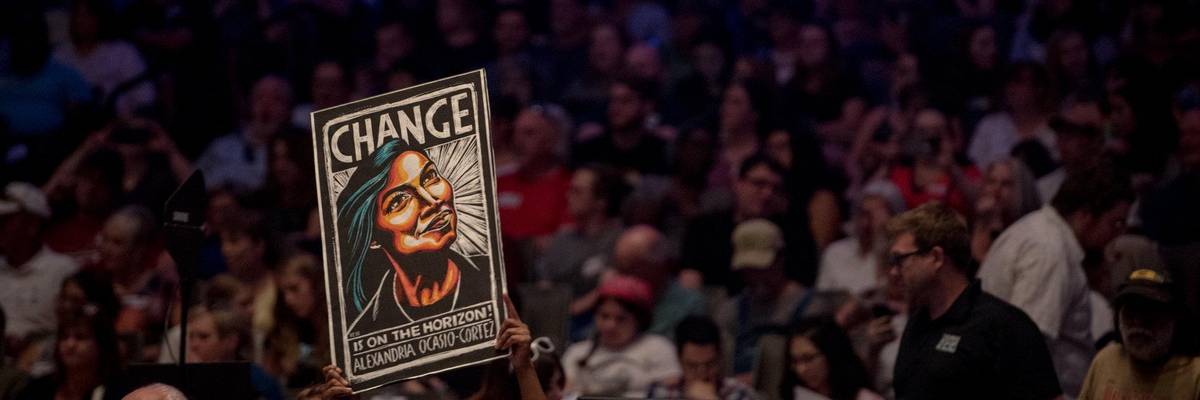
At a rally last week in Wichita, Kan., for James Thompson, a Democratic House candidate for a House seat, an audience member displayed a sign portraying Alexandria Ocasio-Cortez, a member of the Democratic Socialists of America and Democratic nominee for a House seat in New York City. (Photo: Hilary Swift for The New York Times)
In November, several outright Nazis and white supremacists will appear on Republican ballot lines. Arthur Jones, a founder of a neo-Nazi groupcalled the America First Committee, managed to become the Republican nominee for Congress in the heavily Democratic Third District in Illinois. The Republican candidate in California's 11th District, John Fitzgerald, is running on a platform of Holocaust denial. Russell Walker, a Republican statehouse candidate in North Carolina, has said that Jews descend from Satan and that God is a "white supremacist."
Corey Stewart, Virginia's Republican Senate nominee, is a neo-Confederate who pals around with racists, including one of the organizers of the violent "Unite the Right" rally in Charlottesville last year. The longtime Iowa Republican representative Steve King has moved from standard-issue nativist crank to full-on white nationalist; he recently retweeted a neo-Nazi and then refused to delete the tweet, saying, "It's the message, not the messenger."
Clearly, the time has come for a serious national conversation. And so political insiders across the land are asking: Has the Democratic Party become too extreme?
Everywhere you look lately, centrists are panicking about the emboldened left. Moderates, reported Alex Seitz-Wald of NBC News, "are warning that ignoring them will lead the party to disaster in the midterm elections and the 2020 presidential contest." Former Senator Joe Lieberman wrote in The Wall Street Journal that the primary victory of Alexandria Ocasio-Cortez, a member of the Democratic Socialists of America, over Representative Joe Crowley "seems likely to hurt Congress, America and the Democratic Party." James Comey, former director of the F.B.I., tweeted, "Democrats, please, please don't lose your minds and rush to the socialist left," arguing that "America's great middle wants sensible, balanced, ethical leadership."
Though Comey's judgment about things that affect political campaigns is not good, I think he's sincere in wanting Democrats to win in November. But his worry is misplaced. Partly, this is because Democrats are not, in fact, rushing to the socialist left in great numbers. "Overall, it's not really true that the insurgent leftist candidates, like the candidates who are affiliated with the D.S.A. or Bernie Sanders's group, are doing all that well," said Alan Abramowitz, a political scientist at Emory University who specializes in partisan polarization. With many of this year's primary races completed, Crowley is the only Democratic congressional incumbentso far to lose to a challenger from his left. Ocasio-Cortez is a bright, exciting new figure in the Democratic Party, but she doesn't define it.
And even people like Comey -- center-right figures who are momentarily allied with Democrats because they abhor Donald Trump -- should be cheered by the energy that Ocasio-Cortez and others like her are creating. In the midterms, passion is likely to matter more than appeals to an ever-shrinking pool of swing voters, who at any rate tend to be idiosyncratic economic populists rather than the judicious centrists of Beltway imagination.
I'm not wholly unsympathetic to people of good faith who want Democrats to win in November, but who fear that America is more conservative than left-wing activists like to believe. I grew up at a time when Democrats were deeply afraid of liberal overreach. For many of the people who taught me about politics, the debacle of George McGovern's 1972 rout was formative. Its lessons were reinforced by the overwhelming defeat of Michael Dukakis, who was painted as soft on crime and mocked by George H.W. Bush for being a "card-carrying member of the A.C.L.U.," as if concern for civil liberties were shameful. I wasn't old enough to vote when Bill Clinton was first elected, but I remember what a relief it was when he broke the Republicans' 12-year stranglehold on the White House, and how necessary and worthwhile his compromises seemed.
Now, however, Hillary Clinton's defeat has overshadowed McGovern's as the Democratic Party's paradigmatic trauma. There are several lessons you can draw from her loss, some of them conflicting -- some voters saw her as too corporate, others as too liberal. But it's clear that in a polarized electorate, grass-roots fervor and a candidate's charisma matter a lot, and an agenda that seems too modest can be as risky as one that appears overly ambitious.
After all, the economic demands that animate the left are generally quite popular. Though "Medicare For All" means different things to different people, a Kaiser Family Foundation poll from last year found that 62 percent of Americans view it positively. A recent Rasmussen poll found 46 percent of likely voters support a federal jobs guarantee, a more radical proposal that was barely present in American politics a couple of years ago.
Centrists might not think these are good ideas, but they are not wild fantasies; they represent efforts to grapple with the chronic economic insecurity that is the enemy of political stability.
Democrats will not defeat Trump and his increasingly fanatical, revanchist party by promising the restoration of what came before him; the country is desperate for a vision of something better. Whether or not you share that vision, if you truly believe that Trump is a threat to democracy, you should welcome politics that inspire people to come to democracy's rescue.
Dear Common Dreams reader, It’s been nearly 30 years since I co-founded Common Dreams with my late wife, Lina Newhouser. We had the radical notion that journalism should serve the public good, not corporate profits. It was clear to us from the outset what it would take to build such a project. No paid advertisements. No corporate sponsors. No millionaire publisher telling us what to think or do. Many people said we wouldn't last a year, but we proved those doubters wrong. Together with a tremendous team of journalists and dedicated staff, we built an independent media outlet free from the constraints of profits and corporate control. Our mission has always been simple: To inform. To inspire. To ignite change for the common good. Building Common Dreams was not easy. Our survival was never guaranteed. When you take on the most powerful forces—Wall Street greed, fossil fuel industry destruction, Big Tech lobbyists, and uber-rich oligarchs who have spent billions upon billions rigging the economy and democracy in their favor—the only bulwark you have is supporters who believe in your work. But here’s the urgent message from me today. It's never been this bad out there. And it's never been this hard to keep us going. At the very moment Common Dreams is most needed, the threats we face are intensifying. We need your support now more than ever. We don't accept corporate advertising and never will. We don't have a paywall because we don't think people should be blocked from critical news based on their ability to pay. Everything we do is funded by the donations of readers like you. When everyone does the little they can afford, we are strong. But if that support retreats or dries up, so do we. Will you donate now to make sure Common Dreams not only survives but thrives? —Craig Brown, Co-founder |
In November, several outright Nazis and white supremacists will appear on Republican ballot lines. Arthur Jones, a founder of a neo-Nazi groupcalled the America First Committee, managed to become the Republican nominee for Congress in the heavily Democratic Third District in Illinois. The Republican candidate in California's 11th District, John Fitzgerald, is running on a platform of Holocaust denial. Russell Walker, a Republican statehouse candidate in North Carolina, has said that Jews descend from Satan and that God is a "white supremacist."
Corey Stewart, Virginia's Republican Senate nominee, is a neo-Confederate who pals around with racists, including one of the organizers of the violent "Unite the Right" rally in Charlottesville last year. The longtime Iowa Republican representative Steve King has moved from standard-issue nativist crank to full-on white nationalist; he recently retweeted a neo-Nazi and then refused to delete the tweet, saying, "It's the message, not the messenger."
Clearly, the time has come for a serious national conversation. And so political insiders across the land are asking: Has the Democratic Party become too extreme?
Everywhere you look lately, centrists are panicking about the emboldened left. Moderates, reported Alex Seitz-Wald of NBC News, "are warning that ignoring them will lead the party to disaster in the midterm elections and the 2020 presidential contest." Former Senator Joe Lieberman wrote in The Wall Street Journal that the primary victory of Alexandria Ocasio-Cortez, a member of the Democratic Socialists of America, over Representative Joe Crowley "seems likely to hurt Congress, America and the Democratic Party." James Comey, former director of the F.B.I., tweeted, "Democrats, please, please don't lose your minds and rush to the socialist left," arguing that "America's great middle wants sensible, balanced, ethical leadership."
Though Comey's judgment about things that affect political campaigns is not good, I think he's sincere in wanting Democrats to win in November. But his worry is misplaced. Partly, this is because Democrats are not, in fact, rushing to the socialist left in great numbers. "Overall, it's not really true that the insurgent leftist candidates, like the candidates who are affiliated with the D.S.A. or Bernie Sanders's group, are doing all that well," said Alan Abramowitz, a political scientist at Emory University who specializes in partisan polarization. With many of this year's primary races completed, Crowley is the only Democratic congressional incumbentso far to lose to a challenger from his left. Ocasio-Cortez is a bright, exciting new figure in the Democratic Party, but she doesn't define it.
And even people like Comey -- center-right figures who are momentarily allied with Democrats because they abhor Donald Trump -- should be cheered by the energy that Ocasio-Cortez and others like her are creating. In the midterms, passion is likely to matter more than appeals to an ever-shrinking pool of swing voters, who at any rate tend to be idiosyncratic economic populists rather than the judicious centrists of Beltway imagination.
I'm not wholly unsympathetic to people of good faith who want Democrats to win in November, but who fear that America is more conservative than left-wing activists like to believe. I grew up at a time when Democrats were deeply afraid of liberal overreach. For many of the people who taught me about politics, the debacle of George McGovern's 1972 rout was formative. Its lessons were reinforced by the overwhelming defeat of Michael Dukakis, who was painted as soft on crime and mocked by George H.W. Bush for being a "card-carrying member of the A.C.L.U.," as if concern for civil liberties were shameful. I wasn't old enough to vote when Bill Clinton was first elected, but I remember what a relief it was when he broke the Republicans' 12-year stranglehold on the White House, and how necessary and worthwhile his compromises seemed.
Now, however, Hillary Clinton's defeat has overshadowed McGovern's as the Democratic Party's paradigmatic trauma. There are several lessons you can draw from her loss, some of them conflicting -- some voters saw her as too corporate, others as too liberal. But it's clear that in a polarized electorate, grass-roots fervor and a candidate's charisma matter a lot, and an agenda that seems too modest can be as risky as one that appears overly ambitious.
After all, the economic demands that animate the left are generally quite popular. Though "Medicare For All" means different things to different people, a Kaiser Family Foundation poll from last year found that 62 percent of Americans view it positively. A recent Rasmussen poll found 46 percent of likely voters support a federal jobs guarantee, a more radical proposal that was barely present in American politics a couple of years ago.
Centrists might not think these are good ideas, but they are not wild fantasies; they represent efforts to grapple with the chronic economic insecurity that is the enemy of political stability.
Democrats will not defeat Trump and his increasingly fanatical, revanchist party by promising the restoration of what came before him; the country is desperate for a vision of something better. Whether or not you share that vision, if you truly believe that Trump is a threat to democracy, you should welcome politics that inspire people to come to democracy's rescue.
In November, several outright Nazis and white supremacists will appear on Republican ballot lines. Arthur Jones, a founder of a neo-Nazi groupcalled the America First Committee, managed to become the Republican nominee for Congress in the heavily Democratic Third District in Illinois. The Republican candidate in California's 11th District, John Fitzgerald, is running on a platform of Holocaust denial. Russell Walker, a Republican statehouse candidate in North Carolina, has said that Jews descend from Satan and that God is a "white supremacist."
Corey Stewart, Virginia's Republican Senate nominee, is a neo-Confederate who pals around with racists, including one of the organizers of the violent "Unite the Right" rally in Charlottesville last year. The longtime Iowa Republican representative Steve King has moved from standard-issue nativist crank to full-on white nationalist; he recently retweeted a neo-Nazi and then refused to delete the tweet, saying, "It's the message, not the messenger."
Clearly, the time has come for a serious national conversation. And so political insiders across the land are asking: Has the Democratic Party become too extreme?
Everywhere you look lately, centrists are panicking about the emboldened left. Moderates, reported Alex Seitz-Wald of NBC News, "are warning that ignoring them will lead the party to disaster in the midterm elections and the 2020 presidential contest." Former Senator Joe Lieberman wrote in The Wall Street Journal that the primary victory of Alexandria Ocasio-Cortez, a member of the Democratic Socialists of America, over Representative Joe Crowley "seems likely to hurt Congress, America and the Democratic Party." James Comey, former director of the F.B.I., tweeted, "Democrats, please, please don't lose your minds and rush to the socialist left," arguing that "America's great middle wants sensible, balanced, ethical leadership."
Though Comey's judgment about things that affect political campaigns is not good, I think he's sincere in wanting Democrats to win in November. But his worry is misplaced. Partly, this is because Democrats are not, in fact, rushing to the socialist left in great numbers. "Overall, it's not really true that the insurgent leftist candidates, like the candidates who are affiliated with the D.S.A. or Bernie Sanders's group, are doing all that well," said Alan Abramowitz, a political scientist at Emory University who specializes in partisan polarization. With many of this year's primary races completed, Crowley is the only Democratic congressional incumbentso far to lose to a challenger from his left. Ocasio-Cortez is a bright, exciting new figure in the Democratic Party, but she doesn't define it.
And even people like Comey -- center-right figures who are momentarily allied with Democrats because they abhor Donald Trump -- should be cheered by the energy that Ocasio-Cortez and others like her are creating. In the midterms, passion is likely to matter more than appeals to an ever-shrinking pool of swing voters, who at any rate tend to be idiosyncratic economic populists rather than the judicious centrists of Beltway imagination.
I'm not wholly unsympathetic to people of good faith who want Democrats to win in November, but who fear that America is more conservative than left-wing activists like to believe. I grew up at a time when Democrats were deeply afraid of liberal overreach. For many of the people who taught me about politics, the debacle of George McGovern's 1972 rout was formative. Its lessons were reinforced by the overwhelming defeat of Michael Dukakis, who was painted as soft on crime and mocked by George H.W. Bush for being a "card-carrying member of the A.C.L.U.," as if concern for civil liberties were shameful. I wasn't old enough to vote when Bill Clinton was first elected, but I remember what a relief it was when he broke the Republicans' 12-year stranglehold on the White House, and how necessary and worthwhile his compromises seemed.
Now, however, Hillary Clinton's defeat has overshadowed McGovern's as the Democratic Party's paradigmatic trauma. There are several lessons you can draw from her loss, some of them conflicting -- some voters saw her as too corporate, others as too liberal. But it's clear that in a polarized electorate, grass-roots fervor and a candidate's charisma matter a lot, and an agenda that seems too modest can be as risky as one that appears overly ambitious.
After all, the economic demands that animate the left are generally quite popular. Though "Medicare For All" means different things to different people, a Kaiser Family Foundation poll from last year found that 62 percent of Americans view it positively. A recent Rasmussen poll found 46 percent of likely voters support a federal jobs guarantee, a more radical proposal that was barely present in American politics a couple of years ago.
Centrists might not think these are good ideas, but they are not wild fantasies; they represent efforts to grapple with the chronic economic insecurity that is the enemy of political stability.
Democrats will not defeat Trump and his increasingly fanatical, revanchist party by promising the restoration of what came before him; the country is desperate for a vision of something better. Whether or not you share that vision, if you truly believe that Trump is a threat to democracy, you should welcome politics that inspire people to come to democracy's rescue.