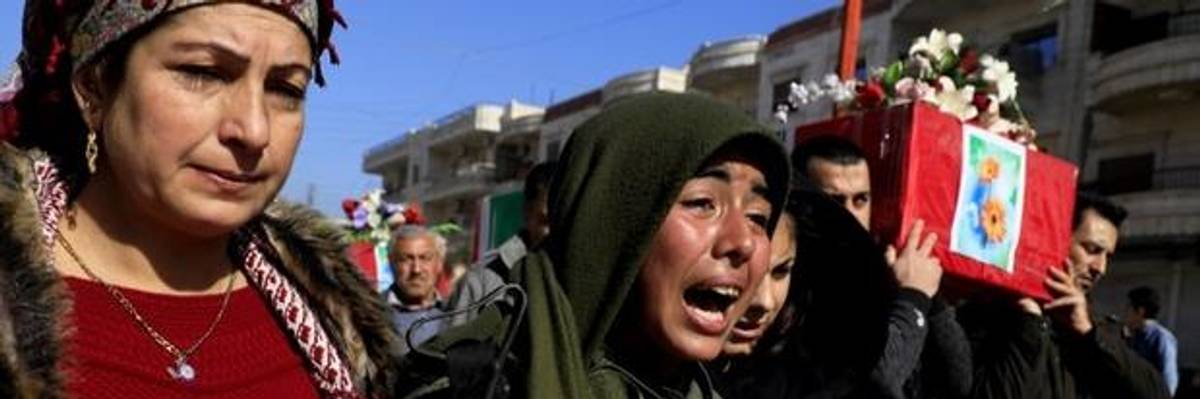
Syrian Kurds mourn during a funeral in the town of Afrin on 29 January 2018 of slain civilians and fighters from the Syrian Kurdish People's Protection Units (AFP)
US Must Stop Using Syria as a Pawn
Instead of counterproductive threats to keep US forces in Syria indefinitely, Americans should press Turkey to withdraw from Afrin.
Coupled with Turkey's invasion of northern Syria, Washington's recent announcement that the US will keep up to 2,000 troops in Syria indefinitely marks another turn for the worse in the country's seven-year conflict. It also highlights the incoherence and recklessness of US policy.
One stated reason for keeping US special forces in Syria is that the US wants to prevent a resurgence of the Islamic State (IS). Another is that the US needs to block Iran's penetration of Syria. Both arguments are flawed.
The fall of IS
The IS "caliphate" has been destroyed and most of its leaders are dead. Preventing the group's revival, at least in terms of territorial control, depends more on what happens in Iraq than in Syria.
If Baghdad adopts inclusive and non-sectarian policies and does a decent job of reconstructing the Sunni-majority cities that IS once occupied, the armed group will not be able to regain much popular support. That is a job for Iraqi politicians and community leaders, not Syrians.
As for Iran's influence in Syria, it arose as a result of the civil war and the threat posed to Bashar al-Assad's rule by IS and other opposition forces. Before the war, in the decades when Syria was a powerful and normally functioning state, Iran's role and authority in Syria were minimal.
Instead of accepting the reality that the Assad government has regained control of Syria's heartland - and that most Syrians, including those who once hoped to see Assad's departure, now just want the war to end - the US is keeping the military option on the table.
But when Assad came under severe pressure, Iran played a vital part in restoring his government's control over most of Syria's cities. If IS was installed in Damascus, it would pose a direct threat to Iran.
Having eliminated that danger, the Iranians will expect some political reward - but the best way to enhance the independence of Damascus from Tehran and to minimise the need for Iranian forces to remain in Syria is for all parties to try to shorten the civil war and rebuild the country's stability.
Threatening to keep US forces in Syria is totally counterproductive and a violation of international law. The US has not been invited by the Syrian government, nor is there any UN resolution that gives it international legality.
Maintaining military pressure
Beyond the stated reasons, the presence of US forces in Syria now that IS has been defeated seems designed to maintain military pressure on the Syrian army by implying the US could at some point increase its commitment and try to topple Assad.
It also acts as encouragement to the non-IS opposition forces to keep up their futile military struggle.
Instead of accepting the reality that the Assad government has regained control of Syria's heartland - and that most Syrians, including those who once hoped to see Assad's departure, now just want the war to end - the US is keeping the military option on the table.
This only encourages opposition politicians at the Geneva talks to continue rejecting compromises and parroting their futile demands for Assad to agree to resign before any new constitution and elections are negotiated.

Washington's attitude towards the Syrian Kurdish forces of the People's Protection Units (YPG) who helped to drive IS out of Raqqa is equally incoherent. On the one hand, the US supports their continued operations as a local military force in northeastern Syria.
On the other hand, it has done little, beyond a phone call from US President Donald Trump to Turkish President Recep Tayyip Erdogan, to condemn Turkey's invasion of northern Syria, which is designed purely to confront and expel the YPG. Turkey is already targeting Afrin and has announced its intent to go on to Manbij, after which it may push further towards Kobane.
The YPG's attitude towards the Assad government is ambiguous. Verbally, its leaders criticise Assad, and there have been occasional clashes with Syrian government forces - but for the most part, the two sides observe a kind of unsigned non-aggression pact.
The question of Kurdish autonomy
The Syrian foreign minister, Walid al-Muallem, has hinted that Damascus would accept local autonomy for Syria's Kurdish northeast. Russia has also come out in favour of a decentralised Syria with Kurdish autonomy.
The best solution is for the US and Russia to make a joint statement endorsing the idea of a loose federation and ensuring that a Syrian Kurdish delegation takes part in the UN-led Geneva process.
Rather than pursuing a costly military option, Erdogan needs to be persuaded to accept a similar solution of autonomy for southeastern Turkey, where the Kurdistan Workers' Party (PKK) insurgency originated.
Turkish officials spent two years negotiating with the PKK's imprisoned leader, Abdullah Ocalan, until Erdogan stopped the process in 2015 in a bid to win votes from Turkey's nationalists.
Now that he has been securely re-elected, he should pull his troops out of Syria and revive peace talks with the PKK.
Russia should give him a message along these lines. Otherwise, Russia's Syria tactics will be as tainted with incoherence as US tactics are. The Kremlin should resist the temptation to drive a wedge through NATO.
Instead of giving a tacit green light to Erdogan to invade northern Syria, Moscow ought to condemn his actions and urge him to withdraw.
Extreme interventionism
Turkey has no legitimate military role to play in Syria, except in relation to blocking the arrival of armed fighters across its border. For the first few years of the civil war, Turkey did the opposite: It facilitated the passage of money, arms and fighters for IS and other rebel groups to confront the Syrian army or move through Syria into Iraq.
Turkey later seemed to change tack and join the anti-IS alliance. Now, it has gone back to a more extreme version of its original interventionist strategy by invading Syria directly and training Syrian opposition fighters, many of them Turkmen, to attack the Kurds.
After seven years of war, the Syria conflict had seemed to be winding down, offering a chance for the millions of displaced civilians to return home. Several hundred thousand people of various ethnic minorities who had fled other cities had taken refuge in Afrin, which had been an oasis of peace.
Now Turkey has made them fearful again.
The US and Russia should stop using Syria as a pawn in a game of mutual point-scoring, and instead jointly use their influence to get Turkey to withdraw.

Urgent. It's never been this bad.
Dear Common Dreams reader, It’s been nearly 30 years since I co-founded Common Dreams with my late wife, Lina Newhouser. We had the radical notion that journalism should serve the public good, not corporate profits. It was clear to us from the outset what it would take to build such a project. No paid advertisements. No corporate sponsors. No millionaire publisher telling us what to think or do. Many people said we wouldn't last a year, but we proved those doubters wrong. Together with a tremendous team of journalists and dedicated staff, we built an independent media outlet free from the constraints of profits and corporate control. Our mission from the outset was simple. To inform. To inspire. To ignite change for the common good. Building Common Dreams was not easy. Our survival was never guaranteed. When you take on the most powerful forces—Wall Street greed, fossil fuel industry destruction, Big Tech lobbyists, and uber-rich oligarchs who have spent billions upon billions rigging the economy and democracy in their favor—the only bulwark you have is supporters who believe in your work. But here’s the urgent message from me today. It’s never been this bad out there. And it’s never been this hard to keep us going. At the very moment Common Dreams is most needed and doing some of its best and most important work, the threats we face are intensifying. Right now, with just four days to go in our Spring Campaign, we are not even halfway to our goal. When everyone does the little they can afford, we are strong. But if that support retreats or dries up, so do we. Can you make a gift right now to make sure Common Dreams not only survives but thrives? There is no backup plan or rainy day fund. There is only you. —Craig Brown, Co-founder |
Coupled with Turkey's invasion of northern Syria, Washington's recent announcement that the US will keep up to 2,000 troops in Syria indefinitely marks another turn for the worse in the country's seven-year conflict. It also highlights the incoherence and recklessness of US policy.
One stated reason for keeping US special forces in Syria is that the US wants to prevent a resurgence of the Islamic State (IS). Another is that the US needs to block Iran's penetration of Syria. Both arguments are flawed.
The fall of IS
The IS "caliphate" has been destroyed and most of its leaders are dead. Preventing the group's revival, at least in terms of territorial control, depends more on what happens in Iraq than in Syria.
If Baghdad adopts inclusive and non-sectarian policies and does a decent job of reconstructing the Sunni-majority cities that IS once occupied, the armed group will not be able to regain much popular support. That is a job for Iraqi politicians and community leaders, not Syrians.
As for Iran's influence in Syria, it arose as a result of the civil war and the threat posed to Bashar al-Assad's rule by IS and other opposition forces. Before the war, in the decades when Syria was a powerful and normally functioning state, Iran's role and authority in Syria were minimal.
Instead of accepting the reality that the Assad government has regained control of Syria's heartland - and that most Syrians, including those who once hoped to see Assad's departure, now just want the war to end - the US is keeping the military option on the table.
But when Assad came under severe pressure, Iran played a vital part in restoring his government's control over most of Syria's cities. If IS was installed in Damascus, it would pose a direct threat to Iran.
Having eliminated that danger, the Iranians will expect some political reward - but the best way to enhance the independence of Damascus from Tehran and to minimise the need for Iranian forces to remain in Syria is for all parties to try to shorten the civil war and rebuild the country's stability.
Threatening to keep US forces in Syria is totally counterproductive and a violation of international law. The US has not been invited by the Syrian government, nor is there any UN resolution that gives it international legality.
Maintaining military pressure
Beyond the stated reasons, the presence of US forces in Syria now that IS has been defeated seems designed to maintain military pressure on the Syrian army by implying the US could at some point increase its commitment and try to topple Assad.
It also acts as encouragement to the non-IS opposition forces to keep up their futile military struggle.
Instead of accepting the reality that the Assad government has regained control of Syria's heartland - and that most Syrians, including those who once hoped to see Assad's departure, now just want the war to end - the US is keeping the military option on the table.
This only encourages opposition politicians at the Geneva talks to continue rejecting compromises and parroting their futile demands for Assad to agree to resign before any new constitution and elections are negotiated.

Washington's attitude towards the Syrian Kurdish forces of the People's Protection Units (YPG) who helped to drive IS out of Raqqa is equally incoherent. On the one hand, the US supports their continued operations as a local military force in northeastern Syria.
On the other hand, it has done little, beyond a phone call from US President Donald Trump to Turkish President Recep Tayyip Erdogan, to condemn Turkey's invasion of northern Syria, which is designed purely to confront and expel the YPG. Turkey is already targeting Afrin and has announced its intent to go on to Manbij, after which it may push further towards Kobane.
The YPG's attitude towards the Assad government is ambiguous. Verbally, its leaders criticise Assad, and there have been occasional clashes with Syrian government forces - but for the most part, the two sides observe a kind of unsigned non-aggression pact.
The question of Kurdish autonomy
The Syrian foreign minister, Walid al-Muallem, has hinted that Damascus would accept local autonomy for Syria's Kurdish northeast. Russia has also come out in favour of a decentralised Syria with Kurdish autonomy.
The best solution is for the US and Russia to make a joint statement endorsing the idea of a loose federation and ensuring that a Syrian Kurdish delegation takes part in the UN-led Geneva process.
Rather than pursuing a costly military option, Erdogan needs to be persuaded to accept a similar solution of autonomy for southeastern Turkey, where the Kurdistan Workers' Party (PKK) insurgency originated.
Turkish officials spent two years negotiating with the PKK's imprisoned leader, Abdullah Ocalan, until Erdogan stopped the process in 2015 in a bid to win votes from Turkey's nationalists.
Now that he has been securely re-elected, he should pull his troops out of Syria and revive peace talks with the PKK.
Russia should give him a message along these lines. Otherwise, Russia's Syria tactics will be as tainted with incoherence as US tactics are. The Kremlin should resist the temptation to drive a wedge through NATO.
Instead of giving a tacit green light to Erdogan to invade northern Syria, Moscow ought to condemn his actions and urge him to withdraw.
Extreme interventionism
Turkey has no legitimate military role to play in Syria, except in relation to blocking the arrival of armed fighters across its border. For the first few years of the civil war, Turkey did the opposite: It facilitated the passage of money, arms and fighters for IS and other rebel groups to confront the Syrian army or move through Syria into Iraq.
Turkey later seemed to change tack and join the anti-IS alliance. Now, it has gone back to a more extreme version of its original interventionist strategy by invading Syria directly and training Syrian opposition fighters, many of them Turkmen, to attack the Kurds.
After seven years of war, the Syria conflict had seemed to be winding down, offering a chance for the millions of displaced civilians to return home. Several hundred thousand people of various ethnic minorities who had fled other cities had taken refuge in Afrin, which had been an oasis of peace.
Now Turkey has made them fearful again.
The US and Russia should stop using Syria as a pawn in a game of mutual point-scoring, and instead jointly use their influence to get Turkey to withdraw.
Coupled with Turkey's invasion of northern Syria, Washington's recent announcement that the US will keep up to 2,000 troops in Syria indefinitely marks another turn for the worse in the country's seven-year conflict. It also highlights the incoherence and recklessness of US policy.
One stated reason for keeping US special forces in Syria is that the US wants to prevent a resurgence of the Islamic State (IS). Another is that the US needs to block Iran's penetration of Syria. Both arguments are flawed.
The fall of IS
The IS "caliphate" has been destroyed and most of its leaders are dead. Preventing the group's revival, at least in terms of territorial control, depends more on what happens in Iraq than in Syria.
If Baghdad adopts inclusive and non-sectarian policies and does a decent job of reconstructing the Sunni-majority cities that IS once occupied, the armed group will not be able to regain much popular support. That is a job for Iraqi politicians and community leaders, not Syrians.
As for Iran's influence in Syria, it arose as a result of the civil war and the threat posed to Bashar al-Assad's rule by IS and other opposition forces. Before the war, in the decades when Syria was a powerful and normally functioning state, Iran's role and authority in Syria were minimal.
Instead of accepting the reality that the Assad government has regained control of Syria's heartland - and that most Syrians, including those who once hoped to see Assad's departure, now just want the war to end - the US is keeping the military option on the table.
But when Assad came under severe pressure, Iran played a vital part in restoring his government's control over most of Syria's cities. If IS was installed in Damascus, it would pose a direct threat to Iran.
Having eliminated that danger, the Iranians will expect some political reward - but the best way to enhance the independence of Damascus from Tehran and to minimise the need for Iranian forces to remain in Syria is for all parties to try to shorten the civil war and rebuild the country's stability.
Threatening to keep US forces in Syria is totally counterproductive and a violation of international law. The US has not been invited by the Syrian government, nor is there any UN resolution that gives it international legality.
Maintaining military pressure
Beyond the stated reasons, the presence of US forces in Syria now that IS has been defeated seems designed to maintain military pressure on the Syrian army by implying the US could at some point increase its commitment and try to topple Assad.
It also acts as encouragement to the non-IS opposition forces to keep up their futile military struggle.
Instead of accepting the reality that the Assad government has regained control of Syria's heartland - and that most Syrians, including those who once hoped to see Assad's departure, now just want the war to end - the US is keeping the military option on the table.
This only encourages opposition politicians at the Geneva talks to continue rejecting compromises and parroting their futile demands for Assad to agree to resign before any new constitution and elections are negotiated.

Washington's attitude towards the Syrian Kurdish forces of the People's Protection Units (YPG) who helped to drive IS out of Raqqa is equally incoherent. On the one hand, the US supports their continued operations as a local military force in northeastern Syria.
On the other hand, it has done little, beyond a phone call from US President Donald Trump to Turkish President Recep Tayyip Erdogan, to condemn Turkey's invasion of northern Syria, which is designed purely to confront and expel the YPG. Turkey is already targeting Afrin and has announced its intent to go on to Manbij, after which it may push further towards Kobane.
The YPG's attitude towards the Assad government is ambiguous. Verbally, its leaders criticise Assad, and there have been occasional clashes with Syrian government forces - but for the most part, the two sides observe a kind of unsigned non-aggression pact.
The question of Kurdish autonomy
The Syrian foreign minister, Walid al-Muallem, has hinted that Damascus would accept local autonomy for Syria's Kurdish northeast. Russia has also come out in favour of a decentralised Syria with Kurdish autonomy.
The best solution is for the US and Russia to make a joint statement endorsing the idea of a loose federation and ensuring that a Syrian Kurdish delegation takes part in the UN-led Geneva process.
Rather than pursuing a costly military option, Erdogan needs to be persuaded to accept a similar solution of autonomy for southeastern Turkey, where the Kurdistan Workers' Party (PKK) insurgency originated.
Turkish officials spent two years negotiating with the PKK's imprisoned leader, Abdullah Ocalan, until Erdogan stopped the process in 2015 in a bid to win votes from Turkey's nationalists.
Now that he has been securely re-elected, he should pull his troops out of Syria and revive peace talks with the PKK.
Russia should give him a message along these lines. Otherwise, Russia's Syria tactics will be as tainted with incoherence as US tactics are. The Kremlin should resist the temptation to drive a wedge through NATO.
Instead of giving a tacit green light to Erdogan to invade northern Syria, Moscow ought to condemn his actions and urge him to withdraw.
Extreme interventionism
Turkey has no legitimate military role to play in Syria, except in relation to blocking the arrival of armed fighters across its border. For the first few years of the civil war, Turkey did the opposite: It facilitated the passage of money, arms and fighters for IS and other rebel groups to confront the Syrian army or move through Syria into Iraq.
Turkey later seemed to change tack and join the anti-IS alliance. Now, it has gone back to a more extreme version of its original interventionist strategy by invading Syria directly and training Syrian opposition fighters, many of them Turkmen, to attack the Kurds.
After seven years of war, the Syria conflict had seemed to be winding down, offering a chance for the millions of displaced civilians to return home. Several hundred thousand people of various ethnic minorities who had fled other cities had taken refuge in Afrin, which had been an oasis of peace.
Now Turkey has made them fearful again.
The US and Russia should stop using Syria as a pawn in a game of mutual point-scoring, and instead jointly use their influence to get Turkey to withdraw.