SUBSCRIBE TO OUR FREE NEWSLETTER
Daily news & progressive opinion—funded by the people, not the corporations—delivered straight to your inbox.
5
#000000
#FFFFFF
To donate by check, phone, or other method, see our More Ways to Give page.
Daily news & progressive opinion—funded by the people, not the corporations—delivered straight to your inbox.
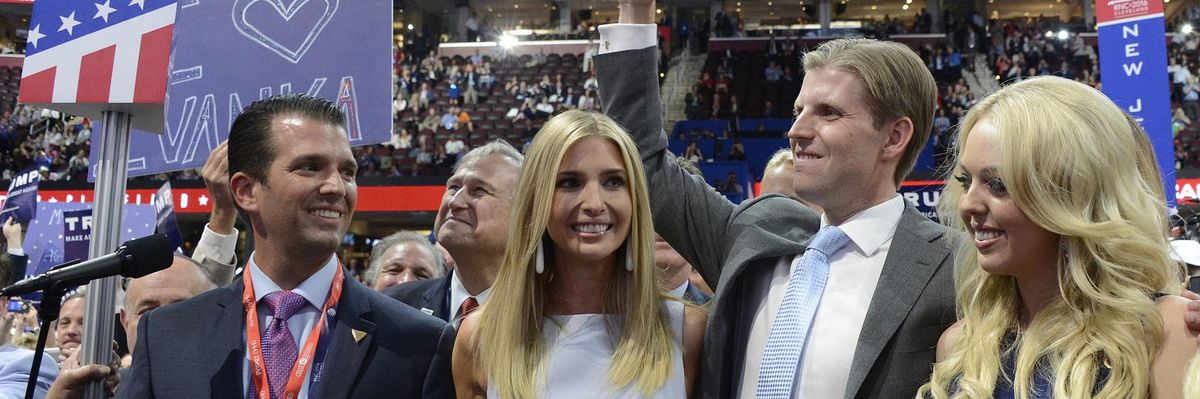
Taxes meant for extremely wealthy Americans have been generating less and less revenue in recent years, as wealthy families like the Trumps find ways to stash away money to pass down to their children, tax-free. (Photo: Disney/ABC/Flickr/cc)
White House National Economic Council director Gary Cohn, former president of Goldman Sachs, said recently that "only morons pay the estate tax."
I'm reminded of Donald Trump's comment that he didn't pay federal income taxes because he was "smart." And billionaire Leona Helmsley's "only the little people pay taxes."
What Cohn was getting at is how easy it is nowadays for the wealthy to pass their fortunes to their children, tax-free.
The estate tax applies only to estates over $11 million per couple. And wealthy families stash away dollars above this into "dynastic" trust funds that escape additional taxes.
No wonder revenues from the estate tax have been dropping for years even as wealth has become concentrated in fewer hands. The tax now generates about $20 billion a year, which is less than 1 percent of federal revenues. And it applies to only about 2 out of every 1,000 people who die.
Now, Trump and Republican leaders are planning to cut or eliminate it altogether.
There's another part of the tax code that Cohn might also have been referring to--capital gains taxes paid on the soaring values of the wealthy people's stocks, bonds, mansions and works of art, when they sell them.
If the wealthy hold on to these assets until they die, the tax code allows their heirs to inherit them without paying any of these capital gains taxes. According to the Congressional Budget Office, this loophole saves heirs $50 billion a year.
The estate and capital gains taxes were originally designed to prevent the growth of large dynasties in the U.S. and to reduce inequality.
They've been failing to do that. The richest 1 tenth of 1 percent of Americans now owns almost as much wealth as the bottom 90 percent.
Many of today's super rich never did a day's work in their lives. Six out of the ten wealthiest Americans alive today are heirs to prominent fortunes. The Walmart heirs alone have more wealth than the bottom 42 percent of Americans combined.
Rich millennials will soon acquire even more of the nation's wealth.
America is now on the cusp of the largest inter-generational transfer of wealth in history. As wealthy boomers expire, an estimated $30 trillion will go to their children over the next three decades.
Those children will be able to live off of the income these assets generate, and then leave the bulk of them--which in the intervening years will have grown far more valuable--to their own heirs, tax-free.
After a few generations of this, almost all of the nation's wealth will be in the hands of a few thousand families.
Dynastic wealth runs counter to the ideal of America as a meritocracy. It makes a mockery of the notions that people earn what they're worth in the market, and that economic gains should go to those who deserve them.
It puts economic power into the hands of a relative small number of people who have never worked, but whose investment decisions will have a significant effect on the nation's future.
And it creates a self-perpetuating aristocracy that is antithetical to democracy.
The last time America faced anything comparable to the concentration of wealth we face now, occurred at the turn of the last century.
Then, President Teddy Roosevelt warned that "a small class of enormously wealthy and economically powerful men, whose chief object is to hold and increase their power," could destroy American democracy.
Roosevelt's answer was to tax wealth. The estate tax was enacted in 1916 and the capital gains tax in 1922.
But since then, both have been eroded. As the rich have accumulated greater wealth, they have also amassed more political power, and they've used that political power to reduce their taxes.
Teddy Roosevelt, a Republican, helped create a movement against dynastic wealth. Trump and today's congressional Republicans will not follow in his footsteps. I doubt even today's Democrats would do so if they had a chance. Big money has become too powerful on both sides of the aisle.
But taxing big wealth is necessary if we're ever to get our democracy back, and make our economy work for everyone rather than a privileged few.
Maybe Gary Cohn is correct that only morons pay the estate tax. But if he and his boss were smart and they cared about America's future, they'd raises taxes on great wealth. Roosevelt's fear of an American dynasty is more applicable today than ever before.
Dear Common Dreams reader, It’s been nearly 30 years since I co-founded Common Dreams with my late wife, Lina Newhouser. We had the radical notion that journalism should serve the public good, not corporate profits. It was clear to us from the outset what it would take to build such a project. No paid advertisements. No corporate sponsors. No millionaire publisher telling us what to think or do. Many people said we wouldn't last a year, but we proved those doubters wrong. Together with a tremendous team of journalists and dedicated staff, we built an independent media outlet free from the constraints of profits and corporate control. Our mission has always been simple: To inform. To inspire. To ignite change for the common good. Building Common Dreams was not easy. Our survival was never guaranteed. When you take on the most powerful forces—Wall Street greed, fossil fuel industry destruction, Big Tech lobbyists, and uber-rich oligarchs who have spent billions upon billions rigging the economy and democracy in their favor—the only bulwark you have is supporters who believe in your work. But here’s the urgent message from me today. It's never been this bad out there. And it's never been this hard to keep us going. At the very moment Common Dreams is most needed, the threats we face are intensifying. We need your support now more than ever. We don't accept corporate advertising and never will. We don't have a paywall because we don't think people should be blocked from critical news based on their ability to pay. Everything we do is funded by the donations of readers like you. When everyone does the little they can afford, we are strong. But if that support retreats or dries up, so do we. Will you donate now to make sure Common Dreams not only survives but thrives? —Craig Brown, Co-founder |
White House National Economic Council director Gary Cohn, former president of Goldman Sachs, said recently that "only morons pay the estate tax."
I'm reminded of Donald Trump's comment that he didn't pay federal income taxes because he was "smart." And billionaire Leona Helmsley's "only the little people pay taxes."
What Cohn was getting at is how easy it is nowadays for the wealthy to pass their fortunes to their children, tax-free.
The estate tax applies only to estates over $11 million per couple. And wealthy families stash away dollars above this into "dynastic" trust funds that escape additional taxes.
No wonder revenues from the estate tax have been dropping for years even as wealth has become concentrated in fewer hands. The tax now generates about $20 billion a year, which is less than 1 percent of federal revenues. And it applies to only about 2 out of every 1,000 people who die.
Now, Trump and Republican leaders are planning to cut or eliminate it altogether.
There's another part of the tax code that Cohn might also have been referring to--capital gains taxes paid on the soaring values of the wealthy people's stocks, bonds, mansions and works of art, when they sell them.
If the wealthy hold on to these assets until they die, the tax code allows their heirs to inherit them without paying any of these capital gains taxes. According to the Congressional Budget Office, this loophole saves heirs $50 billion a year.
The estate and capital gains taxes were originally designed to prevent the growth of large dynasties in the U.S. and to reduce inequality.
They've been failing to do that. The richest 1 tenth of 1 percent of Americans now owns almost as much wealth as the bottom 90 percent.
Many of today's super rich never did a day's work in their lives. Six out of the ten wealthiest Americans alive today are heirs to prominent fortunes. The Walmart heirs alone have more wealth than the bottom 42 percent of Americans combined.
Rich millennials will soon acquire even more of the nation's wealth.
America is now on the cusp of the largest inter-generational transfer of wealth in history. As wealthy boomers expire, an estimated $30 trillion will go to their children over the next three decades.
Those children will be able to live off of the income these assets generate, and then leave the bulk of them--which in the intervening years will have grown far more valuable--to their own heirs, tax-free.
After a few generations of this, almost all of the nation's wealth will be in the hands of a few thousand families.
Dynastic wealth runs counter to the ideal of America as a meritocracy. It makes a mockery of the notions that people earn what they're worth in the market, and that economic gains should go to those who deserve them.
It puts economic power into the hands of a relative small number of people who have never worked, but whose investment decisions will have a significant effect on the nation's future.
And it creates a self-perpetuating aristocracy that is antithetical to democracy.
The last time America faced anything comparable to the concentration of wealth we face now, occurred at the turn of the last century.
Then, President Teddy Roosevelt warned that "a small class of enormously wealthy and economically powerful men, whose chief object is to hold and increase their power," could destroy American democracy.
Roosevelt's answer was to tax wealth. The estate tax was enacted in 1916 and the capital gains tax in 1922.
But since then, both have been eroded. As the rich have accumulated greater wealth, they have also amassed more political power, and they've used that political power to reduce their taxes.
Teddy Roosevelt, a Republican, helped create a movement against dynastic wealth. Trump and today's congressional Republicans will not follow in his footsteps. I doubt even today's Democrats would do so if they had a chance. Big money has become too powerful on both sides of the aisle.
But taxing big wealth is necessary if we're ever to get our democracy back, and make our economy work for everyone rather than a privileged few.
Maybe Gary Cohn is correct that only morons pay the estate tax. But if he and his boss were smart and they cared about America's future, they'd raises taxes on great wealth. Roosevelt's fear of an American dynasty is more applicable today than ever before.
White House National Economic Council director Gary Cohn, former president of Goldman Sachs, said recently that "only morons pay the estate tax."
I'm reminded of Donald Trump's comment that he didn't pay federal income taxes because he was "smart." And billionaire Leona Helmsley's "only the little people pay taxes."
What Cohn was getting at is how easy it is nowadays for the wealthy to pass their fortunes to their children, tax-free.
The estate tax applies only to estates over $11 million per couple. And wealthy families stash away dollars above this into "dynastic" trust funds that escape additional taxes.
No wonder revenues from the estate tax have been dropping for years even as wealth has become concentrated in fewer hands. The tax now generates about $20 billion a year, which is less than 1 percent of federal revenues. And it applies to only about 2 out of every 1,000 people who die.
Now, Trump and Republican leaders are planning to cut or eliminate it altogether.
There's another part of the tax code that Cohn might also have been referring to--capital gains taxes paid on the soaring values of the wealthy people's stocks, bonds, mansions and works of art, when they sell them.
If the wealthy hold on to these assets until they die, the tax code allows their heirs to inherit them without paying any of these capital gains taxes. According to the Congressional Budget Office, this loophole saves heirs $50 billion a year.
The estate and capital gains taxes were originally designed to prevent the growth of large dynasties in the U.S. and to reduce inequality.
They've been failing to do that. The richest 1 tenth of 1 percent of Americans now owns almost as much wealth as the bottom 90 percent.
Many of today's super rich never did a day's work in their lives. Six out of the ten wealthiest Americans alive today are heirs to prominent fortunes. The Walmart heirs alone have more wealth than the bottom 42 percent of Americans combined.
Rich millennials will soon acquire even more of the nation's wealth.
America is now on the cusp of the largest inter-generational transfer of wealth in history. As wealthy boomers expire, an estimated $30 trillion will go to their children over the next three decades.
Those children will be able to live off of the income these assets generate, and then leave the bulk of them--which in the intervening years will have grown far more valuable--to their own heirs, tax-free.
After a few generations of this, almost all of the nation's wealth will be in the hands of a few thousand families.
Dynastic wealth runs counter to the ideal of America as a meritocracy. It makes a mockery of the notions that people earn what they're worth in the market, and that economic gains should go to those who deserve them.
It puts economic power into the hands of a relative small number of people who have never worked, but whose investment decisions will have a significant effect on the nation's future.
And it creates a self-perpetuating aristocracy that is antithetical to democracy.
The last time America faced anything comparable to the concentration of wealth we face now, occurred at the turn of the last century.
Then, President Teddy Roosevelt warned that "a small class of enormously wealthy and economically powerful men, whose chief object is to hold and increase their power," could destroy American democracy.
Roosevelt's answer was to tax wealth. The estate tax was enacted in 1916 and the capital gains tax in 1922.
But since then, both have been eroded. As the rich have accumulated greater wealth, they have also amassed more political power, and they've used that political power to reduce their taxes.
Teddy Roosevelt, a Republican, helped create a movement against dynastic wealth. Trump and today's congressional Republicans will not follow in his footsteps. I doubt even today's Democrats would do so if they had a chance. Big money has become too powerful on both sides of the aisle.
But taxing big wealth is necessary if we're ever to get our democracy back, and make our economy work for everyone rather than a privileged few.
Maybe Gary Cohn is correct that only morons pay the estate tax. But if he and his boss were smart and they cared about America's future, they'd raises taxes on great wealth. Roosevelt's fear of an American dynasty is more applicable today than ever before.