Is Trump Taking Us to War Everywhere?
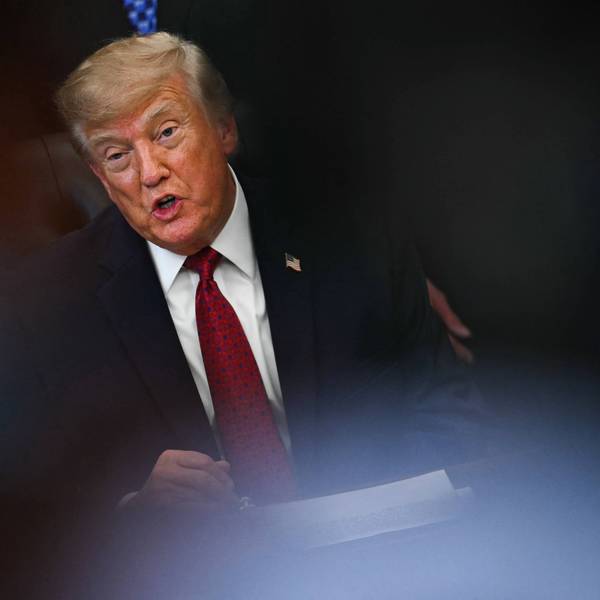
No one expected Trump to be a peace president, but he seems bent on taking us to the verge of World War III.
No one ever expected Donald Trump to be a peace-loving president. On the campaign trail, he endorsed torture, said he'd bomb the families of alleged terrorists, and spoke gleefully about the president's power to launch nuclear weapons.
But threatening war with multiple countries over a few weeks goes beyond even that. Tough-guy, hit-them-before-they-hit-us foreign policy is back with a vengeance.
Under Trump's orders, earlier in April the military dropped the largest non-nuclear bomb in its arsenal -- known as MOAB, or the "Mother of All Bombs" -- on Afghanistan. Outside of Hiroshima and Nagasaki, there's simply no precedent for the use of such a large weapon, which carries grave risks of civilian casualties.
Shortly before that, Trump ordered a military strike on Syria, apparently without informing either Congress or the State Department. Meanwhile, the White House is rattling its saber at North Korea and pondering an expanded military role in both Somalia and Yemen.
In all of these situations, Congress has not only the right but the responsibility to carefully review any authorization of military strikes. Yet so far this president, like others before him, has taken pains to keep the people's representatives completely out of the loop about his plans for the wars we're already fighting, as well as for any new ones he might start.
The wars in Iraq and Afghanistan have each lasted upward of a decade and half or more. Like Vietnam before them, they've taught us the risks associated with intervening in a difficult region with no exit strategy.
Recklessly plunging into new wars not only impacts the world stage. It also takes a huge toll on our federal budget.
Trump's budget proposal increases military spending by $54 billion, at the expense of vital anti-poverty programs like Meals on Wheels, diplomatic resources, food safety, and environmental protections. It "takes money from urgent social needs to feed the already-bloated Pentagon budget," lamented a large group of leaders from diverse movements, from climate justice to immigrant rights.
These aren't programs with extravagant budgets. They represent barely a drop in the ocean of our already ginormous ($600 billion-plus) military budget, not to mention the $21.6 billion appropriated to fund Trump's border wall.
These cuts would only make sense if we were still fighting the Second World War, with every family rationing staple food items and planting victory gardens while scraping money together to buy war bonds to support the troops.
We are not -- at least not yet -- on the verge of World War III. But with recent acts of aggression and military strikes in several diplomatically precarious regions, Trump seems determined to take us close to the ledge.
From backtracking on calling NATO "obsolete" to deciding not to accuse China of currency manipulation, we've already seen Trump completely reverse his policy positions after (presumably) thinking things over a bit more thoroughly. It's time for him to also rethink this more-military-conflicts-than-you-can-shake-a-big-stick-at foreign policy.
As our president, Donald Trump is responsible for our safety. He cannot risk launching us into still more endless wars; the cost is simply too high, and ordinary American families will pay the heavy price.
We are at a crossroads
This country and this world are at a monumental crossroads. In a few short weeks, US voters will have an opportunity to beat back the forces of fascism and confront the billionaires who are rigging the economy, our media system, and our democracy, making it increasingly impossible for ordinary people to get by. We’re not just talking about the election. We’re talking about what must be done once these fascist elements are vanquished from power. We need a bolder set of solutions than what either major party has so far been willing to offer and a working-class movement ready to fight like hell for it. Trump didn't emerge from nowhere. The conditions that fueled MAGA authoritarianism were created by decades of radical neoliberal economic policies and a corrupt political system dominated by corporate interests. They slashed taxes on the super-rich, promising that the benefits would trickle down. They said giveaways to the corporate titans would make life more affordable for the rest of us. It was all bullshit. And when a bitter, betrayed populace searches for someone to blame, right-wing demagogues have little trouble finding scapegoats. People know when they're being lied to, but you won't hear any of this from the corporate media. Only independent journalism—powered and funded by people who believe in building a better world—can deliver truly trustworthy daily news. Our Fall Campaign is underway, and we need your help. To power our newsroom through the rest of the year, we need to raise $125,000 by midnight on October 31. So if you share our vision, please contribute whatever you can to sustain our work. |
No one ever expected Donald Trump to be a peace-loving president. On the campaign trail, he endorsed torture, said he'd bomb the families of alleged terrorists, and spoke gleefully about the president's power to launch nuclear weapons.
But threatening war with multiple countries over a few weeks goes beyond even that. Tough-guy, hit-them-before-they-hit-us foreign policy is back with a vengeance.
Under Trump's orders, earlier in April the military dropped the largest non-nuclear bomb in its arsenal -- known as MOAB, or the "Mother of All Bombs" -- on Afghanistan. Outside of Hiroshima and Nagasaki, there's simply no precedent for the use of such a large weapon, which carries grave risks of civilian casualties.
Shortly before that, Trump ordered a military strike on Syria, apparently without informing either Congress or the State Department. Meanwhile, the White House is rattling its saber at North Korea and pondering an expanded military role in both Somalia and Yemen.
In all of these situations, Congress has not only the right but the responsibility to carefully review any authorization of military strikes. Yet so far this president, like others before him, has taken pains to keep the people's representatives completely out of the loop about his plans for the wars we're already fighting, as well as for any new ones he might start.
The wars in Iraq and Afghanistan have each lasted upward of a decade and half or more. Like Vietnam before them, they've taught us the risks associated with intervening in a difficult region with no exit strategy.
Recklessly plunging into new wars not only impacts the world stage. It also takes a huge toll on our federal budget.
Trump's budget proposal increases military spending by $54 billion, at the expense of vital anti-poverty programs like Meals on Wheels, diplomatic resources, food safety, and environmental protections. It "takes money from urgent social needs to feed the already-bloated Pentagon budget," lamented a large group of leaders from diverse movements, from climate justice to immigrant rights.
These aren't programs with extravagant budgets. They represent barely a drop in the ocean of our already ginormous ($600 billion-plus) military budget, not to mention the $21.6 billion appropriated to fund Trump's border wall.
These cuts would only make sense if we were still fighting the Second World War, with every family rationing staple food items and planting victory gardens while scraping money together to buy war bonds to support the troops.
We are not -- at least not yet -- on the verge of World War III. But with recent acts of aggression and military strikes in several diplomatically precarious regions, Trump seems determined to take us close to the ledge.
From backtracking on calling NATO "obsolete" to deciding not to accuse China of currency manipulation, we've already seen Trump completely reverse his policy positions after (presumably) thinking things over a bit more thoroughly. It's time for him to also rethink this more-military-conflicts-than-you-can-shake-a-big-stick-at foreign policy.
As our president, Donald Trump is responsible for our safety. He cannot risk launching us into still more endless wars; the cost is simply too high, and ordinary American families will pay the heavy price.
No one ever expected Donald Trump to be a peace-loving president. On the campaign trail, he endorsed torture, said he'd bomb the families of alleged terrorists, and spoke gleefully about the president's power to launch nuclear weapons.
But threatening war with multiple countries over a few weeks goes beyond even that. Tough-guy, hit-them-before-they-hit-us foreign policy is back with a vengeance.
Under Trump's orders, earlier in April the military dropped the largest non-nuclear bomb in its arsenal -- known as MOAB, or the "Mother of All Bombs" -- on Afghanistan. Outside of Hiroshima and Nagasaki, there's simply no precedent for the use of such a large weapon, which carries grave risks of civilian casualties.
Shortly before that, Trump ordered a military strike on Syria, apparently without informing either Congress or the State Department. Meanwhile, the White House is rattling its saber at North Korea and pondering an expanded military role in both Somalia and Yemen.
In all of these situations, Congress has not only the right but the responsibility to carefully review any authorization of military strikes. Yet so far this president, like others before him, has taken pains to keep the people's representatives completely out of the loop about his plans for the wars we're already fighting, as well as for any new ones he might start.
The wars in Iraq and Afghanistan have each lasted upward of a decade and half or more. Like Vietnam before them, they've taught us the risks associated with intervening in a difficult region with no exit strategy.
Recklessly plunging into new wars not only impacts the world stage. It also takes a huge toll on our federal budget.
Trump's budget proposal increases military spending by $54 billion, at the expense of vital anti-poverty programs like Meals on Wheels, diplomatic resources, food safety, and environmental protections. It "takes money from urgent social needs to feed the already-bloated Pentagon budget," lamented a large group of leaders from diverse movements, from climate justice to immigrant rights.
These aren't programs with extravagant budgets. They represent barely a drop in the ocean of our already ginormous ($600 billion-plus) military budget, not to mention the $21.6 billion appropriated to fund Trump's border wall.
These cuts would only make sense if we were still fighting the Second World War, with every family rationing staple food items and planting victory gardens while scraping money together to buy war bonds to support the troops.
We are not -- at least not yet -- on the verge of World War III. But with recent acts of aggression and military strikes in several diplomatically precarious regions, Trump seems determined to take us close to the ledge.
From backtracking on calling NATO "obsolete" to deciding not to accuse China of currency manipulation, we've already seen Trump completely reverse his policy positions after (presumably) thinking things over a bit more thoroughly. It's time for him to also rethink this more-military-conflicts-than-you-can-shake-a-big-stick-at foreign policy.
As our president, Donald Trump is responsible for our safety. He cannot risk launching us into still more endless wars; the cost is simply too high, and ordinary American families will pay the heavy price.