SUBSCRIBE TO OUR FREE NEWSLETTER
Daily news & progressive opinion—funded by the people, not the corporations—delivered straight to your inbox.
5
#000000
#FFFFFF
To donate by check, phone, or other method, see our More Ways to Give page.
Daily news & progressive opinion—funded by the people, not the corporations—delivered straight to your inbox.
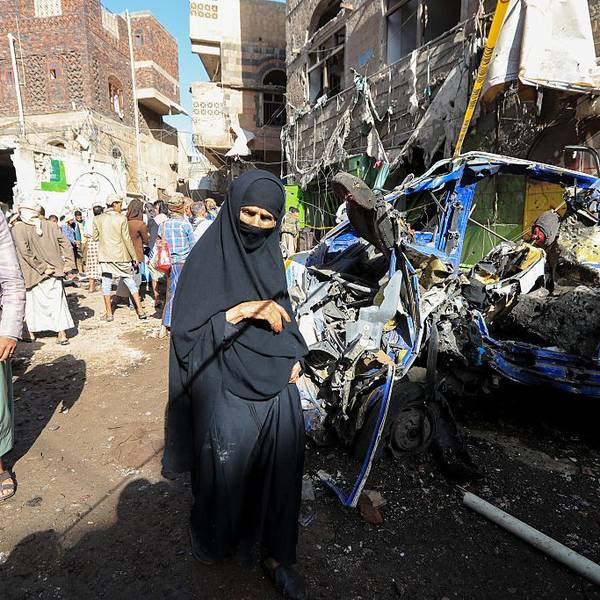
Following a new report from Human Rights Watch on the use of banned cluster bombs by the Saudi-led coalition in Yemen, the United States State Department has once again given a statement so the government may appear as if it is concerned. But there have been consistent cluster bomb reports since the U.S.-backed intervention was launched in March 2015, and each time business as usual has resumed with no regard for the civilians killed by these explosives.
On February 14, HRW reported, "Recently transferred U.S.-manufactured cluster munitions are being used in civilian areas contrary to U.S. export requirements and also appear to be failing to meet the reliability standard required for U.S. export of the weapons."
According to field research by HRW, Amnesty International, and the United Nations, evidence has proven the Saudi-led coalition has used cluster munitions. The human rights groups have interviewed witnesses and victims of the cluster bombs.
Cluster bombs were used by Saudi-led forces on December 12, 2015. Muhammad Ahmad, who is 33 years-old, told HRW, "I was with six friends from the village ... sitting on a small hill watching the strikes."
"We suddenly saw about 20 white parachutes in the air, falling toward the port. Less than a minute later, each one released a cloud of black smoke as it neared the ground and exploded," Ahmad recounted. "It looked like a series of multiple bombs all next to each other. Less than five minutes later, it happened again, another bomb let out a group of about 20 parachutes and the same thing happened. But because of the direction the wind was blowing, the parachutes suddenly started falling toward our village."
Forty-two year-old Hussein Saed said the home of his brother, Ali, was hit by metal fragments. The fragments wounded Ali's wife, Aziza Ahmad Ahdab, a 42 year-old, and their daughter, Salama, who is four years-old. Ahdab had to have her lower right leg amputated.
In 2013, the U.S. government approved a deal to export $640 million worth of cluster bombs to Saudi Arabia by the end of 2015. The contract was with Textron Systems Corporation.
HRW claimed CBU-105 Sensor Fuzed Weapons were used in the December 12 attack. The group raised two key issues: one, the Saudi coalition launched these weapons in populated areas, which U.S. export law is supposed to prohibit. Two, U.S. export law only allows for cluster bombs with a "failure rate of less than 1 percent." These weapons are not functioning reliably when launched in Yemen.
"The CBU-105 disperses 10 BLU-108 canisters that each release four submunitions the manufacturer calls 'skeet' that are designed to sense, classify, and engage a target such as an armored vehicle," HRW described, referencing a data sheet from Textron Systems Corporation. "The submunitions explode above the ground and project an explosively formed jet of metal and fragmentation downward. The skeet are equipped with electronic self-destruct and self-deactivation features.
"However, photographs taken by Human Rights Watch field investigators at one location and photographs received from another location show BLU-108 from separate attacks with their "skeets" or submunitions still attached. This shows a failure to function as intended as the submunitions failed to disperse from the canister, or were dispersed but did not explode," HRW reported.
More significant than the malfunction of the cluster bombs, however, is the fact that the U.S. even permits, endorses, and defends the use of these explosives at all.
The U.S. government refuses to sign the Convention on Cluster Munitions and has actively pressured countries to not support the abolition of cluster bombs.
Diplomatic cables provided to WikiLeaks by U.S. Army whistleblower Chelsea Manning showed the lengths officials will go to fight bans against the weapons. For example, when Afghanistan was about to sign the treaty in 2011, U.S. diplomats argued destruction of stockpiles would "impede the ability of U.S. forces to defend" the country.
"We know from WikiLeaks and from U.S. officials that during the negotiating process that the U.S. contacted more than 100 countries to talk to them about the convention," Steve Goose, who chairs the Cluster Munition Coalition, told The Washington Post. "The U.S. contact ranged from expressing concern to twisting arms not to be part of the process and not to sign--and they had a very concerted campaign to influence the language of the treaty."
In addition to the December 12 attack, HRW reported on instances on April 17, April 27, and May 21, 2015, when cluster bombs were used. Amnesty reported cluster bombs were used on June 29. But reports, backed up by evidence, have not changed the manner in which government officials approach the issue of cluster bombs.
On January 7, State Department spokesperson John Kirby was pushed to answer whether the U.S. government would investigate the use of cluster bombs. Kirby tried to dodge the question, and then declared, "I know of no such investigation by the United States into the potential use of this particular weapon by the Saudi-led coalition." That was not the question.
The use of cluster bombs was also referred to as the "alleged use," even though it is abundantly clear the weapons have been used.
On December 29, 2015, State Department deputy spokesperson Mark Toner said, "I don't have anything here that conclusively points to or conclusively speaks to the use of cluster munitions. We have expressed these concerns, though, about their use in the past."
A reporter pressed Kirby on September 9, 2015, on how cluster bombs were different than barrel bombs, because the U.S. government condemned the Syrian government for using barrel bombs that killed civilians.
QUESTION: Yeah, but in your description, it's not really that much different than cluster bombs, which, let's say, the Saudis are using in Yemen that are supplied by the United States.
MR. KIRBY: Well, there's a huge difference, Said. I mean, cluster munitions are allowed legally when they are applied in a combat environment for discrete purposes. And when we transfer them or sell them, there is an end-use requirement there for how they're used, and certainly, we have vehicles at our disposal should they not be used appropriately. That's the big difference between the tactical, specific use of cluster munitions in accordance with international law and then dropping a barrel bomb out of an aircraft or a helicopter on a crowd of people. Big difference.
In other words, cluster bombs aren't bad because we have given their use a veneer of adherence to the rule of law. No amount of brutality will convince us cluster bombs are intended to kill and maim like barrel bombs. Plus, we use them and we do not have evil objectives like Bashar al-Assad.
When acting deputy State Department spokesperson Jeff Rathke was asked on May 4, 2015, "Would the U.S. bear any responsibility given that the alleged use of cluster munitions were supplied by the U.S.?"
"Well, we're looking into the specific allegations, so I don't have confirmation of those in the report," Rathke replied.
Around eight months later, the State Department continues to act as if it is the sole responsibility of Saudi Arabia to account for the use of cluster bombs. But the U.S. cannot wash its hands of the blood being spilled as a result of deadly weapons exported to Saudi Arabia.
The State Department maintains the U.S. "spends more than any other country to eliminate the risk to civilians from land mines and all explosive remnants of war, including unexploded cluster munitions." However, at no point has the State Department had anything to say about efforts to ensure Saudi Arabia cleans up unexploded cluster bombs. In fact, one can bet no such cleanup operations are underway as the carnage unfolds in Yemen.
Instead, the U.S. government clings to the notion that cluster bombs have some "military utility."
"Their elimination from U.S. stockpiles would put the lives of its soldiers and those of its coalition partners at risk. Moreover, cluster munitions can often result in much less collateral damage than unitary weapons, such as a larger bomb or larger artillery shell would cause, if used for the same mission," the State Department has claimed.
That basically translates to, be happy we are not defending the use of barrel bombs or other explosives more deadly than cluster bombs. Because we could be permitting the use of far worse weapons.
Dear Common Dreams reader, It’s been nearly 30 years since I co-founded Common Dreams with my late wife, Lina Newhouser. We had the radical notion that journalism should serve the public good, not corporate profits. It was clear to us from the outset what it would take to build such a project. No paid advertisements. No corporate sponsors. No millionaire publisher telling us what to think or do. Many people said we wouldn't last a year, but we proved those doubters wrong. Together with a tremendous team of journalists and dedicated staff, we built an independent media outlet free from the constraints of profits and corporate control. Our mission has always been simple: To inform. To inspire. To ignite change for the common good. Building Common Dreams was not easy. Our survival was never guaranteed. When you take on the most powerful forces—Wall Street greed, fossil fuel industry destruction, Big Tech lobbyists, and uber-rich oligarchs who have spent billions upon billions rigging the economy and democracy in their favor—the only bulwark you have is supporters who believe in your work. But here’s the urgent message from me today. It's never been this bad out there. And it's never been this hard to keep us going. At the very moment Common Dreams is most needed, the threats we face are intensifying. We need your support now more than ever. We don't accept corporate advertising and never will. We don't have a paywall because we don't think people should be blocked from critical news based on their ability to pay. Everything we do is funded by the donations of readers like you. When everyone does the little they can afford, we are strong. But if that support retreats or dries up, so do we. Will you donate now to make sure Common Dreams not only survives but thrives? —Craig Brown, Co-founder |
Following a new report from Human Rights Watch on the use of banned cluster bombs by the Saudi-led coalition in Yemen, the United States State Department has once again given a statement so the government may appear as if it is concerned. But there have been consistent cluster bomb reports since the U.S.-backed intervention was launched in March 2015, and each time business as usual has resumed with no regard for the civilians killed by these explosives.
On February 14, HRW reported, "Recently transferred U.S.-manufactured cluster munitions are being used in civilian areas contrary to U.S. export requirements and also appear to be failing to meet the reliability standard required for U.S. export of the weapons."
According to field research by HRW, Amnesty International, and the United Nations, evidence has proven the Saudi-led coalition has used cluster munitions. The human rights groups have interviewed witnesses and victims of the cluster bombs.
Cluster bombs were used by Saudi-led forces on December 12, 2015. Muhammad Ahmad, who is 33 years-old, told HRW, "I was with six friends from the village ... sitting on a small hill watching the strikes."
"We suddenly saw about 20 white parachutes in the air, falling toward the port. Less than a minute later, each one released a cloud of black smoke as it neared the ground and exploded," Ahmad recounted. "It looked like a series of multiple bombs all next to each other. Less than five minutes later, it happened again, another bomb let out a group of about 20 parachutes and the same thing happened. But because of the direction the wind was blowing, the parachutes suddenly started falling toward our village."
Forty-two year-old Hussein Saed said the home of his brother, Ali, was hit by metal fragments. The fragments wounded Ali's wife, Aziza Ahmad Ahdab, a 42 year-old, and their daughter, Salama, who is four years-old. Ahdab had to have her lower right leg amputated.
In 2013, the U.S. government approved a deal to export $640 million worth of cluster bombs to Saudi Arabia by the end of 2015. The contract was with Textron Systems Corporation.
HRW claimed CBU-105 Sensor Fuzed Weapons were used in the December 12 attack. The group raised two key issues: one, the Saudi coalition launched these weapons in populated areas, which U.S. export law is supposed to prohibit. Two, U.S. export law only allows for cluster bombs with a "failure rate of less than 1 percent." These weapons are not functioning reliably when launched in Yemen.
"The CBU-105 disperses 10 BLU-108 canisters that each release four submunitions the manufacturer calls 'skeet' that are designed to sense, classify, and engage a target such as an armored vehicle," HRW described, referencing a data sheet from Textron Systems Corporation. "The submunitions explode above the ground and project an explosively formed jet of metal and fragmentation downward. The skeet are equipped with electronic self-destruct and self-deactivation features.
"However, photographs taken by Human Rights Watch field investigators at one location and photographs received from another location show BLU-108 from separate attacks with their "skeets" or submunitions still attached. This shows a failure to function as intended as the submunitions failed to disperse from the canister, or were dispersed but did not explode," HRW reported.
More significant than the malfunction of the cluster bombs, however, is the fact that the U.S. even permits, endorses, and defends the use of these explosives at all.
The U.S. government refuses to sign the Convention on Cluster Munitions and has actively pressured countries to not support the abolition of cluster bombs.
Diplomatic cables provided to WikiLeaks by U.S. Army whistleblower Chelsea Manning showed the lengths officials will go to fight bans against the weapons. For example, when Afghanistan was about to sign the treaty in 2011, U.S. diplomats argued destruction of stockpiles would "impede the ability of U.S. forces to defend" the country.
"We know from WikiLeaks and from U.S. officials that during the negotiating process that the U.S. contacted more than 100 countries to talk to them about the convention," Steve Goose, who chairs the Cluster Munition Coalition, told The Washington Post. "The U.S. contact ranged from expressing concern to twisting arms not to be part of the process and not to sign--and they had a very concerted campaign to influence the language of the treaty."
In addition to the December 12 attack, HRW reported on instances on April 17, April 27, and May 21, 2015, when cluster bombs were used. Amnesty reported cluster bombs were used on June 29. But reports, backed up by evidence, have not changed the manner in which government officials approach the issue of cluster bombs.
On January 7, State Department spokesperson John Kirby was pushed to answer whether the U.S. government would investigate the use of cluster bombs. Kirby tried to dodge the question, and then declared, "I know of no such investigation by the United States into the potential use of this particular weapon by the Saudi-led coalition." That was not the question.
The use of cluster bombs was also referred to as the "alleged use," even though it is abundantly clear the weapons have been used.
On December 29, 2015, State Department deputy spokesperson Mark Toner said, "I don't have anything here that conclusively points to or conclusively speaks to the use of cluster munitions. We have expressed these concerns, though, about their use in the past."
A reporter pressed Kirby on September 9, 2015, on how cluster bombs were different than barrel bombs, because the U.S. government condemned the Syrian government for using barrel bombs that killed civilians.
QUESTION: Yeah, but in your description, it's not really that much different than cluster bombs, which, let's say, the Saudis are using in Yemen that are supplied by the United States.
MR. KIRBY: Well, there's a huge difference, Said. I mean, cluster munitions are allowed legally when they are applied in a combat environment for discrete purposes. And when we transfer them or sell them, there is an end-use requirement there for how they're used, and certainly, we have vehicles at our disposal should they not be used appropriately. That's the big difference between the tactical, specific use of cluster munitions in accordance with international law and then dropping a barrel bomb out of an aircraft or a helicopter on a crowd of people. Big difference.
In other words, cluster bombs aren't bad because we have given their use a veneer of adherence to the rule of law. No amount of brutality will convince us cluster bombs are intended to kill and maim like barrel bombs. Plus, we use them and we do not have evil objectives like Bashar al-Assad.
When acting deputy State Department spokesperson Jeff Rathke was asked on May 4, 2015, "Would the U.S. bear any responsibility given that the alleged use of cluster munitions were supplied by the U.S.?"
"Well, we're looking into the specific allegations, so I don't have confirmation of those in the report," Rathke replied.
Around eight months later, the State Department continues to act as if it is the sole responsibility of Saudi Arabia to account for the use of cluster bombs. But the U.S. cannot wash its hands of the blood being spilled as a result of deadly weapons exported to Saudi Arabia.
The State Department maintains the U.S. "spends more than any other country to eliminate the risk to civilians from land mines and all explosive remnants of war, including unexploded cluster munitions." However, at no point has the State Department had anything to say about efforts to ensure Saudi Arabia cleans up unexploded cluster bombs. In fact, one can bet no such cleanup operations are underway as the carnage unfolds in Yemen.
Instead, the U.S. government clings to the notion that cluster bombs have some "military utility."
"Their elimination from U.S. stockpiles would put the lives of its soldiers and those of its coalition partners at risk. Moreover, cluster munitions can often result in much less collateral damage than unitary weapons, such as a larger bomb or larger artillery shell would cause, if used for the same mission," the State Department has claimed.
That basically translates to, be happy we are not defending the use of barrel bombs or other explosives more deadly than cluster bombs. Because we could be permitting the use of far worse weapons.
Following a new report from Human Rights Watch on the use of banned cluster bombs by the Saudi-led coalition in Yemen, the United States State Department has once again given a statement so the government may appear as if it is concerned. But there have been consistent cluster bomb reports since the U.S.-backed intervention was launched in March 2015, and each time business as usual has resumed with no regard for the civilians killed by these explosives.
On February 14, HRW reported, "Recently transferred U.S.-manufactured cluster munitions are being used in civilian areas contrary to U.S. export requirements and also appear to be failing to meet the reliability standard required for U.S. export of the weapons."
According to field research by HRW, Amnesty International, and the United Nations, evidence has proven the Saudi-led coalition has used cluster munitions. The human rights groups have interviewed witnesses and victims of the cluster bombs.
Cluster bombs were used by Saudi-led forces on December 12, 2015. Muhammad Ahmad, who is 33 years-old, told HRW, "I was with six friends from the village ... sitting on a small hill watching the strikes."
"We suddenly saw about 20 white parachutes in the air, falling toward the port. Less than a minute later, each one released a cloud of black smoke as it neared the ground and exploded," Ahmad recounted. "It looked like a series of multiple bombs all next to each other. Less than five minutes later, it happened again, another bomb let out a group of about 20 parachutes and the same thing happened. But because of the direction the wind was blowing, the parachutes suddenly started falling toward our village."
Forty-two year-old Hussein Saed said the home of his brother, Ali, was hit by metal fragments. The fragments wounded Ali's wife, Aziza Ahmad Ahdab, a 42 year-old, and their daughter, Salama, who is four years-old. Ahdab had to have her lower right leg amputated.
In 2013, the U.S. government approved a deal to export $640 million worth of cluster bombs to Saudi Arabia by the end of 2015. The contract was with Textron Systems Corporation.
HRW claimed CBU-105 Sensor Fuzed Weapons were used in the December 12 attack. The group raised two key issues: one, the Saudi coalition launched these weapons in populated areas, which U.S. export law is supposed to prohibit. Two, U.S. export law only allows for cluster bombs with a "failure rate of less than 1 percent." These weapons are not functioning reliably when launched in Yemen.
"The CBU-105 disperses 10 BLU-108 canisters that each release four submunitions the manufacturer calls 'skeet' that are designed to sense, classify, and engage a target such as an armored vehicle," HRW described, referencing a data sheet from Textron Systems Corporation. "The submunitions explode above the ground and project an explosively formed jet of metal and fragmentation downward. The skeet are equipped with electronic self-destruct and self-deactivation features.
"However, photographs taken by Human Rights Watch field investigators at one location and photographs received from another location show BLU-108 from separate attacks with their "skeets" or submunitions still attached. This shows a failure to function as intended as the submunitions failed to disperse from the canister, or were dispersed but did not explode," HRW reported.
More significant than the malfunction of the cluster bombs, however, is the fact that the U.S. even permits, endorses, and defends the use of these explosives at all.
The U.S. government refuses to sign the Convention on Cluster Munitions and has actively pressured countries to not support the abolition of cluster bombs.
Diplomatic cables provided to WikiLeaks by U.S. Army whistleblower Chelsea Manning showed the lengths officials will go to fight bans against the weapons. For example, when Afghanistan was about to sign the treaty in 2011, U.S. diplomats argued destruction of stockpiles would "impede the ability of U.S. forces to defend" the country.
"We know from WikiLeaks and from U.S. officials that during the negotiating process that the U.S. contacted more than 100 countries to talk to them about the convention," Steve Goose, who chairs the Cluster Munition Coalition, told The Washington Post. "The U.S. contact ranged from expressing concern to twisting arms not to be part of the process and not to sign--and they had a very concerted campaign to influence the language of the treaty."
In addition to the December 12 attack, HRW reported on instances on April 17, April 27, and May 21, 2015, when cluster bombs were used. Amnesty reported cluster bombs were used on June 29. But reports, backed up by evidence, have not changed the manner in which government officials approach the issue of cluster bombs.
On January 7, State Department spokesperson John Kirby was pushed to answer whether the U.S. government would investigate the use of cluster bombs. Kirby tried to dodge the question, and then declared, "I know of no such investigation by the United States into the potential use of this particular weapon by the Saudi-led coalition." That was not the question.
The use of cluster bombs was also referred to as the "alleged use," even though it is abundantly clear the weapons have been used.
On December 29, 2015, State Department deputy spokesperson Mark Toner said, "I don't have anything here that conclusively points to or conclusively speaks to the use of cluster munitions. We have expressed these concerns, though, about their use in the past."
A reporter pressed Kirby on September 9, 2015, on how cluster bombs were different than barrel bombs, because the U.S. government condemned the Syrian government for using barrel bombs that killed civilians.
QUESTION: Yeah, but in your description, it's not really that much different than cluster bombs, which, let's say, the Saudis are using in Yemen that are supplied by the United States.
MR. KIRBY: Well, there's a huge difference, Said. I mean, cluster munitions are allowed legally when they are applied in a combat environment for discrete purposes. And when we transfer them or sell them, there is an end-use requirement there for how they're used, and certainly, we have vehicles at our disposal should they not be used appropriately. That's the big difference between the tactical, specific use of cluster munitions in accordance with international law and then dropping a barrel bomb out of an aircraft or a helicopter on a crowd of people. Big difference.
In other words, cluster bombs aren't bad because we have given their use a veneer of adherence to the rule of law. No amount of brutality will convince us cluster bombs are intended to kill and maim like barrel bombs. Plus, we use them and we do not have evil objectives like Bashar al-Assad.
When acting deputy State Department spokesperson Jeff Rathke was asked on May 4, 2015, "Would the U.S. bear any responsibility given that the alleged use of cluster munitions were supplied by the U.S.?"
"Well, we're looking into the specific allegations, so I don't have confirmation of those in the report," Rathke replied.
Around eight months later, the State Department continues to act as if it is the sole responsibility of Saudi Arabia to account for the use of cluster bombs. But the U.S. cannot wash its hands of the blood being spilled as a result of deadly weapons exported to Saudi Arabia.
The State Department maintains the U.S. "spends more than any other country to eliminate the risk to civilians from land mines and all explosive remnants of war, including unexploded cluster munitions." However, at no point has the State Department had anything to say about efforts to ensure Saudi Arabia cleans up unexploded cluster bombs. In fact, one can bet no such cleanup operations are underway as the carnage unfolds in Yemen.
Instead, the U.S. government clings to the notion that cluster bombs have some "military utility."
"Their elimination from U.S. stockpiles would put the lives of its soldiers and those of its coalition partners at risk. Moreover, cluster munitions can often result in much less collateral damage than unitary weapons, such as a larger bomb or larger artillery shell would cause, if used for the same mission," the State Department has claimed.
That basically translates to, be happy we are not defending the use of barrel bombs or other explosives more deadly than cluster bombs. Because we could be permitting the use of far worse weapons.