Great Britain won't actually ban Donald Trump from the country but Parliament did spend time taking seriously what was called Trump's "poisonous, corrosive" effect on public discourse. At the same time, actors, writers and others, including Harry Belafonte, Eve Ensler and Noam Chomsky, launched a Stop Hate Dump Trump campaign, that included serving notice to media that they "are accountable for normalizing Trump's extremism by treating it as entertainment, by giving it inordinate and unequal air time and by refusing to investigate, interrogate or condemn it appropriately."
For some journalists, this might provoke questions: Reporters can't ignore public figures, but is there daylight between covering news of a person and providing them a near-constant, legitimizing megaphone?
For media executives, though, the main question seems to be: What time does the bank open?
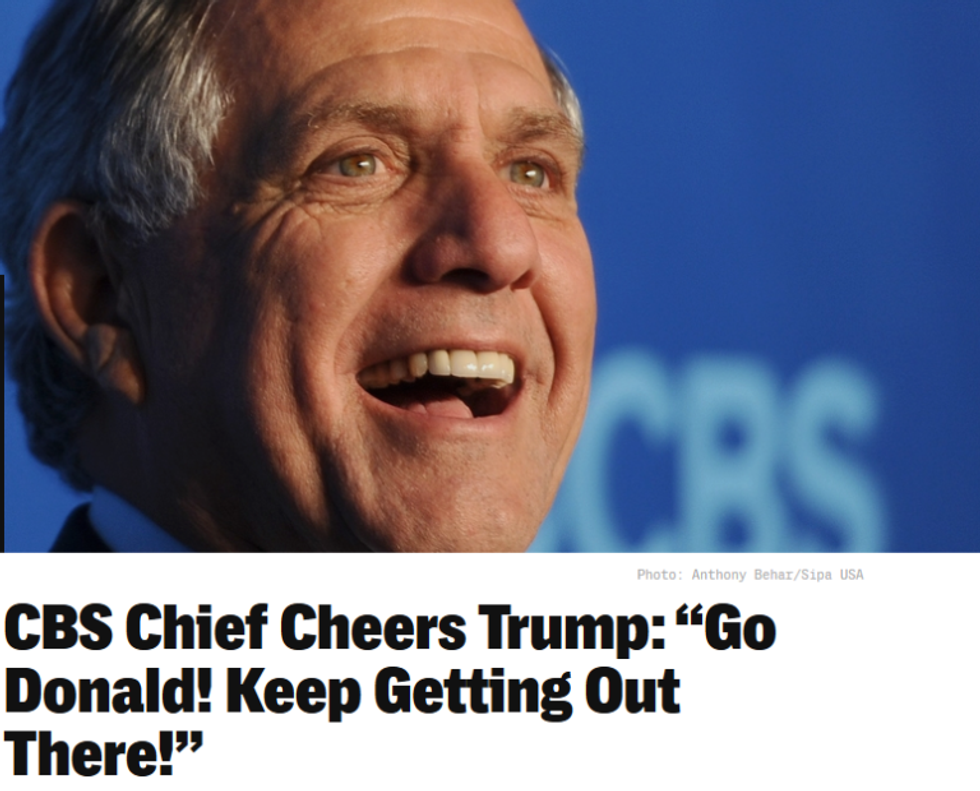
I'm thinking of a report from December by Lee Fang at The Intercept (12/10/15), about how, with visions of campaign ad dollars sparkling in his eye, CBS chief executive Les Moonves cheered on Trump's candidacy at an investor presentation: "The more they spend, the better it is for us, and: Go Donald! Keep getting out there!"
This was after Trump's comments about Mexico sending rapists to the US and his call for Muslim Americans to have to "register" with the government.
In an earlier investor meeting, Moonves had joked, "Looking ahead, the 2016 presidential election is right around the corner and, thank God, the rancor has already begun."
The same media companies that behind the scenes cheerfully acknowledge a preference for rancor or extremism if it keeps candidates spending money, and lobby furiously against campaign finance reforms that might interrupt their cash flow, also--Fang reminds us--present themselves as neutral observers of the electoral process.
Moonves may have said, "This is fun, watching this, let them spend money on us.... We're looking forward to a very exciting political year in '16''--but that doesn't mean that media companies just see green rather than red or blue. They don't care only about profit-making, but also about maintaining the policies and laws that protect that profit-making.
Which may be why, when asked about electoral politics by Time magazine in 2004 (9/27/04), Sumner Redstone, then executive chair of CBS and Viacom, said, "Viacom is my life, and I do believe that a Republican administration is better for media companies than a Democratic one."
Great Britain won't actually ban Donald Trump from the country but Parliament did spend time taking seriously what was called Trump's "poisonous, corrosive" effect on public discourse. At the same time, actors, writers and others, including Harry Belafonte, Eve Ensler and Noam Chomsky, launched a Stop Hate Dump Trump campaign, that included serving notice to media that they "are accountable for normalizing Trump's extremism by treating it as entertainment, by giving it inordinate and unequal air time and by refusing to investigate, interrogate or condemn it appropriately."
For some journalists, this might provoke questions: Reporters can't ignore public figures, but is there daylight between covering news of a person and providing them a near-constant, legitimizing megaphone?
For media executives, though, the main question seems to be: What time does the bank open?
I'm thinking of a report from December by Lee Fang at The Intercept (12/10/15), about how, with visions of campaign ad dollars sparkling in his eye, CBS chief executive Les Moonves cheered on Trump's candidacy at an investor presentation: "The more they spend, the better it is for us, and: Go Donald! Keep getting out there!"
This was after Trump's comments about Mexico sending rapists to the US and his call for Muslim Americans to have to "register" with the government.
In an earlier investor meeting, Moonves had joked, "Looking ahead, the 2016 presidential election is right around the corner and, thank God, the rancor has already begun."
The same media companies that behind the scenes cheerfully acknowledge a preference for rancor or extremism if it keeps candidates spending money, and lobby furiously against campaign finance reforms that might interrupt their cash flow, also--Fang reminds us--present themselves as neutral observers of the electoral process.
Moonves may have said, "This is fun, watching this, let them spend money on us.... We're looking forward to a very exciting political year in '16''--but that doesn't mean that media companies just see green rather than red or blue. They don't care only about profit-making, but also about maintaining the policies and laws that protect that profit-making.
Which may be why, when asked about electoral politics by Time magazine in 2004 (9/27/04), Sumner Redstone, then executive chair of CBS and Viacom, said, "Viacom is my life, and I do believe that a Republican administration is better for media companies than a Democratic one."
Great Britain won't actually ban Donald Trump from the country but Parliament did spend time taking seriously what was called Trump's "poisonous, corrosive" effect on public discourse. At the same time, actors, writers and others, including Harry Belafonte, Eve Ensler and Noam Chomsky, launched a Stop Hate Dump Trump campaign, that included serving notice to media that they "are accountable for normalizing Trump's extremism by treating it as entertainment, by giving it inordinate and unequal air time and by refusing to investigate, interrogate or condemn it appropriately."
For some journalists, this might provoke questions: Reporters can't ignore public figures, but is there daylight between covering news of a person and providing them a near-constant, legitimizing megaphone?
For media executives, though, the main question seems to be: What time does the bank open?
I'm thinking of a report from December by Lee Fang at The Intercept (12/10/15), about how, with visions of campaign ad dollars sparkling in his eye, CBS chief executive Les Moonves cheered on Trump's candidacy at an investor presentation: "The more they spend, the better it is for us, and: Go Donald! Keep getting out there!"
This was after Trump's comments about Mexico sending rapists to the US and his call for Muslim Americans to have to "register" with the government.
In an earlier investor meeting, Moonves had joked, "Looking ahead, the 2016 presidential election is right around the corner and, thank God, the rancor has already begun."
The same media companies that behind the scenes cheerfully acknowledge a preference for rancor or extremism if it keeps candidates spending money, and lobby furiously against campaign finance reforms that might interrupt their cash flow, also--Fang reminds us--present themselves as neutral observers of the electoral process.
Moonves may have said, "This is fun, watching this, let them spend money on us.... We're looking forward to a very exciting political year in '16''--but that doesn't mean that media companies just see green rather than red or blue. They don't care only about profit-making, but also about maintaining the policies and laws that protect that profit-making.
Which may be why, when asked about electoral politics by Time magazine in 2004 (9/27/04), Sumner Redstone, then executive chair of CBS and Viacom, said, "Viacom is my life, and I do believe that a Republican administration is better for media companies than a Democratic one."