
The day he died, my organization got a hand-written letter from Pete Seeger, the 94-year-old iconic folksinger who departed last month after decades of inspiring us onward with his peace and justice ballads.
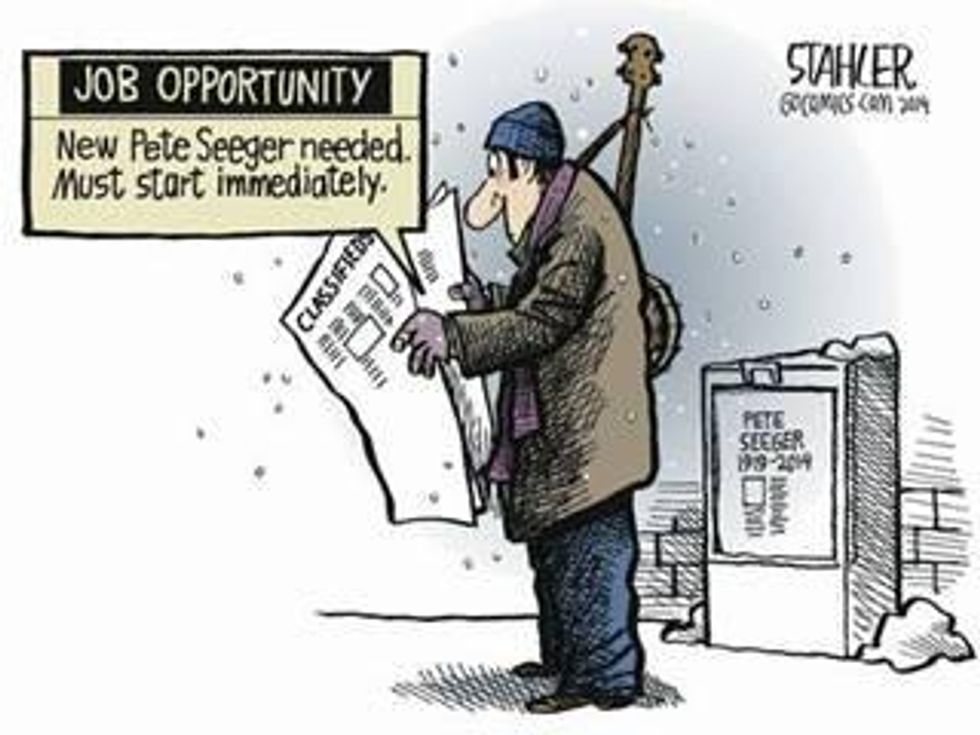
Now with his loss, we realize it is quite a gap to fill. Indeed, one political cartoon showed a hapless banjo player reading his paper's page: "JOB OPPORTUNITY: New Pete Seeger needed. Must start immediately."
What were his final messages to us? In an article last week entitled, "I'm Through With Big Things," Seeger was quoted as saying, "Be wary of great leaders. Hope that there are many, many small leaders." We know of his work to clean up the Hudson River, as well as his call for all of us to get involved at the local level. If he was disappointed in greater things, it was perhaps no wonder--for decades he suffered severe disappointments on the larger scene--a country which blacklisted him, record companies and television stations that marginalized him, and a youth culture and civil rights movement that passed him over when they became enamored by cooler music and more strident activism.
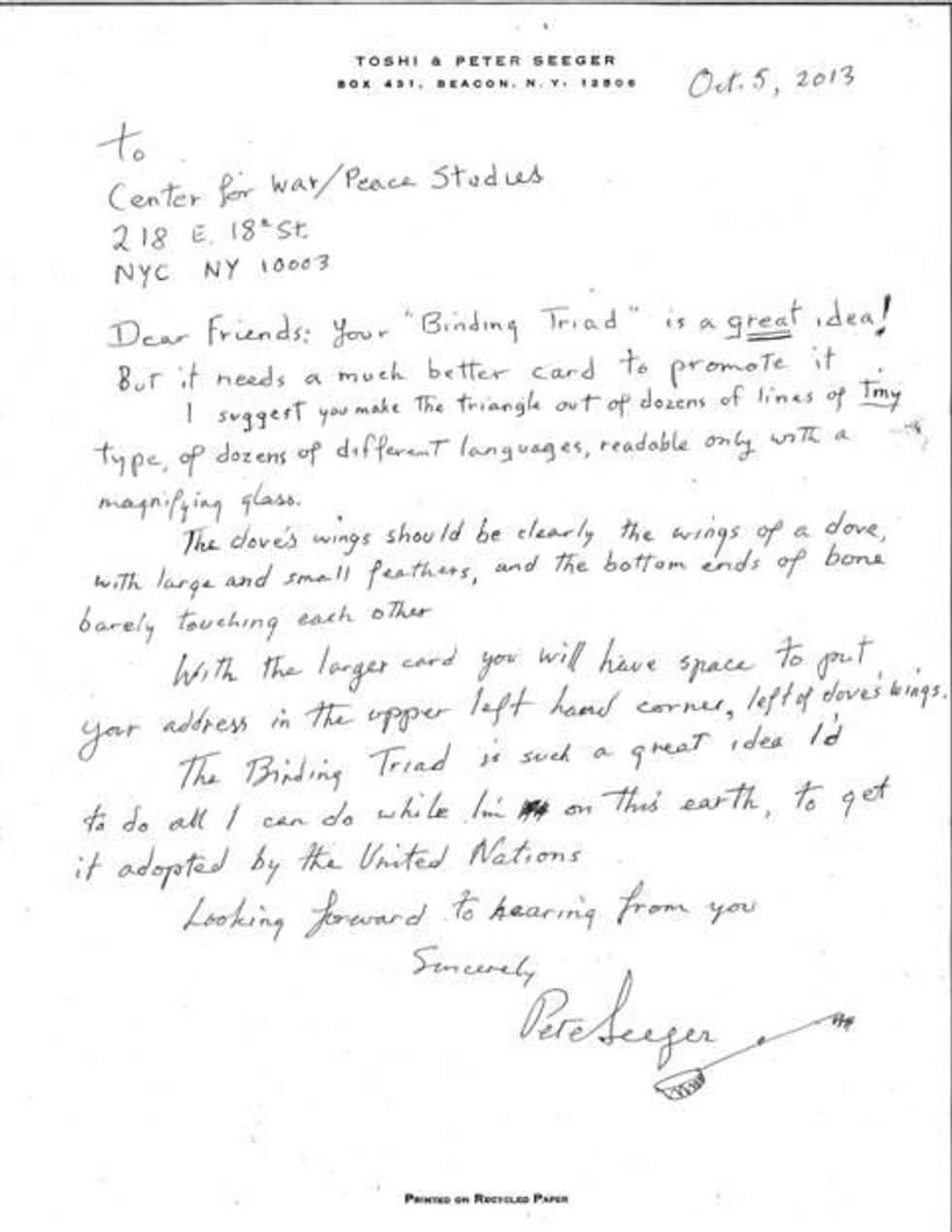
Yet Seeger never did falter from his dream of a united world. This visionary yet practical man understood that probably the one way to make sure all of the 193 countries on the planet would cooperate was through global rules with enforcement power, through a democratic, empowered and more fairly structured United Nations. With me, he was on the Board of Advisors for the Center for War/Peace Studies in New York which received his last letter on the day he died, though it was written October 5, 2013. In it Seeger expressed support for a proposal to reform the United Nations voting structure to make it more representative of the people through a proposal called the Binding Triad.
"The Binding Triad is such a great idea I'd like to do all I can while I'm on this earth to get it adopted by the United Nations," Seeger wrote in his letter and he included ideas on how to better sell the idea to the public.
Seeger loved the earth and all life on it. He was always seeking solutions. As he recently sang with Tomorrow's Children in Solartopia:
Now we're fighting wars over oil and gas, no matter who wins it will not last.
The earth is scarred, the planet is warming. Don't you think that all of it's a great big warning?
Don't you know we're gonna need a Solartopia all over God's green earth?
It is a testament to Seeger's struggle, tenacity and final emergence into redemption that his vision decades ago holds just as true today. With the melting arctic, leaking nuclear reactors, collapsing world economy, continued wars over oil and broken political and economic systems, we know that time is quickly running out. Instead of doom and gloom, however, Seeger inspired optimism with his own joyful sound. He realized there is even an answer to the most largest catastrophes awaiting us - by organizing countries to work together at the global level.
"Participation - that's what's gonna save the human race," was a slogan Seeger was fond of using. Fellow World Citizens, let's all pick up our banjos and march our world into its brave new future.
The day he died, my organization got a hand-written letter from Pete Seeger, the 94-year-old iconic folksinger who departed last month after decades of inspiring us onward with his peace and justice ballads.
Now with his loss, we realize it is quite a gap to fill. Indeed, one political cartoon showed a hapless banjo player reading his paper's page: "JOB OPPORTUNITY: New Pete Seeger needed. Must start immediately."
What were his final messages to us? In an article last week entitled, "I'm Through With Big Things," Seeger was quoted as saying, "Be wary of great leaders. Hope that there are many, many small leaders." We know of his work to clean up the Hudson River, as well as his call for all of us to get involved at the local level. If he was disappointed in greater things, it was perhaps no wonder--for decades he suffered severe disappointments on the larger scene--a country which blacklisted him, record companies and television stations that marginalized him, and a youth culture and civil rights movement that passed him over when they became enamored by cooler music and more strident activism.
Yet Seeger never did falter from his dream of a united world. This visionary yet practical man understood that probably the one way to make sure all of the 193 countries on the planet would cooperate was through global rules with enforcement power, through a democratic, empowered and more fairly structured United Nations. With me, he was on the Board of Advisors for the Center for War/Peace Studies in New York which received his last letter on the day he died, though it was written October 5, 2013. In it Seeger expressed support for a proposal to reform the United Nations voting structure to make it more representative of the people through a proposal called the Binding Triad.
"The Binding Triad is such a great idea I'd like to do all I can while I'm on this earth to get it adopted by the United Nations," Seeger wrote in his letter and he included ideas on how to better sell the idea to the public.
Seeger loved the earth and all life on it. He was always seeking solutions. As he recently sang with Tomorrow's Children in Solartopia:
Now we're fighting wars over oil and gas, no matter who wins it will not last.
The earth is scarred, the planet is warming. Don't you think that all of it's a great big warning?
Don't you know we're gonna need a Solartopia all over God's green earth?
It is a testament to Seeger's struggle, tenacity and final emergence into redemption that his vision decades ago holds just as true today. With the melting arctic, leaking nuclear reactors, collapsing world economy, continued wars over oil and broken political and economic systems, we know that time is quickly running out. Instead of doom and gloom, however, Seeger inspired optimism with his own joyful sound. He realized there is even an answer to the most largest catastrophes awaiting us - by organizing countries to work together at the global level.
"Participation - that's what's gonna save the human race," was a slogan Seeger was fond of using. Fellow World Citizens, let's all pick up our banjos and march our world into its brave new future.
The day he died, my organization got a hand-written letter from Pete Seeger, the 94-year-old iconic folksinger who departed last month after decades of inspiring us onward with his peace and justice ballads.
Now with his loss, we realize it is quite a gap to fill. Indeed, one political cartoon showed a hapless banjo player reading his paper's page: "JOB OPPORTUNITY: New Pete Seeger needed. Must start immediately."
What were his final messages to us? In an article last week entitled, "I'm Through With Big Things," Seeger was quoted as saying, "Be wary of great leaders. Hope that there are many, many small leaders." We know of his work to clean up the Hudson River, as well as his call for all of us to get involved at the local level. If he was disappointed in greater things, it was perhaps no wonder--for decades he suffered severe disappointments on the larger scene--a country which blacklisted him, record companies and television stations that marginalized him, and a youth culture and civil rights movement that passed him over when they became enamored by cooler music and more strident activism.
Yet Seeger never did falter from his dream of a united world. This visionary yet practical man understood that probably the one way to make sure all of the 193 countries on the planet would cooperate was through global rules with enforcement power, through a democratic, empowered and more fairly structured United Nations. With me, he was on the Board of Advisors for the Center for War/Peace Studies in New York which received his last letter on the day he died, though it was written October 5, 2013. In it Seeger expressed support for a proposal to reform the United Nations voting structure to make it more representative of the people through a proposal called the Binding Triad.
"The Binding Triad is such a great idea I'd like to do all I can while I'm on this earth to get it adopted by the United Nations," Seeger wrote in his letter and he included ideas on how to better sell the idea to the public.
Seeger loved the earth and all life on it. He was always seeking solutions. As he recently sang with Tomorrow's Children in Solartopia:
Now we're fighting wars over oil and gas, no matter who wins it will not last.
The earth is scarred, the planet is warming. Don't you think that all of it's a great big warning?
Don't you know we're gonna need a Solartopia all over God's green earth?
It is a testament to Seeger's struggle, tenacity and final emergence into redemption that his vision decades ago holds just as true today. With the melting arctic, leaking nuclear reactors, collapsing world economy, continued wars over oil and broken political and economic systems, we know that time is quickly running out. Instead of doom and gloom, however, Seeger inspired optimism with his own joyful sound. He realized there is even an answer to the most largest catastrophes awaiting us - by organizing countries to work together at the global level.
"Participation - that's what's gonna save the human race," was a slogan Seeger was fond of using. Fellow World Citizens, let's all pick up our banjos and march our world into its brave new future.