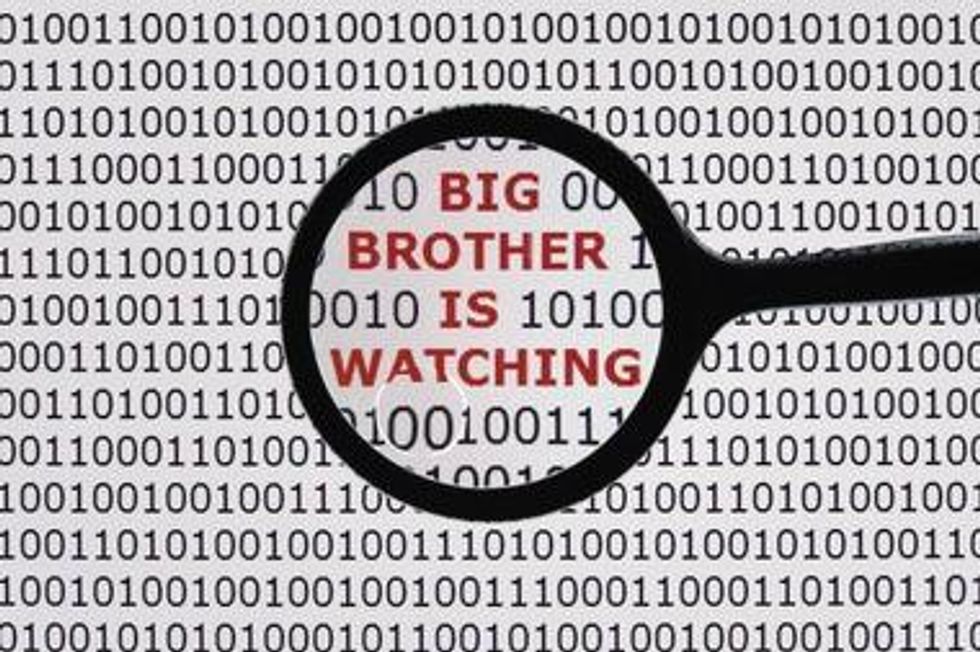
" Big Brother is Watching You," George Orwell wrote in his disturbing book 1984. But, as Mikko Hypponen points out, Orwell "was an optimist." Orwell never could have imagined that the National Security Agency (NSA) would amass metadata on billions of our phone calls and 200 million of our text messages every day. Orwell could not have foreseen that our government would read the content of our emails, file transfers, and live chats from the social media we use.
In his recent speech on NSA reforms, President Obama cited as precedent Paul Revere and the Sons of Liberty, who patrolled the streets at night, "reporting back any signs that the British were preparing raids against America's early Patriots." This was a weak effort to find historical support for the NSA spying program. After all, Paul Revere and his associates were patrolling the streets, not sorting through people's private communications.
To get a more accurate historical perspective, Obama should have considered how our founding fathers reacted to searches conducted by the British before the revolution. The British used "general warrants," which authorized blanket searches without any individualized suspicion or specificity of what the colonial authorities were seeking.
At the American Continental Congress in 1774, in a petition to King George III, Congress protested against the colonial officers' unlimited power of search and seizure. The petition charged that power had been used "to break open and enter houses, without the authority of any civil magistrate founded on legal information."
When the founders later put the Fourth Amendment's prohibition on unreasonable searches and seizures into the Bill of Rights, they were attempting to ensure that our country would not become a police state.
Those who maintain that government surveillance is no threat to our liberty should consider the abuse that occurred nearly 200 years later, when FBI Director J. Edgar Hoover conducted the dreaded COINTELPRO (counter-intelligence program). It was designed to "disrupt, misdirect, discredit and otherwise neutralize" political and activist groups. During the McCarthy witch hunts of the 1950s, in an effort to eradicate the perceived threat of communism, our government engaged in widespread illegal surveillance to threaten and silence anyone with unorthodox political views. Thousands of people were jailed, blacklisted, and fired as the FBI engaged in "red-baiting."
In the 1960's, the FBI targeted Dr. Martin Luther King, Jr. in a program called "Racial Matters." King's campaign to register African-American voters in the South raised the hackles of the FBI, which disingenuously claimed that King's organization was being infiltrated by communists. But the FBI was really worried that King's civil rights campaign "represented a clear threat to the established order of the U.S." The FBI went after King with a vengeance, wiretapping his phones, and securing personal information which it used to try to discredit him, hoping to drive him to divorce and suicide.
Obama would likely argue that our modern day "war on terror" is unlike COINTELPRO because it targets real, rather than imagined, threats. But, as Hypponen says, "It's not the war on terror." Indeed, the Privacy and Civil Liberties Oversight Board, an independent federal privacy watchdog, found "no instance in which the program directly contributed to the discovery of a previously unknown terrorist plot or the disruption of a terrorist attack."
The NSA spying program captures all of us, including European leaders, people in Mexico, Brazil, the United Nations, and the European Union Parliament, not just the terrorists. Although Obama assured us that the government "does not collect intelligence to suppress criticism or dissent," our history, particularly during COINTELPRO, tells us otherwise.
Obama proposed some reforms to the NSA program, but left in place the most egregious aspects. He said that the NSA must secure approval of a judge on the Foreign Intelligence Surveillance Court before it gets access to the phone records of an individual. But that is a secret court, whose judges are appointed by the conservative Chief Justice John Roberts, and it has almost never turned down an executive branch wiretapping request since it was created in 1978. Most significantly, Obama did not say that surveillance without judicial warrants or individual suspicion should be halted.
"One of [Obama's] biggest lapses," a New York Times editorial noted, "was his refusal to acknowledge that his entire speech, and all of the important changes he now advocates, would never have happened without the disclosures by [Edward] Snowden, who continues to live in exile and under the threat of decades in prison if he returns to this country."
Snowden's revelations will reportedly continue to emerge. And you can bet that Orwell will continue to turn in his grave for a long time to come.
" Big Brother is Watching You," George Orwell wrote in his disturbing book 1984. But, as Mikko Hypponen points out, Orwell "was an optimist." Orwell never could have imagined that the National Security Agency (NSA) would amass metadata on billions of our phone calls and 200 million of our text messages every day. Orwell could not have foreseen that our government would read the content of our emails, file transfers, and live chats from the social media we use.
In his recent speech on NSA reforms, President Obama cited as precedent Paul Revere and the Sons of Liberty, who patrolled the streets at night, "reporting back any signs that the British were preparing raids against America's early Patriots." This was a weak effort to find historical support for the NSA spying program. After all, Paul Revere and his associates were patrolling the streets, not sorting through people's private communications.
To get a more accurate historical perspective, Obama should have considered how our founding fathers reacted to searches conducted by the British before the revolution. The British used "general warrants," which authorized blanket searches without any individualized suspicion or specificity of what the colonial authorities were seeking.
At the American Continental Congress in 1774, in a petition to King George III, Congress protested against the colonial officers' unlimited power of search and seizure. The petition charged that power had been used "to break open and enter houses, without the authority of any civil magistrate founded on legal information."
When the founders later put the Fourth Amendment's prohibition on unreasonable searches and seizures into the Bill of Rights, they were attempting to ensure that our country would not become a police state.
Those who maintain that government surveillance is no threat to our liberty should consider the abuse that occurred nearly 200 years later, when FBI Director J. Edgar Hoover conducted the dreaded COINTELPRO (counter-intelligence program). It was designed to "disrupt, misdirect, discredit and otherwise neutralize" political and activist groups. During the McCarthy witch hunts of the 1950s, in an effort to eradicate the perceived threat of communism, our government engaged in widespread illegal surveillance to threaten and silence anyone with unorthodox political views. Thousands of people were jailed, blacklisted, and fired as the FBI engaged in "red-baiting."
In the 1960's, the FBI targeted Dr. Martin Luther King, Jr. in a program called "Racial Matters." King's campaign to register African-American voters in the South raised the hackles of the FBI, which disingenuously claimed that King's organization was being infiltrated by communists. But the FBI was really worried that King's civil rights campaign "represented a clear threat to the established order of the U.S." The FBI went after King with a vengeance, wiretapping his phones, and securing personal information which it used to try to discredit him, hoping to drive him to divorce and suicide.
Obama would likely argue that our modern day "war on terror" is unlike COINTELPRO because it targets real, rather than imagined, threats. But, as Hypponen says, "It's not the war on terror." Indeed, the Privacy and Civil Liberties Oversight Board, an independent federal privacy watchdog, found "no instance in which the program directly contributed to the discovery of a previously unknown terrorist plot or the disruption of a terrorist attack."
The NSA spying program captures all of us, including European leaders, people in Mexico, Brazil, the United Nations, and the European Union Parliament, not just the terrorists. Although Obama assured us that the government "does not collect intelligence to suppress criticism or dissent," our history, particularly during COINTELPRO, tells us otherwise.
Obama proposed some reforms to the NSA program, but left in place the most egregious aspects. He said that the NSA must secure approval of a judge on the Foreign Intelligence Surveillance Court before it gets access to the phone records of an individual. But that is a secret court, whose judges are appointed by the conservative Chief Justice John Roberts, and it has almost never turned down an executive branch wiretapping request since it was created in 1978. Most significantly, Obama did not say that surveillance without judicial warrants or individual suspicion should be halted.
"One of [Obama's] biggest lapses," a New York Times editorial noted, "was his refusal to acknowledge that his entire speech, and all of the important changes he now advocates, would never have happened without the disclosures by [Edward] Snowden, who continues to live in exile and under the threat of decades in prison if he returns to this country."
Snowden's revelations will reportedly continue to emerge. And you can bet that Orwell will continue to turn in his grave for a long time to come.