SUBSCRIBE TO OUR FREE NEWSLETTER
Daily news & progressive opinion—funded by the people, not the corporations—delivered straight to your inbox.
5
#000000
#FFFFFF
To donate by check, phone, or other method, see our More Ways to Give page.
Why does the president need to address a classroom full of third-graders?
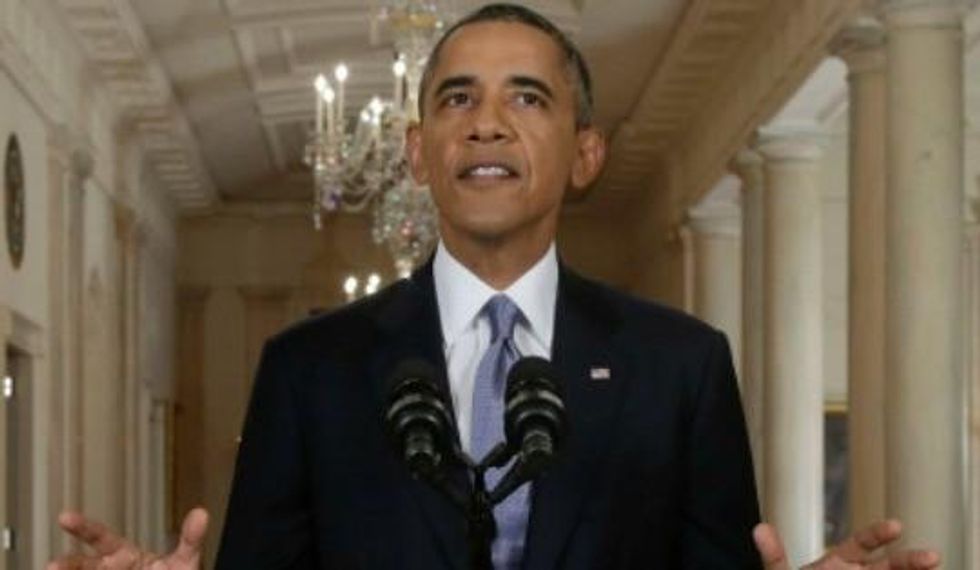
On Tuesday night -- hallelujah -- he stepped back from the brink of war, but in his address to the nation he spent most of his time justifying his earlier aggression toward Syria, detailing the Assad government's single, heinous deviation from the civilized norms of war.
The ever-fresh PR stratagem of war is to cherry-pick an example of evil behavior on the part of the designated enemy and rally the outrage against it, never, never looking inward at one's own behavior, and in our ignorance bonding as a clan or a nation or whatever in our determination to destroy the perpetrator of said evil.
A little over a decade ago, just after we launched our shock-and-awe bombing campaign against Iraq, I wrote: "Pro-war logic ultimately undergoes a mysterious transformation -- from a moral absolutism condemning Saddam to a moral relativism justifying the use of MOABs and daisy cutters and even first-strike nukes, if necessary, to get rid of him. Some of the nicest people you'd ever want to meet have no problem with the slaughter of civilians."
So Barack Obama, in his role as president, belies both his own intelligence and that of -- my guess -- most of his constituents when he asks us to play along with the game. Yes, poison gas is a ghastly evil (though who actually used it in the Damascus suburb of Ghouta remains uncertain), but what a ruse to muster all one's outrage over images of "men, women, children lying in rows, killed by poison gas, others foaming at the mouth, gasping for breath, a father clutching his dead children, imploring them to get up and walk" -- and then use that outrage as the pretext to justify counter-actions on our part that are equally indiscriminate in their delivery of hell to the same people.
Virtually every aspect of modern warfare fits the description Obama drew as a sort of "red line" of bad behavior: the use of weaponry that kills on a mass scale, making no distinction between soldier and infant. We are, after all, the nation that developed nuclear weapons and, over the next half century, spent some $5.5 trillion playing arms race with the Soviet Union and, ultimately, with no one at all. We're still developing further generations of "tactical" nukes, bleeding more than $30 billion annually into this insanity.
The point being, Mr. President, yes, yes, we feel the outrage of Syria's horrific civil war, and no, we're not content doing nothing about that or any other massacre taking place on the planet, whether perpetrated by ally or designated enemy. But we're sick of the inane "solutions" mouthed by tyrants and presidents that do nothing but perpetuate the hell of war and feed the hidden interests of its corporate profiteers. Your decision to step back from the brink of an intervention-lite in Syria is worth celebrating, but spare us the "God bless America" that's backed by Tomahawk missiles and, ultimately, nuclear weapons, and address the nation and the world with courage about how we'll take the lead to end war itself.
As Sarah van Gelder wrote last week in Yes! Magazine: "Instead of launching an assault on Syria, the United States could lead a 'coalition of the willing' in rebuilding the tattered foundation of international law."
Van Gelder's excellent essay, on alternatives to military strikes in Syria, addresses a profound void in the public and political imagination: If there's trouble, the only appropriate -- "real" -- response is a violent one. If you don't show the bad guy who's boss, whoa, watch out, wimp!
And this leads to the idolatry of uncritical "weapons worship," a staple of mainstream media coverage of all matters military, especially during, but not limited to, times of war buildup. For instance: "The Tomahawk cruise missile is standard equipment on U.S. Navy destroyers and cruisers, but it is reserved for the most serious occasions. The United States fired them at Libya in March 2011 and before that during the 'shock and awe' campaign at the beginning of the Iraq War in 2003. . . .
"They carry a 1,000-pound warhead to 'soften' land targets and make way for manned aircraft runs and, if necessary, ground troops."
This story, which ran last week in the San Diego Union-Tribune, describes how awesome and humbling it is to be the captain of a ship that fires off a Tomahawk in a real battle, but avoids the least reflection on the consequences of doing so -- on what happens when it lands. Maybe these million-dollar, thousand pound behemoths "can kill on a mass scale, with no distinction between soldier and infant," but when we do it, we're simply softening up the land targets.
And this is all Obama wanted to do, but the plan, instead of being met with a public shrug, encountered a shockwave of opposition. The normal marketing strategies didn't work. Then the Russians made a geopolitical chess move, suggesting that Syria surrender its chemical weapons stockpile to international control, and Obama announced: "I have therefore asked the leaders of Congress to postpone a vote to authorize the use of force while we pursue this diplomatic path."
As David Swanson put it, "Out of whatever combination of factors, it just may turn out that we've stopped a war. Which means that we can stop another war. Which means that we can begin to work our way out of the war machine that has eaten our economy, our civil liberties, our natural environment, and our soul."
It's written off as war weariness or Republican spleen toward Obama, but there's another factor as well: an intelligently angry slice of the American public that sees through war itself and will no longer buy into the sales job that precedes it. As this constituency grows, the public imagination will begin to open to the endless possibilities for conflict resolution and transformation that exist beyond war.
Why does the president need to address a classroom full of third-graders?
On Tuesday night -- hallelujah -- he stepped back from the brink of war, but in his address to the nation he spent most of his time justifying his earlier aggression toward Syria, detailing the Assad government's single, heinous deviation from the civilized norms of war.
The ever-fresh PR stratagem of war is to cherry-pick an example of evil behavior on the part of the designated enemy and rally the outrage against it, never, never looking inward at one's own behavior, and in our ignorance bonding as a clan or a nation or whatever in our determination to destroy the perpetrator of said evil.
A little over a decade ago, just after we launched our shock-and-awe bombing campaign against Iraq, I wrote: "Pro-war logic ultimately undergoes a mysterious transformation -- from a moral absolutism condemning Saddam to a moral relativism justifying the use of MOABs and daisy cutters and even first-strike nukes, if necessary, to get rid of him. Some of the nicest people you'd ever want to meet have no problem with the slaughter of civilians."
So Barack Obama, in his role as president, belies both his own intelligence and that of -- my guess -- most of his constituents when he asks us to play along with the game. Yes, poison gas is a ghastly evil (though who actually used it in the Damascus suburb of Ghouta remains uncertain), but what a ruse to muster all one's outrage over images of "men, women, children lying in rows, killed by poison gas, others foaming at the mouth, gasping for breath, a father clutching his dead children, imploring them to get up and walk" -- and then use that outrage as the pretext to justify counter-actions on our part that are equally indiscriminate in their delivery of hell to the same people.
Virtually every aspect of modern warfare fits the description Obama drew as a sort of "red line" of bad behavior: the use of weaponry that kills on a mass scale, making no distinction between soldier and infant. We are, after all, the nation that developed nuclear weapons and, over the next half century, spent some $5.5 trillion playing arms race with the Soviet Union and, ultimately, with no one at all. We're still developing further generations of "tactical" nukes, bleeding more than $30 billion annually into this insanity.
The point being, Mr. President, yes, yes, we feel the outrage of Syria's horrific civil war, and no, we're not content doing nothing about that or any other massacre taking place on the planet, whether perpetrated by ally or designated enemy. But we're sick of the inane "solutions" mouthed by tyrants and presidents that do nothing but perpetuate the hell of war and feed the hidden interests of its corporate profiteers. Your decision to step back from the brink of an intervention-lite in Syria is worth celebrating, but spare us the "God bless America" that's backed by Tomahawk missiles and, ultimately, nuclear weapons, and address the nation and the world with courage about how we'll take the lead to end war itself.
As Sarah van Gelder wrote last week in Yes! Magazine: "Instead of launching an assault on Syria, the United States could lead a 'coalition of the willing' in rebuilding the tattered foundation of international law."
Van Gelder's excellent essay, on alternatives to military strikes in Syria, addresses a profound void in the public and political imagination: If there's trouble, the only appropriate -- "real" -- response is a violent one. If you don't show the bad guy who's boss, whoa, watch out, wimp!
And this leads to the idolatry of uncritical "weapons worship," a staple of mainstream media coverage of all matters military, especially during, but not limited to, times of war buildup. For instance: "The Tomahawk cruise missile is standard equipment on U.S. Navy destroyers and cruisers, but it is reserved for the most serious occasions. The United States fired them at Libya in March 2011 and before that during the 'shock and awe' campaign at the beginning of the Iraq War in 2003. . . .
"They carry a 1,000-pound warhead to 'soften' land targets and make way for manned aircraft runs and, if necessary, ground troops."
This story, which ran last week in the San Diego Union-Tribune, describes how awesome and humbling it is to be the captain of a ship that fires off a Tomahawk in a real battle, but avoids the least reflection on the consequences of doing so -- on what happens when it lands. Maybe these million-dollar, thousand pound behemoths "can kill on a mass scale, with no distinction between soldier and infant," but when we do it, we're simply softening up the land targets.
And this is all Obama wanted to do, but the plan, instead of being met with a public shrug, encountered a shockwave of opposition. The normal marketing strategies didn't work. Then the Russians made a geopolitical chess move, suggesting that Syria surrender its chemical weapons stockpile to international control, and Obama announced: "I have therefore asked the leaders of Congress to postpone a vote to authorize the use of force while we pursue this diplomatic path."
As David Swanson put it, "Out of whatever combination of factors, it just may turn out that we've stopped a war. Which means that we can stop another war. Which means that we can begin to work our way out of the war machine that has eaten our economy, our civil liberties, our natural environment, and our soul."
It's written off as war weariness or Republican spleen toward Obama, but there's another factor as well: an intelligently angry slice of the American public that sees through war itself and will no longer buy into the sales job that precedes it. As this constituency grows, the public imagination will begin to open to the endless possibilities for conflict resolution and transformation that exist beyond war.
Why does the president need to address a classroom full of third-graders?
On Tuesday night -- hallelujah -- he stepped back from the brink of war, but in his address to the nation he spent most of his time justifying his earlier aggression toward Syria, detailing the Assad government's single, heinous deviation from the civilized norms of war.
The ever-fresh PR stratagem of war is to cherry-pick an example of evil behavior on the part of the designated enemy and rally the outrage against it, never, never looking inward at one's own behavior, and in our ignorance bonding as a clan or a nation or whatever in our determination to destroy the perpetrator of said evil.
A little over a decade ago, just after we launched our shock-and-awe bombing campaign against Iraq, I wrote: "Pro-war logic ultimately undergoes a mysterious transformation -- from a moral absolutism condemning Saddam to a moral relativism justifying the use of MOABs and daisy cutters and even first-strike nukes, if necessary, to get rid of him. Some of the nicest people you'd ever want to meet have no problem with the slaughter of civilians."
So Barack Obama, in his role as president, belies both his own intelligence and that of -- my guess -- most of his constituents when he asks us to play along with the game. Yes, poison gas is a ghastly evil (though who actually used it in the Damascus suburb of Ghouta remains uncertain), but what a ruse to muster all one's outrage over images of "men, women, children lying in rows, killed by poison gas, others foaming at the mouth, gasping for breath, a father clutching his dead children, imploring them to get up and walk" -- and then use that outrage as the pretext to justify counter-actions on our part that are equally indiscriminate in their delivery of hell to the same people.
Virtually every aspect of modern warfare fits the description Obama drew as a sort of "red line" of bad behavior: the use of weaponry that kills on a mass scale, making no distinction between soldier and infant. We are, after all, the nation that developed nuclear weapons and, over the next half century, spent some $5.5 trillion playing arms race with the Soviet Union and, ultimately, with no one at all. We're still developing further generations of "tactical" nukes, bleeding more than $30 billion annually into this insanity.
The point being, Mr. President, yes, yes, we feel the outrage of Syria's horrific civil war, and no, we're not content doing nothing about that or any other massacre taking place on the planet, whether perpetrated by ally or designated enemy. But we're sick of the inane "solutions" mouthed by tyrants and presidents that do nothing but perpetuate the hell of war and feed the hidden interests of its corporate profiteers. Your decision to step back from the brink of an intervention-lite in Syria is worth celebrating, but spare us the "God bless America" that's backed by Tomahawk missiles and, ultimately, nuclear weapons, and address the nation and the world with courage about how we'll take the lead to end war itself.
As Sarah van Gelder wrote last week in Yes! Magazine: "Instead of launching an assault on Syria, the United States could lead a 'coalition of the willing' in rebuilding the tattered foundation of international law."
Van Gelder's excellent essay, on alternatives to military strikes in Syria, addresses a profound void in the public and political imagination: If there's trouble, the only appropriate -- "real" -- response is a violent one. If you don't show the bad guy who's boss, whoa, watch out, wimp!
And this leads to the idolatry of uncritical "weapons worship," a staple of mainstream media coverage of all matters military, especially during, but not limited to, times of war buildup. For instance: "The Tomahawk cruise missile is standard equipment on U.S. Navy destroyers and cruisers, but it is reserved for the most serious occasions. The United States fired them at Libya in March 2011 and before that during the 'shock and awe' campaign at the beginning of the Iraq War in 2003. . . .
"They carry a 1,000-pound warhead to 'soften' land targets and make way for manned aircraft runs and, if necessary, ground troops."
This story, which ran last week in the San Diego Union-Tribune, describes how awesome and humbling it is to be the captain of a ship that fires off a Tomahawk in a real battle, but avoids the least reflection on the consequences of doing so -- on what happens when it lands. Maybe these million-dollar, thousand pound behemoths "can kill on a mass scale, with no distinction between soldier and infant," but when we do it, we're simply softening up the land targets.
And this is all Obama wanted to do, but the plan, instead of being met with a public shrug, encountered a shockwave of opposition. The normal marketing strategies didn't work. Then the Russians made a geopolitical chess move, suggesting that Syria surrender its chemical weapons stockpile to international control, and Obama announced: "I have therefore asked the leaders of Congress to postpone a vote to authorize the use of force while we pursue this diplomatic path."
As David Swanson put it, "Out of whatever combination of factors, it just may turn out that we've stopped a war. Which means that we can stop another war. Which means that we can begin to work our way out of the war machine that has eaten our economy, our civil liberties, our natural environment, and our soul."
It's written off as war weariness or Republican spleen toward Obama, but there's another factor as well: an intelligently angry slice of the American public that sees through war itself and will no longer buy into the sales job that precedes it. As this constituency grows, the public imagination will begin to open to the endless possibilities for conflict resolution and transformation that exist beyond war.