SUBSCRIBE TO OUR FREE NEWSLETTER
Daily news & progressive opinion—funded by the people, not the corporations—delivered straight to your inbox.
5
#000000
#FFFFFF
To donate by check, phone, or other method, see our More Ways to Give page.
On June 4th, 2013, London-based news source the Guardian reported, "Fukushima tuna safe to eat - study." The day before, the Los Angeles Times reported, "Scientists to eaters: Don't freak out over Fukushima fish." The San Diego Union-Tribune was emphatic: "Tuna Pose No Risk after Nuke Disaster," and online, "Fukushima seafood radiation risk nil, study says." The BBC ran with, "Fukushima tuna pose little health risk." And CNN declared, "Fukushima tuna study finds minuscule health risks."
On June 4th, 2013, London-based news source the Guardian reported, "Fukushima tuna safe to eat - study." The day before, the Los Angeles Times reported, "Scientists to eaters: Don't freak out over Fukushima fish." The San Diego Union-Tribune was emphatic: "Tuna Pose No Risk after Nuke Disaster," and online, "Fukushima seafood radiation risk nil, study says." The BBC ran with, "Fukushima tuna pose little health risk." And CNN declared, "Fukushima tuna study finds minuscule health risks."
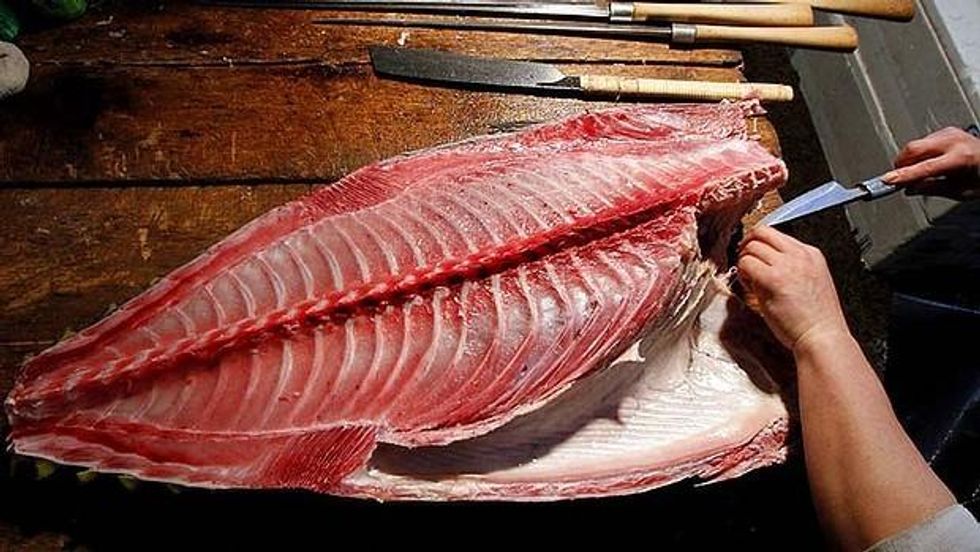
So which is it? Does that sushi or canned tuna pose a minuscule risk, just a little one, or is it safe? The Proceedings of the National Academy of Sciences published a report online May 30, 2013 that garnered these vastly disparate headlines. The NAS team studied measurements of cesium-137 and cesium-134 in Bluefin tuna caught off the California coast. The cesium was dumped or leaked as liquids into and deposited as gaseous fallout on the Pacific Ocean from Fukushima's three catastrophic reactor meltdowns. The poisoned tuna swam 5,000 miles to our West Coast.
It is clear from the report that the Union-Tribune and the Guardian grossly "mis-headlined" the NAS's findings. The tuna had an estimated 7.7 nano-sieverts [the sievert is a standard measure of the biological impacts of radiation] per 7-ounce serving. Since no radiation exposure of any kind is "safe," headlines writers declaring the risk is "nil" and the tuna "safe" had not done the slightest bit of digging.
A simple internet search of agency web sites illustrates the fact that every US government agency that regulates radiation exposures, including the Nuclear Regulatory Commission, the Energy, Transportation and Health and Human Services Departments and the National Academy of Sciences itself, agrees that there is "no safe dose." The National Council on Radiation Protection says, "[E]very increment of radiation exposure produces an incremental increase in the risk of cancer." In addition to noting that "radiation is a carcinogen," the American Nuclear Society warns, "It may also cause other adverse health effects, including genetic defects in the children of exposed parents or mental retardation in the children of mothers exposed during pregnancy."
The headline writers seem not even to have read the contents of their own stories, since the Union-Tribune report says, "the amount doesn't represent a significant health risk." Translating this low risk message into none at all or one that's "nil" is extremely misleading and negligent at best. In the middle of the Guardian article, Nicholas Fisher, the lead US author of the study from Stony Brook University in New York says not that the tuna is safe, but that, "I wouldn't necessarily encourage them to eat these fish -- they can eat something else!"
The BBC article said a person eating a 200-gram meal of tuna would receive a radiation "dose equivalent" from cesium of less than eight nano-sieverts. "This is about a thousand times less than the dose someone would receive from a typical dental X-ray." This comparison and others made to jet airplane rides and the effects of cosmic rays are shockingly deceptive and bogus, like comparing apples to tire irons. This is because external, single-shot exposures like medical and dental X-rays do not lodge in internal tissues, as does ingested or inhaled cesium. Internal radiation emitters deliver a chronic, ongoing exposure and bombard surrounding tissues where they can smash apart DNA again and again. Think of the difference between warming yourself before a glowing wood fire, and popping a hot coal into your mouth.
The BBC went as far as to say that the 200g portion would produce a dose of "roughly five micro-sieverts, which carries an increased probability of developing a fatal cancer of about two in 10 million." If everyone on earth eats that single lunch, the "nil" effect translates to 1,600 cancer deaths. It's a limited to be sure, but it's a powerful little nothing if you're the one with the cancer.
Another significant fault of the lazy reporting is that radiation exposure effects women, children, infants and people with immune dysfunction far more seriously than "reference man," the hypothetical 20 to 30 year old "Caucasian male" used in most radiation protection regulations, including those designed to protect the general public. Its use is scientifically outrageous since the vast majority of people fall outside the definition. Most news accounts also neglected to mention that radiation's effects are cumulative and irreversible and that the poisoned tuna risk has to be considered in conjunction with medical X-rays, tracer isotopes in medicine, dental X-rays, whole-body airport X-ray scanners, high-dose medical CT scans, food irradiation and a hundred other incidental sources.
In northeast Japan, the sale of rockfish and greenling has been banned because of cesium contamination. Reuters said May 31, 2013 that while some fish there contain cesium levels allowed by the government (100 Bequerels-per-kilo or less), fish that live near the sea-floor, like cod, halibut and sole, often test for fantastic levels of cesium.
One Japanese fisherman, 80-year-old Shohei Yaoita, who opposes Japan's plan to dump more cesium into the sea told Reuters something we all might recall: "They say it's safe, but they had always told us that the nuclear power is safe too."
On June 4th, 2013, London-based news source the Guardian reported, "Fukushima tuna safe to eat - study." The day before, the Los Angeles Times reported, "Scientists to eaters: Don't freak out over Fukushima fish." The San Diego Union-Tribune was emphatic: "Tuna Pose No Risk after Nuke Disaster," and online, "Fukushima seafood radiation risk nil, study says." The BBC ran with, "Fukushima tuna pose little health risk." And CNN declared, "Fukushima tuna study finds minuscule health risks."
So which is it? Does that sushi or canned tuna pose a minuscule risk, just a little one, or is it safe? The Proceedings of the National Academy of Sciences published a report online May 30, 2013 that garnered these vastly disparate headlines. The NAS team studied measurements of cesium-137 and cesium-134 in Bluefin tuna caught off the California coast. The cesium was dumped or leaked as liquids into and deposited as gaseous fallout on the Pacific Ocean from Fukushima's three catastrophic reactor meltdowns. The poisoned tuna swam 5,000 miles to our West Coast.
It is clear from the report that the Union-Tribune and the Guardian grossly "mis-headlined" the NAS's findings. The tuna had an estimated 7.7 nano-sieverts [the sievert is a standard measure of the biological impacts of radiation] per 7-ounce serving. Since no radiation exposure of any kind is "safe," headlines writers declaring the risk is "nil" and the tuna "safe" had not done the slightest bit of digging.
A simple internet search of agency web sites illustrates the fact that every US government agency that regulates radiation exposures, including the Nuclear Regulatory Commission, the Energy, Transportation and Health and Human Services Departments and the National Academy of Sciences itself, agrees that there is "no safe dose." The National Council on Radiation Protection says, "[E]very increment of radiation exposure produces an incremental increase in the risk of cancer." In addition to noting that "radiation is a carcinogen," the American Nuclear Society warns, "It may also cause other adverse health effects, including genetic defects in the children of exposed parents or mental retardation in the children of mothers exposed during pregnancy."
The headline writers seem not even to have read the contents of their own stories, since the Union-Tribune report says, "the amount doesn't represent a significant health risk." Translating this low risk message into none at all or one that's "nil" is extremely misleading and negligent at best. In the middle of the Guardian article, Nicholas Fisher, the lead US author of the study from Stony Brook University in New York says not that the tuna is safe, but that, "I wouldn't necessarily encourage them to eat these fish -- they can eat something else!"
The BBC article said a person eating a 200-gram meal of tuna would receive a radiation "dose equivalent" from cesium of less than eight nano-sieverts. "This is about a thousand times less than the dose someone would receive from a typical dental X-ray." This comparison and others made to jet airplane rides and the effects of cosmic rays are shockingly deceptive and bogus, like comparing apples to tire irons. This is because external, single-shot exposures like medical and dental X-rays do not lodge in internal tissues, as does ingested or inhaled cesium. Internal radiation emitters deliver a chronic, ongoing exposure and bombard surrounding tissues where they can smash apart DNA again and again. Think of the difference between warming yourself before a glowing wood fire, and popping a hot coal into your mouth.
The BBC went as far as to say that the 200g portion would produce a dose of "roughly five micro-sieverts, which carries an increased probability of developing a fatal cancer of about two in 10 million." If everyone on earth eats that single lunch, the "nil" effect translates to 1,600 cancer deaths. It's a limited to be sure, but it's a powerful little nothing if you're the one with the cancer.
Another significant fault of the lazy reporting is that radiation exposure effects women, children, infants and people with immune dysfunction far more seriously than "reference man," the hypothetical 20 to 30 year old "Caucasian male" used in most radiation protection regulations, including those designed to protect the general public. Its use is scientifically outrageous since the vast majority of people fall outside the definition. Most news accounts also neglected to mention that radiation's effects are cumulative and irreversible and that the poisoned tuna risk has to be considered in conjunction with medical X-rays, tracer isotopes in medicine, dental X-rays, whole-body airport X-ray scanners, high-dose medical CT scans, food irradiation and a hundred other incidental sources.
In northeast Japan, the sale of rockfish and greenling has been banned because of cesium contamination. Reuters said May 31, 2013 that while some fish there contain cesium levels allowed by the government (100 Bequerels-per-kilo or less), fish that live near the sea-floor, like cod, halibut and sole, often test for fantastic levels of cesium.
One Japanese fisherman, 80-year-old Shohei Yaoita, who opposes Japan's plan to dump more cesium into the sea told Reuters something we all might recall: "They say it's safe, but they had always told us that the nuclear power is safe too."
On June 4th, 2013, London-based news source the Guardian reported, "Fukushima tuna safe to eat - study." The day before, the Los Angeles Times reported, "Scientists to eaters: Don't freak out over Fukushima fish." The San Diego Union-Tribune was emphatic: "Tuna Pose No Risk after Nuke Disaster," and online, "Fukushima seafood radiation risk nil, study says." The BBC ran with, "Fukushima tuna pose little health risk." And CNN declared, "Fukushima tuna study finds minuscule health risks."
So which is it? Does that sushi or canned tuna pose a minuscule risk, just a little one, or is it safe? The Proceedings of the National Academy of Sciences published a report online May 30, 2013 that garnered these vastly disparate headlines. The NAS team studied measurements of cesium-137 and cesium-134 in Bluefin tuna caught off the California coast. The cesium was dumped or leaked as liquids into and deposited as gaseous fallout on the Pacific Ocean from Fukushima's three catastrophic reactor meltdowns. The poisoned tuna swam 5,000 miles to our West Coast.
It is clear from the report that the Union-Tribune and the Guardian grossly "mis-headlined" the NAS's findings. The tuna had an estimated 7.7 nano-sieverts [the sievert is a standard measure of the biological impacts of radiation] per 7-ounce serving. Since no radiation exposure of any kind is "safe," headlines writers declaring the risk is "nil" and the tuna "safe" had not done the slightest bit of digging.
A simple internet search of agency web sites illustrates the fact that every US government agency that regulates radiation exposures, including the Nuclear Regulatory Commission, the Energy, Transportation and Health and Human Services Departments and the National Academy of Sciences itself, agrees that there is "no safe dose." The National Council on Radiation Protection says, "[E]very increment of radiation exposure produces an incremental increase in the risk of cancer." In addition to noting that "radiation is a carcinogen," the American Nuclear Society warns, "It may also cause other adverse health effects, including genetic defects in the children of exposed parents or mental retardation in the children of mothers exposed during pregnancy."
The headline writers seem not even to have read the contents of their own stories, since the Union-Tribune report says, "the amount doesn't represent a significant health risk." Translating this low risk message into none at all or one that's "nil" is extremely misleading and negligent at best. In the middle of the Guardian article, Nicholas Fisher, the lead US author of the study from Stony Brook University in New York says not that the tuna is safe, but that, "I wouldn't necessarily encourage them to eat these fish -- they can eat something else!"
The BBC article said a person eating a 200-gram meal of tuna would receive a radiation "dose equivalent" from cesium of less than eight nano-sieverts. "This is about a thousand times less than the dose someone would receive from a typical dental X-ray." This comparison and others made to jet airplane rides and the effects of cosmic rays are shockingly deceptive and bogus, like comparing apples to tire irons. This is because external, single-shot exposures like medical and dental X-rays do not lodge in internal tissues, as does ingested or inhaled cesium. Internal radiation emitters deliver a chronic, ongoing exposure and bombard surrounding tissues where they can smash apart DNA again and again. Think of the difference between warming yourself before a glowing wood fire, and popping a hot coal into your mouth.
The BBC went as far as to say that the 200g portion would produce a dose of "roughly five micro-sieverts, which carries an increased probability of developing a fatal cancer of about two in 10 million." If everyone on earth eats that single lunch, the "nil" effect translates to 1,600 cancer deaths. It's a limited to be sure, but it's a powerful little nothing if you're the one with the cancer.
Another significant fault of the lazy reporting is that radiation exposure effects women, children, infants and people with immune dysfunction far more seriously than "reference man," the hypothetical 20 to 30 year old "Caucasian male" used in most radiation protection regulations, including those designed to protect the general public. Its use is scientifically outrageous since the vast majority of people fall outside the definition. Most news accounts also neglected to mention that radiation's effects are cumulative and irreversible and that the poisoned tuna risk has to be considered in conjunction with medical X-rays, tracer isotopes in medicine, dental X-rays, whole-body airport X-ray scanners, high-dose medical CT scans, food irradiation and a hundred other incidental sources.
In northeast Japan, the sale of rockfish and greenling has been banned because of cesium contamination. Reuters said May 31, 2013 that while some fish there contain cesium levels allowed by the government (100 Bequerels-per-kilo or less), fish that live near the sea-floor, like cod, halibut and sole, often test for fantastic levels of cesium.
One Japanese fisherman, 80-year-old Shohei Yaoita, who opposes Japan's plan to dump more cesium into the sea told Reuters something we all might recall: "They say it's safe, but they had always told us that the nuclear power is safe too."