SUBSCRIBE TO OUR FREE NEWSLETTER
Daily news & progressive opinion—funded by the people, not the corporations—delivered straight to your inbox.
5
#000000
#FFFFFF
To donate by check, phone, or other method, see our More Ways to Give page.
One of the ironies of warfare is that an apparently vastly superior force can be defeated by an apparently much weaker one when the weaker force refuses to meet the more powerful on its own terms, play by its rules, square off army to army, submit to punch and counterpunch. A combination of strategy and tactics designed by the weaker force to enervate the morale, confidence and finances of the powerful may prove decisive --- as it did for the American revolutionaries against the British, North Vietnamese & Viet Cong against the U.S., or the Afghanis against the Soviets. In 1975 Andrew Mack first used the term "asymmetric warfare" to describe this phenomenon in an article called Why Big Nations Lose Small Wars. A materially weaker force with higher motivation --- they may be fighting for their own land --- and greater perseverance may prevail. The weaker force may be beleaguered by the horrible and high tech weaponry of exorbitant power --- stealth bombers, napalm, cluster bombs, cruise missiles and drones, depleted uranium, helicopter gun ships and satellite surveillance --- but it manages to dodge and absorb, go underground, patiently wait to strike an exposed weakness.
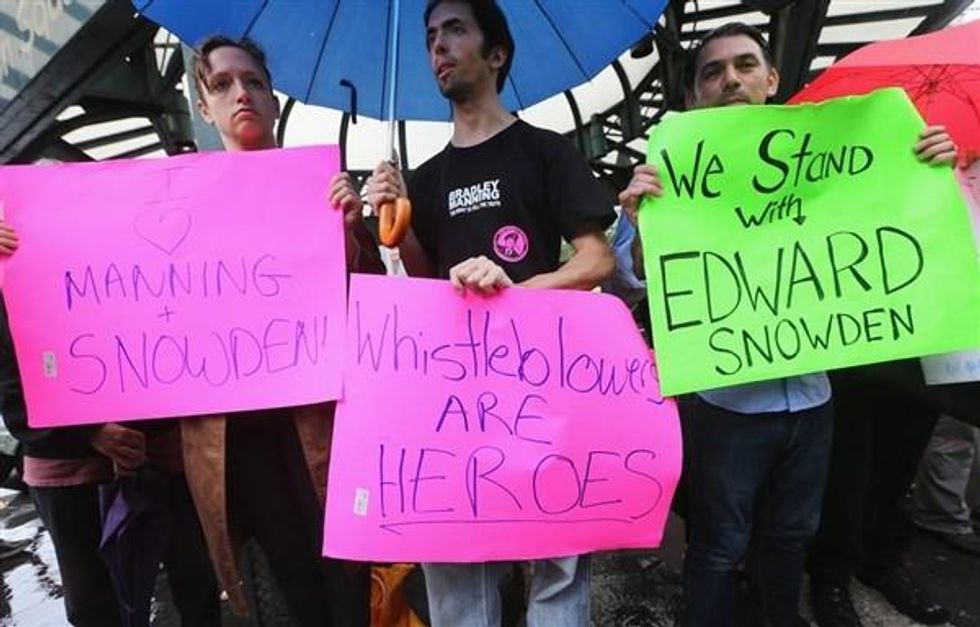
I was thinking about asymmetry this week as the story of Edward Snowden unfolded. This story, one young man pitted against our national security state, is an extreme asymmetry, but the disparity is not between lesser and greater violent forces. And, for that reason, it could not properly be called a David versus Goliath confrontation. David was small but armed with sling & stone. Edward's only "weapons" are courage and truth.
In asymmetric warfare, the powerful say, "Come out and fight on our terms! We'll show you who's stronger!" The weaker say, "Not on your life! We plan to win, not commit suicide."
Conversely, in a contest of asymmetric courage, the lone whistleblower says to the powerful institutions, "Come out and fight on my terms --- ethics, courage, truth, law!" And there is deafening silence from the powerful institutions because with all their secret knowledge and secret money, their special forces and spies, their torture and secret prisons, they have not courage. They have not ethics, truth or law. They are muscled up with conformity, with arrogance, with self-congratulatory winks and nods. They have the power to easily crush the person of courage, to discredit him in the media, to arrest and convict him in a kangaroo court, to torture him, disappear him, force feed him. They have secret protocol and secret policy, the power to change the law to legalize atrocity. But they have no courage. They have the pathetic vanity of a steroid-pumped-up robots flexing in front of a mirror. With satisfied smirks they ask rhetorically, "Who's the strongest in the world?" But they have no courage.
Thomas Jefferson said, "When the people fear their government, there is tyranny; when the government fears the people, there is liberty." He could have been commenting on the situation of Edward Snowden or any one of so many recent whistleblowers. People fear the government when it secretly and lawlessly insinuates itself into the fabric of their lives with the ever present threat that each person could be plucked out of that fabric with no recourse. This is done in the name of security. But a government that spies on its own people actually prefers fear to security. Or, simply, the security of fear. There should be no trade off or balancing act, no compromise, between our freedoms and our security. Our freedoms are our security. Sacrificing our privacy, which is our autonomy as individuals, for the sake of security is like willingly agreeing to be half a slave.
The false dichotomy between security and freedom obscures a more important fact. When we wring our hands and listen to a president pontificate about how to balance this either/or, we are encouraged not to notice that it is our foreign, military and economic policies that are designed to create injustice and insecurity. Imperialism, both soft and hard, fosters anger and insecurity. The obsession with secrecy is absurd. There is no secrecy about this. The only secret worth divining is where the next moral hero will come from to expose the extent of tyranny and inspire more people to act with asymmetric courage. In that action is the hope of democracy. In that "illegal" action is the hope of the rule of law.
Edward Snowden reminds me of Rachel Corrie, who was run over and killed by an armored Israeli bulldozer on March 16, 2003 as she placed herself --- asymmetrically --- between the bulldozer and a Palestinian home she hoped to protect from destruction. The similarity between Rachel and Edward is in the nature of the stand-off --- isolated courage versus brute power. The difference is that no one knew about Rachel's courage until it was too late. We all know about Edward, and, perhaps, if we can summon a fraction of his courage, we can protect him and thus change the policy.
In early 2003 shortly after arriving in Palestine, in her first email home, Rachel said, "I don't know if many of the children here have ever existed without tank-shell holes in their walls and the towers of an occupying army surveying them constantly from the near horizons." She assumed that all Americans would recognize constant surveillance as a prime indicator of tyranny. Like Rachel, Edward attempts to protect an increasingly fragile structure, our Constitution and the democracy it is meant to house. Edward said, "...they [the NSA] are intent on making every conversation and every form of behavior in the world known to them." While our national security state has all the ideological arrogance and democratic sensitivity of a bulldozer operated by a storm trooper, it is susceptible to and befuddled by courage. It blusters, it growls, it threatens and backfires. It uses its x-ray vision to spy out the color of our underwear and the temerity of our intention to resist. But, ultimately, it's a coward.
Edward Snowden's courage is like a lever the end of which he shoved under the NSA's enormous dead weight. Whether the weight moves depends on how many of us grab on. Asymmetry can move mountains.
One of the ironies of warfare is that an apparently vastly superior force can be defeated by an apparently much weaker one when the weaker force refuses to meet the more powerful on its own terms, play by its rules, square off army to army, submit to punch and counterpunch. A combination of strategy and tactics designed by the weaker force to enervate the morale, confidence and finances of the powerful may prove decisive --- as it did for the American revolutionaries against the British, North Vietnamese & Viet Cong against the U.S., or the Afghanis against the Soviets. In 1975 Andrew Mack first used the term "asymmetric warfare" to describe this phenomenon in an article called Why Big Nations Lose Small Wars. A materially weaker force with higher motivation --- they may be fighting for their own land --- and greater perseverance may prevail. The weaker force may be beleaguered by the horrible and high tech weaponry of exorbitant power --- stealth bombers, napalm, cluster bombs, cruise missiles and drones, depleted uranium, helicopter gun ships and satellite surveillance --- but it manages to dodge and absorb, go underground, patiently wait to strike an exposed weakness.
I was thinking about asymmetry this week as the story of Edward Snowden unfolded. This story, one young man pitted against our national security state, is an extreme asymmetry, but the disparity is not between lesser and greater violent forces. And, for that reason, it could not properly be called a David versus Goliath confrontation. David was small but armed with sling & stone. Edward's only "weapons" are courage and truth.
In asymmetric warfare, the powerful say, "Come out and fight on our terms! We'll show you who's stronger!" The weaker say, "Not on your life! We plan to win, not commit suicide."
Conversely, in a contest of asymmetric courage, the lone whistleblower says to the powerful institutions, "Come out and fight on my terms --- ethics, courage, truth, law!" And there is deafening silence from the powerful institutions because with all their secret knowledge and secret money, their special forces and spies, their torture and secret prisons, they have not courage. They have not ethics, truth or law. They are muscled up with conformity, with arrogance, with self-congratulatory winks and nods. They have the power to easily crush the person of courage, to discredit him in the media, to arrest and convict him in a kangaroo court, to torture him, disappear him, force feed him. They have secret protocol and secret policy, the power to change the law to legalize atrocity. But they have no courage. They have the pathetic vanity of a steroid-pumped-up robots flexing in front of a mirror. With satisfied smirks they ask rhetorically, "Who's the strongest in the world?" But they have no courage.
Thomas Jefferson said, "When the people fear their government, there is tyranny; when the government fears the people, there is liberty." He could have been commenting on the situation of Edward Snowden or any one of so many recent whistleblowers. People fear the government when it secretly and lawlessly insinuates itself into the fabric of their lives with the ever present threat that each person could be plucked out of that fabric with no recourse. This is done in the name of security. But a government that spies on its own people actually prefers fear to security. Or, simply, the security of fear. There should be no trade off or balancing act, no compromise, between our freedoms and our security. Our freedoms are our security. Sacrificing our privacy, which is our autonomy as individuals, for the sake of security is like willingly agreeing to be half a slave.
The false dichotomy between security and freedom obscures a more important fact. When we wring our hands and listen to a president pontificate about how to balance this either/or, we are encouraged not to notice that it is our foreign, military and economic policies that are designed to create injustice and insecurity. Imperialism, both soft and hard, fosters anger and insecurity. The obsession with secrecy is absurd. There is no secrecy about this. The only secret worth divining is where the next moral hero will come from to expose the extent of tyranny and inspire more people to act with asymmetric courage. In that action is the hope of democracy. In that "illegal" action is the hope of the rule of law.
Edward Snowden reminds me of Rachel Corrie, who was run over and killed by an armored Israeli bulldozer on March 16, 2003 as she placed herself --- asymmetrically --- between the bulldozer and a Palestinian home she hoped to protect from destruction. The similarity between Rachel and Edward is in the nature of the stand-off --- isolated courage versus brute power. The difference is that no one knew about Rachel's courage until it was too late. We all know about Edward, and, perhaps, if we can summon a fraction of his courage, we can protect him and thus change the policy.
In early 2003 shortly after arriving in Palestine, in her first email home, Rachel said, "I don't know if many of the children here have ever existed without tank-shell holes in their walls and the towers of an occupying army surveying them constantly from the near horizons." She assumed that all Americans would recognize constant surveillance as a prime indicator of tyranny. Like Rachel, Edward attempts to protect an increasingly fragile structure, our Constitution and the democracy it is meant to house. Edward said, "...they [the NSA] are intent on making every conversation and every form of behavior in the world known to them." While our national security state has all the ideological arrogance and democratic sensitivity of a bulldozer operated by a storm trooper, it is susceptible to and befuddled by courage. It blusters, it growls, it threatens and backfires. It uses its x-ray vision to spy out the color of our underwear and the temerity of our intention to resist. But, ultimately, it's a coward.
Edward Snowden's courage is like a lever the end of which he shoved under the NSA's enormous dead weight. Whether the weight moves depends on how many of us grab on. Asymmetry can move mountains.
One of the ironies of warfare is that an apparently vastly superior force can be defeated by an apparently much weaker one when the weaker force refuses to meet the more powerful on its own terms, play by its rules, square off army to army, submit to punch and counterpunch. A combination of strategy and tactics designed by the weaker force to enervate the morale, confidence and finances of the powerful may prove decisive --- as it did for the American revolutionaries against the British, North Vietnamese & Viet Cong against the U.S., or the Afghanis against the Soviets. In 1975 Andrew Mack first used the term "asymmetric warfare" to describe this phenomenon in an article called Why Big Nations Lose Small Wars. A materially weaker force with higher motivation --- they may be fighting for their own land --- and greater perseverance may prevail. The weaker force may be beleaguered by the horrible and high tech weaponry of exorbitant power --- stealth bombers, napalm, cluster bombs, cruise missiles and drones, depleted uranium, helicopter gun ships and satellite surveillance --- but it manages to dodge and absorb, go underground, patiently wait to strike an exposed weakness.
I was thinking about asymmetry this week as the story of Edward Snowden unfolded. This story, one young man pitted against our national security state, is an extreme asymmetry, but the disparity is not between lesser and greater violent forces. And, for that reason, it could not properly be called a David versus Goliath confrontation. David was small but armed with sling & stone. Edward's only "weapons" are courage and truth.
In asymmetric warfare, the powerful say, "Come out and fight on our terms! We'll show you who's stronger!" The weaker say, "Not on your life! We plan to win, not commit suicide."
Conversely, in a contest of asymmetric courage, the lone whistleblower says to the powerful institutions, "Come out and fight on my terms --- ethics, courage, truth, law!" And there is deafening silence from the powerful institutions because with all their secret knowledge and secret money, their special forces and spies, their torture and secret prisons, they have not courage. They have not ethics, truth or law. They are muscled up with conformity, with arrogance, with self-congratulatory winks and nods. They have the power to easily crush the person of courage, to discredit him in the media, to arrest and convict him in a kangaroo court, to torture him, disappear him, force feed him. They have secret protocol and secret policy, the power to change the law to legalize atrocity. But they have no courage. They have the pathetic vanity of a steroid-pumped-up robots flexing in front of a mirror. With satisfied smirks they ask rhetorically, "Who's the strongest in the world?" But they have no courage.
Thomas Jefferson said, "When the people fear their government, there is tyranny; when the government fears the people, there is liberty." He could have been commenting on the situation of Edward Snowden or any one of so many recent whistleblowers. People fear the government when it secretly and lawlessly insinuates itself into the fabric of their lives with the ever present threat that each person could be plucked out of that fabric with no recourse. This is done in the name of security. But a government that spies on its own people actually prefers fear to security. Or, simply, the security of fear. There should be no trade off or balancing act, no compromise, between our freedoms and our security. Our freedoms are our security. Sacrificing our privacy, which is our autonomy as individuals, for the sake of security is like willingly agreeing to be half a slave.
The false dichotomy between security and freedom obscures a more important fact. When we wring our hands and listen to a president pontificate about how to balance this either/or, we are encouraged not to notice that it is our foreign, military and economic policies that are designed to create injustice and insecurity. Imperialism, both soft and hard, fosters anger and insecurity. The obsession with secrecy is absurd. There is no secrecy about this. The only secret worth divining is where the next moral hero will come from to expose the extent of tyranny and inspire more people to act with asymmetric courage. In that action is the hope of democracy. In that "illegal" action is the hope of the rule of law.
Edward Snowden reminds me of Rachel Corrie, who was run over and killed by an armored Israeli bulldozer on March 16, 2003 as she placed herself --- asymmetrically --- between the bulldozer and a Palestinian home she hoped to protect from destruction. The similarity between Rachel and Edward is in the nature of the stand-off --- isolated courage versus brute power. The difference is that no one knew about Rachel's courage until it was too late. We all know about Edward, and, perhaps, if we can summon a fraction of his courage, we can protect him and thus change the policy.
In early 2003 shortly after arriving in Palestine, in her first email home, Rachel said, "I don't know if many of the children here have ever existed without tank-shell holes in their walls and the towers of an occupying army surveying them constantly from the near horizons." She assumed that all Americans would recognize constant surveillance as a prime indicator of tyranny. Like Rachel, Edward attempts to protect an increasingly fragile structure, our Constitution and the democracy it is meant to house. Edward said, "...they [the NSA] are intent on making every conversation and every form of behavior in the world known to them." While our national security state has all the ideological arrogance and democratic sensitivity of a bulldozer operated by a storm trooper, it is susceptible to and befuddled by courage. It blusters, it growls, it threatens and backfires. It uses its x-ray vision to spy out the color of our underwear and the temerity of our intention to resist. But, ultimately, it's a coward.
Edward Snowden's courage is like a lever the end of which he shoved under the NSA's enormous dead weight. Whether the weight moves depends on how many of us grab on. Asymmetry can move mountains.