Although there hasn't been much mainstream news coverage, the U.S. is currently in negotiations with nine APEC (Asia-Pacific Economic Cooperation) countries on what could become the biggest, most ambitious, most comprehensive FTA (free trade agreement) in history. The proposed agreement is called TPP (Trans-Pacific Partnership). Basically, if approved in its present form, it would resemble NAFTA on steroids. And we all know how
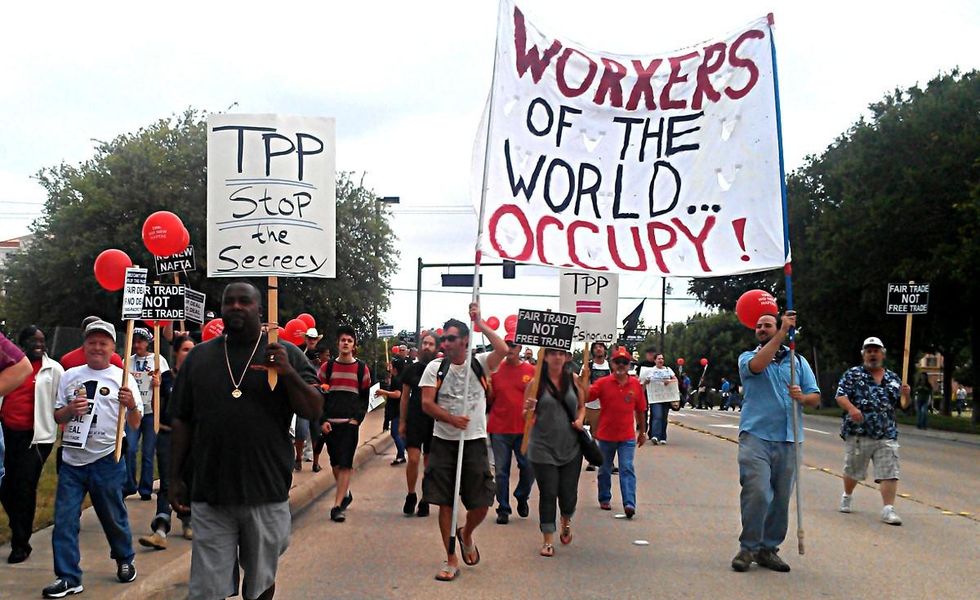
The nine countries involved in TPP negotiations are: the U.S., Vietnam, Singapore, Brunei, Mexico, Malaysia, Peru, Chile, New Zealand and Australia. Trade analysts have noted that should TPP be approved in its present, open-ended form, it would allow additional countries to sign onto it whenever they liked (without having to negotiate) which would mean, in effect, that TPP could be the last trade agreement the U.S. ever signed. In other words, it's a critically important agreement.
And because it is such an important agreement, labor, human rights, and environmental groups are paying close attention. One concern is whether TPP will include the same controversial provision NAFTA had--the one that bestows upon foreign investors the privilege of circumventing the U.S. judicial system. Instead of going through U.S. courts, foreign investors who believe they haven't been treated "fairly" can sue the U.S. government under the auspices of an international arbitration panel.
That was one of NAFTA's major concessions, one that never should've been granted. By dangling in front of their eyes the opportunity to bypass the cumbersome U.S. judicial system (and take their chances with an arbitration panel), NAFTA encouraged U.S. companies to withdraw money from American enterprises and invest it in those of our trading partners. And why not? Under NAFTA they get a better deal going offshore than by staying put in the U.S. What gets sacrificed as a result is American jobs.
Another concern is the extent to which labor standards and practices laid out in the UN's ILO (International Labor Organization) will be emphasized in TPP, and, equally important, whether TPP will include a mechanism insuring that these standards and practices are enforced. After all, if there is no reliable way to identify and punish violators, then all the well-meaning language in the world--no matter how noble and high-minded--is useless.
And because this is where things (motivations, expectations, limitations) get a little hairy, we need to resort to a baseball analogy. It's a truism in baseball that no team ever intentionally makes a trade it believes will hurt them. Indeed (except for extraordinary circumstances), the only reason a team ever agrees to a trade in the first place is because they think it will benefit them. Which brings us to Vietnam.
Not to pick on anybody, but when it comes to labor abuses (low wages, sweatshop conditions, anti-union hysteria) Vietnam has a deplorable reputation. How deplorable? The modestly paid unionized auto workers in India's northern Haryana state are constantly being told by management that if they don't stop their bitching, the company is going to pull up stakes and move the whole damn operation to Vietnam.
So why would Vietnam sign an agreement that required them to treat workers in ways they never, not in their wildest dreams, ever considered? Why would Vietnam tolerate something as repellent as collective bargaining? The obvious answer is that access to exciting new markets would make it a fair trade-off. But the not-so-obvious answer is that Vietnam has no intention whatever of complying with TPP's labor provisions.
Let's not kid ourselves. Pretending we can enforce labor practices in faraway Vietnam (or Brunei or Singapore) is a fantasy. We can't even do it here at home. It's true. Labor statutes right here in the U.S. get violated with impunity everyday, which why so many ULP (unfair labor practice) charges are filed each year with the NLRB. Unless we arm TPP with the most extravagant and menacing penalty clauses ever written into an FTA, this whole deal could turn out very ugly.
Although there hasn't been much mainstream news coverage, the U.S. is currently in negotiations with nine APEC (Asia-Pacific Economic Cooperation) countries on what could become the biggest, most ambitious, most comprehensive FTA (free trade agreement) in history. The proposed agreement is called TPP (Trans-Pacific Partnership). Basically, if approved in its present form, it would resemble NAFTA on steroids. And we all know how
The nine countries involved in TPP negotiations are: the U.S., Vietnam, Singapore, Brunei, Mexico, Malaysia, Peru, Chile, New Zealand and Australia. Trade analysts have noted that should TPP be approved in its present, open-ended form, it would allow additional countries to sign onto it whenever they liked (without having to negotiate) which would mean, in effect, that TPP could be the last trade agreement the U.S. ever signed. In other words, it's a critically important agreement.
And because it is such an important agreement, labor, human rights, and environmental groups are paying close attention. One concern is whether TPP will include the same controversial provision NAFTA had--the one that bestows upon foreign investors the privilege of circumventing the U.S. judicial system. Instead of going through U.S. courts, foreign investors who believe they haven't been treated "fairly" can sue the U.S. government under the auspices of an international arbitration panel.
That was one of NAFTA's major concessions, one that never should've been granted. By dangling in front of their eyes the opportunity to bypass the cumbersome U.S. judicial system (and take their chances with an arbitration panel), NAFTA encouraged U.S. companies to withdraw money from American enterprises and invest it in those of our trading partners. And why not? Under NAFTA they get a better deal going offshore than by staying put in the U.S. What gets sacrificed as a result is American jobs.
Another concern is the extent to which labor standards and practices laid out in the UN's ILO (International Labor Organization) will be emphasized in TPP, and, equally important, whether TPP will include a mechanism insuring that these standards and practices are enforced. After all, if there is no reliable way to identify and punish violators, then all the well-meaning language in the world--no matter how noble and high-minded--is useless.
And because this is where things (motivations, expectations, limitations) get a little hairy, we need to resort to a baseball analogy. It's a truism in baseball that no team ever intentionally makes a trade it believes will hurt them. Indeed (except for extraordinary circumstances), the only reason a team ever agrees to a trade in the first place is because they think it will benefit them. Which brings us to Vietnam.
Not to pick on anybody, but when it comes to labor abuses (low wages, sweatshop conditions, anti-union hysteria) Vietnam has a deplorable reputation. How deplorable? The modestly paid unionized auto workers in India's northern Haryana state are constantly being told by management that if they don't stop their bitching, the company is going to pull up stakes and move the whole damn operation to Vietnam.
So why would Vietnam sign an agreement that required them to treat workers in ways they never, not in their wildest dreams, ever considered? Why would Vietnam tolerate something as repellent as collective bargaining? The obvious answer is that access to exciting new markets would make it a fair trade-off. But the not-so-obvious answer is that Vietnam has no intention whatever of complying with TPP's labor provisions.
Let's not kid ourselves. Pretending we can enforce labor practices in faraway Vietnam (or Brunei or Singapore) is a fantasy. We can't even do it here at home. It's true. Labor statutes right here in the U.S. get violated with impunity everyday, which why so many ULP (unfair labor practice) charges are filed each year with the NLRB. Unless we arm TPP with the most extravagant and menacing penalty clauses ever written into an FTA, this whole deal could turn out very ugly.
Although there hasn't been much mainstream news coverage, the U.S. is currently in negotiations with nine APEC (Asia-Pacific Economic Cooperation) countries on what could become the biggest, most ambitious, most comprehensive FTA (free trade agreement) in history. The proposed agreement is called TPP (Trans-Pacific Partnership). Basically, if approved in its present form, it would resemble NAFTA on steroids. And we all know how
The nine countries involved in TPP negotiations are: the U.S., Vietnam, Singapore, Brunei, Mexico, Malaysia, Peru, Chile, New Zealand and Australia. Trade analysts have noted that should TPP be approved in its present, open-ended form, it would allow additional countries to sign onto it whenever they liked (without having to negotiate) which would mean, in effect, that TPP could be the last trade agreement the U.S. ever signed. In other words, it's a critically important agreement.
And because it is such an important agreement, labor, human rights, and environmental groups are paying close attention. One concern is whether TPP will include the same controversial provision NAFTA had--the one that bestows upon foreign investors the privilege of circumventing the U.S. judicial system. Instead of going through U.S. courts, foreign investors who believe they haven't been treated "fairly" can sue the U.S. government under the auspices of an international arbitration panel.
That was one of NAFTA's major concessions, one that never should've been granted. By dangling in front of their eyes the opportunity to bypass the cumbersome U.S. judicial system (and take their chances with an arbitration panel), NAFTA encouraged U.S. companies to withdraw money from American enterprises and invest it in those of our trading partners. And why not? Under NAFTA they get a better deal going offshore than by staying put in the U.S. What gets sacrificed as a result is American jobs.
Another concern is the extent to which labor standards and practices laid out in the UN's ILO (International Labor Organization) will be emphasized in TPP, and, equally important, whether TPP will include a mechanism insuring that these standards and practices are enforced. After all, if there is no reliable way to identify and punish violators, then all the well-meaning language in the world--no matter how noble and high-minded--is useless.
And because this is where things (motivations, expectations, limitations) get a little hairy, we need to resort to a baseball analogy. It's a truism in baseball that no team ever intentionally makes a trade it believes will hurt them. Indeed (except for extraordinary circumstances), the only reason a team ever agrees to a trade in the first place is because they think it will benefit them. Which brings us to Vietnam.
Not to pick on anybody, but when it comes to labor abuses (low wages, sweatshop conditions, anti-union hysteria) Vietnam has a deplorable reputation. How deplorable? The modestly paid unionized auto workers in India's northern Haryana state are constantly being told by management that if they don't stop their bitching, the company is going to pull up stakes and move the whole damn operation to Vietnam.
So why would Vietnam sign an agreement that required them to treat workers in ways they never, not in their wildest dreams, ever considered? Why would Vietnam tolerate something as repellent as collective bargaining? The obvious answer is that access to exciting new markets would make it a fair trade-off. But the not-so-obvious answer is that Vietnam has no intention whatever of complying with TPP's labor provisions.
Let's not kid ourselves. Pretending we can enforce labor practices in faraway Vietnam (or Brunei or Singapore) is a fantasy. We can't even do it here at home. It's true. Labor statutes right here in the U.S. get violated with impunity everyday, which why so many ULP (unfair labor practice) charges are filed each year with the NLRB. Unless we arm TPP with the most extravagant and menacing penalty clauses ever written into an FTA, this whole deal could turn out very ugly.