
Here's a get-out-of-jail-free card, and while we're at it, take this obscenely huge bonus for having wrecked the economy. As the inspector general for the Troubled Asset Relief Program pointed out in a devastating report this week, "excessive" compensation was approved by the Treasury Department for the executives of the three companies that required the largest taxpayer bailouts to survive.
In a stinging rebuke of Timothy Geithner's Treasury Department, the report "found that once again, in 2012, Treasury failed to rein in excessive pay." Whopping pay packages of $5 million or more were allowed by the Treasury Department for a quarter of the top executives at AIG, General Motors and Ally Financial, the former financial arm of GM.
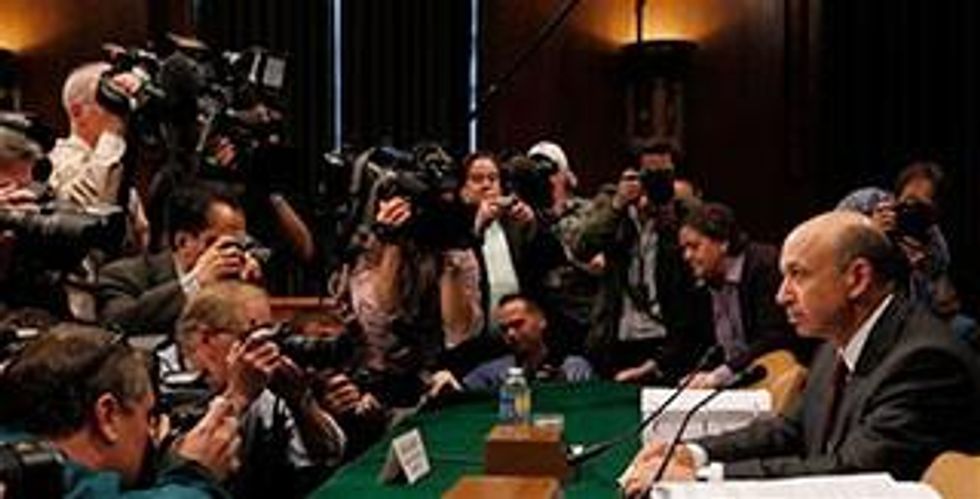
But that's nothing compared with the $21 million for last year's work garnered by Lloyd Blankfein, CEO of Goldman Sachs, which is now free of TARP supervision. In addition to his paltry $2 million in salary, Blankfein received a $19 million bonus for his efforts. Not quite the $67.9 million bonus he got in 2007 before the market crash that his firm did so much to engineer, but times are still hard.
Goldman was the training ground for Robert Rubin and Henry Paulson, the two Treasury secretaries who did their best to grease the skids for Wall Street hustlers. It was Rubin under President Bill Clinton who pushed to get the law changed to allow investment banks like Goldman to become commercial banks, and it was Paulson under President George W. Bush who permitted Goldman to take advantage of that loophole and partake in the low interest Fed money available to the commercial banks. Throw in the AIG bailout that allowed the passage of billions of dollars to Goldman, and you get the picture.
What you may not know, and file this in the gallery of the terminally shameless, is the role of James A. Johnson, the longest serving director of Goldman Sachs and chairman of its compensation committee that awarded Blankfein his outrageous bonuses. Before being named a director at Goldman, Johnson served as the CEO of Fannie Mae when the once public-spirited federal housing agency joined forces with Countrywide CEO Angelo Mozilo and other mortgage scam artists in initiating the great housing bubble.
Back in 1996, Johnson had named Mozilo to be chair of Fannie Mae's National Advisory Council, and together they cooked up a deal in which Fannie Mae came to rely on Countrywide's proprietary CLUES software for short-circuiting the mortgage qualification process. Thus was born the housing mortgage debacle that to this day has haunted the economy.
Countrywide announced its "Strategic Agreement with Fannie Mae" in a press release that all but predicted the subsequent housing crisis: "The objective is to expand markets to accommodate more customers and streamline loan processing in order to reduce the upfront cost of homeownership. This entails increased acceptance of Countrywide's proprietary CLUES underwriting technology, greater usage of short form appraisals, expansion of streamlined loan products, flow sales for expanded criteria loans, and guideline waivers."
That history became inconvenient back in 2008, when Democratic candidate Barack Obama picked Johnson, a lifelong Democrat, to head the search for a vice presidential candidate. Turns out Johnson was one of the beneficiaries of the new streamlined loan processing system, being what was known inside Countrywide as a "friend of Angelo," entitled to fast-track approval on loans. As a result, Obama had to drop him, but not so Goldman Sachs, where Johnson had landed as a director and remains today as the chairman of the firm's compensation committee.
They do flock together, and so it makes perfect sense that Johnson would approve the enormous bonus for Blankfein. In the end, it doesn't matter whether these folks are Democrats or Republicans, nor whether they are operating at the highest levels of government or banking--they take care of their own. It is the new model of crony capitalism that must have Adam Smith turning in his grave, for it has nothing to do with free-market performance.
The invisible hand of that primitive and pure free market so celebrated in the folklore of capitalism as the essence of efficiency and productivity has been replaced by the all too visible hand of the fixer, who can combine government power and corporate profits to game the system. Yes, visible. Just observe how easily folks such as Rubin, Paulson and Johnson move through the revolving door between corporate and government power undeterred by critical media notice. And now it is Geithner's turn.
Here's a get-out-of-jail-free card, and while we're at it, take this obscenely huge bonus for having wrecked the economy. As the inspector general for the Troubled Asset Relief Program pointed out in a devastating report this week, "excessive" compensation was approved by the Treasury Department for the executives of the three companies that required the largest taxpayer bailouts to survive.
In a stinging rebuke of Timothy Geithner's Treasury Department, the report "found that once again, in 2012, Treasury failed to rein in excessive pay." Whopping pay packages of $5 million or more were allowed by the Treasury Department for a quarter of the top executives at AIG, General Motors and Ally Financial, the former financial arm of GM.
But that's nothing compared with the $21 million for last year's work garnered by Lloyd Blankfein, CEO of Goldman Sachs, which is now free of TARP supervision. In addition to his paltry $2 million in salary, Blankfein received a $19 million bonus for his efforts. Not quite the $67.9 million bonus he got in 2007 before the market crash that his firm did so much to engineer, but times are still hard.
Goldman was the training ground for Robert Rubin and Henry Paulson, the two Treasury secretaries who did their best to grease the skids for Wall Street hustlers. It was Rubin under President Bill Clinton who pushed to get the law changed to allow investment banks like Goldman to become commercial banks, and it was Paulson under President George W. Bush who permitted Goldman to take advantage of that loophole and partake in the low interest Fed money available to the commercial banks. Throw in the AIG bailout that allowed the passage of billions of dollars to Goldman, and you get the picture.
What you may not know, and file this in the gallery of the terminally shameless, is the role of James A. Johnson, the longest serving director of Goldman Sachs and chairman of its compensation committee that awarded Blankfein his outrageous bonuses. Before being named a director at Goldman, Johnson served as the CEO of Fannie Mae when the once public-spirited federal housing agency joined forces with Countrywide CEO Angelo Mozilo and other mortgage scam artists in initiating the great housing bubble.
Back in 1996, Johnson had named Mozilo to be chair of Fannie Mae's National Advisory Council, and together they cooked up a deal in which Fannie Mae came to rely on Countrywide's proprietary CLUES software for short-circuiting the mortgage qualification process. Thus was born the housing mortgage debacle that to this day has haunted the economy.
Countrywide announced its "Strategic Agreement with Fannie Mae" in a press release that all but predicted the subsequent housing crisis: "The objective is to expand markets to accommodate more customers and streamline loan processing in order to reduce the upfront cost of homeownership. This entails increased acceptance of Countrywide's proprietary CLUES underwriting technology, greater usage of short form appraisals, expansion of streamlined loan products, flow sales for expanded criteria loans, and guideline waivers."
That history became inconvenient back in 2008, when Democratic candidate Barack Obama picked Johnson, a lifelong Democrat, to head the search for a vice presidential candidate. Turns out Johnson was one of the beneficiaries of the new streamlined loan processing system, being what was known inside Countrywide as a "friend of Angelo," entitled to fast-track approval on loans. As a result, Obama had to drop him, but not so Goldman Sachs, where Johnson had landed as a director and remains today as the chairman of the firm's compensation committee.
They do flock together, and so it makes perfect sense that Johnson would approve the enormous bonus for Blankfein. In the end, it doesn't matter whether these folks are Democrats or Republicans, nor whether they are operating at the highest levels of government or banking--they take care of their own. It is the new model of crony capitalism that must have Adam Smith turning in his grave, for it has nothing to do with free-market performance.
The invisible hand of that primitive and pure free market so celebrated in the folklore of capitalism as the essence of efficiency and productivity has been replaced by the all too visible hand of the fixer, who can combine government power and corporate profits to game the system. Yes, visible. Just observe how easily folks such as Rubin, Paulson and Johnson move through the revolving door between corporate and government power undeterred by critical media notice. And now it is Geithner's turn.
Here's a get-out-of-jail-free card, and while we're at it, take this obscenely huge bonus for having wrecked the economy. As the inspector general for the Troubled Asset Relief Program pointed out in a devastating report this week, "excessive" compensation was approved by the Treasury Department for the executives of the three companies that required the largest taxpayer bailouts to survive.
In a stinging rebuke of Timothy Geithner's Treasury Department, the report "found that once again, in 2012, Treasury failed to rein in excessive pay." Whopping pay packages of $5 million or more were allowed by the Treasury Department for a quarter of the top executives at AIG, General Motors and Ally Financial, the former financial arm of GM.
But that's nothing compared with the $21 million for last year's work garnered by Lloyd Blankfein, CEO of Goldman Sachs, which is now free of TARP supervision. In addition to his paltry $2 million in salary, Blankfein received a $19 million bonus for his efforts. Not quite the $67.9 million bonus he got in 2007 before the market crash that his firm did so much to engineer, but times are still hard.
Goldman was the training ground for Robert Rubin and Henry Paulson, the two Treasury secretaries who did their best to grease the skids for Wall Street hustlers. It was Rubin under President Bill Clinton who pushed to get the law changed to allow investment banks like Goldman to become commercial banks, and it was Paulson under President George W. Bush who permitted Goldman to take advantage of that loophole and partake in the low interest Fed money available to the commercial banks. Throw in the AIG bailout that allowed the passage of billions of dollars to Goldman, and you get the picture.
What you may not know, and file this in the gallery of the terminally shameless, is the role of James A. Johnson, the longest serving director of Goldman Sachs and chairman of its compensation committee that awarded Blankfein his outrageous bonuses. Before being named a director at Goldman, Johnson served as the CEO of Fannie Mae when the once public-spirited federal housing agency joined forces with Countrywide CEO Angelo Mozilo and other mortgage scam artists in initiating the great housing bubble.
Back in 1996, Johnson had named Mozilo to be chair of Fannie Mae's National Advisory Council, and together they cooked up a deal in which Fannie Mae came to rely on Countrywide's proprietary CLUES software for short-circuiting the mortgage qualification process. Thus was born the housing mortgage debacle that to this day has haunted the economy.
Countrywide announced its "Strategic Agreement with Fannie Mae" in a press release that all but predicted the subsequent housing crisis: "The objective is to expand markets to accommodate more customers and streamline loan processing in order to reduce the upfront cost of homeownership. This entails increased acceptance of Countrywide's proprietary CLUES underwriting technology, greater usage of short form appraisals, expansion of streamlined loan products, flow sales for expanded criteria loans, and guideline waivers."
That history became inconvenient back in 2008, when Democratic candidate Barack Obama picked Johnson, a lifelong Democrat, to head the search for a vice presidential candidate. Turns out Johnson was one of the beneficiaries of the new streamlined loan processing system, being what was known inside Countrywide as a "friend of Angelo," entitled to fast-track approval on loans. As a result, Obama had to drop him, but not so Goldman Sachs, where Johnson had landed as a director and remains today as the chairman of the firm's compensation committee.
They do flock together, and so it makes perfect sense that Johnson would approve the enormous bonus for Blankfein. In the end, it doesn't matter whether these folks are Democrats or Republicans, nor whether they are operating at the highest levels of government or banking--they take care of their own. It is the new model of crony capitalism that must have Adam Smith turning in his grave, for it has nothing to do with free-market performance.
The invisible hand of that primitive and pure free market so celebrated in the folklore of capitalism as the essence of efficiency and productivity has been replaced by the all too visible hand of the fixer, who can combine government power and corporate profits to game the system. Yes, visible. Just observe how easily folks such as Rubin, Paulson and Johnson move through the revolving door between corporate and government power undeterred by critical media notice. And now it is Geithner's turn.