SUBSCRIBE TO OUR FREE NEWSLETTER
Daily news & progressive opinion—funded by the people, not the corporations—delivered straight to your inbox.
5
#000000
#FFFFFF
To donate by check, phone, or other method, see our More Ways to Give page.
How many lobbyists does it take to defend billions in subsidies for one of the most profitable industries in the world? 786. That's the size of the army that oil and gas companies maintain in Washington to strong-arm Congress into bankrolling an industry that is cutting jobs and literally fueling the climate crisis. This army is bigger than Congress itself, which has only 535 members.
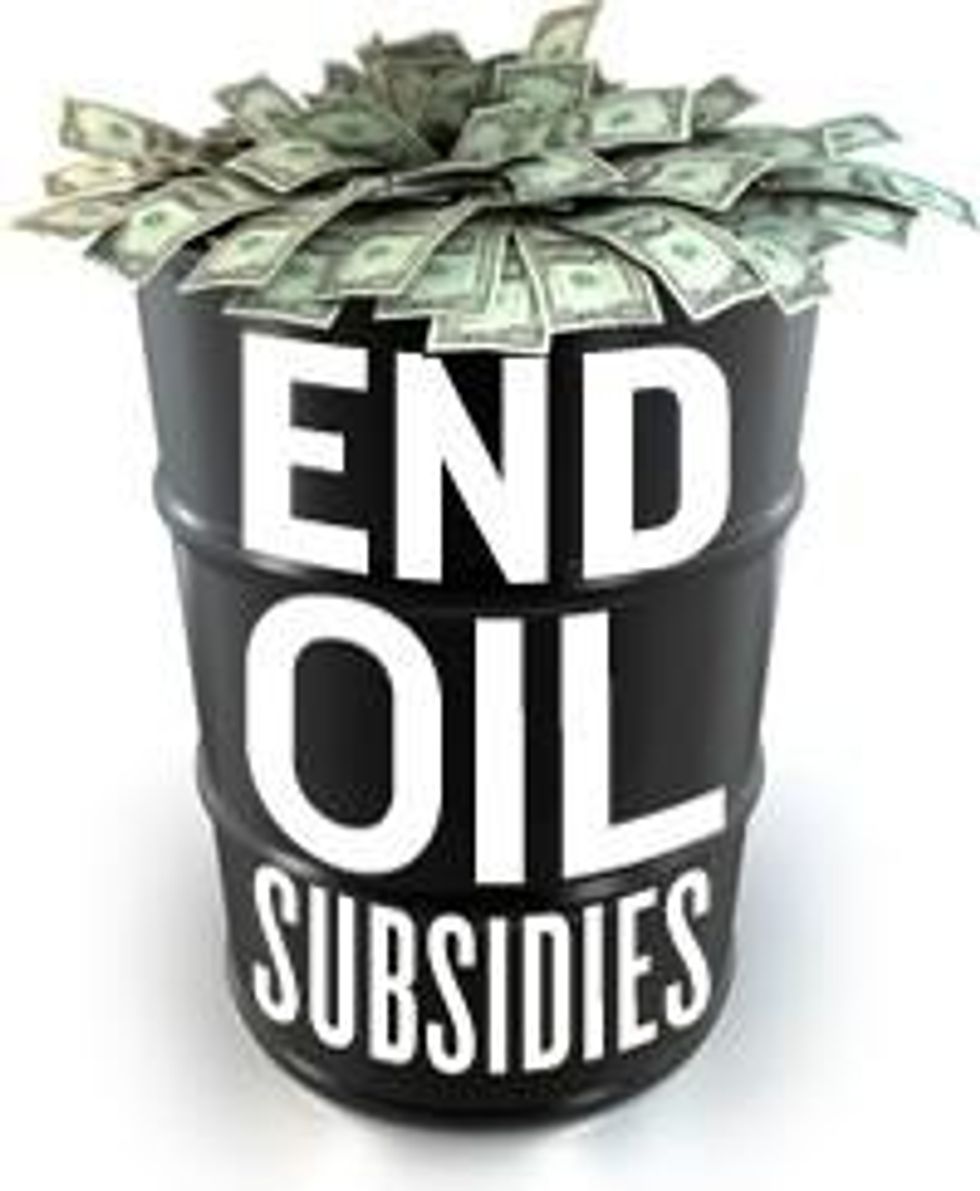
Last year, Democrats on the House Natural Resources Committee decided to investigate Big Oil's jobs claims -- and it turns out the industry has gone on a firing spree in recent years. They discovered that despite generating $546 billion in profits between 2005 and 2010, ExxonMobil, Chevron, Shell, and BP reduced their U.S. workforce by 11,200 employees over that period. In 2010 alone, the top five oil companies slashed their global workforce by 4,400 employees -- the same year executives paid themselves nearly $220 million. But at least those working in the industry as a whole get paid high wages, right? Turns out that 40 percent of U.S oil-industry jobs consist of minimum-wage work at gas stations.
With job numbers like these, it is no wonder the fossil-fuel industry needs to spend millions ensuring they are not branded as "job killers." As Rep. Ed Markey (D-Mass.) said, "Oil companies that make record profits and then cut American jobs strain their own credibility when they claim to be huge job-creators."
And it gets worse. In what must rank as one of the greatest boondoggles in history, Big Oil is leveraging its taxpayer subsidies to rake in profits that, in the words of The New York Times, are "being continuously recycled to win the support of pliable legislators [and] underwrite misleading advertising campaigns."
There is also a bigger, far more insidious way that Big Oil is killing jobs and undermining our economy: The industry remains hell-bent on denying climate change and obstructing climate action.
But the planet appears to be running a campaign of its own to persuade Americans that the oil lobby is leading us ever closer to economic ruin. Over the last year alone, hurricanes, floods, and droughts have had a devastating effect on American jobs. After tornadoes hit the area around Tuscaloosa, Ala., in April of last year, more than 6,000 people applied for disaster-related unemployment benefits. In Vermont, the number of workers filing unemployment claims went from 731 before Hurricane Irene to 1,331 two weeks afterwards. For the U.S. economy as a whole, 2011 was a historic year for expensive weather-related disasters, costing taxpayers $52 billion.
Consider one of the centers of U.S. oil production: Louisiana. Economists have been studying the long-term economic effects of Hurricane Katrina [PDF] in hopes of modeling the risks for the rest of the nation's coastal regions. They found that Katrina wiped out 129,000 jobs in the New Orleans region -- about 19 percent. Three years later, in 2008, 47,000 of the jobs lost in Katrina had returned, but 82,000 had not -- and that doesn't even consider the tens of thousands of new jobs that likely would have been created had there been no Katrina.
Our nation is in desperate need of jobs. Instead of bankrolling an industry that is laying off workers and threatening our economic future, why not take the billions in subsidies going to oil companies and invest instead in a sector that both creates jobs and protects the planet? It will be money well spent: According to the Political Economy Research Institute at the University of Massachusetts-Amherst, investment in a green infrastructure program would create nearly four times as many jobs as an equal investment in oil and gas.
Big Oil has spent millions positioning itself as the ultimate job creator, while branding those of us pushing to end fossil-fuel subsidies as "job killers." But we are the ones fighting to put people back to work and ensure that we have a sustainable economy for generations to come. The oil and gas industry may have an army of 786 lobbyists, but we tally in the hundreds of thousands. This is the year we are coming to take our money back, create jobs, and protect our planet.
How many lobbyists does it take to defend billions in subsidies for one of the most profitable industries in the world? 786. That's the size of the army that oil and gas companies maintain in Washington to strong-arm Congress into bankrolling an industry that is cutting jobs and literally fueling the climate crisis. This army is bigger than Congress itself, which has only 535 members.
Last year, Democrats on the House Natural Resources Committee decided to investigate Big Oil's jobs claims -- and it turns out the industry has gone on a firing spree in recent years. They discovered that despite generating $546 billion in profits between 2005 and 2010, ExxonMobil, Chevron, Shell, and BP reduced their U.S. workforce by 11,200 employees over that period. In 2010 alone, the top five oil companies slashed their global workforce by 4,400 employees -- the same year executives paid themselves nearly $220 million. But at least those working in the industry as a whole get paid high wages, right? Turns out that 40 percent of U.S oil-industry jobs consist of minimum-wage work at gas stations.
With job numbers like these, it is no wonder the fossil-fuel industry needs to spend millions ensuring they are not branded as "job killers." As Rep. Ed Markey (D-Mass.) said, "Oil companies that make record profits and then cut American jobs strain their own credibility when they claim to be huge job-creators."
And it gets worse. In what must rank as one of the greatest boondoggles in history, Big Oil is leveraging its taxpayer subsidies to rake in profits that, in the words of The New York Times, are "being continuously recycled to win the support of pliable legislators [and] underwrite misleading advertising campaigns."
There is also a bigger, far more insidious way that Big Oil is killing jobs and undermining our economy: The industry remains hell-bent on denying climate change and obstructing climate action.
But the planet appears to be running a campaign of its own to persuade Americans that the oil lobby is leading us ever closer to economic ruin. Over the last year alone, hurricanes, floods, and droughts have had a devastating effect on American jobs. After tornadoes hit the area around Tuscaloosa, Ala., in April of last year, more than 6,000 people applied for disaster-related unemployment benefits. In Vermont, the number of workers filing unemployment claims went from 731 before Hurricane Irene to 1,331 two weeks afterwards. For the U.S. economy as a whole, 2011 was a historic year for expensive weather-related disasters, costing taxpayers $52 billion.
Consider one of the centers of U.S. oil production: Louisiana. Economists have been studying the long-term economic effects of Hurricane Katrina [PDF] in hopes of modeling the risks for the rest of the nation's coastal regions. They found that Katrina wiped out 129,000 jobs in the New Orleans region -- about 19 percent. Three years later, in 2008, 47,000 of the jobs lost in Katrina had returned, but 82,000 had not -- and that doesn't even consider the tens of thousands of new jobs that likely would have been created had there been no Katrina.
Our nation is in desperate need of jobs. Instead of bankrolling an industry that is laying off workers and threatening our economic future, why not take the billions in subsidies going to oil companies and invest instead in a sector that both creates jobs and protects the planet? It will be money well spent: According to the Political Economy Research Institute at the University of Massachusetts-Amherst, investment in a green infrastructure program would create nearly four times as many jobs as an equal investment in oil and gas.
Big Oil has spent millions positioning itself as the ultimate job creator, while branding those of us pushing to end fossil-fuel subsidies as "job killers." But we are the ones fighting to put people back to work and ensure that we have a sustainable economy for generations to come. The oil and gas industry may have an army of 786 lobbyists, but we tally in the hundreds of thousands. This is the year we are coming to take our money back, create jobs, and protect our planet.
How many lobbyists does it take to defend billions in subsidies for one of the most profitable industries in the world? 786. That's the size of the army that oil and gas companies maintain in Washington to strong-arm Congress into bankrolling an industry that is cutting jobs and literally fueling the climate crisis. This army is bigger than Congress itself, which has only 535 members.
Last year, Democrats on the House Natural Resources Committee decided to investigate Big Oil's jobs claims -- and it turns out the industry has gone on a firing spree in recent years. They discovered that despite generating $546 billion in profits between 2005 and 2010, ExxonMobil, Chevron, Shell, and BP reduced their U.S. workforce by 11,200 employees over that period. In 2010 alone, the top five oil companies slashed their global workforce by 4,400 employees -- the same year executives paid themselves nearly $220 million. But at least those working in the industry as a whole get paid high wages, right? Turns out that 40 percent of U.S oil-industry jobs consist of minimum-wage work at gas stations.
With job numbers like these, it is no wonder the fossil-fuel industry needs to spend millions ensuring they are not branded as "job killers." As Rep. Ed Markey (D-Mass.) said, "Oil companies that make record profits and then cut American jobs strain their own credibility when they claim to be huge job-creators."
And it gets worse. In what must rank as one of the greatest boondoggles in history, Big Oil is leveraging its taxpayer subsidies to rake in profits that, in the words of The New York Times, are "being continuously recycled to win the support of pliable legislators [and] underwrite misleading advertising campaigns."
There is also a bigger, far more insidious way that Big Oil is killing jobs and undermining our economy: The industry remains hell-bent on denying climate change and obstructing climate action.
But the planet appears to be running a campaign of its own to persuade Americans that the oil lobby is leading us ever closer to economic ruin. Over the last year alone, hurricanes, floods, and droughts have had a devastating effect on American jobs. After tornadoes hit the area around Tuscaloosa, Ala., in April of last year, more than 6,000 people applied for disaster-related unemployment benefits. In Vermont, the number of workers filing unemployment claims went from 731 before Hurricane Irene to 1,331 two weeks afterwards. For the U.S. economy as a whole, 2011 was a historic year for expensive weather-related disasters, costing taxpayers $52 billion.
Consider one of the centers of U.S. oil production: Louisiana. Economists have been studying the long-term economic effects of Hurricane Katrina [PDF] in hopes of modeling the risks for the rest of the nation's coastal regions. They found that Katrina wiped out 129,000 jobs in the New Orleans region -- about 19 percent. Three years later, in 2008, 47,000 of the jobs lost in Katrina had returned, but 82,000 had not -- and that doesn't even consider the tens of thousands of new jobs that likely would have been created had there been no Katrina.
Our nation is in desperate need of jobs. Instead of bankrolling an industry that is laying off workers and threatening our economic future, why not take the billions in subsidies going to oil companies and invest instead in a sector that both creates jobs and protects the planet? It will be money well spent: According to the Political Economy Research Institute at the University of Massachusetts-Amherst, investment in a green infrastructure program would create nearly four times as many jobs as an equal investment in oil and gas.
Big Oil has spent millions positioning itself as the ultimate job creator, while branding those of us pushing to end fossil-fuel subsidies as "job killers." But we are the ones fighting to put people back to work and ensure that we have a sustainable economy for generations to come. The oil and gas industry may have an army of 786 lobbyists, but we tally in the hundreds of thousands. This is the year we are coming to take our money back, create jobs, and protect our planet.