
Day two of the historic arguments before the United States Supreme Court on the Patient Protection and Affordable Care Act, otherwise known as Obamacare, is a wrap, and it's hard to see the ultimate outcome being anything less than a total train wreck for the administration and a long-awaited godsend for the American right.
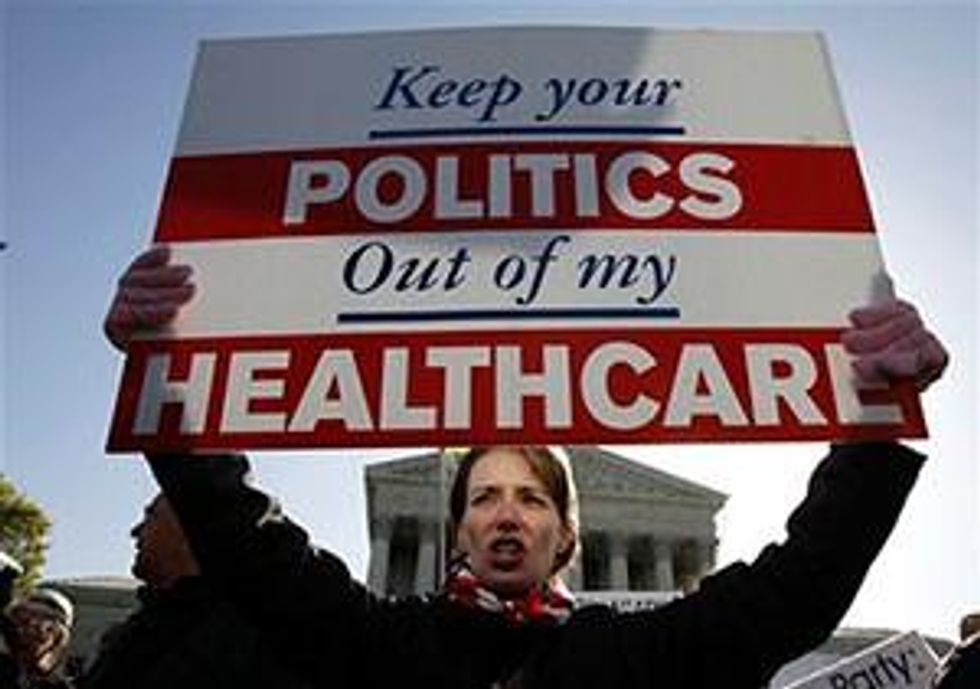
Topping the agenda on the second of three days of arguments was the constitutionality of the legislation's centerpiece--the so-called individual mandate that requires virtually all Americans not covered by Medicare, Medicaid or their employer to purchase at least minimal health insurance. Supporters of the mandate say it is vital to offset the cost to insurers of some of the act's protections by forcing people who might otherwise not pay for or need health insurance to buy into the system. The court appeared split 5 to 4 along party lines, with the majority consisting entirely of Republican appointees prepared to overturn the mandate as exceeding the limits of congressional and executive power. Barring an unexpected turnabout from Justice Anthony Kennedy, who is considered the panel's sole swing vote, the decision the court releases by the current term's end will have profound implications not just for the future of health care, but for the future of constitutional law generally.
Given the enormous size and scope of the federal government and the abuses of power it sometimes commits, it's often difficult to remember that the Constitution defines the federal government as one of limited or enumerated powers. To act, the federal government is required, at least in theory, to tether its action to a grant of constitutional power.
The administration sought to uphold the individual mandate as a valid exercise of congressional authority under the Commerce Clause of the Constitution, which gives the feds the power to regulate commerce among the states. In so doing, the Obama team relied on a long string of Supreme Court precedents, dating back to the 1940s, that have interpreted the clause broadly to uphold a wide array of national initiatives in areas including fair labor standards, civil rights and environmental protection. Along with the power to levy taxes to promote the general welfare (a power also enumerated in Article I and used as the legal basis for Social Security), the Commerce Clause has served as a crucial tool in support of progressive movements aimed at mitigating the meanest features of American capitalism.
But the American right has never accepted the broad interpretation of the Commerce Clause or, for that matter, most other constitutional provisions invoked on behalf of the poor and the underprivileged. Although the right-wing rallying cries have changed over time, from the redbaiting of the '30s, '40s and '50s to the states-rights banners of the '60s and '70s, the "original intent" theories of the '80s and the "new federalism" of the '90s, the right has consistently sought to undo the expansion of progressive federal power.
Unfortunately, beginning with the tenure of former Chief Justice William Rehnquist and continuing with the present tribunal headed by John Roberts, a former Rehnquist clerk, the right's painstaking efforts are now paying off and paying off big. The court, which in 2010 upended decades of carefully crafted campaign finance law in the Citizens United case, is now prepared to sidestep if not reverse decades of law defining the reach and meaning of the Commerce Clause, in the process depriving millions of Americans access to health insurance. And the damage won't stop with health care. With the gateway to constitutional retrenchment open, the fundamental legal landscape of the country is poised to change and not for the better.
Day two of the historic arguments before the United States Supreme Court on the Patient Protection and Affordable Care Act, otherwise known as Obamacare, is a wrap, and it's hard to see the ultimate outcome being anything less than a total train wreck for the administration and a long-awaited godsend for the American right.
Topping the agenda on the second of three days of arguments was the constitutionality of the legislation's centerpiece--the so-called individual mandate that requires virtually all Americans not covered by Medicare, Medicaid or their employer to purchase at least minimal health insurance. Supporters of the mandate say it is vital to offset the cost to insurers of some of the act's protections by forcing people who might otherwise not pay for or need health insurance to buy into the system. The court appeared split 5 to 4 along party lines, with the majority consisting entirely of Republican appointees prepared to overturn the mandate as exceeding the limits of congressional and executive power. Barring an unexpected turnabout from Justice Anthony Kennedy, who is considered the panel's sole swing vote, the decision the court releases by the current term's end will have profound implications not just for the future of health care, but for the future of constitutional law generally.
Given the enormous size and scope of the federal government and the abuses of power it sometimes commits, it's often difficult to remember that the Constitution defines the federal government as one of limited or enumerated powers. To act, the federal government is required, at least in theory, to tether its action to a grant of constitutional power.
The administration sought to uphold the individual mandate as a valid exercise of congressional authority under the Commerce Clause of the Constitution, which gives the feds the power to regulate commerce among the states. In so doing, the Obama team relied on a long string of Supreme Court precedents, dating back to the 1940s, that have interpreted the clause broadly to uphold a wide array of national initiatives in areas including fair labor standards, civil rights and environmental protection. Along with the power to levy taxes to promote the general welfare (a power also enumerated in Article I and used as the legal basis for Social Security), the Commerce Clause has served as a crucial tool in support of progressive movements aimed at mitigating the meanest features of American capitalism.
But the American right has never accepted the broad interpretation of the Commerce Clause or, for that matter, most other constitutional provisions invoked on behalf of the poor and the underprivileged. Although the right-wing rallying cries have changed over time, from the redbaiting of the '30s, '40s and '50s to the states-rights banners of the '60s and '70s, the "original intent" theories of the '80s and the "new federalism" of the '90s, the right has consistently sought to undo the expansion of progressive federal power.
Unfortunately, beginning with the tenure of former Chief Justice William Rehnquist and continuing with the present tribunal headed by John Roberts, a former Rehnquist clerk, the right's painstaking efforts are now paying off and paying off big. The court, which in 2010 upended decades of carefully crafted campaign finance law in the Citizens United case, is now prepared to sidestep if not reverse decades of law defining the reach and meaning of the Commerce Clause, in the process depriving millions of Americans access to health insurance. And the damage won't stop with health care. With the gateway to constitutional retrenchment open, the fundamental legal landscape of the country is poised to change and not for the better.
Day two of the historic arguments before the United States Supreme Court on the Patient Protection and Affordable Care Act, otherwise known as Obamacare, is a wrap, and it's hard to see the ultimate outcome being anything less than a total train wreck for the administration and a long-awaited godsend for the American right.
Topping the agenda on the second of three days of arguments was the constitutionality of the legislation's centerpiece--the so-called individual mandate that requires virtually all Americans not covered by Medicare, Medicaid or their employer to purchase at least minimal health insurance. Supporters of the mandate say it is vital to offset the cost to insurers of some of the act's protections by forcing people who might otherwise not pay for or need health insurance to buy into the system. The court appeared split 5 to 4 along party lines, with the majority consisting entirely of Republican appointees prepared to overturn the mandate as exceeding the limits of congressional and executive power. Barring an unexpected turnabout from Justice Anthony Kennedy, who is considered the panel's sole swing vote, the decision the court releases by the current term's end will have profound implications not just for the future of health care, but for the future of constitutional law generally.
Given the enormous size and scope of the federal government and the abuses of power it sometimes commits, it's often difficult to remember that the Constitution defines the federal government as one of limited or enumerated powers. To act, the federal government is required, at least in theory, to tether its action to a grant of constitutional power.
The administration sought to uphold the individual mandate as a valid exercise of congressional authority under the Commerce Clause of the Constitution, which gives the feds the power to regulate commerce among the states. In so doing, the Obama team relied on a long string of Supreme Court precedents, dating back to the 1940s, that have interpreted the clause broadly to uphold a wide array of national initiatives in areas including fair labor standards, civil rights and environmental protection. Along with the power to levy taxes to promote the general welfare (a power also enumerated in Article I and used as the legal basis for Social Security), the Commerce Clause has served as a crucial tool in support of progressive movements aimed at mitigating the meanest features of American capitalism.
But the American right has never accepted the broad interpretation of the Commerce Clause or, for that matter, most other constitutional provisions invoked on behalf of the poor and the underprivileged. Although the right-wing rallying cries have changed over time, from the redbaiting of the '30s, '40s and '50s to the states-rights banners of the '60s and '70s, the "original intent" theories of the '80s and the "new federalism" of the '90s, the right has consistently sought to undo the expansion of progressive federal power.
Unfortunately, beginning with the tenure of former Chief Justice William Rehnquist and continuing with the present tribunal headed by John Roberts, a former Rehnquist clerk, the right's painstaking efforts are now paying off and paying off big. The court, which in 2010 upended decades of carefully crafted campaign finance law in the Citizens United case, is now prepared to sidestep if not reverse decades of law defining the reach and meaning of the Commerce Clause, in the process depriving millions of Americans access to health insurance. And the damage won't stop with health care. With the gateway to constitutional retrenchment open, the fundamental legal landscape of the country is poised to change and not for the better.