SUBSCRIBE TO OUR FREE NEWSLETTER
Daily news & progressive opinion—funded by the people, not the corporations—delivered straight to your inbox.
5
#000000
#FFFFFF
To donate by check, phone, or other method, see our More Ways to Give page.
Not surprisingly, today's debut Supreme Court argument over the so-called "individual mandate" requiring everyone to buy health insurance revolved around epistemological niceties such as the meaning of a "tax," and the question of whether the issue is ripe for review.
Behind this judicial foreplay is the brute political fact that if the Court decides the individual mandate is an unconstitutional extension of federal authority, the entire law starts unraveling.
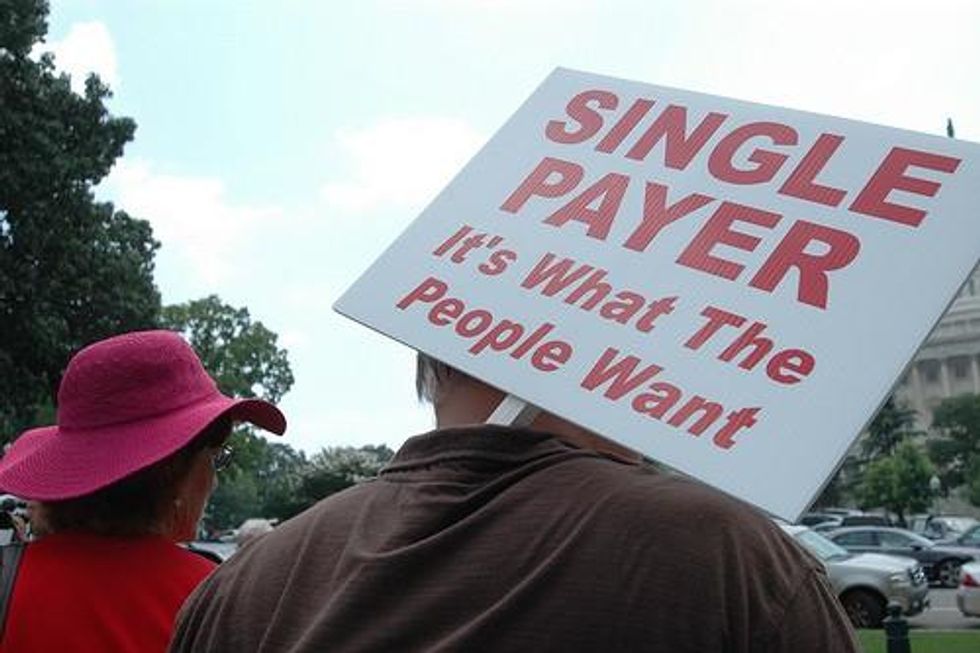
But with a bit of political jujitsu, the President could turn any such defeat into a victory for a single-payer healthcare system - Medicare for all.
Here's how.
The dilemma at the heart of the new law is that it continues to depend on private health insurers, who have to make a profit or at least pay all their costs including marketing and advertising.
Yet the only way private insurers can afford to cover everyone with pre-existing health problems, as the new law requires, is to have every American buy health insurance - including young and healthier people who are unlikely to rack up large healthcare costs.
This dilemma is the product of political compromise. You'll remember the Administration couldn't get the votes for a single-payer system such as Medicare for all. It hardly tried. Not a single Republican would even agree to a bill giving Americans the option of buying into it.
But don't expect the Supreme Court to address this dilemma. It lies buried under an avalanche of constitutional argument.
Those who are defending the law in Court say the federal government has authority to compel Americans to buy health insurance under the Commerce Clause of the Constitution, which gives Washington the power to regulate interstate commerce. They argue our sprawling health insurance system surely extends beyond an individual state.
Those who are opposing the law say a requirement that individuals contract with private insurance companies isn't regulation of interstate commerce. It's coercion of individuals.
Unhappily for Obama and the Democrats, most Americans don't seem to like the individual mandate very much anyway. Many on the political right believe it a threat to individual liberty. Many on the left object to being required to buy something from a private company.
The President and the Democrats could have avoided this dilemma in the first place if they'd insisted on Medicare for all, or at least a public option.
After all, Social Security and Medicare require every working American to "buy" them. The purchase happens automatically in the form of a deduction from everyone's paychecks. But because Social Security and Medicare are government programs financed by payroll taxes they don't feel like mandatory purchases.
Americans don't mind mandates in the form of payroll taxes for Social Security or Medicare. In fact, both programs are so popular even conservative Republicans were heard to shout "don't take away my Medicare!" at rallies opposed to the new health care law.
There's no question payroll taxes are constitutional, because there's no doubt that the federal government can tax people in order to finance particular public benefits. But requiring citizens to buy something from a private company is different because private companies aren't directly accountable to the public. They're accountable to their owners and their purpose is to maximize profits. What if they monopolize the market and charge humongous premiums? (Some already seem to be doing this.)
Even if private health insurers are organized as not-for-profits, there's still a problem of public accountability. What's to prevent top executives from being paid small fortunes? (In more than a few cases this is already happening.)
Moreover, compared to private insurance, Medicare is a great deal. Its administrative costs are only around 3 percent, while the administrative costs of private insurers eat up 30 to 40 percent of premiums. Medicare's costs are even below the 5 percent to 10 percent administrative costs borne by large companies that self-insure, and under the 11 percent costs of private plans under Medicare Advantage, the current private-insurance option under Medicare.
So why not Medicare for all?
Because Republicans have mastered the art of political jujitsu. Their strategy has been to demonize government and seek to privatize everything that might otherwise be a public program financed by tax dollars (see Paul Ryan's plan for turning Medicare into vouchers). Then they go to court and argue that any mandatory purchase is unconstitutional because it exceeds the government's authority.
Obama and the Democrats should do the reverse. If the Supreme Court strikes down the individual mandate in the new health law, private insurers will swarm Capitol Hill demanding that the law be amended to remove the requirement that they cover people with pre-existing conditions.
When this happens, Obama and the Democrats should say they're willing to remove that requirement - but only if Medicare is available to all, financed by payroll taxes.
If they did this the public will be behind them -- as will the Supreme Court.
Not surprisingly, today's debut Supreme Court argument over the so-called "individual mandate" requiring everyone to buy health insurance revolved around epistemological niceties such as the meaning of a "tax," and the question of whether the issue is ripe for review.
Behind this judicial foreplay is the brute political fact that if the Court decides the individual mandate is an unconstitutional extension of federal authority, the entire law starts unraveling.
But with a bit of political jujitsu, the President could turn any such defeat into a victory for a single-payer healthcare system - Medicare for all.
Here's how.
The dilemma at the heart of the new law is that it continues to depend on private health insurers, who have to make a profit or at least pay all their costs including marketing and advertising.
Yet the only way private insurers can afford to cover everyone with pre-existing health problems, as the new law requires, is to have every American buy health insurance - including young and healthier people who are unlikely to rack up large healthcare costs.
This dilemma is the product of political compromise. You'll remember the Administration couldn't get the votes for a single-payer system such as Medicare for all. It hardly tried. Not a single Republican would even agree to a bill giving Americans the option of buying into it.
But don't expect the Supreme Court to address this dilemma. It lies buried under an avalanche of constitutional argument.
Those who are defending the law in Court say the federal government has authority to compel Americans to buy health insurance under the Commerce Clause of the Constitution, which gives Washington the power to regulate interstate commerce. They argue our sprawling health insurance system surely extends beyond an individual state.
Those who are opposing the law say a requirement that individuals contract with private insurance companies isn't regulation of interstate commerce. It's coercion of individuals.
Unhappily for Obama and the Democrats, most Americans don't seem to like the individual mandate very much anyway. Many on the political right believe it a threat to individual liberty. Many on the left object to being required to buy something from a private company.
The President and the Democrats could have avoided this dilemma in the first place if they'd insisted on Medicare for all, or at least a public option.
After all, Social Security and Medicare require every working American to "buy" them. The purchase happens automatically in the form of a deduction from everyone's paychecks. But because Social Security and Medicare are government programs financed by payroll taxes they don't feel like mandatory purchases.
Americans don't mind mandates in the form of payroll taxes for Social Security or Medicare. In fact, both programs are so popular even conservative Republicans were heard to shout "don't take away my Medicare!" at rallies opposed to the new health care law.
There's no question payroll taxes are constitutional, because there's no doubt that the federal government can tax people in order to finance particular public benefits. But requiring citizens to buy something from a private company is different because private companies aren't directly accountable to the public. They're accountable to their owners and their purpose is to maximize profits. What if they monopolize the market and charge humongous premiums? (Some already seem to be doing this.)
Even if private health insurers are organized as not-for-profits, there's still a problem of public accountability. What's to prevent top executives from being paid small fortunes? (In more than a few cases this is already happening.)
Moreover, compared to private insurance, Medicare is a great deal. Its administrative costs are only around 3 percent, while the administrative costs of private insurers eat up 30 to 40 percent of premiums. Medicare's costs are even below the 5 percent to 10 percent administrative costs borne by large companies that self-insure, and under the 11 percent costs of private plans under Medicare Advantage, the current private-insurance option under Medicare.
So why not Medicare for all?
Because Republicans have mastered the art of political jujitsu. Their strategy has been to demonize government and seek to privatize everything that might otherwise be a public program financed by tax dollars (see Paul Ryan's plan for turning Medicare into vouchers). Then they go to court and argue that any mandatory purchase is unconstitutional because it exceeds the government's authority.
Obama and the Democrats should do the reverse. If the Supreme Court strikes down the individual mandate in the new health law, private insurers will swarm Capitol Hill demanding that the law be amended to remove the requirement that they cover people with pre-existing conditions.
When this happens, Obama and the Democrats should say they're willing to remove that requirement - but only if Medicare is available to all, financed by payroll taxes.
If they did this the public will be behind them -- as will the Supreme Court.
Not surprisingly, today's debut Supreme Court argument over the so-called "individual mandate" requiring everyone to buy health insurance revolved around epistemological niceties such as the meaning of a "tax," and the question of whether the issue is ripe for review.
Behind this judicial foreplay is the brute political fact that if the Court decides the individual mandate is an unconstitutional extension of federal authority, the entire law starts unraveling.
But with a bit of political jujitsu, the President could turn any such defeat into a victory for a single-payer healthcare system - Medicare for all.
Here's how.
The dilemma at the heart of the new law is that it continues to depend on private health insurers, who have to make a profit or at least pay all their costs including marketing and advertising.
Yet the only way private insurers can afford to cover everyone with pre-existing health problems, as the new law requires, is to have every American buy health insurance - including young and healthier people who are unlikely to rack up large healthcare costs.
This dilemma is the product of political compromise. You'll remember the Administration couldn't get the votes for a single-payer system such as Medicare for all. It hardly tried. Not a single Republican would even agree to a bill giving Americans the option of buying into it.
But don't expect the Supreme Court to address this dilemma. It lies buried under an avalanche of constitutional argument.
Those who are defending the law in Court say the federal government has authority to compel Americans to buy health insurance under the Commerce Clause of the Constitution, which gives Washington the power to regulate interstate commerce. They argue our sprawling health insurance system surely extends beyond an individual state.
Those who are opposing the law say a requirement that individuals contract with private insurance companies isn't regulation of interstate commerce. It's coercion of individuals.
Unhappily for Obama and the Democrats, most Americans don't seem to like the individual mandate very much anyway. Many on the political right believe it a threat to individual liberty. Many on the left object to being required to buy something from a private company.
The President and the Democrats could have avoided this dilemma in the first place if they'd insisted on Medicare for all, or at least a public option.
After all, Social Security and Medicare require every working American to "buy" them. The purchase happens automatically in the form of a deduction from everyone's paychecks. But because Social Security and Medicare are government programs financed by payroll taxes they don't feel like mandatory purchases.
Americans don't mind mandates in the form of payroll taxes for Social Security or Medicare. In fact, both programs are so popular even conservative Republicans were heard to shout "don't take away my Medicare!" at rallies opposed to the new health care law.
There's no question payroll taxes are constitutional, because there's no doubt that the federal government can tax people in order to finance particular public benefits. But requiring citizens to buy something from a private company is different because private companies aren't directly accountable to the public. They're accountable to their owners and their purpose is to maximize profits. What if they monopolize the market and charge humongous premiums? (Some already seem to be doing this.)
Even if private health insurers are organized as not-for-profits, there's still a problem of public accountability. What's to prevent top executives from being paid small fortunes? (In more than a few cases this is already happening.)
Moreover, compared to private insurance, Medicare is a great deal. Its administrative costs are only around 3 percent, while the administrative costs of private insurers eat up 30 to 40 percent of premiums. Medicare's costs are even below the 5 percent to 10 percent administrative costs borne by large companies that self-insure, and under the 11 percent costs of private plans under Medicare Advantage, the current private-insurance option under Medicare.
So why not Medicare for all?
Because Republicans have mastered the art of political jujitsu. Their strategy has been to demonize government and seek to privatize everything that might otherwise be a public program financed by tax dollars (see Paul Ryan's plan for turning Medicare into vouchers). Then they go to court and argue that any mandatory purchase is unconstitutional because it exceeds the government's authority.
Obama and the Democrats should do the reverse. If the Supreme Court strikes down the individual mandate in the new health law, private insurers will swarm Capitol Hill demanding that the law be amended to remove the requirement that they cover people with pre-existing conditions.
When this happens, Obama and the Democrats should say they're willing to remove that requirement - but only if Medicare is available to all, financed by payroll taxes.
If they did this the public will be behind them -- as will the Supreme Court.