SUBSCRIBE TO OUR FREE NEWSLETTER
Daily news & progressive opinion—funded by the people, not the corporations—delivered straight to your inbox.
5
#000000
#FFFFFF
To donate by check, phone, or other method, see our More Ways to Give page.
Now he tells us. On Wednesday Federal Reserve Chairman Ben Bernanke referred to the nation's unemployment rate as a "national crisis," an obvious if depressing fact of life to the 25 million Americans who have been unsuccessfully attempting to find full-time employment.
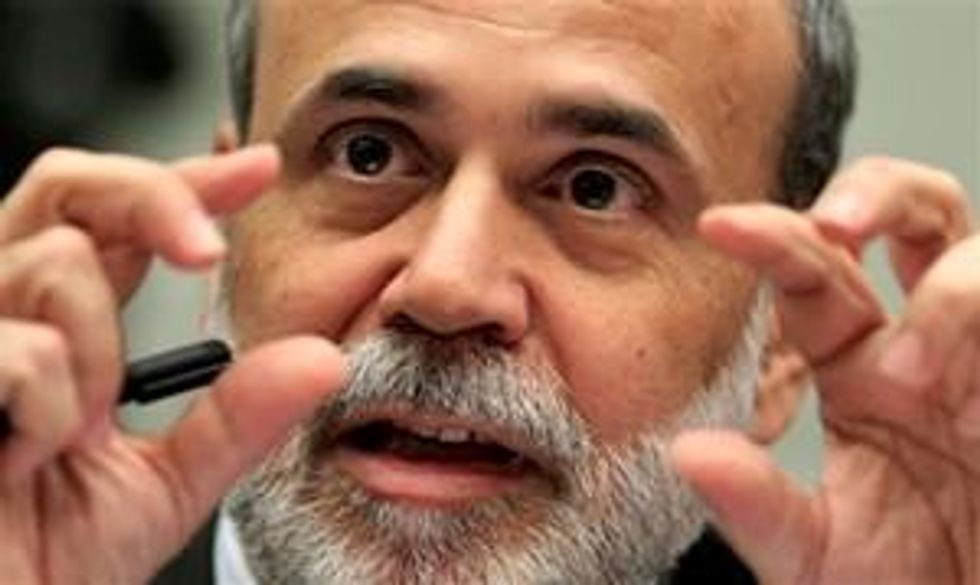
But to finally hear those words from the man George W. Bush and Barack Obama both appointed to lead us out of the great recession is a bracing reminder of how markedly the policies of both those presidents have failed: "We've had close to 10 percent unemployment now for a number of years, and of the people who are unemployed, about 45 percent have been unemployed for six months or more," Bernanke said. "This is unheard of."
But why is Bernanke just now discovering this after having overseen the Fed's purchase of trillions in toxic mortgage-backed securities from the too-big-to-fail banks that sacrificed people's homes in a giant Ponzi scheme? Why did he throw all of that money at the banks without getting anything back in the way of relief for the people the bankers swindled?
The housing meltdown, which has robbed Americans of a considerable portion of their net worth, has led to the continued depressed consumer confidence that is the prime cause of crisis-level unemployment. In another of his too-late-to-matter moments, Bernanke acknowledged that "strong housing policies to help the market recover" would "clearly be very useful," but he failed to suggest any.
Bernanke, along with then-New York Fed President Timothy Geithner, helped implement the Bush strategy of saving the banks in the hope that their rising tide would lift our little boats. That remained the strategy when President Obama rewarded Geithner for having saved AIG and Citigroup by naming him treasury secretary in the incoming government.
With the Geithner appointment, and the even more disturbing selection of Lawrence Summers to be his top economic adviser, Obama sealed his own fate as president. By turning to those disciples of Clinton-era Treasury Secretary Robert Rubin, a prime enabler of Wall Street greed, the new president fatally betrayed his promise of hope.
If you still need confirmation of just how decisive a betrayal those appointments were, check out Ron Suskind's new book, "Confidence Men," a devastating insider account of the Obama White House that clearly identifies as the source of this president's failure "Rubin's B-Team," Summers and Geithner, "two men whose actions had contributed to the very financial disaster they were hired to solve." Suskind quotes then-Sen. Byron Dorgan, D-N.D., one of the few who dared stand up to the Wall Street lobbyists, as telling Obama, "I don't understand how you could do this; you've picked the wrong people!"
Of course the Democrats from the Clinton era don't bear all of the responsibility for the radical deregulation of the financial industry that ended the sensible restraints on greed installed by Franklin Roosevelt in response to the Great Depression. Indeed, the inspiration came from Republicans led by Phil Gramm, the then-senator from Texas who as head of the Banking Committee authored the legislation that Wall Street lobbyists had long pushed unsuccessfully.
The mayhem they wrought and the subsequent big-money rewards to Rubin and Gramm do not seem to have shocked this president or the leading contenders for the Republican presidential nomination. Rubin became chairman of Citigroup and was rewarded with $120 million while he guided the bank to the edge of bankruptcy. Gramm went to a leading position at the Swiss-based UBS, the continually troubled institution now in the midst of its latest scandal, involving fraudulent trading. In addition to a $45 billion direct TARP bailout, Citigroup got $99.5 billion, and Gramm's UBS $77.2 billion from a $1.2 trillion secret Fed loan fund.
Gramm and Rubin were partners in what should be considered the crime of the century, speaking in moral and not legal terms since, as regards the financial world, the bad guys get to write the laws. Thanks to their efforts, which allowed the creation of the "too-big-to-fail banks" and a totally unregulated derivatives market in toxic home mortgage securities, we entered the Great Recession, but neither of its authors has ever been held seriously accountable for the enormous suffering he caused.
On the contrary, Gramm and Rubin's "just free Wall Street to do its thing" ideology still dominates the economic policies of both major political parties. Rubin's acolytes have controlled the Obama administration's economic strategy of saving Wall Street by betraying Main Street, and Gramm, who recently endorsed his former student at Texas A&M, Rick Perry, for president, remains the free-market-mayhem guru for Republicans. On Election Day, whoever wins, we lose.
Now he tells us. On Wednesday Federal Reserve Chairman Ben Bernanke referred to the nation's unemployment rate as a "national crisis," an obvious if depressing fact of life to the 25 million Americans who have been unsuccessfully attempting to find full-time employment.
But to finally hear those words from the man George W. Bush and Barack Obama both appointed to lead us out of the great recession is a bracing reminder of how markedly the policies of both those presidents have failed: "We've had close to 10 percent unemployment now for a number of years, and of the people who are unemployed, about 45 percent have been unemployed for six months or more," Bernanke said. "This is unheard of."
But why is Bernanke just now discovering this after having overseen the Fed's purchase of trillions in toxic mortgage-backed securities from the too-big-to-fail banks that sacrificed people's homes in a giant Ponzi scheme? Why did he throw all of that money at the banks without getting anything back in the way of relief for the people the bankers swindled?
The housing meltdown, which has robbed Americans of a considerable portion of their net worth, has led to the continued depressed consumer confidence that is the prime cause of crisis-level unemployment. In another of his too-late-to-matter moments, Bernanke acknowledged that "strong housing policies to help the market recover" would "clearly be very useful," but he failed to suggest any.
Bernanke, along with then-New York Fed President Timothy Geithner, helped implement the Bush strategy of saving the banks in the hope that their rising tide would lift our little boats. That remained the strategy when President Obama rewarded Geithner for having saved AIG and Citigroup by naming him treasury secretary in the incoming government.
With the Geithner appointment, and the even more disturbing selection of Lawrence Summers to be his top economic adviser, Obama sealed his own fate as president. By turning to those disciples of Clinton-era Treasury Secretary Robert Rubin, a prime enabler of Wall Street greed, the new president fatally betrayed his promise of hope.
If you still need confirmation of just how decisive a betrayal those appointments were, check out Ron Suskind's new book, "Confidence Men," a devastating insider account of the Obama White House that clearly identifies as the source of this president's failure "Rubin's B-Team," Summers and Geithner, "two men whose actions had contributed to the very financial disaster they were hired to solve." Suskind quotes then-Sen. Byron Dorgan, D-N.D., one of the few who dared stand up to the Wall Street lobbyists, as telling Obama, "I don't understand how you could do this; you've picked the wrong people!"
Of course the Democrats from the Clinton era don't bear all of the responsibility for the radical deregulation of the financial industry that ended the sensible restraints on greed installed by Franklin Roosevelt in response to the Great Depression. Indeed, the inspiration came from Republicans led by Phil Gramm, the then-senator from Texas who as head of the Banking Committee authored the legislation that Wall Street lobbyists had long pushed unsuccessfully.
The mayhem they wrought and the subsequent big-money rewards to Rubin and Gramm do not seem to have shocked this president or the leading contenders for the Republican presidential nomination. Rubin became chairman of Citigroup and was rewarded with $120 million while he guided the bank to the edge of bankruptcy. Gramm went to a leading position at the Swiss-based UBS, the continually troubled institution now in the midst of its latest scandal, involving fraudulent trading. In addition to a $45 billion direct TARP bailout, Citigroup got $99.5 billion, and Gramm's UBS $77.2 billion from a $1.2 trillion secret Fed loan fund.
Gramm and Rubin were partners in what should be considered the crime of the century, speaking in moral and not legal terms since, as regards the financial world, the bad guys get to write the laws. Thanks to their efforts, which allowed the creation of the "too-big-to-fail banks" and a totally unregulated derivatives market in toxic home mortgage securities, we entered the Great Recession, but neither of its authors has ever been held seriously accountable for the enormous suffering he caused.
On the contrary, Gramm and Rubin's "just free Wall Street to do its thing" ideology still dominates the economic policies of both major political parties. Rubin's acolytes have controlled the Obama administration's economic strategy of saving Wall Street by betraying Main Street, and Gramm, who recently endorsed his former student at Texas A&M, Rick Perry, for president, remains the free-market-mayhem guru for Republicans. On Election Day, whoever wins, we lose.
Now he tells us. On Wednesday Federal Reserve Chairman Ben Bernanke referred to the nation's unemployment rate as a "national crisis," an obvious if depressing fact of life to the 25 million Americans who have been unsuccessfully attempting to find full-time employment.
But to finally hear those words from the man George W. Bush and Barack Obama both appointed to lead us out of the great recession is a bracing reminder of how markedly the policies of both those presidents have failed: "We've had close to 10 percent unemployment now for a number of years, and of the people who are unemployed, about 45 percent have been unemployed for six months or more," Bernanke said. "This is unheard of."
But why is Bernanke just now discovering this after having overseen the Fed's purchase of trillions in toxic mortgage-backed securities from the too-big-to-fail banks that sacrificed people's homes in a giant Ponzi scheme? Why did he throw all of that money at the banks without getting anything back in the way of relief for the people the bankers swindled?
The housing meltdown, which has robbed Americans of a considerable portion of their net worth, has led to the continued depressed consumer confidence that is the prime cause of crisis-level unemployment. In another of his too-late-to-matter moments, Bernanke acknowledged that "strong housing policies to help the market recover" would "clearly be very useful," but he failed to suggest any.
Bernanke, along with then-New York Fed President Timothy Geithner, helped implement the Bush strategy of saving the banks in the hope that their rising tide would lift our little boats. That remained the strategy when President Obama rewarded Geithner for having saved AIG and Citigroup by naming him treasury secretary in the incoming government.
With the Geithner appointment, and the even more disturbing selection of Lawrence Summers to be his top economic adviser, Obama sealed his own fate as president. By turning to those disciples of Clinton-era Treasury Secretary Robert Rubin, a prime enabler of Wall Street greed, the new president fatally betrayed his promise of hope.
If you still need confirmation of just how decisive a betrayal those appointments were, check out Ron Suskind's new book, "Confidence Men," a devastating insider account of the Obama White House that clearly identifies as the source of this president's failure "Rubin's B-Team," Summers and Geithner, "two men whose actions had contributed to the very financial disaster they were hired to solve." Suskind quotes then-Sen. Byron Dorgan, D-N.D., one of the few who dared stand up to the Wall Street lobbyists, as telling Obama, "I don't understand how you could do this; you've picked the wrong people!"
Of course the Democrats from the Clinton era don't bear all of the responsibility for the radical deregulation of the financial industry that ended the sensible restraints on greed installed by Franklin Roosevelt in response to the Great Depression. Indeed, the inspiration came from Republicans led by Phil Gramm, the then-senator from Texas who as head of the Banking Committee authored the legislation that Wall Street lobbyists had long pushed unsuccessfully.
The mayhem they wrought and the subsequent big-money rewards to Rubin and Gramm do not seem to have shocked this president or the leading contenders for the Republican presidential nomination. Rubin became chairman of Citigroup and was rewarded with $120 million while he guided the bank to the edge of bankruptcy. Gramm went to a leading position at the Swiss-based UBS, the continually troubled institution now in the midst of its latest scandal, involving fraudulent trading. In addition to a $45 billion direct TARP bailout, Citigroup got $99.5 billion, and Gramm's UBS $77.2 billion from a $1.2 trillion secret Fed loan fund.
Gramm and Rubin were partners in what should be considered the crime of the century, speaking in moral and not legal terms since, as regards the financial world, the bad guys get to write the laws. Thanks to their efforts, which allowed the creation of the "too-big-to-fail banks" and a totally unregulated derivatives market in toxic home mortgage securities, we entered the Great Recession, but neither of its authors has ever been held seriously accountable for the enormous suffering he caused.
On the contrary, Gramm and Rubin's "just free Wall Street to do its thing" ideology still dominates the economic policies of both major political parties. Rubin's acolytes have controlled the Obama administration's economic strategy of saving Wall Street by betraying Main Street, and Gramm, who recently endorsed his former student at Texas A&M, Rick Perry, for president, remains the free-market-mayhem guru for Republicans. On Election Day, whoever wins, we lose.