SUBSCRIBE TO OUR FREE NEWSLETTER
Daily news & progressive opinion—funded by the people, not the corporations—delivered straight to your inbox.
5
#000000
#FFFFFF
To donate by check, phone, or other method, see our More Ways to Give page.
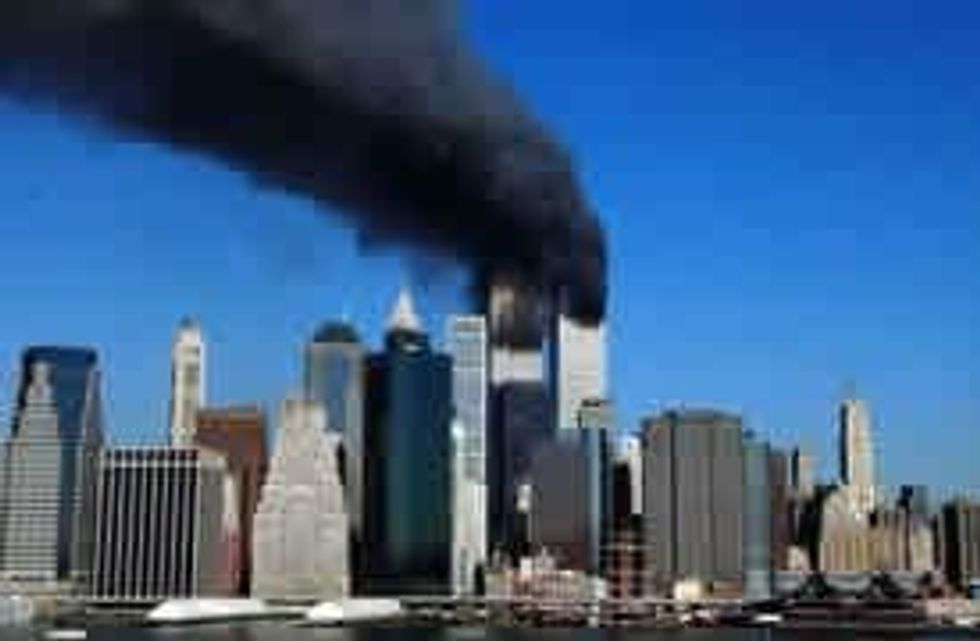
For weeks I've been dreading the 10th anniversary of 9/11, and not because I fear another attack. As a New Yorker who works below 14th Street, I'm reluctant to revisit the unhappy images I witnessed on that paradoxically lovely, cloudless day: the vast plume of smoke blowing eastward over my office building when I emerged from the Bleecker Street subway station around 9 a.m.; the thousands of dazed and ashen office workers tromping uptown in the middle of Broadway like refugees from a 1950s horror film; the soldiers armed with automatic weapons patrolling intersections; the constantly repeated television images of the two towers collapsing into rubble, people burned and crushed to bits - these are things I would prefer not to dwell on.
We don't have to sympathize with bin Laden or even to understand his messianic thinking to know how wrong-headed and misleading our public recounting of 9/11 has become. Lost in the purity of America's martyrdom are basic political realities: that bin Laden was a wealthy and well-connected Saudi Arabian, a former CIA asset, and America's stalwart, only somewhat covert ally in the anti-communist jihad that drove the Soviet Union out of Afghanistan in the 1980s; that bin Laden felt betrayed when the Saudi monarchy allowed American troops - in his view, infidel agents of the devil - to use its sacred soil as a staging ground, in 1990-91, to dislodge Saddam Hussein from Kuwait; that bin Laden, already a very violent terrorist suspect, was somehow never apprehended in the 1990s - not even for questioning - because of the Saudi regime's double game of protecting extremists while pretending to co-operate with Americans in the guise of "moderate Arab ally."
Why don't we lament with equal passion each anniversary of 2/26? Because the first attempt to destroy the World Trade Center, in 1993, should have led, eventually, to the arrest of bin Laden in Sudan in late 1995 or early 1996, after he was expelled from Saudi Arabia. George W. Bush ought to have listened more attentively to the warnings of his counterterrorism chief, Richard Clarke, in 2001, but the Clinton administration's decision to prevent the CIA from grabbing Osama in Khartoum - before he decamped for Afghanistan and greater feats of mayhem - remains the emblematic failure of American "intelligence" and foreign policy in the decade leading up to 9/11. Of course, either Clinton or Bush could have severed, or at least loosened, the Gordian knot that ties the White House to the House of Saud and its oil wells - thus removing bin Laden's casus belli - but such daring logic rarely figures in the high councils of American leadership. The nearly 3,000 dead at ground zero, the Pentagon, and Somerset County, Pennsylvania, were not martyrs to American freedom; they were victims of American foreign policy, just so much collateral damage resulting from the thirst of U.S. businessmen and politicians for Middle Eastern petroleum and influence.
John O'Neill, the FBI's one-time director of anti-terrorism in New York, was quoted after 9/11 by two French authors saying that "all the answers, all the keys to dismantling Osama bin Laden's organization can be found in Saudi Arabia." This is likely still the truth. Unfortunately, O'Neill quit the FBI in frustration over what he said was Saudi pressure on Washington to squelch his investigation of al-Qaeda inside the kingdom of the Fahds - then went to work as security director of the World Trade Center, where he died on 9/11. The photograph of Saudi King Abdullah handing Barack Obama a valuable gold medallion on the president's state visit to Riyadh in 2009 - a symbolic "gift" to be sure - suggests that America's meddling Middle Eastern policy will continue to discourage future John O'Neills from doing their jobs or the governing elite from learning any lessons.
But delineating the failures of the Clinton and Bush administrations to anticipate or prevent 9/11 doesn't explain the apparently bottomless well of self-pity, vengeance, and rage on display these past 10 years. To combat "the terrorist threat" and respond to public outrage over bin Laden's attack, presidents Bush and Obama have prosecuted two major and disastrous wars, authorized "targeted assassinations," severely damaged the historic right of habeas corpus, and curtailed civil liberties by engaging in illegal surveillance and entrapment of "potential terrorists" on a scale not seen since the height of anticommunist paranoia during the Cold War. The torture conducted at Abu Ghraib and the prisons at Guantanamo and Bagram Air Force Base are stains on the American soul, while the FBI's grossly unconstitutional practice of enticing Muslim-Americans into fictional "terror plots" is a scandal that deserves much greater exposure. How can we understand all of this anti-libertarian, "un-American" activity? Such angry, costly, and ultimately self-defeating overreactions can only be traced back to the wounded innocence that makes up so much of the American psyche.
In fact, Americans should long ago have got over their sense of "exceptionalism," their deep belief in their well-meaning sanctity. Slavery and the genocide against the Indians might be a good place to start a re-examination of American "innocence." I lost any notion that such a thing existed when I watched the nightly television reports about American bombing and napalming of Vietnamese civilians; I lost it again when I finally read up on the poorlytaught history of America's brutal colonial war in the Philippines, the original counter-insurgency that introduced the American use of "waterboarding" to extract information. Graham Greene said it best in his Vietnam novel, The Quiet American: "Innocence is like a dumb leper who has lost his bell, wandering the world, meaning no harm."
The ongoing legacy of 9/11 appears to be more of the same: more killing in the name of saving lives, more repression in the name of defending liberty, more camouflaged Christian piety in the name of freedom of religion, more hypocrisy in the name of "American" values of truth and justice, more massacres of the English language (terrorism is a tactic not an ideology) in the name of straight talk. I don't think it's the legacy Americans deserve, and it is certainly the wrong memorial for the dead of 9/11.
For weeks I've been dreading the 10th anniversary of 9/11, and not because I fear another attack. As a New Yorker who works below 14th Street, I'm reluctant to revisit the unhappy images I witnessed on that paradoxically lovely, cloudless day: the vast plume of smoke blowing eastward over my office building when I emerged from the Bleecker Street subway station around 9 a.m.; the thousands of dazed and ashen office workers tromping uptown in the middle of Broadway like refugees from a 1950s horror film; the soldiers armed with automatic weapons patrolling intersections; the constantly repeated television images of the two towers collapsing into rubble, people burned and crushed to bits - these are things I would prefer not to dwell on.
We don't have to sympathize with bin Laden or even to understand his messianic thinking to know how wrong-headed and misleading our public recounting of 9/11 has become. Lost in the purity of America's martyrdom are basic political realities: that bin Laden was a wealthy and well-connected Saudi Arabian, a former CIA asset, and America's stalwart, only somewhat covert ally in the anti-communist jihad that drove the Soviet Union out of Afghanistan in the 1980s; that bin Laden felt betrayed when the Saudi monarchy allowed American troops - in his view, infidel agents of the devil - to use its sacred soil as a staging ground, in 1990-91, to dislodge Saddam Hussein from Kuwait; that bin Laden, already a very violent terrorist suspect, was somehow never apprehended in the 1990s - not even for questioning - because of the Saudi regime's double game of protecting extremists while pretending to co-operate with Americans in the guise of "moderate Arab ally."
Why don't we lament with equal passion each anniversary of 2/26? Because the first attempt to destroy the World Trade Center, in 1993, should have led, eventually, to the arrest of bin Laden in Sudan in late 1995 or early 1996, after he was expelled from Saudi Arabia. George W. Bush ought to have listened more attentively to the warnings of his counterterrorism chief, Richard Clarke, in 2001, but the Clinton administration's decision to prevent the CIA from grabbing Osama in Khartoum - before he decamped for Afghanistan and greater feats of mayhem - remains the emblematic failure of American "intelligence" and foreign policy in the decade leading up to 9/11. Of course, either Clinton or Bush could have severed, or at least loosened, the Gordian knot that ties the White House to the House of Saud and its oil wells - thus removing bin Laden's casus belli - but such daring logic rarely figures in the high councils of American leadership. The nearly 3,000 dead at ground zero, the Pentagon, and Somerset County, Pennsylvania, were not martyrs to American freedom; they were victims of American foreign policy, just so much collateral damage resulting from the thirst of U.S. businessmen and politicians for Middle Eastern petroleum and influence.
John O'Neill, the FBI's one-time director of anti-terrorism in New York, was quoted after 9/11 by two French authors saying that "all the answers, all the keys to dismantling Osama bin Laden's organization can be found in Saudi Arabia." This is likely still the truth. Unfortunately, O'Neill quit the FBI in frustration over what he said was Saudi pressure on Washington to squelch his investigation of al-Qaeda inside the kingdom of the Fahds - then went to work as security director of the World Trade Center, where he died on 9/11. The photograph of Saudi King Abdullah handing Barack Obama a valuable gold medallion on the president's state visit to Riyadh in 2009 - a symbolic "gift" to be sure - suggests that America's meddling Middle Eastern policy will continue to discourage future John O'Neills from doing their jobs or the governing elite from learning any lessons.
But delineating the failures of the Clinton and Bush administrations to anticipate or prevent 9/11 doesn't explain the apparently bottomless well of self-pity, vengeance, and rage on display these past 10 years. To combat "the terrorist threat" and respond to public outrage over bin Laden's attack, presidents Bush and Obama have prosecuted two major and disastrous wars, authorized "targeted assassinations," severely damaged the historic right of habeas corpus, and curtailed civil liberties by engaging in illegal surveillance and entrapment of "potential terrorists" on a scale not seen since the height of anticommunist paranoia during the Cold War. The torture conducted at Abu Ghraib and the prisons at Guantanamo and Bagram Air Force Base are stains on the American soul, while the FBI's grossly unconstitutional practice of enticing Muslim-Americans into fictional "terror plots" is a scandal that deserves much greater exposure. How can we understand all of this anti-libertarian, "un-American" activity? Such angry, costly, and ultimately self-defeating overreactions can only be traced back to the wounded innocence that makes up so much of the American psyche.
In fact, Americans should long ago have got over their sense of "exceptionalism," their deep belief in their well-meaning sanctity. Slavery and the genocide against the Indians might be a good place to start a re-examination of American "innocence." I lost any notion that such a thing existed when I watched the nightly television reports about American bombing and napalming of Vietnamese civilians; I lost it again when I finally read up on the poorlytaught history of America's brutal colonial war in the Philippines, the original counter-insurgency that introduced the American use of "waterboarding" to extract information. Graham Greene said it best in his Vietnam novel, The Quiet American: "Innocence is like a dumb leper who has lost his bell, wandering the world, meaning no harm."
The ongoing legacy of 9/11 appears to be more of the same: more killing in the name of saving lives, more repression in the name of defending liberty, more camouflaged Christian piety in the name of freedom of religion, more hypocrisy in the name of "American" values of truth and justice, more massacres of the English language (terrorism is a tactic not an ideology) in the name of straight talk. I don't think it's the legacy Americans deserve, and it is certainly the wrong memorial for the dead of 9/11.
For weeks I've been dreading the 10th anniversary of 9/11, and not because I fear another attack. As a New Yorker who works below 14th Street, I'm reluctant to revisit the unhappy images I witnessed on that paradoxically lovely, cloudless day: the vast plume of smoke blowing eastward over my office building when I emerged from the Bleecker Street subway station around 9 a.m.; the thousands of dazed and ashen office workers tromping uptown in the middle of Broadway like refugees from a 1950s horror film; the soldiers armed with automatic weapons patrolling intersections; the constantly repeated television images of the two towers collapsing into rubble, people burned and crushed to bits - these are things I would prefer not to dwell on.
We don't have to sympathize with bin Laden or even to understand his messianic thinking to know how wrong-headed and misleading our public recounting of 9/11 has become. Lost in the purity of America's martyrdom are basic political realities: that bin Laden was a wealthy and well-connected Saudi Arabian, a former CIA asset, and America's stalwart, only somewhat covert ally in the anti-communist jihad that drove the Soviet Union out of Afghanistan in the 1980s; that bin Laden felt betrayed when the Saudi monarchy allowed American troops - in his view, infidel agents of the devil - to use its sacred soil as a staging ground, in 1990-91, to dislodge Saddam Hussein from Kuwait; that bin Laden, already a very violent terrorist suspect, was somehow never apprehended in the 1990s - not even for questioning - because of the Saudi regime's double game of protecting extremists while pretending to co-operate with Americans in the guise of "moderate Arab ally."
Why don't we lament with equal passion each anniversary of 2/26? Because the first attempt to destroy the World Trade Center, in 1993, should have led, eventually, to the arrest of bin Laden in Sudan in late 1995 or early 1996, after he was expelled from Saudi Arabia. George W. Bush ought to have listened more attentively to the warnings of his counterterrorism chief, Richard Clarke, in 2001, but the Clinton administration's decision to prevent the CIA from grabbing Osama in Khartoum - before he decamped for Afghanistan and greater feats of mayhem - remains the emblematic failure of American "intelligence" and foreign policy in the decade leading up to 9/11. Of course, either Clinton or Bush could have severed, or at least loosened, the Gordian knot that ties the White House to the House of Saud and its oil wells - thus removing bin Laden's casus belli - but such daring logic rarely figures in the high councils of American leadership. The nearly 3,000 dead at ground zero, the Pentagon, and Somerset County, Pennsylvania, were not martyrs to American freedom; they were victims of American foreign policy, just so much collateral damage resulting from the thirst of U.S. businessmen and politicians for Middle Eastern petroleum and influence.
John O'Neill, the FBI's one-time director of anti-terrorism in New York, was quoted after 9/11 by two French authors saying that "all the answers, all the keys to dismantling Osama bin Laden's organization can be found in Saudi Arabia." This is likely still the truth. Unfortunately, O'Neill quit the FBI in frustration over what he said was Saudi pressure on Washington to squelch his investigation of al-Qaeda inside the kingdom of the Fahds - then went to work as security director of the World Trade Center, where he died on 9/11. The photograph of Saudi King Abdullah handing Barack Obama a valuable gold medallion on the president's state visit to Riyadh in 2009 - a symbolic "gift" to be sure - suggests that America's meddling Middle Eastern policy will continue to discourage future John O'Neills from doing their jobs or the governing elite from learning any lessons.
But delineating the failures of the Clinton and Bush administrations to anticipate or prevent 9/11 doesn't explain the apparently bottomless well of self-pity, vengeance, and rage on display these past 10 years. To combat "the terrorist threat" and respond to public outrage over bin Laden's attack, presidents Bush and Obama have prosecuted two major and disastrous wars, authorized "targeted assassinations," severely damaged the historic right of habeas corpus, and curtailed civil liberties by engaging in illegal surveillance and entrapment of "potential terrorists" on a scale not seen since the height of anticommunist paranoia during the Cold War. The torture conducted at Abu Ghraib and the prisons at Guantanamo and Bagram Air Force Base are stains on the American soul, while the FBI's grossly unconstitutional practice of enticing Muslim-Americans into fictional "terror plots" is a scandal that deserves much greater exposure. How can we understand all of this anti-libertarian, "un-American" activity? Such angry, costly, and ultimately self-defeating overreactions can only be traced back to the wounded innocence that makes up so much of the American psyche.
In fact, Americans should long ago have got over their sense of "exceptionalism," their deep belief in their well-meaning sanctity. Slavery and the genocide against the Indians might be a good place to start a re-examination of American "innocence." I lost any notion that such a thing existed when I watched the nightly television reports about American bombing and napalming of Vietnamese civilians; I lost it again when I finally read up on the poorlytaught history of America's brutal colonial war in the Philippines, the original counter-insurgency that introduced the American use of "waterboarding" to extract information. Graham Greene said it best in his Vietnam novel, The Quiet American: "Innocence is like a dumb leper who has lost his bell, wandering the world, meaning no harm."
The ongoing legacy of 9/11 appears to be more of the same: more killing in the name of saving lives, more repression in the name of defending liberty, more camouflaged Christian piety in the name of freedom of religion, more hypocrisy in the name of "American" values of truth and justice, more massacres of the English language (terrorism is a tactic not an ideology) in the name of straight talk. I don't think it's the legacy Americans deserve, and it is certainly the wrong memorial for the dead of 9/11.