SUBSCRIBE TO OUR FREE NEWSLETTER
Daily news & progressive opinion—funded by the people, not the corporations—delivered straight to your inbox.
5
#000000
#FFFFFF
To donate by check, phone, or other method, see our More Ways to Give page.
So much for the meritocracy. Despite an elite education, effusive charm and brilliant wit, Barack Obama, like Bill Clinton before him, has ended up betraying his humble origins by abjectly serving the most rapacious variant of Wall Street greed. They both talk a good progressive game, but when push comes to shove--meaning when the banking lobby weighs in--big money talks and the best and the brightest fold.
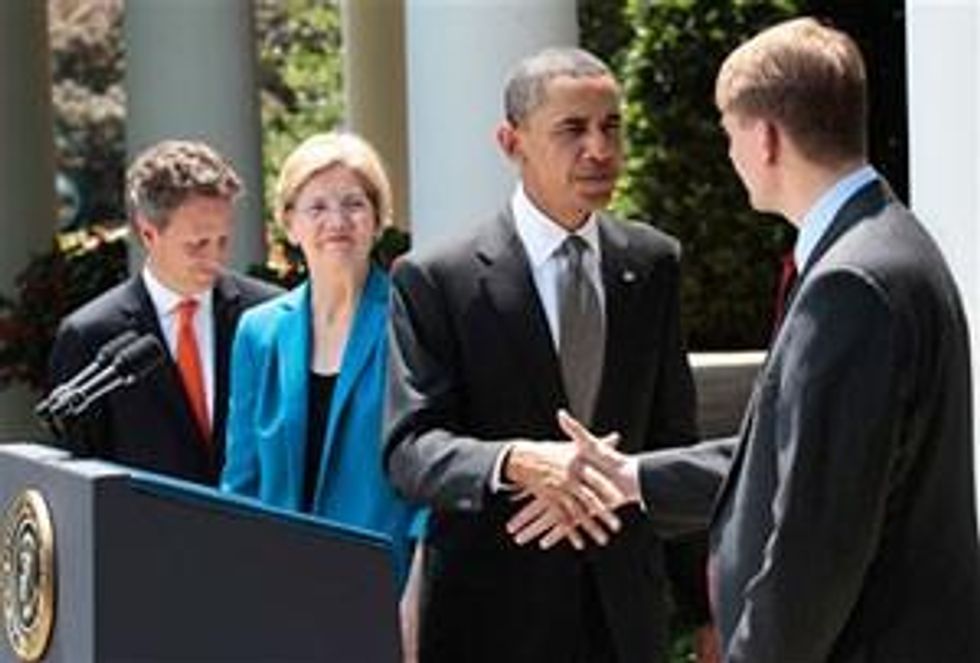
The defining moment of Clinton's capitulation was his destruction of Brooksley Born, the one member of his administration with the courage and prescience to warn him about the unregulated derivatives trading that ultimately led to the housing collapse. For Obama, it is his decision not to nominate Elizabeth Warren to run the new Consumer Financial Protection Bureau, which she fought so hard to create.
Obama's refusal to take the fight to Senate Republicans by nominating Warren should be taken as the vital measure of the man. This gutless decision comes after the president populated his administration with the very people who created the financial meltdown.
The Harvard credential worked for the likes of economist Lawrence Summers, who carried water for Wall Street under both Clinton and Obama, but not for that university's distinguished law professor Warren, an outspoken defender of consumer rights who dared represent the interests of the victims of the banking scams. It is a painful reminder that for Democrats as well as Republicans, governance is still all about serving the rich.
Both Democratic presidents had no difficulty appointing top bankers and their acolytes to all of the key economic positions in their administrations but drew the line at fully backing the rare member of their team who had a proven record of defending the public interest when it was being savaged. Consider the fawning treatment of former Goldman Sachs partner Gary Gensler by both Clinton and Obama. In the Clinton Treasury Department, it was Gensler working under both Robert Rubin and Summers who forcefully pushed for the radical deregulation of the financial industry that led to the biggest economic implosion since the Great Depression.
As Sen. Bernie Sanders, I-Vt., put it in opposing Obama's nomination of Gensler to be head of the Commodity Futures Trading Commission, the position once held by Born: "Mr. Gensler worked with Sen. Phil Gramm and Alan Greenspan to exempt credit default swaps from regulation, which led to the collapse of AIG and has resulted in the largest taxpayer bailout in U.S. history." This bailout was engineered in cooperation with the Bush administration by Timothy Geithner, then head of the New York Federal Reserve Bank, who was rewarded for his catering to Wall Street avarice by being named Obama's treasury secretary.
With Geithner and Gensler now in charge of reregulating Wall Street as ordered by the Dodd-Frank law, it is no wonder that the lobbyists have been able to stall any significant progress in controlling the ever-threatening time bomb of the still unregulated $600 trillion over-the-counter derivatives market. It was after all Gensler who assured Congress back during the Clinton years that Brooksley Born was an alarmist and that the "OTC derivatives directly and indirectly support higher investment and growth in living standards in the United States and around the world."
No wonder Gensler had no difficulty being confirmed by Senate Republicans and Democrats, who are basically united in giving Wall Street lobbyists the governance they paid for. Of course, the main culpability is with congressional Republicans, who are dead set against any meaningful consumer protection.
For that reason, they are likely to oppose the person Obama nominated instead of Warren, former Ohio Attorney General Richard Cordray, who has acted forcefully to defend consumer interests. As David Lazarus, the knowledgeable business columnist for the Los Angeles Times, wrote, "President Obama shouldn't have backed down" in the face of GOP opposition to Warren, because Republicans will probably also find Cordray unacceptable. The reason being that they don't want a strong director for the consumer protection agency, or even the agency itself.
What remains to be seen is if Obama will play their game or finally take the gloves off. If we should have learned anything in the last decade of financial malfeasance by the banking industry, it is that consumers are in desperate need of protection. If Obama goes to battle for Cordray and he proves to be a strong director for the new agency, I will stand corrected, but the president's abandonment of the brilliant and dedicated Warren is hardly an auspicious beginning.
So much for the meritocracy. Despite an elite education, effusive charm and brilliant wit, Barack Obama, like Bill Clinton before him, has ended up betraying his humble origins by abjectly serving the most rapacious variant of Wall Street greed. They both talk a good progressive game, but when push comes to shove--meaning when the banking lobby weighs in--big money talks and the best and the brightest fold.
The defining moment of Clinton's capitulation was his destruction of Brooksley Born, the one member of his administration with the courage and prescience to warn him about the unregulated derivatives trading that ultimately led to the housing collapse. For Obama, it is his decision not to nominate Elizabeth Warren to run the new Consumer Financial Protection Bureau, which she fought so hard to create.
Obama's refusal to take the fight to Senate Republicans by nominating Warren should be taken as the vital measure of the man. This gutless decision comes after the president populated his administration with the very people who created the financial meltdown.
The Harvard credential worked for the likes of economist Lawrence Summers, who carried water for Wall Street under both Clinton and Obama, but not for that university's distinguished law professor Warren, an outspoken defender of consumer rights who dared represent the interests of the victims of the banking scams. It is a painful reminder that for Democrats as well as Republicans, governance is still all about serving the rich.
Both Democratic presidents had no difficulty appointing top bankers and their acolytes to all of the key economic positions in their administrations but drew the line at fully backing the rare member of their team who had a proven record of defending the public interest when it was being savaged. Consider the fawning treatment of former Goldman Sachs partner Gary Gensler by both Clinton and Obama. In the Clinton Treasury Department, it was Gensler working under both Robert Rubin and Summers who forcefully pushed for the radical deregulation of the financial industry that led to the biggest economic implosion since the Great Depression.
As Sen. Bernie Sanders, I-Vt., put it in opposing Obama's nomination of Gensler to be head of the Commodity Futures Trading Commission, the position once held by Born: "Mr. Gensler worked with Sen. Phil Gramm and Alan Greenspan to exempt credit default swaps from regulation, which led to the collapse of AIG and has resulted in the largest taxpayer bailout in U.S. history." This bailout was engineered in cooperation with the Bush administration by Timothy Geithner, then head of the New York Federal Reserve Bank, who was rewarded for his catering to Wall Street avarice by being named Obama's treasury secretary.
With Geithner and Gensler now in charge of reregulating Wall Street as ordered by the Dodd-Frank law, it is no wonder that the lobbyists have been able to stall any significant progress in controlling the ever-threatening time bomb of the still unregulated $600 trillion over-the-counter derivatives market. It was after all Gensler who assured Congress back during the Clinton years that Brooksley Born was an alarmist and that the "OTC derivatives directly and indirectly support higher investment and growth in living standards in the United States and around the world."
No wonder Gensler had no difficulty being confirmed by Senate Republicans and Democrats, who are basically united in giving Wall Street lobbyists the governance they paid for. Of course, the main culpability is with congressional Republicans, who are dead set against any meaningful consumer protection.
For that reason, they are likely to oppose the person Obama nominated instead of Warren, former Ohio Attorney General Richard Cordray, who has acted forcefully to defend consumer interests. As David Lazarus, the knowledgeable business columnist for the Los Angeles Times, wrote, "President Obama shouldn't have backed down" in the face of GOP opposition to Warren, because Republicans will probably also find Cordray unacceptable. The reason being that they don't want a strong director for the consumer protection agency, or even the agency itself.
What remains to be seen is if Obama will play their game or finally take the gloves off. If we should have learned anything in the last decade of financial malfeasance by the banking industry, it is that consumers are in desperate need of protection. If Obama goes to battle for Cordray and he proves to be a strong director for the new agency, I will stand corrected, but the president's abandonment of the brilliant and dedicated Warren is hardly an auspicious beginning.
So much for the meritocracy. Despite an elite education, effusive charm and brilliant wit, Barack Obama, like Bill Clinton before him, has ended up betraying his humble origins by abjectly serving the most rapacious variant of Wall Street greed. They both talk a good progressive game, but when push comes to shove--meaning when the banking lobby weighs in--big money talks and the best and the brightest fold.
The defining moment of Clinton's capitulation was his destruction of Brooksley Born, the one member of his administration with the courage and prescience to warn him about the unregulated derivatives trading that ultimately led to the housing collapse. For Obama, it is his decision not to nominate Elizabeth Warren to run the new Consumer Financial Protection Bureau, which she fought so hard to create.
Obama's refusal to take the fight to Senate Republicans by nominating Warren should be taken as the vital measure of the man. This gutless decision comes after the president populated his administration with the very people who created the financial meltdown.
The Harvard credential worked for the likes of economist Lawrence Summers, who carried water for Wall Street under both Clinton and Obama, but not for that university's distinguished law professor Warren, an outspoken defender of consumer rights who dared represent the interests of the victims of the banking scams. It is a painful reminder that for Democrats as well as Republicans, governance is still all about serving the rich.
Both Democratic presidents had no difficulty appointing top bankers and their acolytes to all of the key economic positions in their administrations but drew the line at fully backing the rare member of their team who had a proven record of defending the public interest when it was being savaged. Consider the fawning treatment of former Goldman Sachs partner Gary Gensler by both Clinton and Obama. In the Clinton Treasury Department, it was Gensler working under both Robert Rubin and Summers who forcefully pushed for the radical deregulation of the financial industry that led to the biggest economic implosion since the Great Depression.
As Sen. Bernie Sanders, I-Vt., put it in opposing Obama's nomination of Gensler to be head of the Commodity Futures Trading Commission, the position once held by Born: "Mr. Gensler worked with Sen. Phil Gramm and Alan Greenspan to exempt credit default swaps from regulation, which led to the collapse of AIG and has resulted in the largest taxpayer bailout in U.S. history." This bailout was engineered in cooperation with the Bush administration by Timothy Geithner, then head of the New York Federal Reserve Bank, who was rewarded for his catering to Wall Street avarice by being named Obama's treasury secretary.
With Geithner and Gensler now in charge of reregulating Wall Street as ordered by the Dodd-Frank law, it is no wonder that the lobbyists have been able to stall any significant progress in controlling the ever-threatening time bomb of the still unregulated $600 trillion over-the-counter derivatives market. It was after all Gensler who assured Congress back during the Clinton years that Brooksley Born was an alarmist and that the "OTC derivatives directly and indirectly support higher investment and growth in living standards in the United States and around the world."
No wonder Gensler had no difficulty being confirmed by Senate Republicans and Democrats, who are basically united in giving Wall Street lobbyists the governance they paid for. Of course, the main culpability is with congressional Republicans, who are dead set against any meaningful consumer protection.
For that reason, they are likely to oppose the person Obama nominated instead of Warren, former Ohio Attorney General Richard Cordray, who has acted forcefully to defend consumer interests. As David Lazarus, the knowledgeable business columnist for the Los Angeles Times, wrote, "President Obama shouldn't have backed down" in the face of GOP opposition to Warren, because Republicans will probably also find Cordray unacceptable. The reason being that they don't want a strong director for the consumer protection agency, or even the agency itself.
What remains to be seen is if Obama will play their game or finally take the gloves off. If we should have learned anything in the last decade of financial malfeasance by the banking industry, it is that consumers are in desperate need of protection. If Obama goes to battle for Cordray and he proves to be a strong director for the new agency, I will stand corrected, but the president's abandonment of the brilliant and dedicated Warren is hardly an auspicious beginning.