SUBSCRIBE TO OUR FREE NEWSLETTER
Daily news & progressive opinion—funded by the people, not the corporations—delivered straight to your inbox.
5
#000000
#FFFFFF
To donate by check, phone, or other method, see our More Ways to Give page.
Daily news & progressive opinion—funded by the people, not the corporations—delivered straight to your inbox.
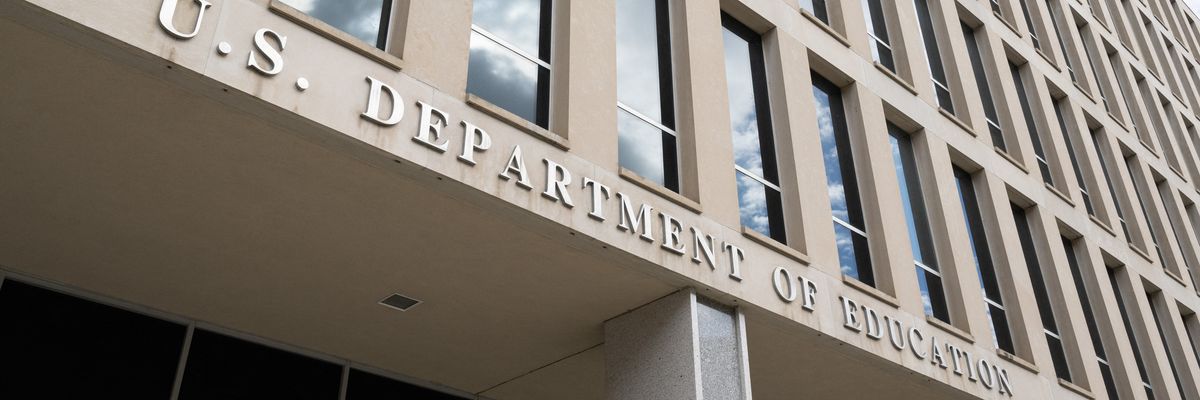
US President Donald Trump is expected to sign an executive order as soon as March 6 instructing Secretary of Education Linda McMahon to dismantle the department she now leads, US media has reported.
Elon Musk and U.S. President Donald Trump "have aimed their wrecking ball at public schools and the futures of the 50 million students in rural, suburban, and urban communities across America," said one union leader.
With the Trump administration reportedly preparing an executive order aimed at shutting down the Department of Education, the head of the union the American Federation of Teachers has vowed to fight any gutting of agency programs "tooth and nail."
According to Wednesday reporting from The Wall Street Journal, a draft text of the executive order compels Secretary of Education Linda McMahon to "take all necessary steps to facilitate the closure of the Education Department" based on "the maximum extent appropriate and permitted by law."
The Journal and other outlets reported that the order could come as soon as Thursday, though Karoline Leavitt, the White House press secretary, said in a statement on X that Trump will not sign an order Thursday.
AFT president Randi Weingarten and Becky Pringle, the president of the teachers union the National Education Association (NEA), cast the latest news as an attack ultimately aimed at public education.
"Don't use a 'war on woke' to attack the children living in poverty and the children with disabilities, in order to pay for vouchers and tax cuts for billionaires," Weingarten said in a Wednesday statement.
Pringle said Thursday that U.S. President Donald Trump and billionaire Elon Musk "have aimed their wrecking ball at public schools and the futures of the 50 million students in rural, suburban, and urban communities across America, by dismantling public education to pay for tax handouts for billionaires."
The Trump administration and congressional Republicans are currently pursuing trillions in tax cuts that would primarily benefit the wealthy.
While education policy and funding in the U.S. are largely handled at the state and local level, the Department of Education provides money for districts that serve lower income-income communities, as well as funding to help districts better serve students with disabilities. The agency is also responsible for managing federal college financial aid and federal student loans and also makes sure schools comply with a variety of federal laws, such as Title IX.
Getting rid of the Department of Education would ultimately empower the "the extremist anti-public education agenda" that is already being implemented in parts of the country, according to NEA. A key part of that agenda is vouchers for private schools, per NEA.
Vouchers siphon funding away from public schools. In 2024, the majority staff of the Senate Committee on Health, Education, Labor, and Pensions, then chaired by Sen. Bernie Sanders (I-Vt.), authored a report detailing how right-wing billionaires have bankrolled coordinated efforts to privatize U.S. public education by promoting voucher programs.
Vouchers are often the mechanism at play when conservatives talk about advancing "school choice"—which was one of the key education goals put forward by the far-right policy blueprint Project 2025. The cornerstone education policy in Project 2025 is getting rid of the Department of Education.
In January, Trump issued an executive order asking the Department of Education to spend time coming up with guidance to help states apply federal funding to school choice initiatives.
While education union voices and Democrats have vowed to resist attacks on the Department of Education, those attacks have already begun. Probationary employees there have been laid off and the agency has paused some civil rights enforcement, among other actions, per the Journal.
While the draft executive order reviewed by the Journal makes clear the ultimate aim is to get rid of the department, the Trump administration needs Congress' help to unwind the agency, according to legal experts.
The order doesn't mention Congress, which created the Department of Education in 1979, and fully dismantling the department would require a filibuster-proof majority in the Senate.
"You can't just drop a bomb on the Department of Education and turn it into rubble," Jonathan E. Collins, a professor of political science and education at Teachers College, Columbia University, told Time in February. "Legally, it has to start with Congress, not the president."
Dear Common Dreams reader, It’s been nearly 30 years since I co-founded Common Dreams with my late wife, Lina Newhouser. We had the radical notion that journalism should serve the public good, not corporate profits. It was clear to us from the outset what it would take to build such a project. No paid advertisements. No corporate sponsors. No millionaire publisher telling us what to think or do. Many people said we wouldn't last a year, but we proved those doubters wrong. Together with a tremendous team of journalists and dedicated staff, we built an independent media outlet free from the constraints of profits and corporate control. Our mission has always been simple: To inform. To inspire. To ignite change for the common good. Building Common Dreams was not easy. Our survival was never guaranteed. When you take on the most powerful forces—Wall Street greed, fossil fuel industry destruction, Big Tech lobbyists, and uber-rich oligarchs who have spent billions upon billions rigging the economy and democracy in their favor—the only bulwark you have is supporters who believe in your work. But here’s the urgent message from me today. It's never been this bad out there. And it's never been this hard to keep us going. At the very moment Common Dreams is most needed, the threats we face are intensifying. We need your support now more than ever. We don't accept corporate advertising and never will. We don't have a paywall because we don't think people should be blocked from critical news based on their ability to pay. Everything we do is funded by the donations of readers like you. When everyone does the little they can afford, we are strong. But if that support retreats or dries up, so do we. Will you donate now to make sure Common Dreams not only survives but thrives? —Craig Brown, Co-founder |
With the Trump administration reportedly preparing an executive order aimed at shutting down the Department of Education, the head of the union the American Federation of Teachers has vowed to fight any gutting of agency programs "tooth and nail."
According to Wednesday reporting from The Wall Street Journal, a draft text of the executive order compels Secretary of Education Linda McMahon to "take all necessary steps to facilitate the closure of the Education Department" based on "the maximum extent appropriate and permitted by law."
The Journal and other outlets reported that the order could come as soon as Thursday, though Karoline Leavitt, the White House press secretary, said in a statement on X that Trump will not sign an order Thursday.
AFT president Randi Weingarten and Becky Pringle, the president of the teachers union the National Education Association (NEA), cast the latest news as an attack ultimately aimed at public education.
"Don't use a 'war on woke' to attack the children living in poverty and the children with disabilities, in order to pay for vouchers and tax cuts for billionaires," Weingarten said in a Wednesday statement.
Pringle said Thursday that U.S. President Donald Trump and billionaire Elon Musk "have aimed their wrecking ball at public schools and the futures of the 50 million students in rural, suburban, and urban communities across America, by dismantling public education to pay for tax handouts for billionaires."
The Trump administration and congressional Republicans are currently pursuing trillions in tax cuts that would primarily benefit the wealthy.
While education policy and funding in the U.S. are largely handled at the state and local level, the Department of Education provides money for districts that serve lower income-income communities, as well as funding to help districts better serve students with disabilities. The agency is also responsible for managing federal college financial aid and federal student loans and also makes sure schools comply with a variety of federal laws, such as Title IX.
Getting rid of the Department of Education would ultimately empower the "the extremist anti-public education agenda" that is already being implemented in parts of the country, according to NEA. A key part of that agenda is vouchers for private schools, per NEA.
Vouchers siphon funding away from public schools. In 2024, the majority staff of the Senate Committee on Health, Education, Labor, and Pensions, then chaired by Sen. Bernie Sanders (I-Vt.), authored a report detailing how right-wing billionaires have bankrolled coordinated efforts to privatize U.S. public education by promoting voucher programs.
Vouchers are often the mechanism at play when conservatives talk about advancing "school choice"—which was one of the key education goals put forward by the far-right policy blueprint Project 2025. The cornerstone education policy in Project 2025 is getting rid of the Department of Education.
In January, Trump issued an executive order asking the Department of Education to spend time coming up with guidance to help states apply federal funding to school choice initiatives.
While education union voices and Democrats have vowed to resist attacks on the Department of Education, those attacks have already begun. Probationary employees there have been laid off and the agency has paused some civil rights enforcement, among other actions, per the Journal.
While the draft executive order reviewed by the Journal makes clear the ultimate aim is to get rid of the department, the Trump administration needs Congress' help to unwind the agency, according to legal experts.
The order doesn't mention Congress, which created the Department of Education in 1979, and fully dismantling the department would require a filibuster-proof majority in the Senate.
"You can't just drop a bomb on the Department of Education and turn it into rubble," Jonathan E. Collins, a professor of political science and education at Teachers College, Columbia University, told Time in February. "Legally, it has to start with Congress, not the president."
With the Trump administration reportedly preparing an executive order aimed at shutting down the Department of Education, the head of the union the American Federation of Teachers has vowed to fight any gutting of agency programs "tooth and nail."
According to Wednesday reporting from The Wall Street Journal, a draft text of the executive order compels Secretary of Education Linda McMahon to "take all necessary steps to facilitate the closure of the Education Department" based on "the maximum extent appropriate and permitted by law."
The Journal and other outlets reported that the order could come as soon as Thursday, though Karoline Leavitt, the White House press secretary, said in a statement on X that Trump will not sign an order Thursday.
AFT president Randi Weingarten and Becky Pringle, the president of the teachers union the National Education Association (NEA), cast the latest news as an attack ultimately aimed at public education.
"Don't use a 'war on woke' to attack the children living in poverty and the children with disabilities, in order to pay for vouchers and tax cuts for billionaires," Weingarten said in a Wednesday statement.
Pringle said Thursday that U.S. President Donald Trump and billionaire Elon Musk "have aimed their wrecking ball at public schools and the futures of the 50 million students in rural, suburban, and urban communities across America, by dismantling public education to pay for tax handouts for billionaires."
The Trump administration and congressional Republicans are currently pursuing trillions in tax cuts that would primarily benefit the wealthy.
While education policy and funding in the U.S. are largely handled at the state and local level, the Department of Education provides money for districts that serve lower income-income communities, as well as funding to help districts better serve students with disabilities. The agency is also responsible for managing federal college financial aid and federal student loans and also makes sure schools comply with a variety of federal laws, such as Title IX.
Getting rid of the Department of Education would ultimately empower the "the extremist anti-public education agenda" that is already being implemented in parts of the country, according to NEA. A key part of that agenda is vouchers for private schools, per NEA.
Vouchers siphon funding away from public schools. In 2024, the majority staff of the Senate Committee on Health, Education, Labor, and Pensions, then chaired by Sen. Bernie Sanders (I-Vt.), authored a report detailing how right-wing billionaires have bankrolled coordinated efforts to privatize U.S. public education by promoting voucher programs.
Vouchers are often the mechanism at play when conservatives talk about advancing "school choice"—which was one of the key education goals put forward by the far-right policy blueprint Project 2025. The cornerstone education policy in Project 2025 is getting rid of the Department of Education.
In January, Trump issued an executive order asking the Department of Education to spend time coming up with guidance to help states apply federal funding to school choice initiatives.
While education union voices and Democrats have vowed to resist attacks on the Department of Education, those attacks have already begun. Probationary employees there have been laid off and the agency has paused some civil rights enforcement, among other actions, per the Journal.
While the draft executive order reviewed by the Journal makes clear the ultimate aim is to get rid of the department, the Trump administration needs Congress' help to unwind the agency, according to legal experts.
The order doesn't mention Congress, which created the Department of Education in 1979, and fully dismantling the department would require a filibuster-proof majority in the Senate.
"You can't just drop a bomb on the Department of Education and turn it into rubble," Jonathan E. Collins, a professor of political science and education at Teachers College, Columbia University, told Time in February. "Legally, it has to start with Congress, not the president."