

SUBSCRIBE TO OUR FREE NEWSLETTER
Daily news & progressive opinion—funded by the people, not the corporations—delivered straight to your inbox.
5
#000000
#FFFFFF
To donate by check, phone, or other method, see our More Ways to Give page.
Daily news & progressive opinion—funded by the people, not the corporations—delivered straight to your inbox.

Put simply, the U.S. gets it wrong when it comes to trade rules on food safety. Their lawyers—experienced as they are—should know better.
The United States ups the ante in its legal clash with Mexico over genetically modified (GMO) corn. Last month, a trade panel released the US’s latest legal filing. It essentially doubts the science Mexico offers and claims Mexico violates obligations from the USMCA trade pact.
This regards Mexico’s Decree from April 2023 banning GMO corn for human consumption. The ban cites harms from genetic manipulation of corn seeds and cancer risks from herbicides like glyphosate, needed by GMO farms. A USMCA panel will hold hearings on American complaints in June.
The U.S. position is not as strong as it claims—far from it. Observers analyze why Mexico’s scientific justifications are on solid ground. As a law professor, I explain how the U.S. overstates its legal case, at times severely so, when it comes to the ban on GMOs in tortillas and masa (dough).
Put simply, the U.S. gets it wrong when it comes to trade rules on food safety, called sanitary and phytosanitary measures (SPS) and covered in USMCA Chapter 9. Weaknesses regard two aspects of food safety: protection levels and health risks. In a recent journal article, I offer detailed examinations of these and other obstacles.
American faults involve established international law. The USMCA is three years old and this case raises its first SPS controversy. Fortunately, there are long-settled understandings in international law specific to SPS and trade obligations. For decades, panels have interpretated the World Trade Organization’s (WTO) SPS Agreement. This will inform the USMCA panel.
SPS Agreement obligations are central to the USMCA. In the new trade pact, the U.S., Mexico and Canada expressly agreed to affirm “rights and obligations” from the SPS Agreement. Numerous tribunals have ruled on disputes about the SPS Agreement. They’ve examined food safety measures and impacts on trade in food and agriculture, similar to gripes concerning Mexico’s Decree.
Both sides refer to panel reports from SPS cases. Reports are like court opinions. The U.S. cites over 40 reports, including 16 from the highest level, the WTO’s Appellate Body. Mexico references nearly50 and 23 from the highest level. The U.S. problem : it excludes important legal aspects from these reports.
One omission regards what is called the “appropriate level of protection” (ALOP). The USMCA uses the WTO definition for ALOP: the “level of protection deemed appropriate” by the country establishing a measure to protect human life.
The U.S. gets it wrong in terms of what this level can be and who determines it, to then say Mexico inadequately defines it. Mexico is clear that for human consumption of GMO corn, its ALOP is “zero risk.”
The U.S. may not like this, but it is legal under trade rules. This is irrefutable. In 1998, the Appellate Body found “zero risk” is permitted for an ALOP. This comes from a controversy between Australia and Canada over salmon imports. In the corn dispute, the U.S. refers to the case but not to its sections approving “zero risk” levels.
This is forgetful lawyering. Trade law treatises describe “zero risk” as a settled option and interpreted as such by later trade panels. Like legal encyclopedias, treatises summarize how legal doctrine develops, based on new rulings. Attorneys and judges use them to identify how courts and panels interpret legal rules. For ALOP, American lawyers fail with the basics.
The US underplays who actually determines the ALOP. Mexico does, according to the USMCA. Trade rules are explicit that countries in situations like Mexico have wide discretion to determine the ALOP. This is “unambiguous.”
Prior cases are clear. In 2008, the Appellate Body said a country employing a food safety measure has the “prerogative” to determine the ALOP. This involved an American challenge to European Union (EU) controls of hormones in beef.
Second, the US exaggerates requirements in evaluating food safety, called “risk assessment.” Risk assessments are “evaluation[s] of the potential for adverse effects on human health.” This definition comes from the SPS Agreement and is incorporated by the USMCA. Mexico’s assessment is titled the “Scientific Record on Glyphosate and GM Crops” published in 2020 and available since then online from the National Council of Humanities, Sciences and Technologies (CONAHCYT).
The U.S. overstates what is legally needed, to then characterize Mexico’s assessment as “incoherent and inadequate.” WTO cases find that risk assessments must only establish a “potential” for adverse effects. The Appellate Body confirmed this standard in the US’s first challenge of EU controls for hormones in beef in 1998.
The standard has staying power. Ten years later, the tribunal re-affirmed this requirement in the U.S.’s second trade case against beef hormone regulations.
The standard is a fixture of SPS doctrine. Recent treatises explain that for risks in human food, trade rules are deferential to SPS measures since “protection of public health is at stake.”
In its legal filing, the U.S. demands far more than is legally necessary. It calls for excessive proof. This includes “estimates of hazard, exposure, or risk” and “levels that can cause” adverse effects when eating corn. It faults Mexico for not proving that imported GMO corn “presents unsafe levels of glyphosate residue.” These are a few examples that veer from what international trade law actually requires.
SPS cases on risk assessments further undercut American positions. In the first beef hormone controversy, the Appellate Body explained that food safety measures must have a “rational relationship with the risk assessment” and that risk assessments must “reasonably support” this food safety measure. This U.S. must have missed these trade rules, since it asks for significantly more from Mexico.
Emotionally, the U.S. presents criticisms of GMOs as fringe and unacceptable. The filing says that scientific evidence provided by Mexico only “distract[s] from prevailing scientific opinion.” This is demeaning.
Trade rules are more based on reason. They do not require SPS measures to reflect majority scientific opinion. Lawyers for the U.S. should know this. In the first fight over beef hormones, the report explained that assessments do not need to “embody” the “view of a majority” of the scientific community. Then with a second American try, the Appellate Body added that scientific support is acceptable as long as it is “considered to be legitimate science.”
Where does this take us? With legal lapses in several areas, the U.S. should try to resolve its gripes with Mexico versus pursuing fruitless disputes. The commercial reality is U.S. corn exports to Mexico have dramatically increased since the Decree.
Be careful what you ask for, when it comes to trade rulings. It is 2024 and trade lawyers for the U.S. eerily face the same legal questions from 1998 and 2008. Then they concerned American beef exports. U.S. lawyers should re-read those rulings. Trade law is clear on ALOP and risk assessments. American farmers don’t need another trade loss, they need better legal advice.

and people across the world.
On October 24, the U.S. government withdrew support for a set of proposals for digital trade rules in talks at the World Trade Organization (WTO) that the U.S. itself had proposed in 2019.
With regard to negotiations on digital trade, or “e-commerce,” the Office of the U.S. Trade Representative stated: “many countries, including the United States, are examining their approaches to data and source code, and the impact of trade rules in these areas. In order to provide enough policy space for those debates to unfold, the United States has removed its support for proposals that might prejudice or hinder those domestic policy considerations.” However, variations on the proposed rules continue to be supported by other WTO members, as can be seen in the most recent leaked text, and it remains to be seen where the U.S. will sit in relation to those.
The proposals, developed and backed by Big Tech lobbying groups, were intended to limit governments’ ability to regulate cross-border transfers of data, as well as governments’ regulation of source code and algorithms, a source of significant public debate in many countries around the world.
Although Big Tech includes the largest corporations in world history, the industry is subject to far less regulation than other economic sectors.
The Biden administration’s step back from outdated Big Tech proposals in trade agreements is a huge symbolic win for workers and small businesses, as well as for fairness, democracy, and development around the world. It’s a major win for the civil society groups that form part of the Our World Is Not for Sale (OWINFS) global network that has campaigned against these rules since they were first proposed in other trade agreements as far back as 2015.
The U.S. first proposed these Big Tech rules when public opinion was largely unaware of the dangers of Big Tech corporations controlling our data, monopolizing key technologies, and preventing effective regulation of the digital environment.
Today, much of the world is far more aware of the damage caused by Big Tech as it monopolizes vast swathes of our economy to lock out fair competition for small businesses, profits from discrimination and surveillance, undermines civil rights, and foments extremism and disinformation. Using its vast economic power, it intervenes in policy-making processes to evade regulation, thereby weakening our democracies. Big Tech hoards, steals, and illegally collects data, the key economic resource today, thereby exacerbating inequities between industry owners and the rest of us. It also invades our privacy and makes us and our children less safe online. It violates workers’ rights in order to maximize profits.
All of these issues, and more, are subjects of contemporary debate, as well as multiple lawsuits, indictments, and financial penalties, in the U.S. and around the world.
For nearly a decade, Big Tech has tried to secure binding new global disciplines to constrain regulation on these issues and preempt appropriate governance through democratic channels. Although Big Tech includes the largest corporations in world history, the industry is subject to far less regulation than other economic sectors.
Big Tech’s proposals on source code are illustrative. The use of artificial intelligence (AI) has increased exponentially in recent years. AI involves using large data sets to train computers to make decisions using the data provided to them, based on instructions from algorithms written into the source code.
However, algorithmic systems can exacerbate racial, gender, and labor discrimination; facilitate corporate evasion of regulatory oversight; and be used to prevent competition. Yet Big Tech is pursuing proposals that would bar governments from having access to the source code for algorithms in order to regulate it. Companies use AI to decide more and more business practices, many of which, it turns out, often violate competition rules, privacy, or civil or labor rights. Thus, Big Tech wants to lock source code up in permanent, binding “trade” agreements to ensure that governments can’t regulate most of their business practices!
Proponents argue that these source code provisions are needed to protect against forced technology transfer (usually referencing China). But this is not considered a real issue in most of the countries party to digital trade deals. Source codes are already protected by intellectual property law, including copyright and, in some cases, patents, as well as trade secrets. The proposed bans on source code disclosures would have represented an additional layer of protection for algorithms embedded in source code, affecting a broad swathe of human activity in which hardly any other counterbalancing human, social, economic, or cultural rights would have been affirmed.
Extensive further reasons why exceptions to the source code text in these agreements are insufficient — in the US, the European Union (EU), and around the world — can be found in the report, “The European Union’s Digital Trade Rules: Undermining European Policy to Rein in Big Tech.” For example, experts have noted that for algorithmic systems, “white box” testing (with access to the source code) is far superior to “black box” testing (without it). True public oversight would require scrutiny, and thus access to the source code, by academics, media, critical engineers, and trade unions, and not only by the regulators and judicial adjudicators currently recognized in the proposed provisions.
In a debate in the European Parliament with this author, the head of services and digital trade for the European Commission, Sylvia Baule, tried to claim that the “general exceptions” in the WTO — the model for those in the digital trade provisions — would be sufficient to protect the public interest. However, these provisions have been successful in defending public interests in trade cases only 2 out of 48 times in the WTO’s history, which Baule sheepishly acknowledged was “not 100 percent.” In addition, enforcement of public interest laws, labor rights, and civil rights such as privacy must not be subject to review by a trade tribunal, which prioritizes trade considerations over human and fundamental rights.
Finally, the exceptions contemplate, however insufficiently, only some known risks inherent to AI systems. As new risks and social harms become known, it will be even more important for governments to maintain the power to regulate algorithmic systems, including their source codes, to ensure that human rights are upheld and that harms to society are reduced.
[Countries] need to use the public’s data for the public’s interest, such as for addressingclimate change or resolving global pandemics — rather than having it monopolized for the private profit of a handful of Big Tech corporations.
Allowing Big Tech monopolies to establish rules enabling them to transfer data around the world without regulation would also further tilt the playing field against workers, consumers, citizens, small businesses, and developing countries generally, thereby locking in unequal access to the greatest source of wealth creation in the future: data. Countries need to be able to use their data for digital industrialization, based on decent job creation. They also need to use the public’s data for the public’s interest, such as for addressing climate change or resolving global pandemics — rather than having it monopolized for the private profit of a handful of Big Tech corporations.
When these risks are considered, together with the myriad harms to society and development potential becoming more well-known each day (and detailed in “Digital Trade Rules: A disastrous new constitution for the global economy written by and for Big Tech”), it is difficult to avoid a conclusion: there is no compelling justification for, and in fact an abundance of arguments against, including provisions that bar governments from requiring the disclosure of source code, and from regulating data flows, in “trade” agreements.
Other provisions would also be harmful for development, according to the United Nations Conference on Trade and Development’s “Joint Statement Initiative on E-Commerce (JSI): Economic and Fiscal Implications for the South,” and much other research available at the OWINFS site here.
Nevertheless, Big Tech has thrown a predictable temper tantrum since the announcement, deluging the press with outlandish claims that this prudent and cautious change will somehow benefit China (it won’t) or that it’s harmful to workers (it isn’t, and Big Tech wouldn’t care anyway).
None of these claims have merit. Yet their lobbying offensive demonstrates clearly how much Big Tech stood to gain economically from the provisions.
The EU, Japan, Australia, Canada, and other countries pushing these proposals should also hit the “pause” button. Their national industries were never set to gain from them; rather it would have been the local divisions of Google, Apple, Facebook, Amazon, and the like, which formed the core of the lobbying pressure for the provisions around the world.
Developing countries being pressured to join these agreements can take this opportunity to strengthen their resolve. The Africa Group’s rejection of these proposals at the WTO in December 2017 set an important precedent. The majority of developing countries have stayed out of the so-called Joint Statement Initiative (JSI) by a breakaway group that led to negotiations on digital trade without a mandate from the WTO. This is despite an ongoing pressure campaign which includes the egregious use of “development aid” funds to lobby countries to join.
A few dozen developing countries have joined the JSI. Nigeria has proposed an exception that would allow them not to comply with the most problematic rules, but there’s no real chance it will be accepted. The change in the U.S. position is an important sign that the tide is turning against these rules, even in countries that have championed them. This new context provides a signal for countries to withdraw from participation. Many countries are also being pressured to accept the same provisions through bilateral or regional trade agreements, and these should also be rejected. And the US position could change again.
Preventing “trade” policy from imposing regulatory handcuffs on the digital economy is the first step toward using digitalization in the public interest, including for digital industrialization.
The change in the U.S. position is an important sign that the tide is turning...
Next, countries should fill that policy space with appropriate regulations. These would include rules to, for example, prevent monopolies and promote start-ups; prevent discrimination; ensure that civil rights, such as privacy and labor rights, are enforced in the digital sphere, and assess fair taxation; among others. For developing countries, technology transfer and a genuine commitment to supporting digital industrialization are top priorities.
Legal, policy, and programmatic developments in the EU, and some developing countries such as India, already go beyond the data flows and source code-related provisions proposed in the JSI. As their digitalization progresses, all countries will have to employ policies inconsistent with these provisions, as the U.S. — otherwise the home of digital laissez faire — has now realized.
In a few months’ time, WTO members will have to make a decision on another digital trade issue. More than 25 years ago, the U.S. snuck an agreement into the WTO to ban customs duties on electronic transmissions. But there is abundant evidence that Amazon, Netflix, Apple, and Microsoft can afford normal trade taxes on electronic books, movies, music, and software, while still making huge profits selling these products around the world. This agreement has been extended over and over. These taxes could be essential revenue sources for developing countries to build their digital infrastructures, not to mention for public services, climate resilience, and other key needs. A tax holiday for the most profitable of Big Tech corporations does nothing for workers or small businesses, in the United States or around the world. Now, developed country members of the WTO must drop their insistence on extending it yet again.
Instead, the moratorium on customs duties on electronic transmissions should be allowed to expire at the upcoming 13th Ministerial Conference of the WTO in Abu Dhabi in February 2024. This will be the next test of the “worker-centeredness” of the trade policy of the U.S., the EU, and other countries.
Only with proper policy space — by keeping rules preventing effective regulation of the digital economy out of trade agreements — will citizens worldwide have a chance to rein in Big Tech.
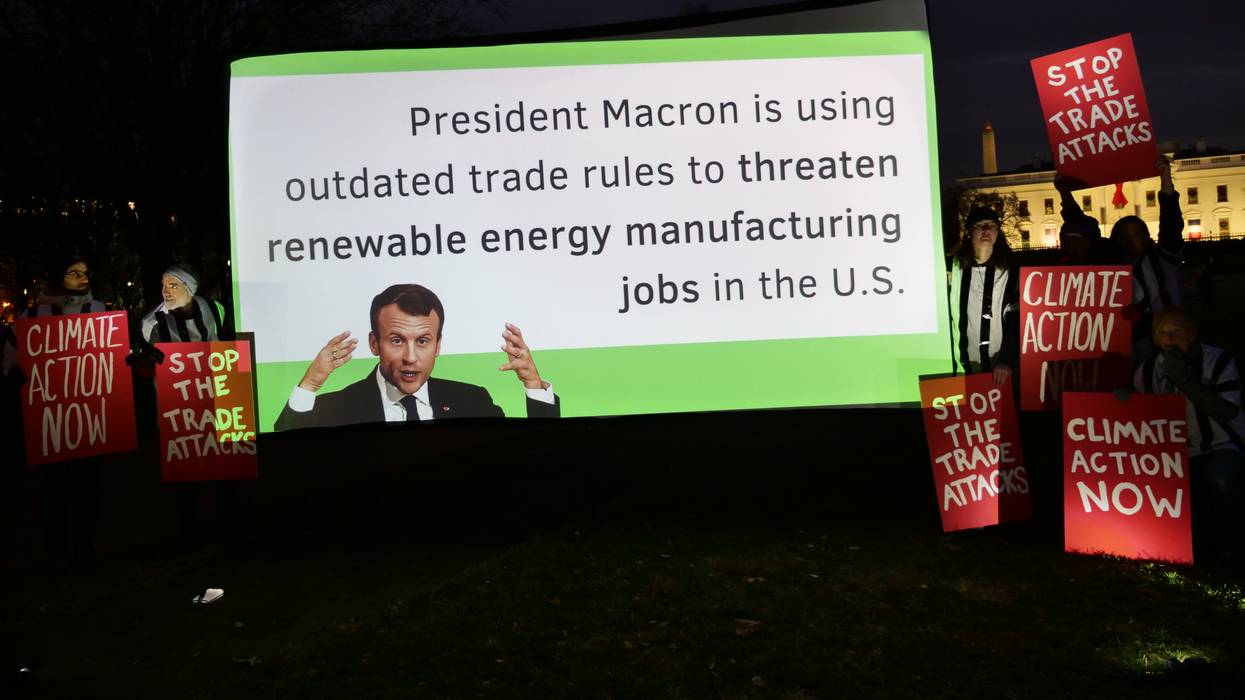
Environmental campaigners implored French President Emmanuel Macron to stop inhibiting sorely needed climate action by weaponizing global trade rules during a Thursday night protest outside the White House, where U.S. President Joe Biden hosted Macron for the first state visit of his tenure.
"We simply do not have time for governments to continue using outdated trade agreements to attack and undermine climate action."
In a nod to the ongoing World Cup, activists donning referee outfits and red cards called on Macron to stop threatening to launch a trade dispute against domestic electric vehicle manufacturing incentives, renewable energy tax credits, and other green provisions in the Inflation Reduction Act (IRA) passed earlier this year by the U.S. Congress.
"Macron claims France is a climate leader, but his vocal critique of the Inflation Reduction Act's climate measures deserves a penalty for hypocrisy," Public Citizen's Global Trade Watch tweeted.
Melinda St. Louis, the group's director, added: "Activists braved the cold to issue the 'red card' for Macron's threats to U.S. climate law on behalf of European business interests."
"President Macron clearly cares about climate change, so he and other European leaders should drop all the complaints about the IRA and threats to launch a trade challenge against it," St. Louis said in a statement. "Governments should be empowered to fight climate change and support the clean energy transition without fear of being undermined by antiquated trade rules."
As Politico reported, Macron has "bristled against tax incentives for clean energy included in the Inflation Reduction Act--a move that European leaders fear could cause sectors of their own economies to shift operations to the United States."
According to the news outlet: "On Thursday, Biden made 'no apologies' for the legislation but acknowledged 'glitches' in the bill, declaring the U.S. 'never intended to exclude' allies who were cooperating with Washington. He also suggested there were 'tweaks we can make' to satisfy allies."
The rally outside the White House comes as progressive advocacy groups escalate their demands to prioritize climate action over corporate-friendly trade rules ahead of next week's U.S.-E.U. Trade and Technology Council (TTC) talks in Maryland.
In an analysis published Thursday, the Trade Justice Education Fund and the Sierra Club made the case for the urgent adoption of a "climate peace clause," which they defined as a "commitment from governments to refrain from using dispute settlement mechanisms in international trade agreements to challenge other countries' climate mitigation and/or clean energy transition measures."
"In the face of increasing use of trade pacts to challenge climate policies," the groups explained, "a climate peace clause would help governments safeguard existing climate mitigation and transition measures by protecting them from trade challenges and incentivize and offer countries time to work together and resolve conflicts between trade agreements and the imperative for climate action."
Hebah Kassam, director of the Sierra Club's Living Economy program, noted that the world "is not on track to reduce emissions at the scale needed to avoid irreversible damage to communities and ecosystems."
"Governments must have and use every tool in the toolbox to ratchet up climate ambition, and we simply do not have time for governments to continue using outdated trade agreements to attack and undermine climate action," said Kassam. "We are calling on the U.S. to propose a climate peace clause in the TTC negotiations to end trade attacks on climate policies such as initiatives to create green jobs and healthier communities."
"A climate peace clause is a commonsense step the U.S. and E.U. can take right now to show leadership both on trade and on climate."
According to Trade Justice Education Fund executive director Arthur Stamoulis, "Language similar to a climate peace clause had been included in TTC text leaked earlier this year, but was later reported to have been removed."
"As two trusted trading partners committed to tackling climate change, a climate peace clause is a commonsense step the U.S. and E.U. can take right now to show leadership both on trade and on climate," said Stamoulis. "We urge the U.S. to make good on its promise to create a worker- and climate-friendly model of trade and to propose and adopt a climate peace clause in the TTC."
Also on Thursday, the Transatlantic Consumer Dialogue, which represents more than 70 consumer advocacy organizations on both sides of the Atlantic, released a statement that said, in part, "If the U.S. and E.U. are serious about making trade more sustainable, they must first ensure that trade challenges do not undermine domestic climate policies needed to support the green transition of our economies."
The coalition called on the European Union and Washington to "find a solution to avoid a trade dispute around the U.S. Inflation Reduction Act that would weaken the new climate policy."
North American production requirements were key to securing the political support needed to pass the IRA, but as the Trade Justice Education Fund and the Sierra Club's new research details, progress on creating green jobs and slashing planet-heating pollution remains at risk of being derailed by Investor-State Dispute Settlement complaints and other objections lodged at neoliberal trade institutions.
To take just two examples of recent World Trade Organization (WTO) state-to-state cases mentioned in the paper, the U.S. successfully challenged India's program subsidizing local solar production in 2017. Two years later, India successfully challenged clean energy programs in eight U.S. states that included "buy-local" rules.
The Trade Justice Education Fund, the Sierra Club, and Public Citizen held a webinar last month documenting how corporate-managed trade agreements are impeding climate action. Recent actions follow a May letter in which more than 150 U.S.-based organizations urged the Biden administration to support a climate peace clause.
On the heels of the recent global summit in Paris to tackle climate disruption, the World Trade Organization (WTO) has ruled against an important piece of the climate solution puzzle: India's ambitious program to create homegrown solar energy. The ruling shows decades-old, over-reaching trade rules are out of sync with the global challenge of transitioning to 100 percent clean energy.
In just five years, thanks to India's National Solar Mission, India has gone from having virtually no solar capacity to boasting one of the world's fastest-growing solar industries. In just the last year, a parade of leading solar companies has announced plans to establish new factories in India to produce solar cells, the parts of solar panels that use sunlight to produce electricity. India has named the solar program as a core component of its contribution to the Paris agreement to tackle climate change.
But on Wednesday, the WTO released its ruling against India's National Solar Mission, deciding that India's efforts to boost local production of solar cells violated WTO rules. Though India argued that the program helps the country to meet its climate commitments under the United Nations Framework Convention on Climate Change (UNFCCC), the WTO rejected that argument. Indeed, the ruling boldly states that domestic policies seen as violating WTO rules cannot be justified on the basis that they fulfill UNFCCC or other international climate commitments. In effect, the WTO has officially asserted that antiquated trade rules trump climate imperatives.
To understand the importance of this case, you must first understand the progress the Indian government has made in deploying solar energy. In the five years since India announced its national solar program, the country has grown its solar capacity from nearly nothing to commissioning nearly 5,000 megawatts, as a result of government subsidies and long-term contracts. As we've noted before, this solar expansion has been timely, as the troubled Indian coal industry has been unable to expand to meet power demand. The program aims to reduce the cost of solar energy and achieve 100,000 megawatts of solar power capacity by 2022 - more than the current solar capacity of the world's top five solar-producing countries combined.
India also plans to use the solar program to establish "a leadership role in low-cost, high-quality solar manufacturing." In January 2015, President Obama seemed to indicate support for that goal. After a visit with Indian Prime Minister Modi, the two leaders released a statement "emphasizing the critical importance of expanding clean energy research, development, manufacturing and deployment, which increases energy access and reduces greenhouse gas emissions." Their statement even declared, "the US intends to support India's [solar power] goal by enhancing cooperation on clean energy and climate change."
In 2014, however, the United States launched a WTO case against India's ambitious solar program. The United States claimed that the "buy-local" rules of the first phases of the program, which say that power companies must use solar components made in India in order to benefit from the government-subsidized program, discriminate against U.S. solar exports. In its ruling, the WTO agreed that India's buy-local rules "accord less favorable treatment" to imported solar components, even while acknowledging that "imported cells and modules currently have a dominant share of the market for solar cells and modules in India." India has indicated that it may alter its solar program to try to persuade the U.S. to drop the case. It is unclear whether the U.S. will accept the proposed changes, and what impact they may have on India's solar expansion plans.
Bringing this case is a perverse move for the United States. Nearly half of U.S. states have renewable energy programs that, like India's solar program, include "buy-local" rules that create local, green jobs and bring new solar entrepreneurs to the economy. The U.S. government should drop this case to avoid undermining jobs and climate protections not just in India, but also at home.
Every country should have the right to set its own clean energy future. "Buy local" rules -- a standard policy tool to foster, nurture, and grow new industries -- can help push us toward the goal of 100 percent clean energy that our planet needs by cultivating domestic renewable energy firms that promote strong climate policies. "Buy local" policies can also benefit workers and bring in new constituencies to advocate for increased clean energy production. And by bringing more renewable energy goods producers like India to the global market, "buy-local" policies can encourage greater competition and innovation, reducing the cost of renewable energy over time.
The WTO ruling against India's homegrown solar program echoes another WTO ruling in 2013 against "buy-local" provisions in a groundbreaking clean energy program in Ontario, which had successfully reduced climate-disrupting emissions while creating thousands of green jobs. Three weeks after the WTO's ruling, Ontario eliminated its "buy-local" provisions and ended incentives for large-scale clean energy projects.
Rather than reform this outdated model of trade that constrains climate progress, the Trans-Pacific Partnership (TPP), a trade pact between the U.S. and 11 other Pacific Rim nations that could come before Congress this year, would expand the model. Indeed, the text of the controversial deal replicates the very rules that the WTO used against India's solar program today. While many in Congress oppose the TPP, if the deal were to pass, we could see even more trade cases against clean energy initiatives.
Congress should view this ruling as further confirmation that a vote against the TPP is a vote for green jobs and climate action. You can take action now to protect job-creating clean energy programs by asking your member of Congress to vote no on the toxic TPP.
In an outcome described as an outrage and a blow for local green jobs, the World Trade Organization ruled Wednesday in favor of the United States in its challenge to India's rapidly growing solar energy program.
It marks "a step in the wrong direction, away from the climate progress that the global community committed to achieving in December's Paris climate agreement," according to Ilana Solomon, director of the Sierra Club's Responsible Trade Program.
The U.S. initiated its challenge to part of India's National Solar Mission in Feb. 2013. The problem, as the U.S. saw it, was part of India's National Solar Mission, requiring solar power developers to use solar cells and modules made in India rather than in the U.S. or another country. The WTO dispute settlement panel agreed with the U.S. that this locally-favoring requirement is "inconsistent" with and "not justified" by WTO rules.
India's solar mission also meant losses in profits for the United States. As the office of the U.S. trade representative stated following the ruling, "Since India enacted these domestic content requirements in 2011, U.S. solar exports to India have fallen by over 90 percent."
In addition, as Solomon and Ben Beachy, senior policy advisor with Sierra Club's Responsible Trade Program, write,
Though India argued that the program helps the country to meet its climate commitments under the United Nations Framework Convention on Climate Change (UNFCCC), the WTO rejected that argument. Indeed, the ruling boldly states that domestic policies seen as violating WTO rules cannot be justified on the basis that they fulfill UNFCCC or other international climate commitments. In effect, the WTO has officially asserted that antiquated trade rules trump climate imperatives.
The ruling sparked a similar reaction from Bill Waren, senior trade analyst at Friends of the Earth. "The government of India reasonably provided some preferences for local solar energy producers to convert from a carbon economy to a green economy. The WTO decision, finding India's solar energy program a violation of international trade law, is an outrage. Trade law trumps the Paris climate accord," he stated.
For its part, the Obama administration welcomed the WTO decision as a "victory" and said it sent a warning shot.
"This is an important outcome, not just as it applies to this case, but for the message it sends to other countries considering discriminatory 'localization' policies," U.S. Trade Representative Michael Froman said in a statement.
Froman and environmental groups agree that the ruling is of particular importance in light of the Trans-Pacific Partnership (TPP) trade pact, which President Obama is pushing Congress to approve.
"This win underscores not just how aggressive and successful the Obama Administration has been in terms of enforcing our current trade agreements, but also the resolve with which we will enforce the high standards negotiated in TPP, whether it's with regard to labor, intellectual property rights or the environment," Froman stated.
However, the Sierra Club says that the WTO decision should warn lawmakers to reject the TPP.
"Indeed," Beachy and Solomon write, "the text of the controversial deal replicates the rules that the WTO used against India's solar program today. While many in Congress oppose the TPP, we could see even more trade cases against clean energy initiatives if the deal were to pass. Congress should view this ruling as further confirmation that a vote against the TPP is a vote for green jobs and climate action."
The Calcutta Telegraph reports that India will likely appeal the ruling, which it has 60 days to do.
Corporate media failed to cover the dangers of business-friendly trade deals in 2015, despite growing grassroots opposition to such pacts--and increasing public awareness about their contents.
Will 2016 be the year looming toxic trade policies catapult into the mainstream? Sierra Club trade representative Ilana Solomon hopes so.
"If we continue this work and build our movement we will build a new model of trade that puts the interests of communities and the environment before the interests of multinational corporations," Solomon wrote this month.
"Our short-term work is to stop harmful trade agreements," she said. "Our long-term work is to continue to build our movement so strong and fierce that it becomes unthinkable for governments to allow trade rules to undermine environmental and public interest policies because the backlash would be too severe."
Here are the deals you need to know to be part of the fight in the coming year:
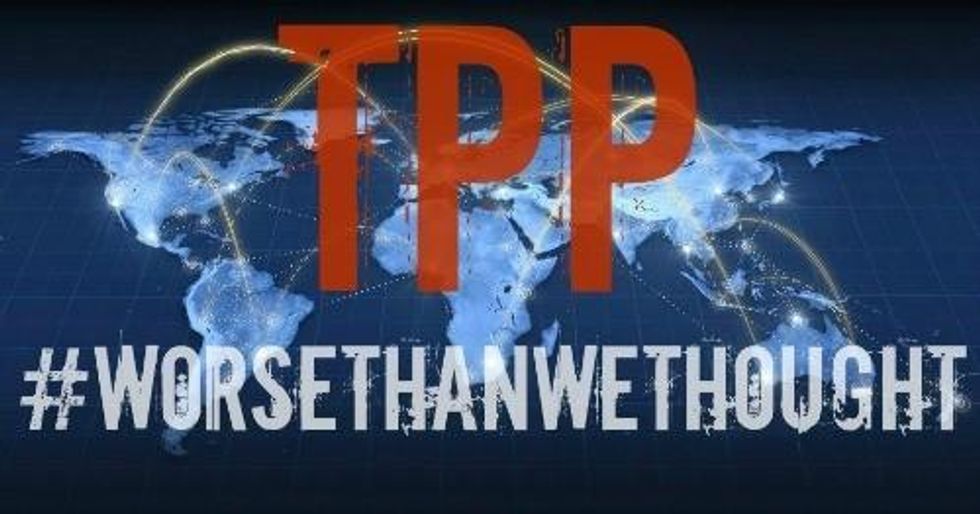
It was a "great day for corporate America" when the U.S. Senate passed Fast Track, or Trade Promotion Authority (TPA), in June, effectively surrendering legislators' ability to fully debate or even amend trade agreements like the TPP that have been negotiated entirely in secret. And when the text of the deal was finally released this fall, it confirmed the worst fears of environmentalists, public health advocates, and digital rights activists: the TPP, they said, was "worse than anything we could've imagined."
Thanks to Fast Track, President Barack Obama will be able to unilaterally sign the TPP for the U.S. after February 4, 2016. But it's not a done deal yet.
As Electronic Frontier Foundation's Maira Sutton explained earlier this month:
Both congressional houses must ratify the agreement in the form of approving "implementing legislation" that the White House will submit to lawmakers. This submission will happen after the President's signature, likely sometime in April or May. Once that happens, the House has 60 days from the bill's introduction to hold a vote on it and the Senate gets another 30 days, so 90 days in total, to approve or reject it. Since this second timeline only begins when the White House decides that they're ready for it, it all rests on whether the executive branch believes that it has the votes to get it through both houses. That's why it's critical that we call on our lawmakers to come out against this agreement: because that's how we can stop it.
"If we want to ensure that laws don't just uphold powerful private interests, but are designed and implemented with the public's best interests in mind," Sutton wrote, "then we must stop the TPP--for the sake of the Internet, our rights, and our future."
And the 2016 elections could prove helpful to those who oppose the corporate-friendly pact. The Japan Times reported Thursday that the pact "looks increasingly unlikely to be implemented before U.S. President Barack Obama's tenure ends due to opposition among leading presidential candidates and some industries."
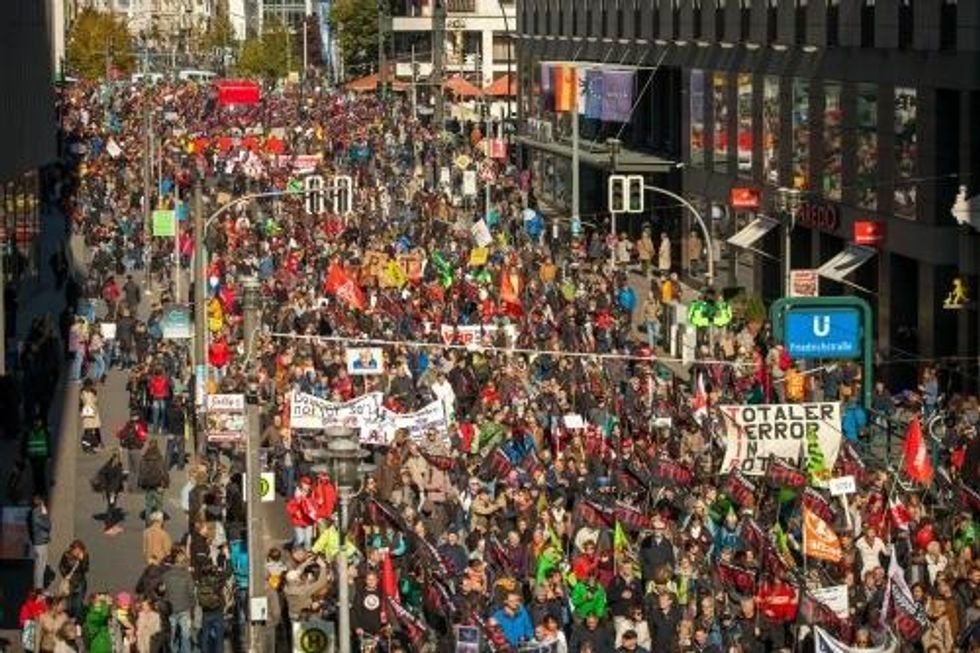
October saw hundreds of thousands of Europeans pour into the streets of Brussels to voice their opposition to the TTIP, which would cover more than 40 percent of global GDP. And push back against the so-called trade deal, which would have negative implications for everything from human rights and global climate goals to democracy and food safety, goes much deeper than that. As of October, more than three million people had signed a petition demanding an end to the TTIP negotiations--showing, as Global Justice Now director Nick Dearden said, "that the EU does not have the public mandate to continue this deal."
Indeed, there appears to be brewing discontent across the continent, with the president of the German Bundestag, or parliament, in late-October threatening to vote against the TTIP due to its lack of transparency and democratic legitimacy. That statement came on the heels of remarks made by a French trade minister in September, who said "France is considering all options including an outright termination of negotiations" due to TTIP talks appearing to favor American interests.
As American Prospect co-founder and editor Robert Kuttner posited in an op-ed earlier this year, both the TTIP and TPP could be "on the verge of collapse from their own contradictory goals and incoherent logic."
TISA may be the least well-known of the so-called Big Three "strategic neoliberal trade deals being advanced by the Obama administration," as WikiLeaks puts it--but its dangers loom just as large.
Leaks in 2015 exposed how the pact "favors privatization over public services, limits governmental action on issues ranging from safety to the environment using trade as a smokescreen to limit citizen rights," Larry Cohen, president of Communications Workers of America, said in June. Our World is Not For Sale, a group that has been working against TISA since 2013, described the deal in July as "a developed countries' corporate wish lists for services which seeks to bypass resistance from the global South to this agenda inside the WTO, and to secure an agreement on services without confronting the continued inequities on agriculture, intellectual property, cotton subsidies, and many other issues."
In 2016, we can only hope that people power will pressure more countries to follow the lead of Uruguay, which in September decided to end its involvement in TISA negotiations. In doing so, Friends of the Earth activists Viviana Barreto and Sam Cossar-Gilbert wrote at Common Dreams, "Uruguay has created a blueprint of how to beat these corporate-driven agreements. A strong coalition of trade unions, environmentalists and farmers working together on an effective public campaign were able to take on the interests of the world's biggest companies and win."
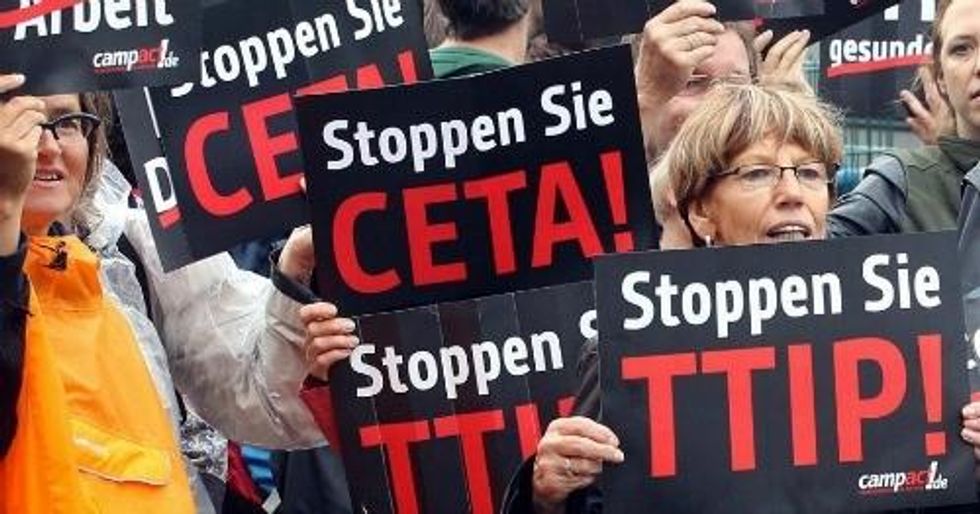
"What's exciting about CETA," Council of Canadians trade campaigner Sujata Dey wrote earlier this month, "is that Europeans actually have the power to defeat it."
As Common Dreams reported in October, the Canada-EU deal would create "a parallel legal system for corporations" that could make "regulations in sensitive public service sectors such as education, water, health, social welfare, and pensions prone to all kinds of investor attacks."
"What is at stake in trade agreements such as TTIP and CETA is our right to vital services, and more, it is about our ability to steer services of all kinds to the benefit of society at large," the Brussels-based Corporate Europe Observatory declared at the time. "If left to their own course, trade negotiations will eventually make it impossible to implement decisions for the common good."
According to Council of Canadians, it is expected that CETA will go before the European Parliament for ratification votes either in late 2016 or early 2017. Prime Minister Justin Trudeau has already instructed trade minister Chrystia Freeland "to implement" CETA.
On May 8th at Nike's headquarters, President Obama denounced opponents of the hotly contested Trans-Pacific Partnership as ill informed. "(C)ritics warn that parts of this deal would undermine American regulation....They're making this stuff up. This is just not true. No trade agreement is going to force us to change our laws."
On May 8th at Nike's headquarters, President Obama denounced opponents of the hotly contested Trans-Pacific Partnership as ill informed. "(C)ritics warn that parts of this deal would undermine American regulation....They're making this stuff up. This is just not true. No trade agreement is going to force us to change our laws."
On May 18th the World Trade Organization (WTO) issued a final ruling in favor of Canada and Mexico in a case involving a US law requiring country-of-origin labels on packages of beef, pork, chicken and other kinds of meat. The WTO three judge panel estimated economic damages of more than $3 billion. These will be meted out by Canada and Mexico as retaliatory tariffs on a potentially wide array of U.S. industries, from "California wines to Minnesota mattresses," as Gerry Ritz, Canada's Minister of Agriculture predicted.
"The only way for the United States to avoid billions in immediate retaliation is to repeal COOL," Ritz announced.
Congress hastened to comply. The day the WTO issued its ruling Rep. Michael Conway (R-TX) introduced legislation to overturn the COOL law. On June 10th the House overwhelmingly passed the bill, 300-131.
The COOL decision and its almost immediate legislative impact demonstrated in real time the inaccuracy of President Obama's comments. Encompassing 12 Pacific Rim countries with 40 percent of the world's economy the Trans-Pacific Partnership would be the largest trade agreement since the WTO was formed in 1995. But to call it a trade agreement is both accurate and misleading for it conjures up images of agreements that largely target tariffs. That is no longer the case. Of TPP's 29 draft chapters, only five deal with traditional trade issues.
Modern trade agreements have less to do with trade than with sovereignty. The primary focus of modern trade agreements is the elimination of existing national and subnational laws that regulate commerce.
The decision about whether a country can force the livestock industry to reveal where their animals were reared and slaughtered is behind us. Currently under consideration by the WTO is whether a country can force businesses that sell a lethal product to make the packaging of that product unattractive.
The product is tobacco. Before the 1990s the US government actively assisted American tobacco in opening up markets in Asia by threatening trade fights with countries like Japan, Thailand, Taiwan and South Korea that refused to overturn domestic laws impeding companies from using sophisticated marketing techniques.
In the 1970s and 1980s, as evidence of the malignant effects of tobacco accumulated states and cities began to enact anti-smoking initiatives. In the 1990's lawsuits by states resulted in a $200 billion settlement with tobacco companies and the discovery of concrete evidence that they had willfully kept from the American public the evidence that smoking can and in many cases does cripple or kill.
The increasingly schizophrenic nature of US tobacco policies led the GAO to issue a report aptly titled: Dichotomy Between U.S. Tobacco Export Policy and Antismoking Initiatives. The GAO asked lawmakers to clarify which values would guide their decision-making. "If the Congress believes that trade concerns should predominate, then it should do nothing to alter the current trade policy process. The U.S. government can simultaneously continue to actively help U.S. cigarette exporters overcome foreign trade barriers and promote awareness of the dangers of smoking and further restrict the circumstances in which smoking may take place," it advised. "If Congress believes that health considerations should have primacy, the Congress could grant the Department of Health and Human Services the responsibility to decide whether to pursue trade initiatives involving products with substantial adverse health consequences."
At the end of his term President Bill Clinton issued an executive order forbidding the US government to advocate on tobacco's behalf.
But by that time we had given birth to a new planetary organization, the WTO and new trade rules that for the first time allowed corporations to sue countries directly for damages caused by regulations. Adding insult to injury their suit would be heard in a new extra territorial judicial system comprised largely of judges who has been trade lawyers often representing corporations similar to those who would come before them.
In this new judicial system largely designed by corporations there is no conflict of interest. Indeed, the head of the three judge WTO panel the decided the COOL case had served as Mexico's deputy General Counsel for Trade Negotiations for a decade and had acted as Mexico's lead counsel in several WTO disputes.
As countries began to follow the lead of the United States and enact significant restrictions on tobacco products the tobacco companies repeatedly sued under this new judicial system, claiming economic damages for the violation of their copyrights, the diminishing value of their brand name and the expropriation of their intellectual property.
Sometimes tobacco companies sue countries directly, as in the case of Uruguay and Australia. Sometimes they do so indirectly by paying some or all of the legal costs of suits brought by countries like Honduras, Indonesia, Dominican Republic and Cuba.
In May 2014 the WTO appointed a panel to review the many tobacco product-related lawsuits. It expects to issue a final ruling during the second half of 2016.
Given the sordid history of tobacco companies abusing their newly gained ability to sue governments directly President Obama initially was not going to allow that ability to be expanded to 12 additional countries through the TPP. In September 2013 the Washington Post editorialized, "Initially the Obama administration favored a TPP provision exempting individual nations' tobacco regulations...from legal attack as 'non-tariff barriers' to the free flow of goods. The idea was that, when it comes to controlling a uniquely dangerous product, there's no such thing as 'protectionism'."
But Obama later backtracked and the TPP will simply require governments to consult before challenging each other's tobacco rules and still allows tobacco companies to mount legal challenges.
So far the tobacco lawsuits have not targeted the United State, but that could change. Thomas Bollyky, a former US trade negotiator, observes, "U.S. federal, state, and local laws include many of the same regulations that the tobacco industry has challenged in Uruguay, Norway, and elsewhere."
One of the most pernicious effects of the new trade rules is that they allow giant corporations to cow countries with a limited capacity to defend themselves. As John Oliver informs us, in 2014 Philip Morris International sent a letter to Togo threatening that tiny country with "an incalculable amount of international trade litigation" if it implemented a tobacco product packaging law. Togo abandoned the initiative. Uruguay has been able to defend itself for the last 5 years in part because of financial assistance from the World Health Organization and former New York City Mayor Michael Bloomberg.
Would a US city or small state be financially able to defend itself if a global corporation were to sue to overturn laws that require government contracts to favor local businesses and local workers?
The contents of new trade agreements like the TPP largely comprise a laundry list of corporate aspirations.
To understand its bias we might engage in a thought exercise. What if a trade agreement were designed to protect and nurture labor rather than capital? Several U.S. trade agreements have included "side agreements" on labor but these lack the enforcement mechanisms accorded to capital. There is no extraterritorial judicial system to hear suits by workers or unions. Instead these agreements establish a multi-national forum where nations can be held responsible for not enforcing labor laws they have on the books. As the Heritage Foundation concludes, "they are largely meaningless."
At present the International Labor Organization's (ILO) 186 member nations have signed a Declaration on Fundamental Principles and Rights at Work that, according to the ILO "commits Member States to respect and promote principles and rights in four categories, whether or not they have ratified the relevant Conventions. These categories are: freedom of association and the effective recognition of the right to collective bargaining, the elimination of forced or compulsory labour, the abolition of child labour and the elimination of discrimination in respect of employment and occupation."
But the ILO's Declaration, like the labor side agreements of US trade agreements lack an enforcement mechanism. Member nations can refuse to ratify any individual standard. Of the eight core conventions, the U.S. for example has ratified only two. It should go without saying that neither workers nor unions have the right to sue for economic damages in a world court comprised of judges who had formerly served as labor lawyers.
If the TPP's enforcement mechanisms were as toothless as those of labor side agreements or the ILO Declaration there would be no need for fast track. If the labor side agreements or the ILO Declaration had enforcement mechanisms as vigorous as those of the TPP I daresay the vote on fast track would be lopsidedly against.
The clear and present evidence of the far-reaching negative impact of the TPP is compelling. Rather than being forced to have an up or down vote on a bill consisting of thousands of pages of fine print after only a very limited debate and with no amendments, we should engage in a spirited national conversation about the values that should guide international trade agreements and what type of enforcement mechanisms would best serve the public interest.