

SUBSCRIBE TO OUR FREE NEWSLETTER
Daily news & progressive opinion—funded by the people, not the corporations—delivered straight to your inbox.
5
#000000
#FFFFFF
To donate by check, phone, or other method, see our More Ways to Give page.
Daily news & progressive opinion—funded by the people, not the corporations—delivered straight to your inbox.
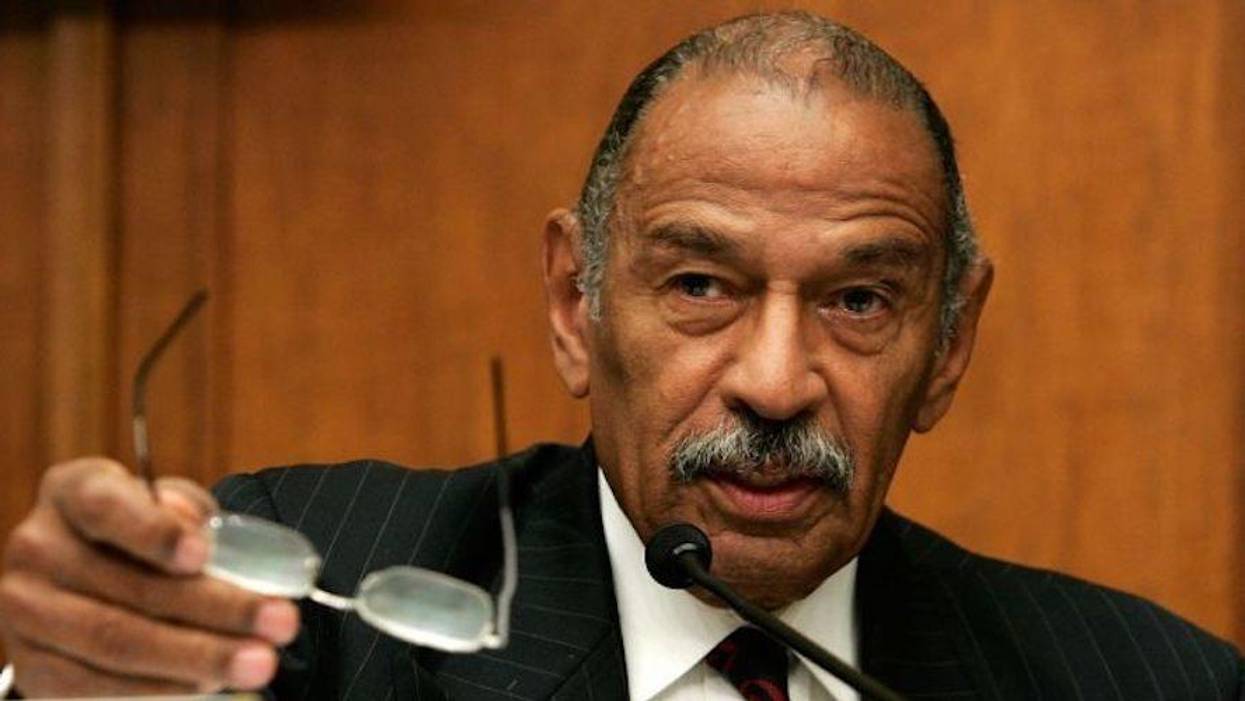
Former Rep. John Conyers, whose 53 years in Congress were spent advocating for civil rights causes, died Sunday at 90.
"He never once wavered in fighting for jobs, justice and peace," Rep. Rashida Tlaib (D-Mich.), who was elected to Conyers' seat in 2018, said on Twitter. "We always knew where he stood on issues of equality and civil rights in the fight for the people."
Tlaib repeated the sentiment during a rally with Sen. Bernie Sanders (I-Vt.).
Conyers began his decades in Congress in 1965 and served in the lower chamber until resigning in 2017 after a series of sexual harassment allegations were made public. The congressman denied the accusations.
"My legacy can't be compromised or diminished in any way by what we're going through now," Conyers told radio host Mildred Gaddis at the time. "This too shall pass."
His long career included founding the Congressional Black Caucus and serving as the chairman of the House Judiciary Committee from 2007 to 2011.
According to CNN:
In 1983, Conyers introduced the original bill to make Martin Luther King Jr. Day a federal holiday and in 1994 worked on the Violence against Women Act. He became the first African American to serve as Chair of the House Judiciary Committee in 2007.
"From co-founding the Congressional Black Caucus to leading the fight in Congress to enshrine Martin Luther King's birthday as a national holiday, John Conyers' impact on our city and nation will never be forgotten," Detroit Mayor Mike Duggan said in a statement.
At the rally on Sunday evening with Tlaib, Sanders remembered Conyers.
"Thank you very much John, for all you've done for this country," said Sanders.
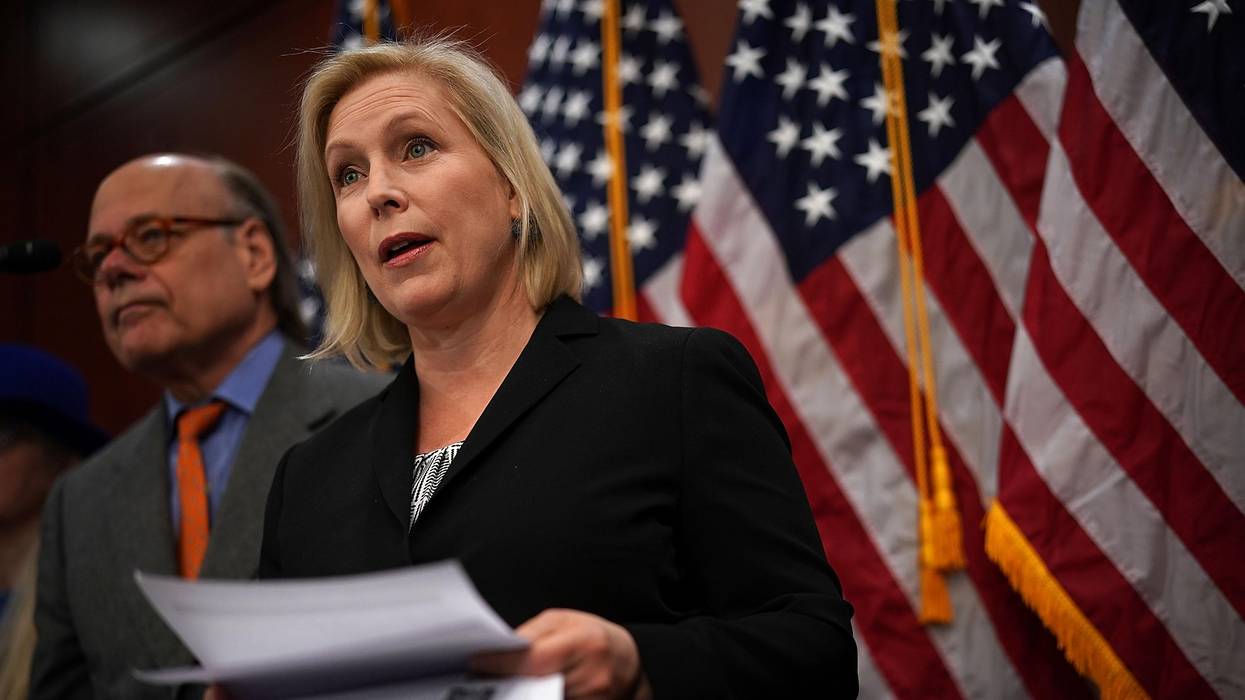
Sen. Kirsten Gillibrand (D-N.Y.) quickly fired back at President Donald Trump on Tuesday after he posted a crude tweet about her, attacking the lawmaker amid calls for Congress to investigate the president's history of sexual harassment and assault and her suggestion that he resign.
With as many as 19 separate allegations aimed at the president, Gillibrand has been leading the charge in the Senate against Trump and recently called for his resignation.
In his tweet Tuesday morning, Trump lashed out by calling the senator a "lightweight" and then suggested that Gillibrand "would do anything for" his donations before he ran for office.
After responding on social media, the senator held a press conference, calling Trump's tweet a "sexist smear."
Gillibrand has become a leading voice in calls to hold Trump accountable for his sexual misconduct--including behavior that he openly admitted to in an audio recording that was circulated during the 2016 campaign--just as Democratic lawmakers Rep. John Conyers (D-Mich.) and Sen. Al Franken (D-Minn.) have been called to account for allegations against them.
The #TrumpToo movement has taken off in recent days, weeks after the #MeToo social media campaign flooded Facebook and Twitter feeds. Supporters want Congress and the Justice Department to open an inquiry into reports that Trump grabbed, forcibly kissed, and harassed women at various times during his career.
As of Tuesday, 277,845 people had signed a MoveOn.org petition calling for an investigation.
Trump has denied the allegations, despite his statement last year that the audio recording in which he bragged about sexually assaulting a woman, was authentic. White House Press Secretary Sarah Huckabee Sanders said Monday that the allegations took place "long before he was elected president" while also claiming they were untrue.
Speaking to reporters, Sen. Mazie Hirono (D-Hawaii) strongly condemned the president's remarks about Gillibrand, saying, "He's a misogynist and admitted sexual predator and a liar. The only thing that will stop him from attacking us, because nobody is safe, is his resignation."
On social media, Trump critics and supporters of #TrumpToo also jumped to Gillibrand's defense and expressed shock at his comments about the senator, which many said qualified as a new incident of sexual harassment.
To be clear: Trump sexually harassed Gillibrand in his tweet by strongly implying she'd have sex for campaign contributions.
-- Pe Resists (@4everNeverTrump) December 12, 2017
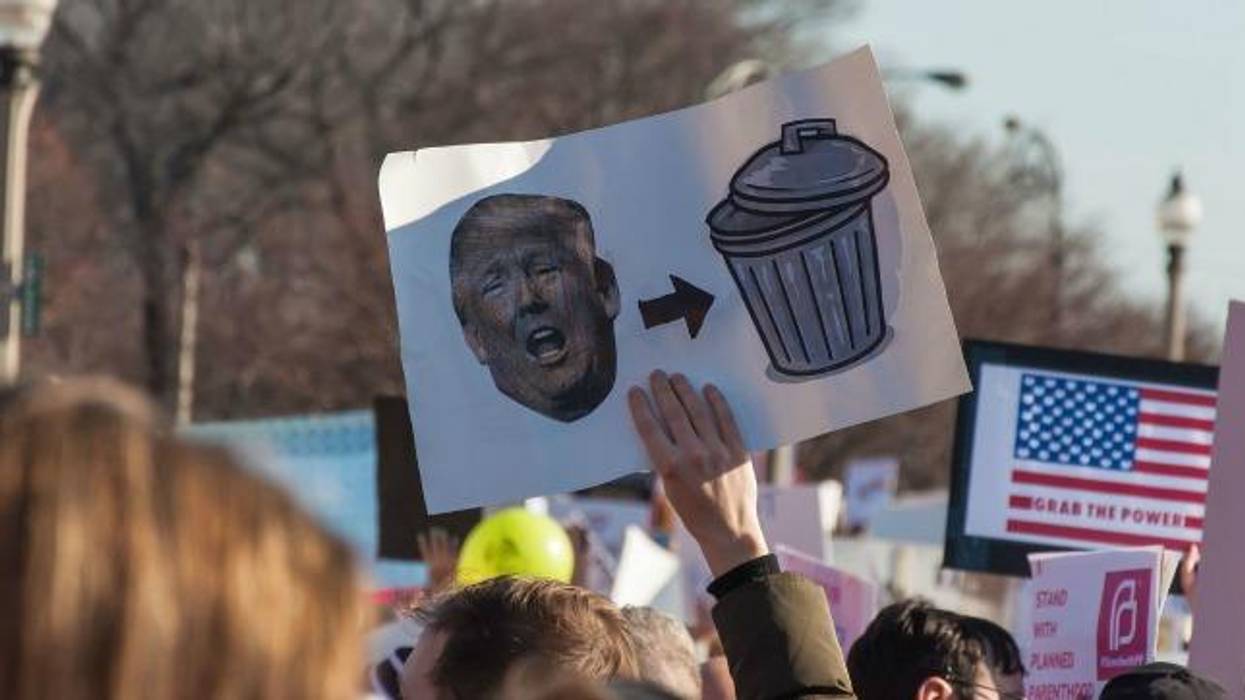
The #TrumpToo movement, which is demanding accountability for President Donald Trump's history of alleged sexual harassment and assault, is gaining more steam this week after the resignations of Democratic lawmakers Al Franken and John Conyers.
A MoveOn.org petition calling for a Congressional and Justice Department investigation into the claims against the president gathered over 150,000 signatures in a week, the group said. As of this writing, it has 161,405 signatures.
"Twenty women have come forward with allegations of sexual harassment or assault against Donald Trump," the MoveOn petition, started by member Susan O'Connor, states. "As the nation grapples with allegations against Roy Moore, Senator Al Franken, and Representative John Conyers, it's past time for Congress and the Department of Justice to formally investigate these allegations against Trump."
A Quinnipiac poll released this week reveals strong support for such a call, finding that 70 percent of Americans would back a congressional inquiry into the numerous allegations.
Conyers and Franken faced multiple allegations of sexual misconduct and calls within their own party to resign. Conyers did so on Tuesday while Franken announced his resignation Thursday.
Speaking on the Senate floor, Franken said, "I of all people am aware that there is some irony in the fact that I am leaving while a man who has bragged on tape about his history of sexual assault sits in the Oval Office and a man who has repeatedly preyed on young girls campaigns for the Senate with the full support of his party," referring to Trump-backed Alabama Senate candidate Moore.
Franken's resignation, said progressive advocacy group CREDO, is not "enough to root out sexual harassment and assault in the federal government." The group pointed to its petition calling for congressional investigations into sexual assault allegations against any federal official, starting with Trump.
The petition, which so far has 182,501 signatures, states that "right now, the momentum for holding powerful men accountable for using their power to harass, assault, and discriminate against women is on our side."
Writing at Rolling Stone, David S. Cohen comments on this "unique moment in modern history" as well. "Remarkably, however, the highest-profile person in the nation, whose treatment of women is notably checkered, has largely escaped this current round of scrutiny. That has to change now. President Trump has to be put under this newly glaring spotlight," he writes.
The Nation's Joan Walsh also made the case this week, writing that "Franken's departure [should] be not just another #MeToo moment but a long-delayed #TrumpToo moment."

While much of the nation looked on in horror as President Donald Trump delivered a speech ripped "out of a psychopathology textbook" on Tuesday night in Arizona, Sen. Bernie Sanders (I-Vt.) and Rep. John Conyers (D-Mich.) headlined a town hall-style event in Detroit, Michigan on racial and economic justice that served as a marked contrast to Trump's "unhinged" performance.
"I want Democrats to be the party not of corporate interests, but of the working class."
--Sen. Bernie SandersBefore Sanders approached the podium, Rev. Wendell Anthony of the Detroit Fellowship Chapel Church delivered a remarkable introduction that was quickly spread on social media.
Sanders is "trying to take down the tributes to racism and division" while also "trying to stand up for universal healthcare, stand up for jobs for everybody, stand up for income equality, stand up for tuition-free education, stand up for fair treatment and respect from law enforcement across the nation," Anthony said.
"If you spent two minutes watching Trump tonight, spend two watching this," a pro-Sanders group wrote on Twitter, referring to Anthony's speech.
Watch:
Speaking to an audience of more than 2,000 people, Conyers and Sanders slammed Trump while also outlining a positive vision, one that included Medicare for All, a higher federal minimum wage, and full employment.
Pointing to Trump's insistence that "many sides" were to blame for the deadly violence in Charlottesville, Virginia, Sanders said: "We have a president who was equivocal--nice people on both sides! No! There are no nice Nazis!"
Watch:
Sanders--who, according to a new poll, would handily defeat Trump in a hypothetical 2020 match-up--went on to express the urgent need to fundamentally alter America's for-profit healthcare status quo.
"If every other major country guarantees healthcare to every man, woman, and child in their nations, by God we can do it in the United States," Sanders said.
Conyers added to Sanders's Medicare for All pitch a call for full employment. A decent-paying job, Conyers said, should be a "fundamental" right in the wealthiest nation on earth.
"We need jobs, justice, and peace," Conyers said. "We need political justice and economic justice."
"We need jobs, justice, and peace. We need political justice and economic justice."
--Rep. John ConyersConyers and Sanders have both introduced ambitious legislation taking aim at America's healthcare crisis and, more recently, youth unemployment.
"Youth unemployment is one of the great crises facing our country, impacting millions of young people and their families, but it is one we rarely discuss in Washington," Sanders wrote shortly after introducing the Employ Young Americans Now Act. Conyers introduced the same bill in the House of Representatives.
Sanders ended the Detroit town hall by acknowledging that while "there are divisions in this country on a number of issues," most Americans are united in their desire for a government that works for the public good, not for the interests of the wealthy.
"I want Democrats to be the party not of corporate interests, but of the working class," Sanders said. "On major issue after major issue, the American people are united in wanting a government that represents all of us and not the one percent."

As popular support for single-payer continues to grow and Sen. Bernie Sanders (I-Vt.) prepares to introduce Medicare for All legislation, the Establishment wing of the Democratic Party is reportedly "alarmed" by the shifting dynamics and fearful "of primary election challenges" if they don't support Sanders's proposal.
"It's a litmus test. It's a clarifying issue like none I've ever seen. We're talking about people's lives and health and money."
-- RoseAnn DeMoro, National Nurses United
"Democrats who don't get behind it could find themselves on the wrong side of the most energetic wing of the party," Politico reported Monday.
Political organizers and supporters of Sanders are already speaking out about how lawmakers' responses could impact upcoming elections.
"Any Democrat worth their salt that doesn't unequivocally say Medicare for All is the way to go? To me, there's something wrong with them," Nina Turner, president of Our Revolution--the political group that formed out of Sanders's presidential campaign--told Politico. "We're not going to accept no more hemming and hawing. No more game playing. Make your stand."
"Our view is that within the Democratic Party, this is fast-emerging as a litmus test," Ben Tulchin, the pollster for Sanders's presidential run, told Politico.
RoseAnn DeMoro, executive director of the Sanders-aligned National Nurses United union, agrees. "It's a litmus test," DeMoro told NBC News last month. "It's a clarifying issue like none I've ever seen. We're talking about people's lives and health and money."
Mounting public support of a Medicare for All national healthcare system could sway centrist Democrats, and perhaps even Senate Republicans, who are up for reelection in 2018 or 2020.
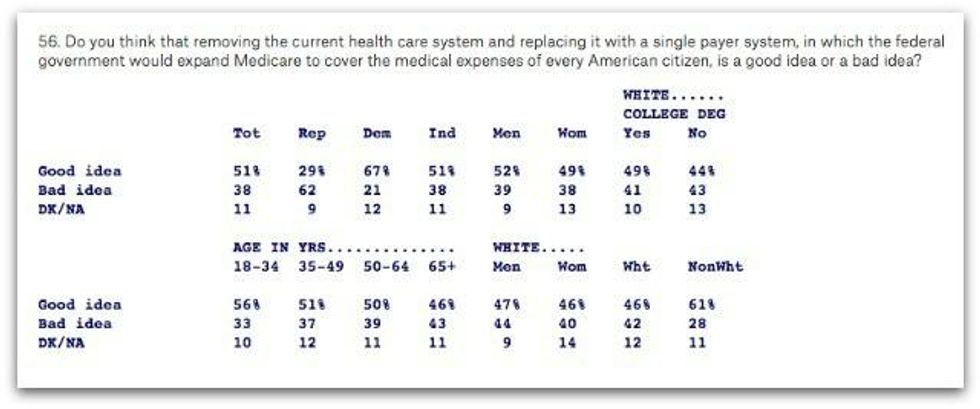
A national poll released by Quinnipiac last week found that a majority of American voters overall, and 67 percent of Democrats, believe that replacing the nation's current healthcare system with a single-payer system--"in which the federal government would expand Medicare to cover the medical expenses of every American citizen"--is a good idea.
Growing support for related legislation in the House also suggests that Democratic senators could be pressured by public opinion to support Sen. Sanders's proposal.
For more than a decade, Rep. John Conyers (D-Mich.) has consistently introduced House single-payer legislation, but his bill introduced earlier this year--"The Expanded And Improved Medicare For All Act" or H.R. 676 (pdf)--has received unprecedented support from House Democrats, with more than 100 of them signing on as co-sponsors.
Rep. Keith Ellison (D-Minn.), deputy chair of the Democratic National Committee, acknowledged how impactful a candidate's position on the Medicare for All issue can be on Congressional races in a May interview with the Huffington Post.
Although Rep. Ellison emphasized that the DNC won't tell candidates which positions to take on any issues, he also said: "I recommend that you win your election, and I think a good way to do it is to support the Conyers bill."
Looking toward the 2020 presidential race, Rep. Conyers told NBC News: "I don't know how many of the candidates will support Medicare for All.... But it's pretty obvious at this point that the winning one will."
Despite the efforts of lawmakers like Sen. Sanders and Rep. Conyers, as well as growing public support of Medicare for All, many establishment Democrats within and beyond Congress remain apprehensive about supporting it.
"In the name of political reality, some liberal pundits, politicians and policy wonks are scolding progressives to give up on Medicare for All," noted Michael Lightly, National Nurses United's director of public policy, in a Common Dreams op-ed on Tuesday.
Citing Paul Krugman's latest New York Times column warning against the push for Medicare for All, Lightly argues that "progressives are badly served" by such "shallow political advice," which "obscures the reality working people actually face, and undermines the fight for our values and program."
The program Lightly envisions aligns with the proposals of Sen. Sanders and Rep. Conyers: improving Medicare, and expanding it to all Americans, which, he writes, would establish a national system to "confront the industry, contain prices and restore the values of caring, compassion and community to our healthcare system."

"The time is long overdue for us to start investing in our young people and help them get the jobs and education they need to be part of our economy and our society," Sen. Bernie Sanders (I-Vt.) wrote in a Mic op-ed published on Tuesday.
"Youth unemployment is one of the great crises facing our country...but it is one we rarely discuss in Washington."
--Sen. Bernie Sanders
"Youth unemployment is one of the great crises facing our country, impacting millions of young people and their families, but it is one we rarely discuss in Washington," he added. Sen. Sanders used the article to explain a youth job bill (pdf) he is co-sponsoring with Rep. John Conyers (D-Mich.) and Rep. Eleanor Holmes Norton (D-D.C.).
"It is time for our country to honor our duty to those young people who are struggling to find work," said Rep. Conyers, when the legislation was announced. "Tackling youth unemployment isn't just good ethics. It's good economics. Putting our youth to work will not only avoid anxiety, poverty, and broken dreams for young people, but will also provide needed tax revenue and reduce the need for social services."
The proposed law would provide states and localities with $5.5 billion in immediate funding to employ a million American workers who are 16 to 24 years old, and support job training for hundreds of thousands more.
"These outrageously high rates of youth unemployment are not only unacceptable: They are having a tragic impact on our society."
--Sen. Sanders
A large portion of the funding--$4 billion--would be issued as grants to state and local governments, to provide low-income youth with summer and year-round employment opportunities, as well as necessary services such as child care and transporation. The remaining $1.5 billion in grants would be issued to employers, community colleges, and local organizations, to provide young workers with apprenticeship programs and on-the-job training.
Sen. Sanders's Mic op-ed pointed to data analyis from the Economic Policy Institute (EPI), which recently found that even as the economy improves, young workers still struggle with unemployment and underemployment. As EPI senior economist Elise Gould wrote in July:
Young workers, ages 16-24 years old, had an unemployment rate more than twice as high as prime-age (25-54 year old) workers (9.8 percent versus 4.0 percent) and nearly three times as high as older (55-64 year old) workers (3.3 percent).... More than 1-in-6 young workers are underemployed, more than twice the rate of prime-age workers (17.8 versus 8.0 percent). More than 1-in-4 young black workers (27.4 percent) and nearly 1-in-5 young Hispanic workers (19.0 percent) are underemployed.
"These outrageously high rates of youth unemployment are not only unacceptable: They are having a tragic impact on our society," Sen. Sanders wrote for Mic, emphasizing the importance of his proposed legislation. "The alternative is to allow the status quo to continue--to ignore the needs of these young people and others like them. When our young people cannot find jobs, housing or income within mainstream society, it is no secret as to what happens.... Today, we spend some $80 billion a year to lock up our fellow Americans instead of investing in our young people, and in jobs and education for them."
The troubling correlation between young Americans' employment struggles and mass incarceration is not a new issue for Sen. Sanders. While campaigning for president in October 2015, he outlined for a large crowd full of cheering young people how the two issues are connected.
"It makes a lot more sense to me that we invest in jobs and education, not in jails and incarceration," Sen. Sanders said in part of the 2015 speech captured by the New York Times.
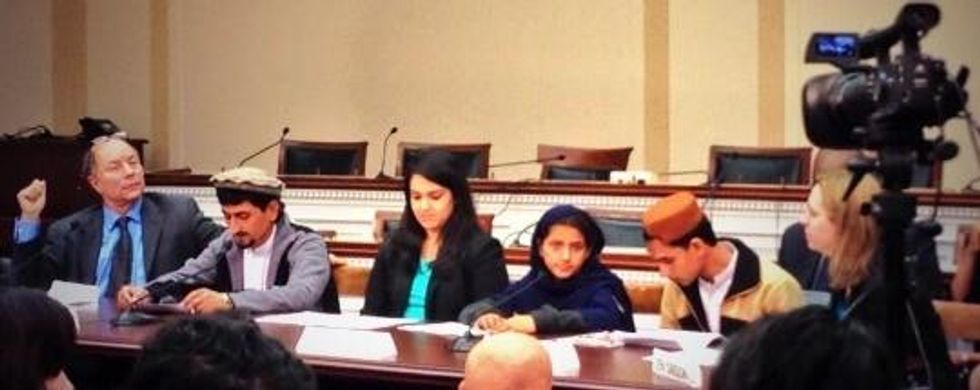
Despite being heralded as the first time in history that U.S. lawmakers would hear directly from the survivors of a U.S. drone strike, only five elected officials chose to attend the congressional briefing that took place Tuesday.
Pakistani schoolteacher Rafiq ur Rehman and his two children--9 year-old daughter Nabila and 13 year-old son Zubair--came to Washington, DC to give their account of a U.S. drone attack that killed Rafiq's mother, Momina Bibi, and injured the two children in the remote tribal region of North Waziristan last October.
According to journalist Anjali Kamat, who was present and tweeting live during the hearing, the only lawmakers to attend the briefing organized by Rep. Alan Grayson (D-Fla.), were Rep. John Conyers (D-Mich.), Rep. Jan Schakowsky (D-Ill.), Rep. Rush Holt (D-NJ) and Rep. Rick Nolan (D-Minn.).
Before the handful of reporters and scant lawmakers, however, Rafiq and his children gave dramatic testimony which reportedly caused the translator to break down into tears.
In her testimony, Nabila shared that she was picking okra with her grandmother when the U.S. missile struck and both children described how they used to play outside but are now too afraid.
"I no longer love blue skies. In fact, I now prefer grey skies. Drones don't fly when sky is grey." -Zubair Rehman, 13-year-old drone victim
"I no longer love blue skies. In fact, I now prefer grey skies. Drones don't fly when sky is grey," said Zubair, whose leg was injured by shrapnel during the strike.
"My grandmother was nobody's enemy," he added.
"Nobody has ever told me why my mother was targeted that day," Rafiq wrote in an open letter to President Barack Obama last week. "The media reported that the attack was on a car, but there is no road alongside my mother's house. Several reported the attack was on a house. But the missiles hit a nearby field, not a house. All reported that five militants were killed. Only one person was killed - a 65-year-old grandmother of nine."
"But the United States and its citizens probably do not know this," Rafiq continued. "No one ever asked us who was killed or injured that day. Not the United States or my own government. Nobody has come to investigate nor has anyone been held accountable."
He concluded, "Quite simply, nobody seems to care."
You can watch a recording of the briefing here.
The purpose of the briefing, Grayson told the Guardian, is "simply to get people to start to think through the implications of killing hundreds of people ordered by the president, or worse, unelected and unidentifiable bureaucrats within the Department of Defense without any declaration of war."
The family was joined by their legal representative Jennifer Gibson of the UK human rights organization Reprieve. Their Islamabad-based lawyer, Shahzad Akbar, was also supposed to be present but was denied a visa by the US authorities--"a recurring problem," according to Reprieve, "since he began representing civilian victims of drone strikes in 2011."
"The onus is now on President Obama and his Administration to bring this war out of the shadows and to give answers," said Gibson.
Also present was U.S. filmmaker Robert Greenwald, who first met Rafiq when he traveled to Pakistan to interview the drone strike victims for his documentary Unmanned: America's Drone Wars. Before the briefing, Greenwald told the Guardian that he hoped the briefing "will begin the process of demanding investigation. Innocent people are being killed."
The following clip from Unmanned was shown at Tuesday's hearing:
_____________________
The failure by Barack Obama to chart another course in the Middle East, to defy the Israel lobby and to denounce the Bush administration's inexorable march toward a conflict with Iran is a failure to challenge the collective insanity that has gripped the political leadership in the United States and Israel.
Obama, in a miscalculation that will have grave consequences, has given his blessing to the widening circle of violence and abuse of the Palestinians by Israel and, most dangerously, to those in the Bush White House and Jerusalem now plotting a war against Iran. He illustrates how the lust for power is morally corrosive. And while he may win the White House, by the time he takes power he will be trapped in George Bush's alternative reality.
We need to get out of Iraq and Afghanistan. We need to stay the hand of Israel, which is building more settlements-including a new plan to put 800 housing units in occupied East Jerusalem-and imposing draconian measures to physically break the 1.5 million Palestinians in Gaza. We need, most of all, to prevent a war with Iran.
House Judiciary Chairman John Conyers, in a letter to President Bush on May 8, threatened to open impeachment proceedings if Bush attacked Iran. The letter is a signal that planning for strikes on Iran is under way and pronounced.
"Our concerns in this area have been heightened by more recent events," Conyers wrote. "The resignation in mid-March of Admiral William J. 'Fox' Fallon from the head of U.S. Central Command, which was reportedly linked to a magazine article that portrayed him as the only person who might stop your Administration from waging preemptive war against Iran, has renewed widespread concerns that your Administration is unilaterally planning for military action against that country. This is despite the fact that the December 2007 National Intelligence Estimate concluded that Iran had halted its nuclear weapons program in the fall of 2003, a stark reversal of previous Administration assessments."
The administration, in rhetoric that is eerily similar to that used to build the case for a war against Iraq, asserts that the Iranian Quds Force is arming anti-American groups in Iraq and providing them with high-tech roadside bombs and sophisticated rockets. It dismisses the National Intelligence Estimate conclusion that Iran suspended its nuclear weapons program. The White House has not provided evidence to back up its claims. I suspect it never will. And when Israel's Deputy Prime Minister Shaul Mofaz tells the Israeli newspaper Yedioth Ahronoth an attack on Iran is "unavoidable" if Tehran does not halt its alleged nuclear weapons program, what he is really telling us is we should prepare for war.
Conyers' threat is too little too late, especially if the Bush White House, possibly assisted by Israel, launches airstrikes on some or all of 1,000 selected Iranian targets in the final weeks of the administration. But it is an effort. Conyers tried.
This is more than we can say for the presumptive Democratic nominee. Obama went before the American Israel Public Affairs Committee (AIPAC) on Wednesday and said he will stand with the right-wing Israeli government, even if this means backing an attack on Iran.
"As president I will use all elements of American power to pressure Iran," he said. "I will do everything in my power to prevent Iran from obtaining a nuclear weapon. Everything in my power to prevent Iran from obtaining a nuclear weapon. Everything."
Obama went on to blame the Palestinians for the conflict, although the ratio of Palestinians to Israelis killed in 2007 was 40 to 1. This is an increase from 30 to 1 in 2006 and 4 to 1 in 2000-2005.
"I will bring to the White House an unshakable commitment to Israel's security. That starts with ensuring Israel's qualitative military advantage, ..." Obama told AIPAC. "I will ensure Israel can defend itself from any threat, from Gaza to Tehran. ..."
Obama spoke about Israelis whose houses were damaged by the crude rockets, most made out of old pipes, fired from Gaza on Israeli towns. He never mentioned the Israeli siege of Gaza, the world's largest open-air prison, or that Israel was deploying fighter jets and helicopters to attack densely crowded refugee camps with missiles and iron fragmentation bombs or that it had cut off food and fuel. He ignored the steady expansion of Jewish settlements on Palestinian land. He called for Jerusalem to become the "undivided capital" of the Jewish state, erasing Arab East Jerusalem from the map in contravention of international law. East Jerusalem, the West Bank and the Gaza Strip are internationally recognized as occupied Palestinian territories, which Israel took over in 1967. Obama's stance is the moral equivalent of assuring the Johannesburg government during the apartheid era that one would support their repressive efforts to punish the restive blacks in the townships.
The deterioration of the conflict in Israel, which would be accelerated by airstrikes on Iran and an ensuring regional war, will propel us into the Armageddon-type scenario in the Middle East relished by the lunatic fringes of the radical Christian right. And so, with Obama's enthusiastic endorsement, we barrel toward a Dr. Strangelove self-immolation. No one will be able to say we did not go out with a spectacular show of firepower, gore and death. Our European and Middle Eastern allies, who are numb with consternation over our death spiral, are frantically trying to reach out to Tehran diplomatically.
The instant we attack Iran, oil prices will double, perhaps triple. This price increase will devastate the American economy. The ensuing retaliatory strikes by Iran on Israel, as well as on American military installations in Iraq, will leave hundreds, maybe thousands, of dead. The Shiites in the region, from Saudi Arabia to Pakistan, will see an attack on Iran as a war against Shiism. They will turn with rage and violence on us and our allies. Hezbollah will renew attacks on northern Israel. And the localized war in Iraq will become a long, messy and protracted regional war that, by the time it is done, will most likely end the American empire and leave in its wake mounds of corpses and smoldering ruins.
The Israeli leadership, like the Bush White House, is increasingly bellicose and threatening. The Israeli prime minister, after a 90-minute meeting with Bush in the White House on Wednesday, said the two leaders were of one mind. "We reached agreement on the need to take care of the Iranian threat," Ehud Olmert said. "I left with a lot less questions marks [than] I had entered with regarding the means, the timetable restrictions and American resoluteness to deal with the problem. George Bush understands the severity of the Iranian threat and the need to vanquish it and intends to act on the matter before the end of his term in the White House."
This time around, unlike about the war with Iraq, the Washington bureaucracy, loathed by the Bush White House, did not remain silent and complicit. The National Intelligence Estimate on Iran's nuclear program released last Dec. 3 distinguished Iran's enrichment of uranium at Natanz and Arak from its formal nuclear weapons program, which it said had halted in 2003 after the American invasion of Iraq. Adm. Fallon, who put his country and his integrity before his career, spoke out against a war with Iran, tried to stop it and lost his job as the head of CENTCOM. He has been replaced with Gen. David H. Petraeus, whose devotion to his career admits no such moral impediments.
" ... There is no greater threat to Israel or peace than Iran," Obama assured AIPAC. "This audience is made up of both Republicans and Democrats. And the enemies of Israel should have no doubt that regardless of party, Americans stand shoulder to shoulder in support of Israel's security. ... The Iran regime supports violent extremists and challenges us across the region. It pursues a nuclear capability that could spark a dangerous arms race and ... its president denies the Holocaust and threatens to wipe Israel off the map. ... [M]y goal will be to eliminate this threat."
Barack Obama, when we need sane leadership the most, has proved feckless and weak. He, and the Democratic leadership, is as morally bankrupt as those preparing to ignite our funeral pyre in the Middle East.
In my opinion, we have no choice but to stand for what is right
As a minister, an activist, and the president of a Hip Hop organization, I speak often on a number of issues. When I speak at anti-war rallies the audience is usually all White, when I speak at immigration rallies the audience is usually all Brown, when I speak at rallies and events with Katrina survivors the audience is usually all Black. Global warming, usually White, police brutality, usually Black, and so on. The progressive movement is segregated, and race is the tripwire that prevents us from coming together. Not only do I find this to be very discouraging, it is self-defeating.
Last week, the impeachment movement challenged Congressman John Conyers on Capitol Hill to put impeachment back on the table. As chair of the U.S. Committee on the Judiciary, Mr. Conyers is the only person in Congress who can move impeachment proceedings forward. When he refused to put impeachment on the table, several key progressive activists wrote articles that said Mr. Conyers had "betrayed" our country and that he "is no Martin Luther King" because he is not using his constitutional powers to begin impeachment proceedings against President Bush and Vice President Cheney. Many in the African-American community felt that the attack was deeply disrespectful of Mr. Conyers.
I agree that these personal attacks are uncalled for and inappropriate. Mr. Conyers represents our struggle for racial and social equality in this country at the Congressional level and is a hero to many African-Americans. However, as I explained in the first article of this series, I believe that impeachment of the president and vice president is an issue of critical importance to our country. At this moment in history we must overcome the racial barriers that so often prevent us from working together.
To our detriment, we define some issues as Black issues, some issues as White issues, and some issues as Brown issues. When White progressives call for impeachment the African-American community says we won't stand with you on impeachment because you won't stand with us on reparations. The White folks give an entitled rebuttal, arguing that they do stand for reparations, but impeachment is more important.
Amidst this back and forth we are missing two critical points. First, African-Americans are the most anti-Bush demographic; nearly 90 percent support impeachment, and commentators Glenn Ford and Bruce Dixon of BlackAgendaReport.com do a wonderful job of reminding us of this fact. Second, we are at a critical moment in history. For the sake of our country 's standing throughout the world, we all need to challenge the Democrats, including Congressman Conyers, on the issue of impeachment.
Instead, the progressive movement is fragmented along issues and these issues provide cover for our race divides. Ostensibly, identity-based politics has emerged because certain issues are more relevant or of more concern to specific communities. Unfortunately, this current paradigm discourages people of different backgrounds from working together and limits what issues people are 'supposed' to work on.
Racist oppression means that certain populations and their experiences tend to be viewed as essentially irrelevant. Among White progressives, race is treated as a special interest issue, which is why it is so difficult for people of color to buy into the progressive movement, as it exists today. Our entire perspective is basically regarded as irrelevant.
The way that this links in with the Conyers controversy is that insofar as White progressives are not seen as consistent allies of the Black Freedom Movement and its demands, their criticisms of liberal and progressive Black elected officials is viewed as suspect. In other words, when our experiences, e.g., Katrina, are treated as exceptional rather than something around which there needs to be broad unity, African-Americans tend to become suspicious of White progressives who call upon us to unite on issues that they believe to be important.
This, I should note, is a problem with a long history. In the aftermath of the Civil War, White organized labor, which largely excluded the Black former slaves from union membership, turned to the freed population and asked that we unite with them to form a labor party separate from the Democratic and Republican parties. While this may sound revolutionary, the Black "Freedmen" found this to be a peculiar offer since it was coming from those who would not permit us to enter into their unions and from those who seemed to ignore the growing terror against the African-American population in the South by White supremacists. In other words, our experiences and our pain were considered to be irrelevant, or at least something that could/should be easily ignored in the interest of the larger unity or greater good.
I chose to protest Congressman Conyers' stand on the question of impeachment, but not out of disrespect for the Congressman. Rather, as I wrote in my earlier piece, because I believe it to have been the right thing to do. Nevertheless, it is quite understandable that some of my sisters and brothers would raise questions about this and I respect those questions. I would say to my White progressive friends that they should be careful who they condemn for not following in the steps of the late Dr. King if they themselves have not been prepared to walk in those steps and be champions of the consistent fight for social justice.
At the same time to my African-American sisters and brothers I would suggest that irrespective of what White progressives do or choose not to do, we must do the right thing even when it means crossing or disagreeing with one of our own. It is easier to see that in the case of a Condoleeza Rice or Colin Powell who are in Black skin but have advanced policies antithetical to the interests of Black America. But sometimes it also means challenging our friends, such as Congressman Conyers, and suggesting that our respect for them necessitates that we openly disagree with them.
In my opinion, we have no choice but to stand for what is right.
For the sake of our country and our world, let us all work to impeach Bush and Cheney now.
On July 23, Cindy Sheehan, Ray McGovern and I met with U.S. Rep. John Conyers about the issue of impeachment. We delivered a petition for impeachment with one million signatures. While we met, 400 activists waited in the halls outside of his office along with a hoard of media to find out what the outcome of the meeting would be. The meeting was a very significant moment for the progressive movement from a historical standpoint. The movement for impeachment and the immediate reactions to why John Conyers was publicly targeted on this issue reflect how race continues to be, as my dear friend Bill Fletcher says, the tripwire for the progressive movement.
Rep. Conyers is a great mentor to me and my respect for him is unquestionable. He has been fighting for peace and justice and civil rights for decades inside and outside of Congress. He is a man for the people and for America. So, it was a truly disappointing moment on Monday, when we realized - as mentor and mentee - that we do not agree on his role as the Chairman of the U.S. House Judiciary committee to uphold our constitution by holding our President and Vice President accountable for their impeachable offensives.
After concluding our meeting I stepped into the hallway with Cindy Sheehan and Ray McGovern to inform the crowd that he refused to put impeachment back on the table. We then returned to his office and sat down, refusing to leave until Capitol Police arrested us.
Since Monday, our action has been criticized on two fronts. First, by the tedious "maintain the Democratic party line no matter what" folks who think that we should wait Bush out until November 2008 and get back at him by voting in a Democrat for President. Second, by folks who have interpreted our targeting of Rep. Conyers, a deeply respected African-American leader in Congress, as an attack that is fundamentally racist by the White leftists of the anti-war movement.
To uncritical supporters of the Democratic Party, I say this is not a time for partisan politics. To use the American people's frustration with Bush as political leverage in the 2008 elections, and to ignore the constitutional responsibility the legislative branch has to hold the executive branch accountable through the impeachment process, flies in the face of our democracy. People are dying in Iraq because of Bush's lies; people are being tortured in Guantanamo because of Bush's disregard for the Constitution and international law; and the American people are loosing faith in our democracy. But, Congress doesn't get that, and that is why their current approval rating is lower than Bush's.
To my African-American counterparts who take issue with the White progressive anti-war movement, I understand your criticism of our recent action in Mr. Conyers office, but I do not agree. It was extremely difficult to challenge a man that means so much to African-Americans, but impeaching Bush is critical to the future of our country. We cannot let the precedent stand that Bush has established, which severely oversteps the bounds of executive power. We cannot send the message that such actions will not go unpunished, or at least unchecked.
Impeachment begins in the U.S. House Committee on the Judiciary, which Rep. John Conyers chairs. He is in the position to begin the impeachment process or keep it from happening, and no other human being is in that position. In addition, Rep. Conyers is the recognized authority on Capitol Hill both on impeachment and on the impeachable offenses of Vice President Cheney and President Bush. He and his staff literally wrote the book on them before the Democrats won the majority last November.
Moreover, the action on Monday was not a first resort - it was a last resort. There is no other recourse against Bush for the American people after impeachment, and if Rep. Conyers does not put forth impeachment then we have no recourse and the Democrats will have failed us.
This moment is not about race, it is not about John Conyers, and it is much bigger than the divides within our movements. This moment is about our future as a country, because humanity is at stake. The Bush administration' s hunger for war has caused so much instability in our world that we face a state of permanent wars.
The challenge we face as activists and leaders is how can we possibly bring an end to this madness when the Democrats in power are not with us? We need a broad-based movement that can hold our elected officials accountable and to create such a movement we need to address our internal divides. The reason many African-Americans have interpreted our action against Rep. Conyers as racial betrayal goes deep into the tradition of the progressive movement. How we can begin to address this is something I will discuss in an upcoming article.
In the meantime, for the sake of our country and our world, let us all work to impeach Bush and Cheney now.