SUBSCRIBE TO OUR FREE NEWSLETTER
Daily news & progressive opinion—funded by the people, not the corporations—delivered straight to your inbox.
5
#000000
#FFFFFF
To donate by check, phone, or other method, see our More Ways to Give page.
Daily news & progressive opinion—funded by the people, not the corporations—delivered straight to your inbox.
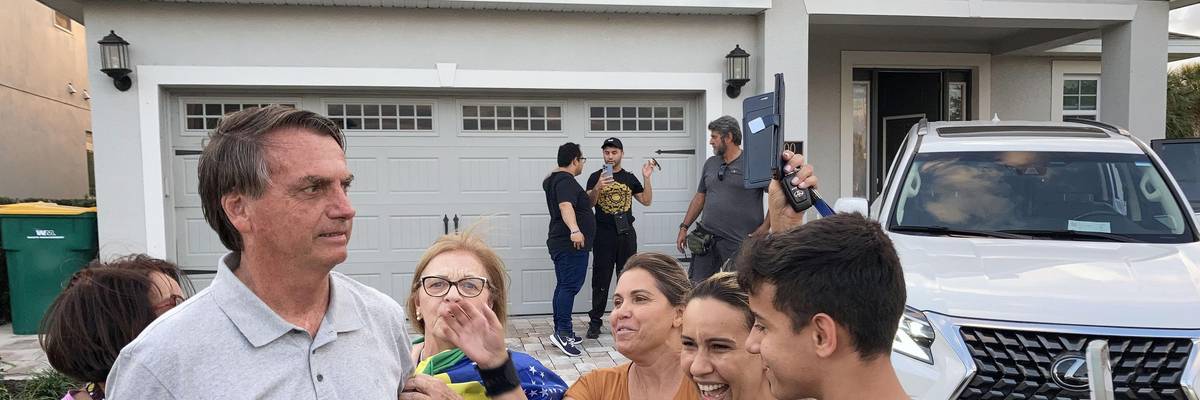
Brazil's far-right ex-president, Jair Bolsonaro, poses for photos with his supporters outside the Kissimmee, Florida home he is staying in on January 22, 2023.
Brazil's far-right ex-president has applied for a visa to remain in the U.S. amid worsening legal troubles in his home country, where he is facing multiple investigations.
Brazil's far-right ex-president Jair Bolsonaro has applied for a six-month visitor visa to remain in the United States amid worsening legal troubles in his home country.
U.S. authorities received Bolsonaro's application on Friday, The Financial Times reported Monday, citing "his lawyer, Felipe Alexandre, who has advised the former president not to leave the country while it is being processed—a period that could last several months."
Bolsonaro is facing multiple investigations in Brazil. That includes longstanding probes into alleged wrongdoing committed during his four-year presidential term as well as the Brazilian Supreme Court's recently launched inquiry aimed at determining whether his incessant lies about electoral fraud are to blame for the coup attempt that his supporters launched in Brasília on January 8.
The close ally of former U.S. President Donald Trump—whose unceasing lies about his loss in the 2020 presidential election sparked a deadly right-wing insurrection in Washington two years ago—retreated to Florida on December 30, two days before the January 1 inauguration of his leftist successor, Luiz Inácio Lula da Silva, commonly known as Lula.
"He has been staying at the Kissimmee home of a former mixed martial arts fighter, José Aldo, where he is often thronged by adoring members of Florida's right-leaning Brazilian expat community," the Times noted. "Bolsonaro had been traveling on an A-1 visa reserved for diplomats and heads of state. It expired the day he left office, with a 30-day grace period."
Earlier this month, several members of U.S. Congress urged the Biden administration to rescind Bolsonaro's visa.
"We must not allow Mr. Bolsonaro or any other former Brazilian officials to take refuge in the United States to escape justice for any crimes they may have committed when in office," stated a letter to the White House signed by 41 Democratic lawmakers.
Alexandre claimed that there is no evidence that Bolsonaro committed any crimes related to the anti-democratic assault in Brasília, when his election-denying supporters ransacked Brazil's presidential palace, Congress, and Supreme Court.
Bolsonaro has tried to distance himself from the rioters, saying that they "crossed the line." In December, however, Bolsonaro broke his post-election silence to tell his backers—many of whom spent weeks after the October 30 runoff calling for a military coup to prevent Lula from taking office—that his political fate rested in their hands.
"Who decides where I go are you," Bolsonaro told a crowd outside the gates of the presidential residence on December 9. "Who decides which way the armed forces go are you."
Days later, hundreds of Bolsonaristas set fire to cars and buses and tried to breach federal police headquarters in Brasília in a preview of the larger January 8 insurrection.
A bigger right-wing mob invaded Brazil's main government buildings earlier this month under the false pretense that Lula's victory in October's election was the result of widespread fraud—a mistaken belief fueled by years of Bolsonaro and his allies' baseless attacks on the integrity of the country's election infrastructure, disinformation that spread rapidly on social media.
The day after the attack, thousands of democracy defenders took to the streets of Rio de Janeiro and São Paulo to demand jail time for those who carried out the violence as well as those who aided and abetted it.
Sen. Tim Kaine (D-Va.), head of the Senate Foreign Relations Committee's Western Hemisphere panel, said earlier this month that the U.S. should comply if Lula's administration requests Bolsonaro's extradition.
Alexandre, meanwhile, told the Times that Bolsonaro "might eventually decide to petition for a more permanent U.S. visa than the six-month extension he is seeking."
Dear Common Dreams reader, It’s been nearly 30 years since I co-founded Common Dreams with my late wife, Lina Newhouser. We had the radical notion that journalism should serve the public good, not corporate profits. It was clear to us from the outset what it would take to build such a project. No paid advertisements. No corporate sponsors. No millionaire publisher telling us what to think or do. Many people said we wouldn't last a year, but we proved those doubters wrong. Together with a tremendous team of journalists and dedicated staff, we built an independent media outlet free from the constraints of profits and corporate control. Our mission has always been simple: To inform. To inspire. To ignite change for the common good. Building Common Dreams was not easy. Our survival was never guaranteed. When you take on the most powerful forces—Wall Street greed, fossil fuel industry destruction, Big Tech lobbyists, and uber-rich oligarchs who have spent billions upon billions rigging the economy and democracy in their favor—the only bulwark you have is supporters who believe in your work. But here’s the urgent message from me today. It's never been this bad out there. And it's never been this hard to keep us going. At the very moment Common Dreams is most needed, the threats we face are intensifying. We need your support now more than ever. We don't accept corporate advertising and never will. We don't have a paywall because we don't think people should be blocked from critical news based on their ability to pay. Everything we do is funded by the donations of readers like you. When everyone does the little they can afford, we are strong. But if that support retreats or dries up, so do we. Will you donate now to make sure Common Dreams not only survives but thrives? —Craig Brown, Co-founder |
Brazil's far-right ex-president Jair Bolsonaro has applied for a six-month visitor visa to remain in the United States amid worsening legal troubles in his home country.
U.S. authorities received Bolsonaro's application on Friday, The Financial Times reported Monday, citing "his lawyer, Felipe Alexandre, who has advised the former president not to leave the country while it is being processed—a period that could last several months."
Bolsonaro is facing multiple investigations in Brazil. That includes longstanding probes into alleged wrongdoing committed during his four-year presidential term as well as the Brazilian Supreme Court's recently launched inquiry aimed at determining whether his incessant lies about electoral fraud are to blame for the coup attempt that his supporters launched in Brasília on January 8.
The close ally of former U.S. President Donald Trump—whose unceasing lies about his loss in the 2020 presidential election sparked a deadly right-wing insurrection in Washington two years ago—retreated to Florida on December 30, two days before the January 1 inauguration of his leftist successor, Luiz Inácio Lula da Silva, commonly known as Lula.
"He has been staying at the Kissimmee home of a former mixed martial arts fighter, José Aldo, where he is often thronged by adoring members of Florida's right-leaning Brazilian expat community," the Times noted. "Bolsonaro had been traveling on an A-1 visa reserved for diplomats and heads of state. It expired the day he left office, with a 30-day grace period."
Earlier this month, several members of U.S. Congress urged the Biden administration to rescind Bolsonaro's visa.
"We must not allow Mr. Bolsonaro or any other former Brazilian officials to take refuge in the United States to escape justice for any crimes they may have committed when in office," stated a letter to the White House signed by 41 Democratic lawmakers.
Alexandre claimed that there is no evidence that Bolsonaro committed any crimes related to the anti-democratic assault in Brasília, when his election-denying supporters ransacked Brazil's presidential palace, Congress, and Supreme Court.
Bolsonaro has tried to distance himself from the rioters, saying that they "crossed the line." In December, however, Bolsonaro broke his post-election silence to tell his backers—many of whom spent weeks after the October 30 runoff calling for a military coup to prevent Lula from taking office—that his political fate rested in their hands.
"Who decides where I go are you," Bolsonaro told a crowd outside the gates of the presidential residence on December 9. "Who decides which way the armed forces go are you."
Days later, hundreds of Bolsonaristas set fire to cars and buses and tried to breach federal police headquarters in Brasília in a preview of the larger January 8 insurrection.
A bigger right-wing mob invaded Brazil's main government buildings earlier this month under the false pretense that Lula's victory in October's election was the result of widespread fraud—a mistaken belief fueled by years of Bolsonaro and his allies' baseless attacks on the integrity of the country's election infrastructure, disinformation that spread rapidly on social media.
The day after the attack, thousands of democracy defenders took to the streets of Rio de Janeiro and São Paulo to demand jail time for those who carried out the violence as well as those who aided and abetted it.
Sen. Tim Kaine (D-Va.), head of the Senate Foreign Relations Committee's Western Hemisphere panel, said earlier this month that the U.S. should comply if Lula's administration requests Bolsonaro's extradition.
Alexandre, meanwhile, told the Times that Bolsonaro "might eventually decide to petition for a more permanent U.S. visa than the six-month extension he is seeking."
Brazil's far-right ex-president Jair Bolsonaro has applied for a six-month visitor visa to remain in the United States amid worsening legal troubles in his home country.
U.S. authorities received Bolsonaro's application on Friday, The Financial Times reported Monday, citing "his lawyer, Felipe Alexandre, who has advised the former president not to leave the country while it is being processed—a period that could last several months."
Bolsonaro is facing multiple investigations in Brazil. That includes longstanding probes into alleged wrongdoing committed during his four-year presidential term as well as the Brazilian Supreme Court's recently launched inquiry aimed at determining whether his incessant lies about electoral fraud are to blame for the coup attempt that his supporters launched in Brasília on January 8.
The close ally of former U.S. President Donald Trump—whose unceasing lies about his loss in the 2020 presidential election sparked a deadly right-wing insurrection in Washington two years ago—retreated to Florida on December 30, two days before the January 1 inauguration of his leftist successor, Luiz Inácio Lula da Silva, commonly known as Lula.
"He has been staying at the Kissimmee home of a former mixed martial arts fighter, José Aldo, where he is often thronged by adoring members of Florida's right-leaning Brazilian expat community," the Times noted. "Bolsonaro had been traveling on an A-1 visa reserved for diplomats and heads of state. It expired the day he left office, with a 30-day grace period."
Earlier this month, several members of U.S. Congress urged the Biden administration to rescind Bolsonaro's visa.
"We must not allow Mr. Bolsonaro or any other former Brazilian officials to take refuge in the United States to escape justice for any crimes they may have committed when in office," stated a letter to the White House signed by 41 Democratic lawmakers.
Alexandre claimed that there is no evidence that Bolsonaro committed any crimes related to the anti-democratic assault in Brasília, when his election-denying supporters ransacked Brazil's presidential palace, Congress, and Supreme Court.
Bolsonaro has tried to distance himself from the rioters, saying that they "crossed the line." In December, however, Bolsonaro broke his post-election silence to tell his backers—many of whom spent weeks after the October 30 runoff calling for a military coup to prevent Lula from taking office—that his political fate rested in their hands.
"Who decides where I go are you," Bolsonaro told a crowd outside the gates of the presidential residence on December 9. "Who decides which way the armed forces go are you."
Days later, hundreds of Bolsonaristas set fire to cars and buses and tried to breach federal police headquarters in Brasília in a preview of the larger January 8 insurrection.
A bigger right-wing mob invaded Brazil's main government buildings earlier this month under the false pretense that Lula's victory in October's election was the result of widespread fraud—a mistaken belief fueled by years of Bolsonaro and his allies' baseless attacks on the integrity of the country's election infrastructure, disinformation that spread rapidly on social media.
The day after the attack, thousands of democracy defenders took to the streets of Rio de Janeiro and São Paulo to demand jail time for those who carried out the violence as well as those who aided and abetted it.
Sen. Tim Kaine (D-Va.), head of the Senate Foreign Relations Committee's Western Hemisphere panel, said earlier this month that the U.S. should comply if Lula's administration requests Bolsonaro's extradition.
Alexandre, meanwhile, told the Times that Bolsonaro "might eventually decide to petition for a more permanent U.S. visa than the six-month extension he is seeking."