SUBSCRIBE TO OUR FREE NEWSLETTER
Daily news & progressive opinion—funded by the people, not the corporations—delivered straight to your inbox.
5
#000000
#FFFFFF
To donate by check, phone, or other method, see our More Ways to Give page.
Daily news & progressive opinion—funded by the people, not the corporations—delivered straight to your inbox.
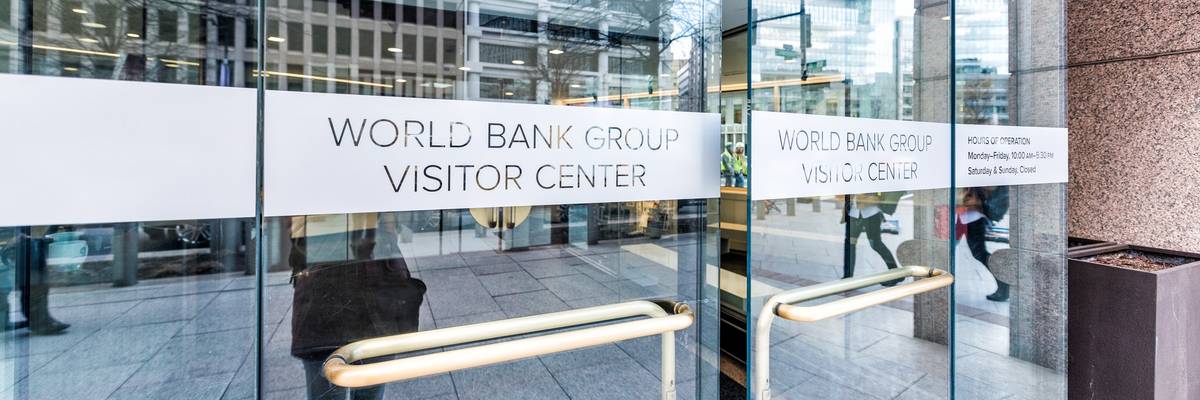
The World Bank Group Visitor Center.
The bank is pushing a statistical notion of “shared prosperity” that, as one expert puts it, “leaves the rich out of the equation!”
Been eating a bit too much ice cream this sweltering summer? Thinking about going on a bit of a diet? Well, imagine yourself counting calories but exempting anything with sugar from all your counting.
Would that approach help you make an appreciable dent on your excess bodily baggage? Of course not. We can’t eliminate what we ignore. And that goes for inequality as well, over 300 distinguished economists worldwide are charging in a new open letter to the United Nations and the World Bank.
Back in 2015, these eminent economists remind us, the world’s nations came together and adopted a series of “Sustainable Development Goals”—SDGs for short—designed to systematically attack both poverty and climate change. The tenth of these goals specifically aims to “reduce inequality within and among countries.”
Significantly narrowing our world’s deeply unequal distribution of income and wealth will, of course, always remain a tall order, given the political power that grand fortunes create. The World Bank, unfortunately, has made that order taller.
The progress so far on this inequality SDG? Practically nonexistent. By many measures, the open-letter economists note, our “inequalities have worsened,” and that worsening really matters. Without reducing the “deep divide” that separates our global rich from the rest of us, the economists suggest, we’ll forever be going nowhere on “ending poverty and preventing climate breakdown.”
Significantly narrowing our world’s deeply unequal distribution of income and wealth will, of course, always remain a tall order, given the political power that grand fortunes create. The World Bank, unfortunately, has made that order taller.
The U.N.’s member nations have essentially made the bank the world’s official inequality scorekeeper. But the metrics the World Bank uses to track inequality have turned out to be “very inadequate,” charges Jayati Ghosh, a coauthor of the economists’ new open letter.
We already have, Ghosh points out, a variety of established yardsticks for measuring inequality. The Gini coefficient plots actually existing income distributions between 0 for total equality and 1 for infinite inequality. The more easily understandable Palma ratio divides the income share of a society’s top 10% by the income share of its bottom 40%.
The World Bank isn’t relying on either of these standard measures. The bank is instead pushing a statistical notion of “shared prosperity” that, as Ghosh puts it, “leaves the rich out of the equation!” This World Bank measure defines success in the battle against inequality as what we have when the incomes of the bottom 40% are growing faster than the national average income.
On the World Bank’s scorecard, in other words, any nation where the incomes of the top 1% are rising ten times faster than the national average income would be making “progress” against inequality so long as the incomes of the bottom 40% were rising slightly faster than that national average.
This “bizarre notion of ‘shared prosperity,’” says Jayati Ghosh, “provides very misleading estimates of the extent of inequality or progress in reducing it.”
By this bizarre World Bank yardstick, over half the world—53% of the nations the bank sampled—were making progress against inequality just before the pandemic hit and another 11% were showing no change.
Researchers with the World Inequality Database, an ambitious statistical effort that takes inspiration from the ground-breaking research of scholars like Thomas Piketty, paint a starkly different picture. Only 26% of the world’s nations, as measured by the Gini coefficient, are actually showing progress against income inequality, and only 12% are showing progress in Palma-ratio terms.
For three top global inequality watchdogs—Oxfam, the Development Finance International, and the New York University Center for International Cooperation’s Pathfinders initiative—the World Bank’s “shared prosperity” scorekeeping makes plain the need for a real “data revolution” that spotlights the wealth of the world’s wealthiest.
The World Bank’s current approach, these three groups charged in a new report released last month, essentially “ignores what is happening to the rich.” We cannot afford that ignoring, the groups stress, not at a time when “the world’s wealthiest citizens continue to be largely responsible for extreme carbon emissions” while the world’s “poorest citizens pay the price through climate disasters.”
Will critiques like this get the World Bank to change its statistical ways? We’ll see. The bank’s first reaction to the economists’ open letter has been somewhat encouraging. The World Bank, says a spokesperson, agrees “we need to do more to address inequality” and “do better in measuring progress.”
Dear Common Dreams reader, It’s been nearly 30 years since I co-founded Common Dreams with my late wife, Lina Newhouser. We had the radical notion that journalism should serve the public good, not corporate profits. It was clear to us from the outset what it would take to build such a project. No paid advertisements. No corporate sponsors. No millionaire publisher telling us what to think or do. Many people said we wouldn't last a year, but we proved those doubters wrong. Together with a tremendous team of journalists and dedicated staff, we built an independent media outlet free from the constraints of profits and corporate control. Our mission has always been simple: To inform. To inspire. To ignite change for the common good. Building Common Dreams was not easy. Our survival was never guaranteed. When you take on the most powerful forces—Wall Street greed, fossil fuel industry destruction, Big Tech lobbyists, and uber-rich oligarchs who have spent billions upon billions rigging the economy and democracy in their favor—the only bulwark you have is supporters who believe in your work. But here’s the urgent message from me today. It's never been this bad out there. And it's never been this hard to keep us going. At the very moment Common Dreams is most needed, the threats we face are intensifying. We need your support now more than ever. We don't accept corporate advertising and never will. We don't have a paywall because we don't think people should be blocked from critical news based on their ability to pay. Everything we do is funded by the donations of readers like you. When everyone does the little they can afford, we are strong. But if that support retreats or dries up, so do we. Will you donate now to make sure Common Dreams not only survives but thrives? —Craig Brown, Co-founder |
Been eating a bit too much ice cream this sweltering summer? Thinking about going on a bit of a diet? Well, imagine yourself counting calories but exempting anything with sugar from all your counting.
Would that approach help you make an appreciable dent on your excess bodily baggage? Of course not. We can’t eliminate what we ignore. And that goes for inequality as well, over 300 distinguished economists worldwide are charging in a new open letter to the United Nations and the World Bank.
Back in 2015, these eminent economists remind us, the world’s nations came together and adopted a series of “Sustainable Development Goals”—SDGs for short—designed to systematically attack both poverty and climate change. The tenth of these goals specifically aims to “reduce inequality within and among countries.”
Significantly narrowing our world’s deeply unequal distribution of income and wealth will, of course, always remain a tall order, given the political power that grand fortunes create. The World Bank, unfortunately, has made that order taller.
The progress so far on this inequality SDG? Practically nonexistent. By many measures, the open-letter economists note, our “inequalities have worsened,” and that worsening really matters. Without reducing the “deep divide” that separates our global rich from the rest of us, the economists suggest, we’ll forever be going nowhere on “ending poverty and preventing climate breakdown.”
Significantly narrowing our world’s deeply unequal distribution of income and wealth will, of course, always remain a tall order, given the political power that grand fortunes create. The World Bank, unfortunately, has made that order taller.
The U.N.’s member nations have essentially made the bank the world’s official inequality scorekeeper. But the metrics the World Bank uses to track inequality have turned out to be “very inadequate,” charges Jayati Ghosh, a coauthor of the economists’ new open letter.
We already have, Ghosh points out, a variety of established yardsticks for measuring inequality. The Gini coefficient plots actually existing income distributions between 0 for total equality and 1 for infinite inequality. The more easily understandable Palma ratio divides the income share of a society’s top 10% by the income share of its bottom 40%.
The World Bank isn’t relying on either of these standard measures. The bank is instead pushing a statistical notion of “shared prosperity” that, as Ghosh puts it, “leaves the rich out of the equation!” This World Bank measure defines success in the battle against inequality as what we have when the incomes of the bottom 40% are growing faster than the national average income.
On the World Bank’s scorecard, in other words, any nation where the incomes of the top 1% are rising ten times faster than the national average income would be making “progress” against inequality so long as the incomes of the bottom 40% were rising slightly faster than that national average.
This “bizarre notion of ‘shared prosperity,’” says Jayati Ghosh, “provides very misleading estimates of the extent of inequality or progress in reducing it.”
By this bizarre World Bank yardstick, over half the world—53% of the nations the bank sampled—were making progress against inequality just before the pandemic hit and another 11% were showing no change.
Researchers with the World Inequality Database, an ambitious statistical effort that takes inspiration from the ground-breaking research of scholars like Thomas Piketty, paint a starkly different picture. Only 26% of the world’s nations, as measured by the Gini coefficient, are actually showing progress against income inequality, and only 12% are showing progress in Palma-ratio terms.
For three top global inequality watchdogs—Oxfam, the Development Finance International, and the New York University Center for International Cooperation’s Pathfinders initiative—the World Bank’s “shared prosperity” scorekeeping makes plain the need for a real “data revolution” that spotlights the wealth of the world’s wealthiest.
The World Bank’s current approach, these three groups charged in a new report released last month, essentially “ignores what is happening to the rich.” We cannot afford that ignoring, the groups stress, not at a time when “the world’s wealthiest citizens continue to be largely responsible for extreme carbon emissions” while the world’s “poorest citizens pay the price through climate disasters.”
Will critiques like this get the World Bank to change its statistical ways? We’ll see. The bank’s first reaction to the economists’ open letter has been somewhat encouraging. The World Bank, says a spokesperson, agrees “we need to do more to address inequality” and “do better in measuring progress.”
Been eating a bit too much ice cream this sweltering summer? Thinking about going on a bit of a diet? Well, imagine yourself counting calories but exempting anything with sugar from all your counting.
Would that approach help you make an appreciable dent on your excess bodily baggage? Of course not. We can’t eliminate what we ignore. And that goes for inequality as well, over 300 distinguished economists worldwide are charging in a new open letter to the United Nations and the World Bank.
Back in 2015, these eminent economists remind us, the world’s nations came together and adopted a series of “Sustainable Development Goals”—SDGs for short—designed to systematically attack both poverty and climate change. The tenth of these goals specifically aims to “reduce inequality within and among countries.”
Significantly narrowing our world’s deeply unequal distribution of income and wealth will, of course, always remain a tall order, given the political power that grand fortunes create. The World Bank, unfortunately, has made that order taller.
The progress so far on this inequality SDG? Practically nonexistent. By many measures, the open-letter economists note, our “inequalities have worsened,” and that worsening really matters. Without reducing the “deep divide” that separates our global rich from the rest of us, the economists suggest, we’ll forever be going nowhere on “ending poverty and preventing climate breakdown.”
Significantly narrowing our world’s deeply unequal distribution of income and wealth will, of course, always remain a tall order, given the political power that grand fortunes create. The World Bank, unfortunately, has made that order taller.
The U.N.’s member nations have essentially made the bank the world’s official inequality scorekeeper. But the metrics the World Bank uses to track inequality have turned out to be “very inadequate,” charges Jayati Ghosh, a coauthor of the economists’ new open letter.
We already have, Ghosh points out, a variety of established yardsticks for measuring inequality. The Gini coefficient plots actually existing income distributions between 0 for total equality and 1 for infinite inequality. The more easily understandable Palma ratio divides the income share of a society’s top 10% by the income share of its bottom 40%.
The World Bank isn’t relying on either of these standard measures. The bank is instead pushing a statistical notion of “shared prosperity” that, as Ghosh puts it, “leaves the rich out of the equation!” This World Bank measure defines success in the battle against inequality as what we have when the incomes of the bottom 40% are growing faster than the national average income.
On the World Bank’s scorecard, in other words, any nation where the incomes of the top 1% are rising ten times faster than the national average income would be making “progress” against inequality so long as the incomes of the bottom 40% were rising slightly faster than that national average.
This “bizarre notion of ‘shared prosperity,’” says Jayati Ghosh, “provides very misleading estimates of the extent of inequality or progress in reducing it.”
By this bizarre World Bank yardstick, over half the world—53% of the nations the bank sampled—were making progress against inequality just before the pandemic hit and another 11% were showing no change.
Researchers with the World Inequality Database, an ambitious statistical effort that takes inspiration from the ground-breaking research of scholars like Thomas Piketty, paint a starkly different picture. Only 26% of the world’s nations, as measured by the Gini coefficient, are actually showing progress against income inequality, and only 12% are showing progress in Palma-ratio terms.
For three top global inequality watchdogs—Oxfam, the Development Finance International, and the New York University Center for International Cooperation’s Pathfinders initiative—the World Bank’s “shared prosperity” scorekeeping makes plain the need for a real “data revolution” that spotlights the wealth of the world’s wealthiest.
The World Bank’s current approach, these three groups charged in a new report released last month, essentially “ignores what is happening to the rich.” We cannot afford that ignoring, the groups stress, not at a time when “the world’s wealthiest citizens continue to be largely responsible for extreme carbon emissions” while the world’s “poorest citizens pay the price through climate disasters.”
Will critiques like this get the World Bank to change its statistical ways? We’ll see. The bank’s first reaction to the economists’ open letter has been somewhat encouraging. The World Bank, says a spokesperson, agrees “we need to do more to address inequality” and “do better in measuring progress.”