SUBSCRIBE TO OUR FREE NEWSLETTER
Daily news & progressive opinion—funded by the people, not the corporations—delivered straight to your inbox.
5
#000000
#FFFFFF
To donate by check, phone, or other method, see our More Ways to Give page.
Daily news & progressive opinion—funded by the people, not the corporations—delivered straight to your inbox.
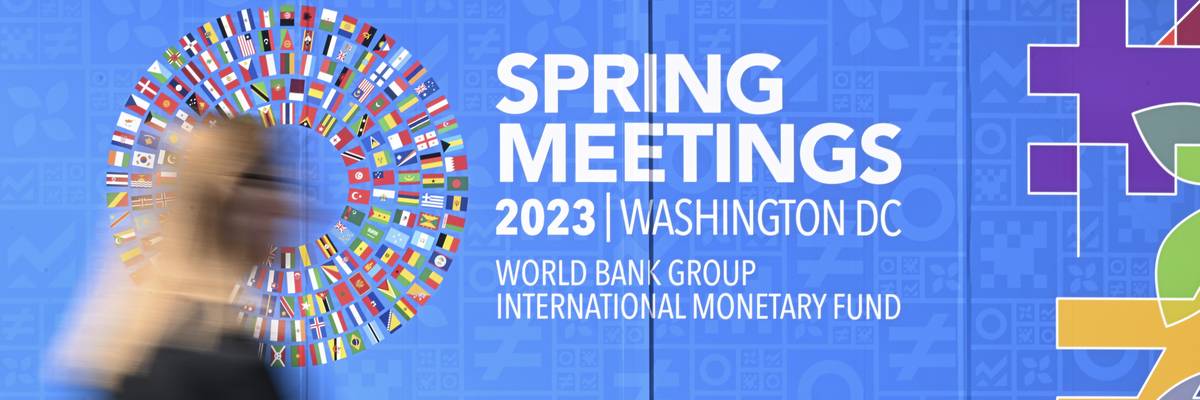
A view of the sign for the 2023 Spring Meetings of the World Bank and International Monetary Fund in Washington, D.C. on April 10, 2023.
"It's time for governments to find their moral fiber and tax the richest, so we can stave off climate catastrophe and lift everyone out of poverty."
With global finance leaders set to gather in Washington, D.C. this week for the spring meetings of the World Bank and International Monetary Fund, Oxfam is warning rich countries against using accounting gimmicks to artificially inflate their global climate funding commitments.
The international humanitarian group estimated in an analysis released Monday that low- and middle-income nations will need an additional $27.4 trillion at minimum by 2030 to "fill financing gaps in health, education, social protection, and tackling climate change"—as well as addressing the damage already inflicted by intensifying extreme weather and other consequences of fossil fuel use.
Interest rate hikes by the U.S. Federal Reserve and other powerful central banks have compounded the financial struggles of poor nations as debt servicing costs rise, putting critical public investments at risk.
"But despite the dire economic situation facing the poorest countries today, and much political discussion of the trillions needed to tackle poverty, inequality, and climate change, there is no indication that rich countries are willing to pay the true price of a fair and sustainable future," Oxfam said Monday. "In fact, there is a risk that rich-country finance ministers meeting in Washington this week will celebrate progress on reforms that deliver just 0.1% of the climate and social spending gap in low- and middle-income countries (LICs and MICs) between now and 2030. And that they will do so through financial wizardry that doesn't cost them a cent."
The group pointed specifically to the recent replenishment process for the International Development Association, a member of the World Bank Group ostensibly dedicated to aiding poor nations with grants and loans.
"Although IDA20 saw a record replenishment in 2021, this was not a result of increased donor contributions. In fact, donor contributions declined and the increased allocation was only achieved through the financial wizardry of 'balance sheet optimization,'" Oxfam noted. "Now, with IDA20 commitments again being frontloaded due to mounting crises, there are fears that IDA is facing a 'financial cliff' in the near future."
Oxfam also criticized "green bonds" and other such "financial innovations" that—while positive-sounding and potentially beneficial on the margins—ultimately provide minimal benefit relative to what's necessary to help avert climate catastrophe in nations that did the least to cause the crisis.
"If rich countries were serious about investing in people and planet, they would go beyond financial wizardry," said Amitabh Behar, Oxfam International's incoming interim executive director. "It's time for governments to find their moral fiber and tax the richest, so we can stave off climate catastrophe and lift everyone out of poverty."
Oxfam's analysis suggests several policy steps for wealthy countries, including actually meeting their existing aid commitments to poor nations and ending "the accounting trickery of siphoning off large amounts of aid to spend in donor countries on things like in-country refugee costs and vaccine donations"; committing to a "debt swap" whereby rich nations would borrow $11.5 trillion to help fund climate costs in low- and middle-income countries; and pledging new Special Drawing Rights (SDRs).
The group also called on rich nations to pursue "steep and progressive tax increases on the incomes of the super-rich, on property, land, and inheritance, and on the profits of the wealthiest companies, especially windfall profits, as well as on fossil fuels and on financial transactions."
"If rich-country governments were willing to implement bold and progressive tax reforms there would be more than enough money to go round," Oxfam said. "We cannot allow the richest countries to argue they 'cannot afford' to raise the trillions needed for social and climate spending in the poorest countries. It is clear that mobilizing this money would simply take political will."
The new analysis comes as the World Bank is preparing to confirm Ajay Banga, a private equity executive and former Mastercard CEO chosen by the U.S., as its new president, replacing an outgoing leader who has come under fire for climate denial.
In recent weeks, as E&E News reported Monday, the World Bank has outlined changes that would "free up roughly $5 billion annually over the next 10 years, mainly through a slight relaxation of the bank's rules for how much risk it can assume."
"Specifically, it would lower the bank's so-called equity-to-loan ratio from 20% to 19%, which would allow it to increase its lending with the same amount of shareholder money," the outlet noted. "Critics have called the plan underwhelming, saying it's still too vague and risk-averse. Some argue that the equity-to-loan ratio could be lowered further without jeopardizing confidence in the bank’s lending ability, making additional lending capacity available."
Oxfam said Monday that it is "essential that the World Bank and IMF also step up their ambition" during this week's talks.
"The World Bank's own analysis shows that extreme economic inequality is a barrier to poverty reduction—yet the current goal on 'shared prosperity' is weak and ineffective," said Behar. "We need to see far more ambition from a global body tasked with fighting poverty."
Dear Common Dreams reader, It’s been nearly 30 years since I co-founded Common Dreams with my late wife, Lina Newhouser. We had the radical notion that journalism should serve the public good, not corporate profits. It was clear to us from the outset what it would take to build such a project. No paid advertisements. No corporate sponsors. No millionaire publisher telling us what to think or do. Many people said we wouldn't last a year, but we proved those doubters wrong. Together with a tremendous team of journalists and dedicated staff, we built an independent media outlet free from the constraints of profits and corporate control. Our mission has always been simple: To inform. To inspire. To ignite change for the common good. Building Common Dreams was not easy. Our survival was never guaranteed. When you take on the most powerful forces—Wall Street greed, fossil fuel industry destruction, Big Tech lobbyists, and uber-rich oligarchs who have spent billions upon billions rigging the economy and democracy in their favor—the only bulwark you have is supporters who believe in your work. But here’s the urgent message from me today. It's never been this bad out there. And it's never been this hard to keep us going. At the very moment Common Dreams is most needed, the threats we face are intensifying. We need your support now more than ever. We don't accept corporate advertising and never will. We don't have a paywall because we don't think people should be blocked from critical news based on their ability to pay. Everything we do is funded by the donations of readers like you. When everyone does the little they can afford, we are strong. But if that support retreats or dries up, so do we. Will you donate now to make sure Common Dreams not only survives but thrives? —Craig Brown, Co-founder |
With global finance leaders set to gather in Washington, D.C. this week for the spring meetings of the World Bank and International Monetary Fund, Oxfam is warning rich countries against using accounting gimmicks to artificially inflate their global climate funding commitments.
The international humanitarian group estimated in an analysis released Monday that low- and middle-income nations will need an additional $27.4 trillion at minimum by 2030 to "fill financing gaps in health, education, social protection, and tackling climate change"—as well as addressing the damage already inflicted by intensifying extreme weather and other consequences of fossil fuel use.
Interest rate hikes by the U.S. Federal Reserve and other powerful central banks have compounded the financial struggles of poor nations as debt servicing costs rise, putting critical public investments at risk.
"But despite the dire economic situation facing the poorest countries today, and much political discussion of the trillions needed to tackle poverty, inequality, and climate change, there is no indication that rich countries are willing to pay the true price of a fair and sustainable future," Oxfam said Monday. "In fact, there is a risk that rich-country finance ministers meeting in Washington this week will celebrate progress on reforms that deliver just 0.1% of the climate and social spending gap in low- and middle-income countries (LICs and MICs) between now and 2030. And that they will do so through financial wizardry that doesn't cost them a cent."
The group pointed specifically to the recent replenishment process for the International Development Association, a member of the World Bank Group ostensibly dedicated to aiding poor nations with grants and loans.
"Although IDA20 saw a record replenishment in 2021, this was not a result of increased donor contributions. In fact, donor contributions declined and the increased allocation was only achieved through the financial wizardry of 'balance sheet optimization,'" Oxfam noted. "Now, with IDA20 commitments again being frontloaded due to mounting crises, there are fears that IDA is facing a 'financial cliff' in the near future."
Oxfam also criticized "green bonds" and other such "financial innovations" that—while positive-sounding and potentially beneficial on the margins—ultimately provide minimal benefit relative to what's necessary to help avert climate catastrophe in nations that did the least to cause the crisis.
"If rich countries were serious about investing in people and planet, they would go beyond financial wizardry," said Amitabh Behar, Oxfam International's incoming interim executive director. "It's time for governments to find their moral fiber and tax the richest, so we can stave off climate catastrophe and lift everyone out of poverty."
Oxfam's analysis suggests several policy steps for wealthy countries, including actually meeting their existing aid commitments to poor nations and ending "the accounting trickery of siphoning off large amounts of aid to spend in donor countries on things like in-country refugee costs and vaccine donations"; committing to a "debt swap" whereby rich nations would borrow $11.5 trillion to help fund climate costs in low- and middle-income countries; and pledging new Special Drawing Rights (SDRs).
The group also called on rich nations to pursue "steep and progressive tax increases on the incomes of the super-rich, on property, land, and inheritance, and on the profits of the wealthiest companies, especially windfall profits, as well as on fossil fuels and on financial transactions."
"If rich-country governments were willing to implement bold and progressive tax reforms there would be more than enough money to go round," Oxfam said. "We cannot allow the richest countries to argue they 'cannot afford' to raise the trillions needed for social and climate spending in the poorest countries. It is clear that mobilizing this money would simply take political will."
The new analysis comes as the World Bank is preparing to confirm Ajay Banga, a private equity executive and former Mastercard CEO chosen by the U.S., as its new president, replacing an outgoing leader who has come under fire for climate denial.
In recent weeks, as E&E News reported Monday, the World Bank has outlined changes that would "free up roughly $5 billion annually over the next 10 years, mainly through a slight relaxation of the bank's rules for how much risk it can assume."
"Specifically, it would lower the bank's so-called equity-to-loan ratio from 20% to 19%, which would allow it to increase its lending with the same amount of shareholder money," the outlet noted. "Critics have called the plan underwhelming, saying it's still too vague and risk-averse. Some argue that the equity-to-loan ratio could be lowered further without jeopardizing confidence in the bank’s lending ability, making additional lending capacity available."
Oxfam said Monday that it is "essential that the World Bank and IMF also step up their ambition" during this week's talks.
"The World Bank's own analysis shows that extreme economic inequality is a barrier to poverty reduction—yet the current goal on 'shared prosperity' is weak and ineffective," said Behar. "We need to see far more ambition from a global body tasked with fighting poverty."
With global finance leaders set to gather in Washington, D.C. this week for the spring meetings of the World Bank and International Monetary Fund, Oxfam is warning rich countries against using accounting gimmicks to artificially inflate their global climate funding commitments.
The international humanitarian group estimated in an analysis released Monday that low- and middle-income nations will need an additional $27.4 trillion at minimum by 2030 to "fill financing gaps in health, education, social protection, and tackling climate change"—as well as addressing the damage already inflicted by intensifying extreme weather and other consequences of fossil fuel use.
Interest rate hikes by the U.S. Federal Reserve and other powerful central banks have compounded the financial struggles of poor nations as debt servicing costs rise, putting critical public investments at risk.
"But despite the dire economic situation facing the poorest countries today, and much political discussion of the trillions needed to tackle poverty, inequality, and climate change, there is no indication that rich countries are willing to pay the true price of a fair and sustainable future," Oxfam said Monday. "In fact, there is a risk that rich-country finance ministers meeting in Washington this week will celebrate progress on reforms that deliver just 0.1% of the climate and social spending gap in low- and middle-income countries (LICs and MICs) between now and 2030. And that they will do so through financial wizardry that doesn't cost them a cent."
The group pointed specifically to the recent replenishment process for the International Development Association, a member of the World Bank Group ostensibly dedicated to aiding poor nations with grants and loans.
"Although IDA20 saw a record replenishment in 2021, this was not a result of increased donor contributions. In fact, donor contributions declined and the increased allocation was only achieved through the financial wizardry of 'balance sheet optimization,'" Oxfam noted. "Now, with IDA20 commitments again being frontloaded due to mounting crises, there are fears that IDA is facing a 'financial cliff' in the near future."
Oxfam also criticized "green bonds" and other such "financial innovations" that—while positive-sounding and potentially beneficial on the margins—ultimately provide minimal benefit relative to what's necessary to help avert climate catastrophe in nations that did the least to cause the crisis.
"If rich countries were serious about investing in people and planet, they would go beyond financial wizardry," said Amitabh Behar, Oxfam International's incoming interim executive director. "It's time for governments to find their moral fiber and tax the richest, so we can stave off climate catastrophe and lift everyone out of poverty."
Oxfam's analysis suggests several policy steps for wealthy countries, including actually meeting their existing aid commitments to poor nations and ending "the accounting trickery of siphoning off large amounts of aid to spend in donor countries on things like in-country refugee costs and vaccine donations"; committing to a "debt swap" whereby rich nations would borrow $11.5 trillion to help fund climate costs in low- and middle-income countries; and pledging new Special Drawing Rights (SDRs).
The group also called on rich nations to pursue "steep and progressive tax increases on the incomes of the super-rich, on property, land, and inheritance, and on the profits of the wealthiest companies, especially windfall profits, as well as on fossil fuels and on financial transactions."
"If rich-country governments were willing to implement bold and progressive tax reforms there would be more than enough money to go round," Oxfam said. "We cannot allow the richest countries to argue they 'cannot afford' to raise the trillions needed for social and climate spending in the poorest countries. It is clear that mobilizing this money would simply take political will."
The new analysis comes as the World Bank is preparing to confirm Ajay Banga, a private equity executive and former Mastercard CEO chosen by the U.S., as its new president, replacing an outgoing leader who has come under fire for climate denial.
In recent weeks, as E&E News reported Monday, the World Bank has outlined changes that would "free up roughly $5 billion annually over the next 10 years, mainly through a slight relaxation of the bank's rules for how much risk it can assume."
"Specifically, it would lower the bank's so-called equity-to-loan ratio from 20% to 19%, which would allow it to increase its lending with the same amount of shareholder money," the outlet noted. "Critics have called the plan underwhelming, saying it's still too vague and risk-averse. Some argue that the equity-to-loan ratio could be lowered further without jeopardizing confidence in the bank’s lending ability, making additional lending capacity available."
Oxfam said Monday that it is "essential that the World Bank and IMF also step up their ambition" during this week's talks.
"The World Bank's own analysis shows that extreme economic inequality is a barrier to poverty reduction—yet the current goal on 'shared prosperity' is weak and ineffective," said Behar. "We need to see far more ambition from a global body tasked with fighting poverty."