SUBSCRIBE TO OUR FREE NEWSLETTER
Daily news & progressive opinion—funded by the people, not the corporations—delivered straight to your inbox.
5
#000000
#FFFFFF
To donate by check, phone, or other method, see our More Ways to Give page.
Daily news & progressive opinion—funded by the people, not the corporations—delivered straight to your inbox.
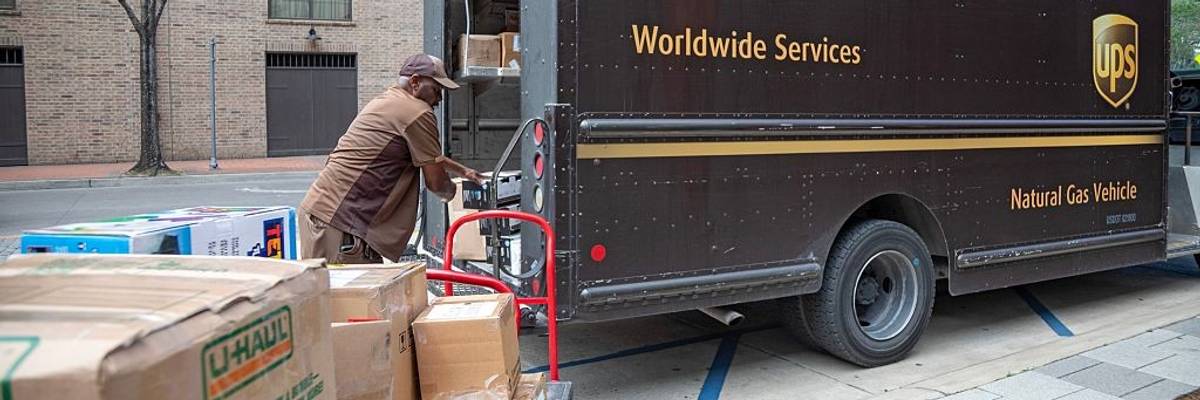
A United Parcel Service driver loads packages into his 'package car' at the New Orleans Convention Center. The private delivery company has announced 20,000 workers will laid off.
Blaming the Trump tariffs for every sin imaginable may be emotionally satisfying, but while it may end up being a factor, it is not the whole story here.
It’s such a tempting storyline: UPS announces that it will lay off 20,000 workers, citing “changes in the global trade policy and new or increased tariffs.”
There you have it. A perfect example of how Trump’s tariffs are screwing working people, many of whom voted for him.
Or is it?
UPS, like every major U.S. corporation, is in business to extract as much wealth as possible and shovel it to its shareholders and top executives in the form of stock buybacks and dividends. And like every major corporation, UPS will pay for that wealth extraction by laying off as many workers as possible. That may reduce the production of goods and services, but so be it, if it generates more money for shareholders and executives. In big business today, wealth extraction always comes first.
This is not a company struggling to make ends meet.
Let’s look at some of UPS’s numbers. In 2023, the company authorized $5 billion in stock buybacks, starting in 2024 with $500 million and another $5.5 billion in dividends. In 2025, UPS plans to spend another $1 billion on stock buybacks, as well as $5.5 billion more in dividends. In 2024, not incidentally, UPS posted $8.5 billion in profits. This is not a company struggling to make ends meet.
(Stock buybacks are when a corporation uses its own funds to repurchase shares and thereby raise the price of those shares, which greatly pleases its largest shareholders. Before deregulation in 1982, a company buying its own shares was considered illegal stock manipulation.)
To maintain this wealth pump for its investors and top officers, who are primarily compensated with stock incentives, cash needs to be generated and replenished. The simplest way to do that without acquiring more debt is to lay off workers.
Before the deregulation of Wall Street that came with the Reagan and Clinton administrations, no corporate manager would dare to lay off workers during profitable periods. To do so was a sign of poor management, a blemish on the CEO and his/her team. Workers and their communities were considered corporate stakeholders, right along with shareholders.
But after deregulation, the only stakeholder that mattered was the shareholder. The hell with workers and their communities. Companies began moving corporate headquarters to the sites of the highest governmental bidders, and in short order layoffs during good times became a symbol of smart management. Greed is good reigned supreme. (Please see Wall Street’s War on Workers for the gory details.)
Do not lend any credibility to corporate PR announcements. Their job is to do all they can to obscure how much they are shoveling to Wall Street.
The Teamsters union, which represents 300,000 UPS hourly workers, will fight these recently announced layoffs. Sean O’Brian, who spoke at the Republican national convention in 2024, sees any Teamsters layoffs as a violation of the contract:
United Parcel Service is contractually obligated to create 30,000 Teamsters jobs under our current national master agreement. If UPS wants to continue to downsize corporate management, the Teamsters won’t stand in its way. But if the company intends to violate our contract or makes any attempt to go after hard-fought, good-paying Teamsters jobs, UPS will be in for a hell of a fight.
We can be sure that the Teamsters will be looking closely at UPS’s finances, especially the large amounts going to stock buybacks and dividends. They will not sacrifice their members’ jobs on the altar of obscene wealth extraction.
Will the Trump tariffs have a major impact on UPS jobs?
We just don’t know that yet. But one thing we know for sure: Do not lend any credibility to corporate PR announcements. Their job is to do all they can to obscure how much they are shoveling to Wall Street. Their credo: The extent and consequences of the wealth extraction machine must never be revealed.
Blaming the Trump tariffs for every sin imaginable may be emotionally satisfying. But letting larger corporations and their Wall Street handlers off the hook when it comes to job destruction, which the Democrats have done for more than a generation, is in large part why we have Trump in the first place.
Dear Common Dreams reader, It’s been nearly 30 years since I co-founded Common Dreams with my late wife, Lina Newhouser. We had the radical notion that journalism should serve the public good, not corporate profits. It was clear to us from the outset what it would take to build such a project. No paid advertisements. No corporate sponsors. No millionaire publisher telling us what to think or do. Many people said we wouldn't last a year, but we proved those doubters wrong. Together with a tremendous team of journalists and dedicated staff, we built an independent media outlet free from the constraints of profits and corporate control. Our mission has always been simple: To inform. To inspire. To ignite change for the common good. Building Common Dreams was not easy. Our survival was never guaranteed. When you take on the most powerful forces—Wall Street greed, fossil fuel industry destruction, Big Tech lobbyists, and uber-rich oligarchs who have spent billions upon billions rigging the economy and democracy in their favor—the only bulwark you have is supporters who believe in your work. But here’s the urgent message from me today. It's never been this bad out there. And it's never been this hard to keep us going. At the very moment Common Dreams is most needed, the threats we face are intensifying. We need your support now more than ever. We don't accept corporate advertising and never will. We don't have a paywall because we don't think people should be blocked from critical news based on their ability to pay. Everything we do is funded by the donations of readers like you. When everyone does the little they can afford, we are strong. But if that support retreats or dries up, so do we. Will you donate now to make sure Common Dreams not only survives but thrives? —Craig Brown, Co-founder |
Les Leopold is the executive director of the Labor Institute and author of the new book, “The Billionaires Have Two Parties, We Need a Party of Our Own” (2026). His previous books include: “Wall Street’s War on Workers: How Mass Layoffs and Greed Are Destroying the Working Class and What to Do About It" (2024); "Runaway Inequality: An Activist's Guide to Economic Justice" (2015); and “The Man Who Hated Work and Loved Labor: The Life and Times of Tony Mazzocchi” (2007). Read more of his work on his substack here.
It’s such a tempting storyline: UPS announces that it will lay off 20,000 workers, citing “changes in the global trade policy and new or increased tariffs.”
There you have it. A perfect example of how Trump’s tariffs are screwing working people, many of whom voted for him.
Or is it?
UPS, like every major U.S. corporation, is in business to extract as much wealth as possible and shovel it to its shareholders and top executives in the form of stock buybacks and dividends. And like every major corporation, UPS will pay for that wealth extraction by laying off as many workers as possible. That may reduce the production of goods and services, but so be it, if it generates more money for shareholders and executives. In big business today, wealth extraction always comes first.
This is not a company struggling to make ends meet.
Let’s look at some of UPS’s numbers. In 2023, the company authorized $5 billion in stock buybacks, starting in 2024 with $500 million and another $5.5 billion in dividends. In 2025, UPS plans to spend another $1 billion on stock buybacks, as well as $5.5 billion more in dividends. In 2024, not incidentally, UPS posted $8.5 billion in profits. This is not a company struggling to make ends meet.
(Stock buybacks are when a corporation uses its own funds to repurchase shares and thereby raise the price of those shares, which greatly pleases its largest shareholders. Before deregulation in 1982, a company buying its own shares was considered illegal stock manipulation.)
To maintain this wealth pump for its investors and top officers, who are primarily compensated with stock incentives, cash needs to be generated and replenished. The simplest way to do that without acquiring more debt is to lay off workers.
Before the deregulation of Wall Street that came with the Reagan and Clinton administrations, no corporate manager would dare to lay off workers during profitable periods. To do so was a sign of poor management, a blemish on the CEO and his/her team. Workers and their communities were considered corporate stakeholders, right along with shareholders.
But after deregulation, the only stakeholder that mattered was the shareholder. The hell with workers and their communities. Companies began moving corporate headquarters to the sites of the highest governmental bidders, and in short order layoffs during good times became a symbol of smart management. Greed is good reigned supreme. (Please see Wall Street’s War on Workers for the gory details.)
Do not lend any credibility to corporate PR announcements. Their job is to do all they can to obscure how much they are shoveling to Wall Street.
The Teamsters union, which represents 300,000 UPS hourly workers, will fight these recently announced layoffs. Sean O’Brian, who spoke at the Republican national convention in 2024, sees any Teamsters layoffs as a violation of the contract:
United Parcel Service is contractually obligated to create 30,000 Teamsters jobs under our current national master agreement. If UPS wants to continue to downsize corporate management, the Teamsters won’t stand in its way. But if the company intends to violate our contract or makes any attempt to go after hard-fought, good-paying Teamsters jobs, UPS will be in for a hell of a fight.
We can be sure that the Teamsters will be looking closely at UPS’s finances, especially the large amounts going to stock buybacks and dividends. They will not sacrifice their members’ jobs on the altar of obscene wealth extraction.
Will the Trump tariffs have a major impact on UPS jobs?
We just don’t know that yet. But one thing we know for sure: Do not lend any credibility to corporate PR announcements. Their job is to do all they can to obscure how much they are shoveling to Wall Street. Their credo: The extent and consequences of the wealth extraction machine must never be revealed.
Blaming the Trump tariffs for every sin imaginable may be emotionally satisfying. But letting larger corporations and their Wall Street handlers off the hook when it comes to job destruction, which the Democrats have done for more than a generation, is in large part why we have Trump in the first place.
Les Leopold is the executive director of the Labor Institute and author of the new book, “The Billionaires Have Two Parties, We Need a Party of Our Own” (2026). His previous books include: “Wall Street’s War on Workers: How Mass Layoffs and Greed Are Destroying the Working Class and What to Do About It" (2024); "Runaway Inequality: An Activist's Guide to Economic Justice" (2015); and “The Man Who Hated Work and Loved Labor: The Life and Times of Tony Mazzocchi” (2007). Read more of his work on his substack here.
It’s such a tempting storyline: UPS announces that it will lay off 20,000 workers, citing “changes in the global trade policy and new or increased tariffs.”
There you have it. A perfect example of how Trump’s tariffs are screwing working people, many of whom voted for him.
Or is it?
UPS, like every major U.S. corporation, is in business to extract as much wealth as possible and shovel it to its shareholders and top executives in the form of stock buybacks and dividends. And like every major corporation, UPS will pay for that wealth extraction by laying off as many workers as possible. That may reduce the production of goods and services, but so be it, if it generates more money for shareholders and executives. In big business today, wealth extraction always comes first.
This is not a company struggling to make ends meet.
Let’s look at some of UPS’s numbers. In 2023, the company authorized $5 billion in stock buybacks, starting in 2024 with $500 million and another $5.5 billion in dividends. In 2025, UPS plans to spend another $1 billion on stock buybacks, as well as $5.5 billion more in dividends. In 2024, not incidentally, UPS posted $8.5 billion in profits. This is not a company struggling to make ends meet.
(Stock buybacks are when a corporation uses its own funds to repurchase shares and thereby raise the price of those shares, which greatly pleases its largest shareholders. Before deregulation in 1982, a company buying its own shares was considered illegal stock manipulation.)
To maintain this wealth pump for its investors and top officers, who are primarily compensated with stock incentives, cash needs to be generated and replenished. The simplest way to do that without acquiring more debt is to lay off workers.
Before the deregulation of Wall Street that came with the Reagan and Clinton administrations, no corporate manager would dare to lay off workers during profitable periods. To do so was a sign of poor management, a blemish on the CEO and his/her team. Workers and their communities were considered corporate stakeholders, right along with shareholders.
But after deregulation, the only stakeholder that mattered was the shareholder. The hell with workers and their communities. Companies began moving corporate headquarters to the sites of the highest governmental bidders, and in short order layoffs during good times became a symbol of smart management. Greed is good reigned supreme. (Please see Wall Street’s War on Workers for the gory details.)
Do not lend any credibility to corporate PR announcements. Their job is to do all they can to obscure how much they are shoveling to Wall Street.
The Teamsters union, which represents 300,000 UPS hourly workers, will fight these recently announced layoffs. Sean O’Brian, who spoke at the Republican national convention in 2024, sees any Teamsters layoffs as a violation of the contract:
United Parcel Service is contractually obligated to create 30,000 Teamsters jobs under our current national master agreement. If UPS wants to continue to downsize corporate management, the Teamsters won’t stand in its way. But if the company intends to violate our contract or makes any attempt to go after hard-fought, good-paying Teamsters jobs, UPS will be in for a hell of a fight.
We can be sure that the Teamsters will be looking closely at UPS’s finances, especially the large amounts going to stock buybacks and dividends. They will not sacrifice their members’ jobs on the altar of obscene wealth extraction.
Will the Trump tariffs have a major impact on UPS jobs?
We just don’t know that yet. But one thing we know for sure: Do not lend any credibility to corporate PR announcements. Their job is to do all they can to obscure how much they are shoveling to Wall Street. Their credo: The extent and consequences of the wealth extraction machine must never be revealed.
Blaming the Trump tariffs for every sin imaginable may be emotionally satisfying. But letting larger corporations and their Wall Street handlers off the hook when it comes to job destruction, which the Democrats have done for more than a generation, is in large part why we have Trump in the first place.