SUBSCRIBE TO OUR FREE NEWSLETTER
Daily news & progressive opinion—funded by the people, not the corporations—delivered straight to your inbox.
5
#000000
#FFFFFF
To donate by check, phone, or other method, see our More Ways to Give page.
Daily news & progressive opinion—funded by the people, not the corporations—delivered straight to your inbox.
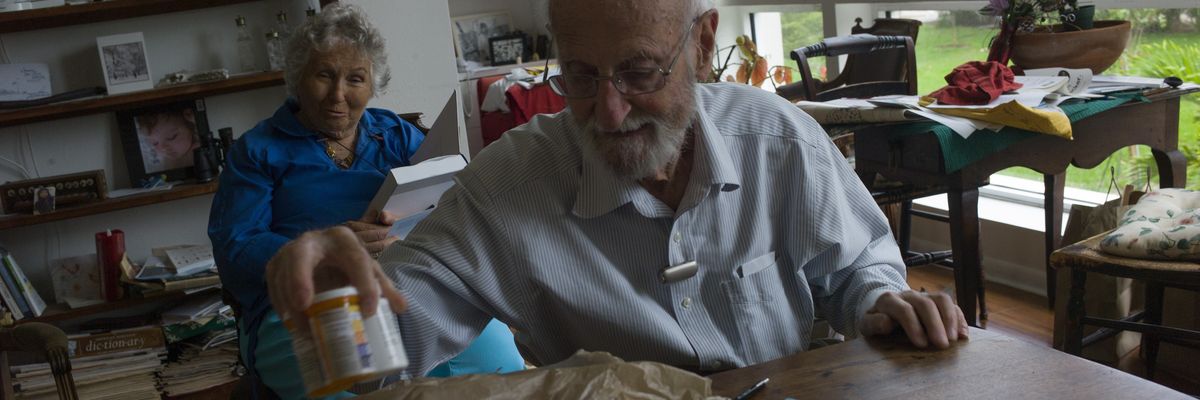
Charles Miller, 90, prepares the daily pills his wife will need for the week on January 4, 2020 in Sarasota, Florida.
Instead of following through on his proposed tax credit for family caregivers, Trump has made their lives even harder with Medicaid cuts and immigration crackdowns.
In a searing op-ed in the New York Times entitled "'We Had No Idea What Was Coming’: Caring for My Aging Father,” opinion writer Michelle Cottle shares her caregiving story and discusses how we as a nation support our family caregivers today. The substance and the emotions of Cottle’s essay will be all too familiar to anyone who has been a caregiver. In particular, the fact that no matter how much you know about health policy or navigating bureaucracy, or think you knew—when you are caregiving for someone you love, you realize you know far too little. For most of us, one of the first steps on a caregiving journey is the realization that you are alone and have to build your support team.
Caregiving was a hard task before Trump was reelected. Trump did not create the unrelenting and cruel world that family caregivers must navigate. He did, however, make it much harder. Cottle summarized this pain:
While caring for loved ones is a deeply personal charge, the weight of that responsibility is influenced by public policy in areas ranging from taxes to labor law to entitlement spending. In his 2024 campaign, Donald Trump promised a tax credit for family caregivers. “They add so much to our country and are never spoken of, ever, ever, ever, but they’re going to be spoken of now,” he vowed during a rally at Madison Square Garden the week before Election Day. Back in office, however, Mr. Trump promptly abandoned the idea. It was not among the raft of tax cuts in his domestic policy bill. Worse still, he has taken steps likely to make families’ caregiving burdens far heavier. Two major moves stand out. One is the slashing of Medicaid. The other is the broad-based assault on immigration. Together, those actions risk upending a caregiving ecosystem already under strain, throwing millions of families into crisis.
Let’s look at Cottle’s claims one by one. The most grievous blow that the Trump administration has wielded against America’s caregivers is the cuts to the Medicaid program which provides 61% of the nursing-home care in this country. According to the University of California at Berkeley School of Public Health, the One Big Beautiful Bill Act (OBBB), which Trump signed into law on July 4, 2025, includes cuts to Medicaid of almost $1 trillion over the next 10 years.
In addition to providing care in an institutional setting, Medicaid pays for a substantial amount of care for people in their homes. As the Kaiser Family Foundation reports, “Over one-third of Medicaid spending pays for long-term care, with most of the spending paying for home care—also known as ‘home- and community-based services’ or HCBS. Medicaid pays for almost 70% of all home care spending in the US, nearly all of which is provided through optional services.” The bottom line in all of these statistics is that Medicaid is the lifeblood of America’s caregivers.
Another way Trump has made life even harder for caregivers is through his immigration policies. As Cottle explains:
As Mr. Trump throttles the flow of immigrants into the United States, families are likely to have more and more difficulty finding help. Already, the cancellation of the temporary protected status of hundreds of thousands of migrants is causing upheaval. “We’re seeing a jarring, sudden loss of workers, of people who are being sent back” to their home countries, said Katie Smith Sloan, the head of LeadingAge, an association of community-based organizations that provide services for seniors.
Caregivers often depend on immigrants to provide care for our loved ones. You also know, if you have been on the frontlines of caregiving, how wonderful so many of these people are. Surely, if we can have an H-1B visa category to bring skills we do not have here in the USA, we can figure out a category for those who help us take care of our most vulnerable.
Finally, there is the question of the tax credit for caregiving. For all of Trump’s praise for his self-styled “One Big Beautiful Bill,” why did he not put in a simple tax credit that would benefit family caregivers? When you review a list of the tax changes in the OBBB, leaving out a tax credit for caregiving stands out as especially egregious. Furthermore, to add insult to injury, too many members of Congress and opinion writers have been silent on Trump’s refusal to provide the promised caregiving tax credit.
A tax credit is not the most effective way to help our beleaguered caregivers in the moment. Family caregivers need immediate help with things like finding at-home care and managing medications. A tax deduction they have to apply for when they file their income tax returns the following year is not the salve for our caregiving crisis. But, the president couldn’t even acknowledge the financial pain that caregiving afflicts on millions of Americans.
There is not a lot of good news for caregivers these days coming from Washington, DC. Almost all caregivers know this fact. However, many elected officials and opinion leaders turn a blind eye toward how Trump has failed caregivers. Recognizing this sad fact is not pleasant, but it is the first step toward giving America’s family caregivers the support they deserve.
Dear Common Dreams reader, It’s been nearly 30 years since I co-founded Common Dreams with my late wife, Lina Newhouser. We had the radical notion that journalism should serve the public good, not corporate profits. It was clear to us from the outset what it would take to build such a project. No paid advertisements. No corporate sponsors. No millionaire publisher telling us what to think or do. Many people said we wouldn't last a year, but we proved those doubters wrong. Together with a tremendous team of journalists and dedicated staff, we built an independent media outlet free from the constraints of profits and corporate control. Our mission has always been simple: To inform. To inspire. To ignite change for the common good. Building Common Dreams was not easy. Our survival was never guaranteed. When you take on the most powerful forces—Wall Street greed, fossil fuel industry destruction, Big Tech lobbyists, and uber-rich oligarchs who have spent billions upon billions rigging the economy and democracy in their favor—the only bulwark you have is supporters who believe in your work. But here’s the urgent message from me today. It's never been this bad out there. And it's never been this hard to keep us going. At the very moment Common Dreams is most needed, the threats we face are intensifying. We need your support now more than ever. We don't accept corporate advertising and never will. We don't have a paywall because we don't think people should be blocked from critical news based on their ability to pay. Everything we do is funded by the donations of readers like you. When everyone does the little they can afford, we are strong. But if that support retreats or dries up, so do we. Will you donate now to make sure Common Dreams not only survives but thrives? —Craig Brown, Co-founder |
In a searing op-ed in the New York Times entitled "'We Had No Idea What Was Coming’: Caring for My Aging Father,” opinion writer Michelle Cottle shares her caregiving story and discusses how we as a nation support our family caregivers today. The substance and the emotions of Cottle’s essay will be all too familiar to anyone who has been a caregiver. In particular, the fact that no matter how much you know about health policy or navigating bureaucracy, or think you knew—when you are caregiving for someone you love, you realize you know far too little. For most of us, one of the first steps on a caregiving journey is the realization that you are alone and have to build your support team.
Caregiving was a hard task before Trump was reelected. Trump did not create the unrelenting and cruel world that family caregivers must navigate. He did, however, make it much harder. Cottle summarized this pain:
While caring for loved ones is a deeply personal charge, the weight of that responsibility is influenced by public policy in areas ranging from taxes to labor law to entitlement spending. In his 2024 campaign, Donald Trump promised a tax credit for family caregivers. “They add so much to our country and are never spoken of, ever, ever, ever, but they’re going to be spoken of now,” he vowed during a rally at Madison Square Garden the week before Election Day. Back in office, however, Mr. Trump promptly abandoned the idea. It was not among the raft of tax cuts in his domestic policy bill. Worse still, he has taken steps likely to make families’ caregiving burdens far heavier. Two major moves stand out. One is the slashing of Medicaid. The other is the broad-based assault on immigration. Together, those actions risk upending a caregiving ecosystem already under strain, throwing millions of families into crisis.
Let’s look at Cottle’s claims one by one. The most grievous blow that the Trump administration has wielded against America’s caregivers is the cuts to the Medicaid program which provides 61% of the nursing-home care in this country. According to the University of California at Berkeley School of Public Health, the One Big Beautiful Bill Act (OBBB), which Trump signed into law on July 4, 2025, includes cuts to Medicaid of almost $1 trillion over the next 10 years.
In addition to providing care in an institutional setting, Medicaid pays for a substantial amount of care for people in their homes. As the Kaiser Family Foundation reports, “Over one-third of Medicaid spending pays for long-term care, with most of the spending paying for home care—also known as ‘home- and community-based services’ or HCBS. Medicaid pays for almost 70% of all home care spending in the US, nearly all of which is provided through optional services.” The bottom line in all of these statistics is that Medicaid is the lifeblood of America’s caregivers.
Another way Trump has made life even harder for caregivers is through his immigration policies. As Cottle explains:
As Mr. Trump throttles the flow of immigrants into the United States, families are likely to have more and more difficulty finding help. Already, the cancellation of the temporary protected status of hundreds of thousands of migrants is causing upheaval. “We’re seeing a jarring, sudden loss of workers, of people who are being sent back” to their home countries, said Katie Smith Sloan, the head of LeadingAge, an association of community-based organizations that provide services for seniors.
Caregivers often depend on immigrants to provide care for our loved ones. You also know, if you have been on the frontlines of caregiving, how wonderful so many of these people are. Surely, if we can have an H-1B visa category to bring skills we do not have here in the USA, we can figure out a category for those who help us take care of our most vulnerable.
Finally, there is the question of the tax credit for caregiving. For all of Trump’s praise for his self-styled “One Big Beautiful Bill,” why did he not put in a simple tax credit that would benefit family caregivers? When you review a list of the tax changes in the OBBB, leaving out a tax credit for caregiving stands out as especially egregious. Furthermore, to add insult to injury, too many members of Congress and opinion writers have been silent on Trump’s refusal to provide the promised caregiving tax credit.
A tax credit is not the most effective way to help our beleaguered caregivers in the moment. Family caregivers need immediate help with things like finding at-home care and managing medications. A tax deduction they have to apply for when they file their income tax returns the following year is not the salve for our caregiving crisis. But, the president couldn’t even acknowledge the financial pain that caregiving afflicts on millions of Americans.
There is not a lot of good news for caregivers these days coming from Washington, DC. Almost all caregivers know this fact. However, many elected officials and opinion leaders turn a blind eye toward how Trump has failed caregivers. Recognizing this sad fact is not pleasant, but it is the first step toward giving America’s family caregivers the support they deserve.
In a searing op-ed in the New York Times entitled "'We Had No Idea What Was Coming’: Caring for My Aging Father,” opinion writer Michelle Cottle shares her caregiving story and discusses how we as a nation support our family caregivers today. The substance and the emotions of Cottle’s essay will be all too familiar to anyone who has been a caregiver. In particular, the fact that no matter how much you know about health policy or navigating bureaucracy, or think you knew—when you are caregiving for someone you love, you realize you know far too little. For most of us, one of the first steps on a caregiving journey is the realization that you are alone and have to build your support team.
Caregiving was a hard task before Trump was reelected. Trump did not create the unrelenting and cruel world that family caregivers must navigate. He did, however, make it much harder. Cottle summarized this pain:
While caring for loved ones is a deeply personal charge, the weight of that responsibility is influenced by public policy in areas ranging from taxes to labor law to entitlement spending. In his 2024 campaign, Donald Trump promised a tax credit for family caregivers. “They add so much to our country and are never spoken of, ever, ever, ever, but they’re going to be spoken of now,” he vowed during a rally at Madison Square Garden the week before Election Day. Back in office, however, Mr. Trump promptly abandoned the idea. It was not among the raft of tax cuts in his domestic policy bill. Worse still, he has taken steps likely to make families’ caregiving burdens far heavier. Two major moves stand out. One is the slashing of Medicaid. The other is the broad-based assault on immigration. Together, those actions risk upending a caregiving ecosystem already under strain, throwing millions of families into crisis.
Let’s look at Cottle’s claims one by one. The most grievous blow that the Trump administration has wielded against America’s caregivers is the cuts to the Medicaid program which provides 61% of the nursing-home care in this country. According to the University of California at Berkeley School of Public Health, the One Big Beautiful Bill Act (OBBB), which Trump signed into law on July 4, 2025, includes cuts to Medicaid of almost $1 trillion over the next 10 years.
In addition to providing care in an institutional setting, Medicaid pays for a substantial amount of care for people in their homes. As the Kaiser Family Foundation reports, “Over one-third of Medicaid spending pays for long-term care, with most of the spending paying for home care—also known as ‘home- and community-based services’ or HCBS. Medicaid pays for almost 70% of all home care spending in the US, nearly all of which is provided through optional services.” The bottom line in all of these statistics is that Medicaid is the lifeblood of America’s caregivers.
Another way Trump has made life even harder for caregivers is through his immigration policies. As Cottle explains:
As Mr. Trump throttles the flow of immigrants into the United States, families are likely to have more and more difficulty finding help. Already, the cancellation of the temporary protected status of hundreds of thousands of migrants is causing upheaval. “We’re seeing a jarring, sudden loss of workers, of people who are being sent back” to their home countries, said Katie Smith Sloan, the head of LeadingAge, an association of community-based organizations that provide services for seniors.
Caregivers often depend on immigrants to provide care for our loved ones. You also know, if you have been on the frontlines of caregiving, how wonderful so many of these people are. Surely, if we can have an H-1B visa category to bring skills we do not have here in the USA, we can figure out a category for those who help us take care of our most vulnerable.
Finally, there is the question of the tax credit for caregiving. For all of Trump’s praise for his self-styled “One Big Beautiful Bill,” why did he not put in a simple tax credit that would benefit family caregivers? When you review a list of the tax changes in the OBBB, leaving out a tax credit for caregiving stands out as especially egregious. Furthermore, to add insult to injury, too many members of Congress and opinion writers have been silent on Trump’s refusal to provide the promised caregiving tax credit.
A tax credit is not the most effective way to help our beleaguered caregivers in the moment. Family caregivers need immediate help with things like finding at-home care and managing medications. A tax deduction they have to apply for when they file their income tax returns the following year is not the salve for our caregiving crisis. But, the president couldn’t even acknowledge the financial pain that caregiving afflicts on millions of Americans.
There is not a lot of good news for caregivers these days coming from Washington, DC. Almost all caregivers know this fact. However, many elected officials and opinion leaders turn a blind eye toward how Trump has failed caregivers. Recognizing this sad fact is not pleasant, but it is the first step toward giving America’s family caregivers the support they deserve.