
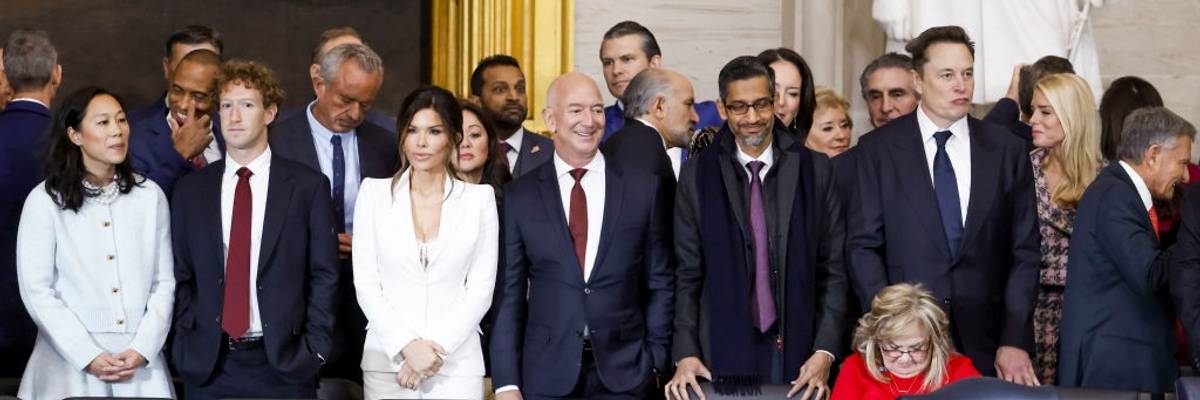
(L-R) Priscilla Chan, Meta CEO Mark Zuckerberg, Lauren Sanchez, businessman Jeff Bezos, Alphabet's CEO Sundar Pichai, and businessman Elon Musk, among other dignitaries, attend the United States Capitol on January 20, 2025 in Washington, D.C.
Trump’s Second Inauguration Symbolized the Reality of Oligarchic Power
The inaugural ceremony featured America’s three richest men—Elon Musk, Jeff Bezos, and Mark Zuckerberg—seated prominently in attendance, alongside other billionaires, as Trump addressed the nation.
Over three score years ago, former U.S. President Dwight Eisenhower had a warning for America.
“We must guard against the acquisition of unwarranted influence, whether sought or unsought, by the military-industrial complex,” Eisenhower exhorted in his 1961 farewell address. “The potential for the disastrous rise of misplaced power exists and will persist.”
“We must never let the weight of this combination,” Ike continued, “endanger our liberties or democratic processes.”
Our wealthiest have never enjoyed a greater direct presence at our government’s highest levels.
Sadly, Eisenhower’s warning went largely unheeded. In the years since, the “military-industrial complex” has morphed into an even more worrisome concentration of wealth and power.
In his own farewell address, former President Joe Biden gave that concentration a grim label. An “oligarchy” of “extreme wealth, power, and influence,” Biden intoned, now “literally threatens our entire democracy, our basic rights and freedoms, and a fair shot for everyone to get ahead.”
We now face a “dangerous concentration of power in the hands of very few ultra-wealthy people,” a reality that Biden warned is eroding our “unity and common purpose” and fomenting “distrust and division.”
The end result? We stand today unable to adequately confront the challenges that face us.
America’s oligarchs, Biden explained, are wielding “their unchecked influence to eliminate the steps we’ve taken to tackle the climate crisis.” By resisting safeguards over artificial intelligence—“the most consequential technology of our time”—they’re also opening the door to “new threats to our rights, our way of life, to our privacy, how we work, and how we protect our nation.”
Perhaps most ominously of all, these oligarchs are burying Americans “under an avalanche of misinformation and disinformation.”
”Participating in our democracy,” the departing president lamented, has become “exhausting and even disillusioning” for average Americans. They no longer “feel like they have a fair shot.”
But Biden also stressed that by working together, average Americans can shear our new oligarchy—and its “tech-industrial complex” core—down to democratic size. We can get the “dark money” of billionaires out of our politics. We can ban members of Congress from making stock trades while they’re legislating. We can tax the richest among us and make sure they’re paying their fair tax share.
In the days right after Biden’s farewell address, progressives added more specifics to Biden’s list of antidotes to oligarchy. We could and should, as former U.S. labor secretary Robert Reich pointed out, either bust up giant, billionaire-owned tech media platforms like X and Facebook or start treating these platforms as public utilities.
We could even ban our wealthiest from owning critical media properties.
But realizing any of these reforms won’t be easy. Our wealthiest have never enjoyed a greater direct presence at our government’s highest levels.
Nothing symbolized the reality of this oligarchic power like President Donald Trump’s second inauguration. The inaugural ceremony featured America’s three richest men—Elon Musk, Jeff Bezos, and Mark Zuckerberg—seated prominently in attendance, alongside other billionaires, as Trump addressed the nation.
“Everybody,” a satisfied president-elect Trump mused last month at a Mar-a-Lago news conference, “wants to be my friend.” Well, no, not everybody. Just everybody with a grand fortune that our new president—and his Republican controlled Congress—can zealously safeguard and grow.
So what can the rest of us do? With Trumpism locked in federally, we can challenge our oligarchs at the state and local level.
Maryland’s governor, for instance, has proposed a series of tax changes that would raise the combined state and local income tax rate on most Marylanders making over $1 million a year to 10.7%. But Maryland, one of the nation’s richest states, could do better. Rich Californians are already paying taxes at a 12% rate.
But that won’t happen more broadly unless average Americans organize—and confront our oligarchs at every opportunity.
An Urgent Message From Our Co-Founder
Dear Common Dreams reader, It’s been nearly 30 years since I co-founded Common Dreams with my late wife, Lina Newhouser. We had the radical notion that journalism should serve the public good, not corporate profits. It was clear to us from the outset what it would take to build such a project. No paid advertisements. No corporate sponsors. No millionaire publisher telling us what to think or do. Many people said we wouldn't last a year, but we proved those doubters wrong. Together with a tremendous team of journalists and dedicated staff, we built an independent media outlet free from the constraints of profits and corporate control. Our mission has always been simple: To inform. To inspire. To ignite change for the common good. Building Common Dreams was not easy. Our survival was never guaranteed. When you take on the most powerful forces—Wall Street greed, fossil fuel industry destruction, Big Tech lobbyists, and uber-rich oligarchs who have spent billions upon billions rigging the economy and democracy in their favor—the only bulwark you have is supporters who believe in your work. But here’s the urgent message from me today. It's never been this bad out there. And it's never been this hard to keep us going. At the very moment Common Dreams is most needed, the threats we face are intensifying. We need your support now more than ever. We don't accept corporate advertising and never will. We don't have a paywall because we don't think people should be blocked from critical news based on their ability to pay. Everything we do is funded by the donations of readers like you. When everyone does the little they can afford, we are strong. But if that support retreats or dries up, so do we. Will you donate now to make sure Common Dreams not only survives but thrives? —Craig Brown, Co-founder |
Over three score years ago, former U.S. President Dwight Eisenhower had a warning for America.
“We must guard against the acquisition of unwarranted influence, whether sought or unsought, by the military-industrial complex,” Eisenhower exhorted in his 1961 farewell address. “The potential for the disastrous rise of misplaced power exists and will persist.”
“We must never let the weight of this combination,” Ike continued, “endanger our liberties or democratic processes.”
Our wealthiest have never enjoyed a greater direct presence at our government’s highest levels.
Sadly, Eisenhower’s warning went largely unheeded. In the years since, the “military-industrial complex” has morphed into an even more worrisome concentration of wealth and power.
In his own farewell address, former President Joe Biden gave that concentration a grim label. An “oligarchy” of “extreme wealth, power, and influence,” Biden intoned, now “literally threatens our entire democracy, our basic rights and freedoms, and a fair shot for everyone to get ahead.”
We now face a “dangerous concentration of power in the hands of very few ultra-wealthy people,” a reality that Biden warned is eroding our “unity and common purpose” and fomenting “distrust and division.”
The end result? We stand today unable to adequately confront the challenges that face us.
America’s oligarchs, Biden explained, are wielding “their unchecked influence to eliminate the steps we’ve taken to tackle the climate crisis.” By resisting safeguards over artificial intelligence—“the most consequential technology of our time”—they’re also opening the door to “new threats to our rights, our way of life, to our privacy, how we work, and how we protect our nation.”
Perhaps most ominously of all, these oligarchs are burying Americans “under an avalanche of misinformation and disinformation.”
”Participating in our democracy,” the departing president lamented, has become “exhausting and even disillusioning” for average Americans. They no longer “feel like they have a fair shot.”
But Biden also stressed that by working together, average Americans can shear our new oligarchy—and its “tech-industrial complex” core—down to democratic size. We can get the “dark money” of billionaires out of our politics. We can ban members of Congress from making stock trades while they’re legislating. We can tax the richest among us and make sure they’re paying their fair tax share.
In the days right after Biden’s farewell address, progressives added more specifics to Biden’s list of antidotes to oligarchy. We could and should, as former U.S. labor secretary Robert Reich pointed out, either bust up giant, billionaire-owned tech media platforms like X and Facebook or start treating these platforms as public utilities.
We could even ban our wealthiest from owning critical media properties.
But realizing any of these reforms won’t be easy. Our wealthiest have never enjoyed a greater direct presence at our government’s highest levels.
Nothing symbolized the reality of this oligarchic power like President Donald Trump’s second inauguration. The inaugural ceremony featured America’s three richest men—Elon Musk, Jeff Bezos, and Mark Zuckerberg—seated prominently in attendance, alongside other billionaires, as Trump addressed the nation.
“Everybody,” a satisfied president-elect Trump mused last month at a Mar-a-Lago news conference, “wants to be my friend.” Well, no, not everybody. Just everybody with a grand fortune that our new president—and his Republican controlled Congress—can zealously safeguard and grow.
So what can the rest of us do? With Trumpism locked in federally, we can challenge our oligarchs at the state and local level.
Maryland’s governor, for instance, has proposed a series of tax changes that would raise the combined state and local income tax rate on most Marylanders making over $1 million a year to 10.7%. But Maryland, one of the nation’s richest states, could do better. Rich Californians are already paying taxes at a 12% rate.
But that won’t happen more broadly unless average Americans organize—and confront our oligarchs at every opportunity.
- Naming Oligarchy as Key Threat, Biden Channels Bernie Sanders in Farewell Address ›
- Progressives Say "Billionaires' Row" at Inauguration Ceremony Shows True Winners of Trump Agenda ›
- Martin Luther King Jr. Would Be Protesting at Trump’s Inauguration ›
- Trump Inauguration Dubbed 'A Coronation of Our Country's Descent Into Oligarchy' ›
Over three score years ago, former U.S. President Dwight Eisenhower had a warning for America.
“We must guard against the acquisition of unwarranted influence, whether sought or unsought, by the military-industrial complex,” Eisenhower exhorted in his 1961 farewell address. “The potential for the disastrous rise of misplaced power exists and will persist.”
“We must never let the weight of this combination,” Ike continued, “endanger our liberties or democratic processes.”
Our wealthiest have never enjoyed a greater direct presence at our government’s highest levels.
Sadly, Eisenhower’s warning went largely unheeded. In the years since, the “military-industrial complex” has morphed into an even more worrisome concentration of wealth and power.
In his own farewell address, former President Joe Biden gave that concentration a grim label. An “oligarchy” of “extreme wealth, power, and influence,” Biden intoned, now “literally threatens our entire democracy, our basic rights and freedoms, and a fair shot for everyone to get ahead.”
We now face a “dangerous concentration of power in the hands of very few ultra-wealthy people,” a reality that Biden warned is eroding our “unity and common purpose” and fomenting “distrust and division.”
The end result? We stand today unable to adequately confront the challenges that face us.
America’s oligarchs, Biden explained, are wielding “their unchecked influence to eliminate the steps we’ve taken to tackle the climate crisis.” By resisting safeguards over artificial intelligence—“the most consequential technology of our time”—they’re also opening the door to “new threats to our rights, our way of life, to our privacy, how we work, and how we protect our nation.”
Perhaps most ominously of all, these oligarchs are burying Americans “under an avalanche of misinformation and disinformation.”
”Participating in our democracy,” the departing president lamented, has become “exhausting and even disillusioning” for average Americans. They no longer “feel like they have a fair shot.”
But Biden also stressed that by working together, average Americans can shear our new oligarchy—and its “tech-industrial complex” core—down to democratic size. We can get the “dark money” of billionaires out of our politics. We can ban members of Congress from making stock trades while they’re legislating. We can tax the richest among us and make sure they’re paying their fair tax share.
In the days right after Biden’s farewell address, progressives added more specifics to Biden’s list of antidotes to oligarchy. We could and should, as former U.S. labor secretary Robert Reich pointed out, either bust up giant, billionaire-owned tech media platforms like X and Facebook or start treating these platforms as public utilities.
We could even ban our wealthiest from owning critical media properties.
But realizing any of these reforms won’t be easy. Our wealthiest have never enjoyed a greater direct presence at our government’s highest levels.
Nothing symbolized the reality of this oligarchic power like President Donald Trump’s second inauguration. The inaugural ceremony featured America’s three richest men—Elon Musk, Jeff Bezos, and Mark Zuckerberg—seated prominently in attendance, alongside other billionaires, as Trump addressed the nation.
“Everybody,” a satisfied president-elect Trump mused last month at a Mar-a-Lago news conference, “wants to be my friend.” Well, no, not everybody. Just everybody with a grand fortune that our new president—and his Republican controlled Congress—can zealously safeguard and grow.
So what can the rest of us do? With Trumpism locked in federally, we can challenge our oligarchs at the state and local level.
Maryland’s governor, for instance, has proposed a series of tax changes that would raise the combined state and local income tax rate on most Marylanders making over $1 million a year to 10.7%. But Maryland, one of the nation’s richest states, could do better. Rich Californians are already paying taxes at a 12% rate.
But that won’t happen more broadly unless average Americans organize—and confront our oligarchs at every opportunity.
- Naming Oligarchy as Key Threat, Biden Channels Bernie Sanders in Farewell Address ›
- Progressives Say "Billionaires' Row" at Inauguration Ceremony Shows True Winners of Trump Agenda ›
- Martin Luther King Jr. Would Be Protesting at Trump’s Inauguration ›
- Trump Inauguration Dubbed 'A Coronation of Our Country's Descent Into Oligarchy' ›