SUBSCRIBE TO OUR FREE NEWSLETTER
Daily news & progressive opinion—funded by the people, not the corporations—delivered straight to your inbox.
5
#000000
#FFFFFF
To donate by check, phone, or other method, see our More Ways to Give page.
Daily news & progressive opinion—funded by the people, not the corporations—delivered straight to your inbox.
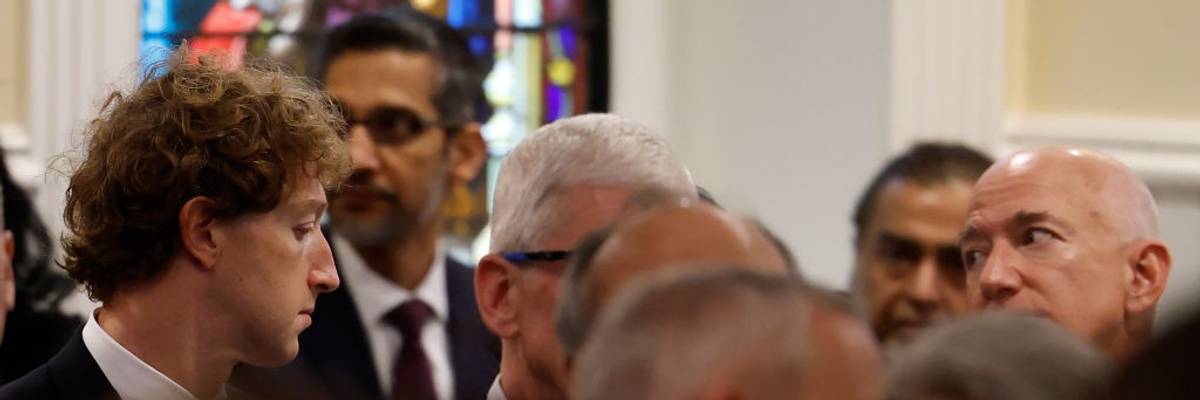
Meta and Facebook CEO Mark Zuckerberg (L), CEO of Apple Tim Cook, and Founder of Amazon and Blue Origin Jeff Bezos attend services as part of Inauguration ceremonies at St. John's Church on January 20, 2025 in Washington, D.C.
The very ripeness for scandal this time around calls for reasonable restrictions on the sources and amounts of inaugural donations.
U.S. President Donald Trump sounded a lot of populist notes on the campaign trail. But as he took the oath of office for the second time, he was joined onstage by billionaires and CEOs who’d spent millions to be there—leaving supporters who’d traveled across the country to attend literally out in the cold.
Presidential inaugurations have always been an opportunity for wealthy special interests to curry favor with the incoming administration with generous inaugural donations. But the nation has never seen influence peddling like we just witnessed at Trump’s second inauguration.
Shattering all records, the Trump Vance Inaugural Committee, Inc. raised and spent over $200 million in special interest money celebrating the 2024 election victory. (The all-time previous record was $107 million for Trump’s first inauguration in 2017. By contrast, former President Joe Biden’s 2021 inauguration raised and spent nearly $62 million.)
The sheer volume of today’s inaugural donations suggests that wealthy special interests believe it is worth the investment.
Nearly all this financing comes from companies and wealthy business leaders who have business pending before the incoming administration. Rarely are small donations received from citizens simply excited about a new president.
The public won’t get a full picture of Trump’s inaugural donors until the spring, when the one-and-only disclosure report is filed 90 days after the inauguration. But the ones we know about so far are painting an ugly picture of corporations, government contractors, billionaires, and millionaires seeking to endear themselves to Trump and his administration.
All the self-reporting donors—including Big Tech firms like Google, Microsoft, Meta, Amazon, and OpenAI—pledged $1 million or more. The cryptocurrency firm Ripple pledged $5 million. In fact, the cryptocurrency industry even hosted its own inaugural ball.
And of course, Wall Street is cozying up with major donations from Goldman Sachs, Bank of America, and billionaire hedge fund manager Ken Griffin.
“EVERYBODY WANTS TO BE MY FRIEND!!!” Trump marvels on his Truth Social account.
Some of these new friends previously expressed opposition toward Trump, who has a history of seeking revenge against his adversaries and even said he might seek retribution in his second administration. “When this election is over… I would have every right to go after them,” Trump said of his political opponents over the summer.
In addition to being former Trump critics, Mark Zuckerberg of Meta, Jeff Bezos of Amazon, and Sam Altman of OpenAI have their sights on major government contracts from the new administration. Each has now donated $1 million to Trump’s Inauguration. Zuckerberg and Bezos even partied with Trump at Mar-a-Lago and at the inauguration in DC.
What else does all this money buy? Access. Access itself does not necessarily mean success at buying official favors. But the sheer volume of today’s inaugural donations suggests that wealthy special interests believe it is worth the investment.
Presidential inaugurations have not always been such a soiree for the wealthy. Former President Richard Nixon in 1973 spent less than $4 million on his inauguration. Former President Jimmy Carter in 1977 spent $3.5 million. Thomas Jefferson in 1801 simply walked to the Capitol to be sworn in and then walked home.
The very ripeness for scandal this time around calls for reasonable restrictions on the sources and amounts of inaugural donations. Corporations, and certainly government contractors, should be banned from donating.
Contributions should be limited to avoid even the appearance of buying favors. The disclosure requirement should be vastly expanded to include disclosing expenditures as well as donations. And rules should be established on how surplus funds are dispensed.
Presidential inaugurations should be celebrations for the nation as a whole, not influence-peddling opportunities for the very wealthy.
This country and this world are at a monumental crossroads. US voters have an opportunity to beat back the forces of fascism and confront the billionaires who are rigging the economy, our media system, and our democracy, making it increasingly impossible for ordinary people to get by. We’re not just talking about the election. We’re talking about what must be done once these fascist elements are vanquished from power. We need a bolder set of solutions than what either major party has so far been willing to offer and a working-class movement ready to fight like hell for it. Trump didn't emerge from nowhere. The conditions that fueled MAGA authoritarianism were created by decades of radical neoliberal economic policies and a corrupt political system dominated by corporate interests. They slashed taxes on the super-rich, promising that the benefits would trickle down. They said giveaways to the corporate titans would make life more affordable for the rest of us. It was all bullshit. And when a bitter, betrayed populace searches for someone to blame, right-wing demagogues have little trouble finding scapegoats. People know when they're being lied to, but you won't hear any of this from the corporate media. Only independent journalism—powered and funded by people who believe in building a better world—can deliver truly trustworthy daily news. If you share our vision, please contribute whatever you can to sustain our work. |
U.S. President Donald Trump sounded a lot of populist notes on the campaign trail. But as he took the oath of office for the second time, he was joined onstage by billionaires and CEOs who’d spent millions to be there—leaving supporters who’d traveled across the country to attend literally out in the cold.
Presidential inaugurations have always been an opportunity for wealthy special interests to curry favor with the incoming administration with generous inaugural donations. But the nation has never seen influence peddling like we just witnessed at Trump’s second inauguration.
Shattering all records, the Trump Vance Inaugural Committee, Inc. raised and spent over $200 million in special interest money celebrating the 2024 election victory. (The all-time previous record was $107 million for Trump’s first inauguration in 2017. By contrast, former President Joe Biden’s 2021 inauguration raised and spent nearly $62 million.)
The sheer volume of today’s inaugural donations suggests that wealthy special interests believe it is worth the investment.
Nearly all this financing comes from companies and wealthy business leaders who have business pending before the incoming administration. Rarely are small donations received from citizens simply excited about a new president.
The public won’t get a full picture of Trump’s inaugural donors until the spring, when the one-and-only disclosure report is filed 90 days after the inauguration. But the ones we know about so far are painting an ugly picture of corporations, government contractors, billionaires, and millionaires seeking to endear themselves to Trump and his administration.
All the self-reporting donors—including Big Tech firms like Google, Microsoft, Meta, Amazon, and OpenAI—pledged $1 million or more. The cryptocurrency firm Ripple pledged $5 million. In fact, the cryptocurrency industry even hosted its own inaugural ball.
And of course, Wall Street is cozying up with major donations from Goldman Sachs, Bank of America, and billionaire hedge fund manager Ken Griffin.
“EVERYBODY WANTS TO BE MY FRIEND!!!” Trump marvels on his Truth Social account.
Some of these new friends previously expressed opposition toward Trump, who has a history of seeking revenge against his adversaries and even said he might seek retribution in his second administration. “When this election is over… I would have every right to go after them,” Trump said of his political opponents over the summer.
In addition to being former Trump critics, Mark Zuckerberg of Meta, Jeff Bezos of Amazon, and Sam Altman of OpenAI have their sights on major government contracts from the new administration. Each has now donated $1 million to Trump’s Inauguration. Zuckerberg and Bezos even partied with Trump at Mar-a-Lago and at the inauguration in DC.
What else does all this money buy? Access. Access itself does not necessarily mean success at buying official favors. But the sheer volume of today’s inaugural donations suggests that wealthy special interests believe it is worth the investment.
Presidential inaugurations have not always been such a soiree for the wealthy. Former President Richard Nixon in 1973 spent less than $4 million on his inauguration. Former President Jimmy Carter in 1977 spent $3.5 million. Thomas Jefferson in 1801 simply walked to the Capitol to be sworn in and then walked home.
The very ripeness for scandal this time around calls for reasonable restrictions on the sources and amounts of inaugural donations. Corporations, and certainly government contractors, should be banned from donating.
Contributions should be limited to avoid even the appearance of buying favors. The disclosure requirement should be vastly expanded to include disclosing expenditures as well as donations. And rules should be established on how surplus funds are dispensed.
Presidential inaugurations should be celebrations for the nation as a whole, not influence-peddling opportunities for the very wealthy.