SUBSCRIBE TO OUR FREE NEWSLETTER
Daily news & progressive opinion—funded by the people, not the corporations—delivered straight to your inbox.
5
#000000
#FFFFFF
To donate by check, phone, or other method, see our More Ways to Give page.
Not even two months in office and President Donald Trump has slashed U.S. climate partnerships and aid to developing countries, notably from USAID. Expected? Yes. International anomaly? No.
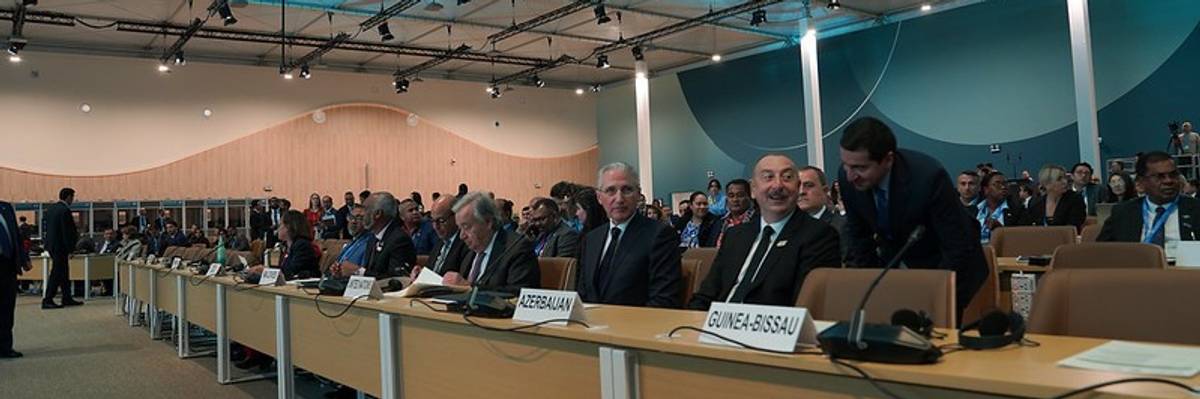
Last November's COP29 conference on climate finance showed the widespread vapidity of global action. Inger Andersen, executive director of the United Nations Environment Program, revealed 1,200 notifications went out about significant gas leaks over the past two years to governments and businesses around the world. Only 1% responded. The U.N. acknowledged "capacity issues, technical barriers, and a lack of accountability," but failed to acknowledge another contributing factor. People are fundamentally not incentivized to care—because the climate crisis is consistently poorly communicated.
Publications like The New York Times typically report climate change like this: "Emissions soared to a record 57 gigatons last year." The U.N. Emissions Gap report's front page has this seething call to action: "Limit global warming to 1.5°C, struggle to adapt to 2°C, or face catastrophic consequences at 2.6°C and beyond." The media skews toward this numerical doom-and-gloom for two main reasons: One, journalists are often taught people pay attention to negative information. Two, scientists are often taught numbers speak for themselves. Logically then, numbers with negative consequences should make people care…
Instead of telling governments to fix a leak because the "data says so," we need to emphasize the positive impact on people.
No. As someone with training in data journalism and storytelling, I advise considering the underlying psychology. In 2023, a Pew Research Center survey revealed 7 in 10 Americans feel "sad about what is happening to the Earth" after seeing climate change in the news. Despite that negative frame, only about 4 in 10 Americans feel "optimistic we can address climate change" when they see news on the topic. And only about 1 in 10 Americans feel activism is "extremely or very effective at getting elected officials to act on the issue." Sadness, fear, and anxiety don't often translate to motivation.
"Climate change" and "greenhouse gases" are simply too abstract. When former U.S. President Joe Biden said climate change is an "existential threat to all of us," it felt like a hypothetical issue. When the media reduces climate change to facts and numbers—to "emissions" and "gigatons" and "degrees Celsius"—it feels like a psychologically distant entity devoid of humanity and ineligible for our care.
How then should we communicate? Maybe the solution is emphasizing the negative consequences on human beings… showing images of wildfires destroying communities and people suffering from drought. Nonprofits, for example, traditionally use negative imagery of emaciated children, often Black and brown, to get donors' attention. And many studies show this "poverty porn" works. After Haiti was severely damaged by an earthquake in 2010, for example, the negative images of victims was criticized by the media. But it led to the second biggest success in the organization's fundraising history.
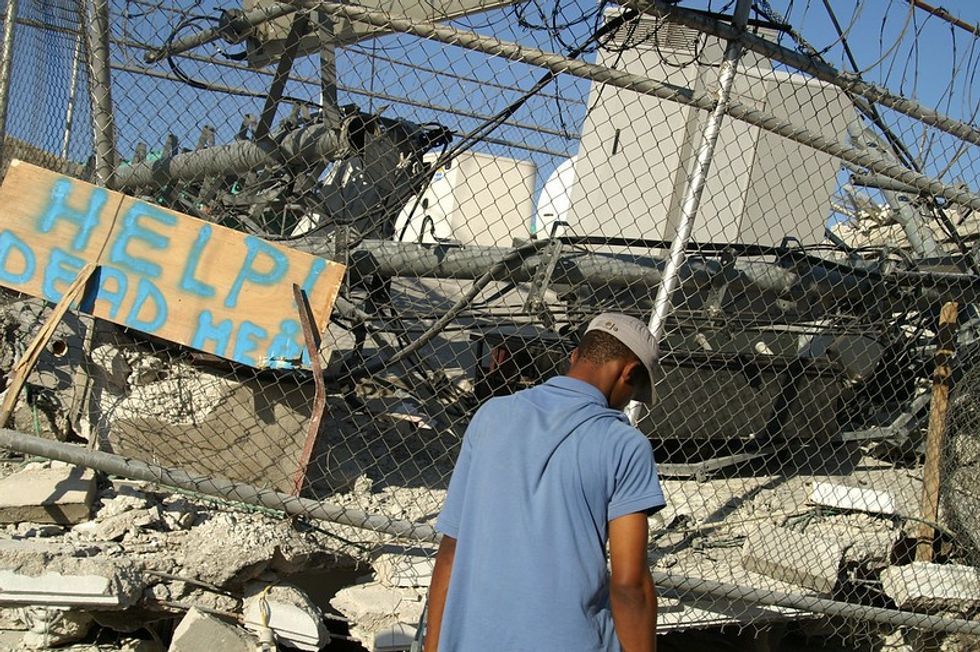 Destroyed Houses during Haiti's Earthquake in 2010. (Photo: ECHO/Raphaël Brigandi via Flickr).
These conclusions, however, lack nuance and ethics. Negative imagery may inspire pity and a donation out of guilt in the short-term. But it can lead to decreased care in the long-term. By portraying people in an undignified light, as "others" in need of "saving," we fetishize their suffering and infantilize their agency. Research demonstrates we attribute less respect and less agency to those in helpless, suffering outgroups, and are less likely to back policies that support them.
If negative data, "poverty porn," and "disaster porn" all aren't the answer, what then is? In my TEDx talk on data communication, I emphasize how emotion guides our decision-making. Research has found people gave the most money to charity after hearing simple stories that start with sadness and end on hope. Yes, negative frames do grab attention and elicit sympathy. But evidence of success emotionally inspires us to act.
Consider the U.N.'s 1% response rate to gas leak notifications. According to the executive director, "We are quite literally talking about screwing bolts tighter in some cases." Our current approach can't even get governments to screw in a bolt. If we want global leaders to keep their COP29 promise of $300 billion in annual funding for developing countries (which the U.S. certainly isn't helping with anymore), we desperately need to pivot.
Instead of telling governments to fix a leak because the "data says so," we need to emphasize the positive impact on people. How will decreasing your abstract methane emissions lead to better health for human beings? How will donating trillions to some abstract goal of "1.5°C" benefit people in your local community that you personally care about? If we want the climate crisis to be seen as not just an "existential" environmental problem, but a horrifically human one happening right now close to home, we need to stop sharing negative stats and start telling hopeful stories. Especially with staunch resistance from a second Trump administration, we need to communicate the climate crisis in a much more human and much more ethical way if we are to inspire global action.
Not even two months in office and President Donald Trump has slashed U.S. climate partnerships and aid to developing countries, notably from USAID. Expected? Yes. International anomaly? No.
Last November's COP29 conference on climate finance showed the widespread vapidity of global action. Inger Andersen, executive director of the United Nations Environment Program, revealed 1,200 notifications went out about significant gas leaks over the past two years to governments and businesses around the world. Only 1% responded. The U.N. acknowledged "capacity issues, technical barriers, and a lack of accountability," but failed to acknowledge another contributing factor. People are fundamentally not incentivized to care—because the climate crisis is consistently poorly communicated.
Publications like The New York Times typically report climate change like this: "Emissions soared to a record 57 gigatons last year." The U.N. Emissions Gap report's front page has this seething call to action: "Limit global warming to 1.5°C, struggle to adapt to 2°C, or face catastrophic consequences at 2.6°C and beyond." The media skews toward this numerical doom-and-gloom for two main reasons: One, journalists are often taught people pay attention to negative information. Two, scientists are often taught numbers speak for themselves. Logically then, numbers with negative consequences should make people care…
Instead of telling governments to fix a leak because the "data says so," we need to emphasize the positive impact on people.
No. As someone with training in data journalism and storytelling, I advise considering the underlying psychology. In 2023, a Pew Research Center survey revealed 7 in 10 Americans feel "sad about what is happening to the Earth" after seeing climate change in the news. Despite that negative frame, only about 4 in 10 Americans feel "optimistic we can address climate change" when they see news on the topic. And only about 1 in 10 Americans feel activism is "extremely or very effective at getting elected officials to act on the issue." Sadness, fear, and anxiety don't often translate to motivation.
"Climate change" and "greenhouse gases" are simply too abstract. When former U.S. President Joe Biden said climate change is an "existential threat to all of us," it felt like a hypothetical issue. When the media reduces climate change to facts and numbers—to "emissions" and "gigatons" and "degrees Celsius"—it feels like a psychologically distant entity devoid of humanity and ineligible for our care.
How then should we communicate? Maybe the solution is emphasizing the negative consequences on human beings… showing images of wildfires destroying communities and people suffering from drought. Nonprofits, for example, traditionally use negative imagery of emaciated children, often Black and brown, to get donors' attention. And many studies show this "poverty porn" works. After Haiti was severely damaged by an earthquake in 2010, for example, the negative images of victims was criticized by the media. But it led to the second biggest success in the organization's fundraising history.
Destroyed Houses during Haiti's Earthquake in 2010. (Photo: ECHO/Raphaël Brigandi via Flickr).
These conclusions, however, lack nuance and ethics. Negative imagery may inspire pity and a donation out of guilt in the short-term. But it can lead to decreased care in the long-term. By portraying people in an undignified light, as "others" in need of "saving," we fetishize their suffering and infantilize their agency. Research demonstrates we attribute less respect and less agency to those in helpless, suffering outgroups, and are less likely to back policies that support them.
If negative data, "poverty porn," and "disaster porn" all aren't the answer, what then is? In my TEDx talk on data communication, I emphasize how emotion guides our decision-making. Research has found people gave the most money to charity after hearing simple stories that start with sadness and end on hope. Yes, negative frames do grab attention and elicit sympathy. But evidence of success emotionally inspires us to act.
Consider the U.N.'s 1% response rate to gas leak notifications. According to the executive director, "We are quite literally talking about screwing bolts tighter in some cases." Our current approach can't even get governments to screw in a bolt. If we want global leaders to keep their COP29 promise of $300 billion in annual funding for developing countries (which the U.S. certainly isn't helping with anymore), we desperately need to pivot.
Instead of telling governments to fix a leak because the "data says so," we need to emphasize the positive impact on people. How will decreasing your abstract methane emissions lead to better health for human beings? How will donating trillions to some abstract goal of "1.5°C" benefit people in your local community that you personally care about? If we want the climate crisis to be seen as not just an "existential" environmental problem, but a horrifically human one happening right now close to home, we need to stop sharing negative stats and start telling hopeful stories. Especially with staunch resistance from a second Trump administration, we need to communicate the climate crisis in a much more human and much more ethical way if we are to inspire global action.
Not even two months in office and President Donald Trump has slashed U.S. climate partnerships and aid to developing countries, notably from USAID. Expected? Yes. International anomaly? No.
Last November's COP29 conference on climate finance showed the widespread vapidity of global action. Inger Andersen, executive director of the United Nations Environment Program, revealed 1,200 notifications went out about significant gas leaks over the past two years to governments and businesses around the world. Only 1% responded. The U.N. acknowledged "capacity issues, technical barriers, and a lack of accountability," but failed to acknowledge another contributing factor. People are fundamentally not incentivized to care—because the climate crisis is consistently poorly communicated.
Publications like The New York Times typically report climate change like this: "Emissions soared to a record 57 gigatons last year." The U.N. Emissions Gap report's front page has this seething call to action: "Limit global warming to 1.5°C, struggle to adapt to 2°C, or face catastrophic consequences at 2.6°C and beyond." The media skews toward this numerical doom-and-gloom for two main reasons: One, journalists are often taught people pay attention to negative information. Two, scientists are often taught numbers speak for themselves. Logically then, numbers with negative consequences should make people care…
Instead of telling governments to fix a leak because the "data says so," we need to emphasize the positive impact on people.
No. As someone with training in data journalism and storytelling, I advise considering the underlying psychology. In 2023, a Pew Research Center survey revealed 7 in 10 Americans feel "sad about what is happening to the Earth" after seeing climate change in the news. Despite that negative frame, only about 4 in 10 Americans feel "optimistic we can address climate change" when they see news on the topic. And only about 1 in 10 Americans feel activism is "extremely or very effective at getting elected officials to act on the issue." Sadness, fear, and anxiety don't often translate to motivation.
"Climate change" and "greenhouse gases" are simply too abstract. When former U.S. President Joe Biden said climate change is an "existential threat to all of us," it felt like a hypothetical issue. When the media reduces climate change to facts and numbers—to "emissions" and "gigatons" and "degrees Celsius"—it feels like a psychologically distant entity devoid of humanity and ineligible for our care.
How then should we communicate? Maybe the solution is emphasizing the negative consequences on human beings… showing images of wildfires destroying communities and people suffering from drought. Nonprofits, for example, traditionally use negative imagery of emaciated children, often Black and brown, to get donors' attention. And many studies show this "poverty porn" works. After Haiti was severely damaged by an earthquake in 2010, for example, the negative images of victims was criticized by the media. But it led to the second biggest success in the organization's fundraising history.
Destroyed Houses during Haiti's Earthquake in 2010. (Photo: ECHO/Raphaël Brigandi via Flickr).
These conclusions, however, lack nuance and ethics. Negative imagery may inspire pity and a donation out of guilt in the short-term. But it can lead to decreased care in the long-term. By portraying people in an undignified light, as "others" in need of "saving," we fetishize their suffering and infantilize their agency. Research demonstrates we attribute less respect and less agency to those in helpless, suffering outgroups, and are less likely to back policies that support them.
If negative data, "poverty porn," and "disaster porn" all aren't the answer, what then is? In my TEDx talk on data communication, I emphasize how emotion guides our decision-making. Research has found people gave the most money to charity after hearing simple stories that start with sadness and end on hope. Yes, negative frames do grab attention and elicit sympathy. But evidence of success emotionally inspires us to act.
Consider the U.N.'s 1% response rate to gas leak notifications. According to the executive director, "We are quite literally talking about screwing bolts tighter in some cases." Our current approach can't even get governments to screw in a bolt. If we want global leaders to keep their COP29 promise of $300 billion in annual funding for developing countries (which the U.S. certainly isn't helping with anymore), we desperately need to pivot.
Instead of telling governments to fix a leak because the "data says so," we need to emphasize the positive impact on people. How will decreasing your abstract methane emissions lead to better health for human beings? How will donating trillions to some abstract goal of "1.5°C" benefit people in your local community that you personally care about? If we want the climate crisis to be seen as not just an "existential" environmental problem, but a horrifically human one happening right now close to home, we need to stop sharing negative stats and start telling hopeful stories. Especially with staunch resistance from a second Trump administration, we need to communicate the climate crisis in a much more human and much more ethical way if we are to inspire global action.