SUBSCRIBE TO OUR FREE NEWSLETTER
Daily news & progressive opinion—funded by the people, not the corporations—delivered straight to your inbox.
5
#000000
#FFFFFF
To donate by check, phone, or other method, see our More Ways to Give page.
Daily news & progressive opinion—funded by the people, not the corporations—delivered straight to your inbox.
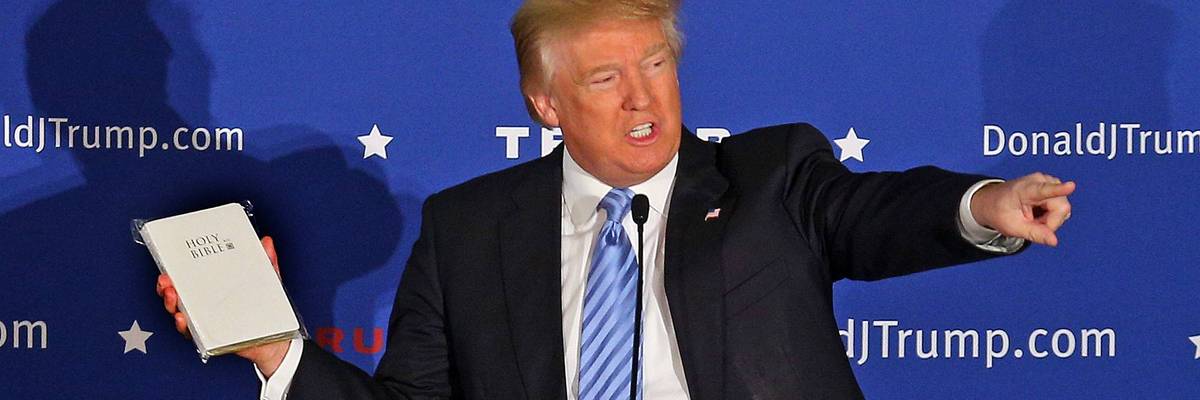
Then-Republican candidate for President Donald Trump shows off a bible given him by someone in the crowd during an event in Windham, New Hampshire on Monday, January 11, 2016.
When the eyes of all people were upon Winthrop's 'city upon a hill,' what they saw was a community established by genocide and based on slavery. Winthrop advocated for, and participated in, both.
On Tuesday night, President Donald Trump participated in America Reads the Bible, in which hundreds of political, faith, business, and entertainment leaders will each read a passage until the entire bible has been read.
Trump read from II Chronicles 7:11-22, including the passage, “If My people, which are called by my name, shall humble themselves, and pray, and seek my face, and turn from their wicked ways; then will I hear from heaven, and will forgive their sin, and will heal their land.”
According to many media outlets, the passage is “a hallmark of the religious right” that implies a covenant between God and the United States and advances the belief “that America has been and should be a Christian nation.”
In his “Message Commemorating 250 Years of the Bible in America,” Trump praised the marathon event and said, “The Bible has been indelibly woven into our national identity and way of life.” He said that throughout the history of the United States, “The truths of Holy Scripture remained deeply embedded in our culture—not only within the walls of our churches but in our homes, schools, courtrooms, and public square.” Continuing a theme that challenges the spirit of the separation of church and state, Trump added that “the Bible has enduringly illuminated our system of Government.”
And Winthrop participated in that slavery too. In his will, he left his slaves—he called them “my Indians”—to his son.
But the most offensive and appalling part of Trump’s Presidential Message was his invocation of John Winthrop to provide a historical foundation for America Reads the Bible and his participation in it. Trump said: “Nearly 400 years ago, a decade after the arrival of the Mayflower, the legendary John Winthrop powerfully invoked Jesus Christ’s Sermon on the Mount as recorded in the Gospel of Matthew: ‘We must consider that we shall be as a city upon a hill. The eyes of all people are upon us,’ Winthrop said, imploring his fellow Christian settlers to stand as a beacon of faith for all the world to see.”
The horror of invoking John Winthrop as a foundation for America as a city upon a hill and a Christian land, is that when the eyes of all people were upon us what they saw was a community established by genocide and based on slavery. Winthrop advocated for, and participated in, both.
In 1620, the Mayflower landed in America. Most of the Indigenous people had died in an epidemic brought, unintentionally, by the British. The few Indigenous people who survived the epidemic helped the English survive that first harsh winter. But, because of the epidemic, the English found many once thriving villages empty.
The Puritans used the emptying results of the epidemic to justify the stealing of the land. They sanctioned their crime by appealing to divine providence. One of the leading spokesmen for divine justification for stealing Indigenous land was Winthrop: “God hath consumed the natives with a miraculous plague, whereby the greater part of the country is left void of inhabitants.”
Winthrop would go on to become one of the vanguards of a movement that defended the legal right to take any land that was not currently inhabited or developed without purchase or deed, ignoring the rights of Indigenous people if they were not currently or permanently on the land or if they were not developing it (or even if they were).
And he was not at all above helping the land to become empty. As Greg Grandin, history professor at Yale University told me, “Winthrop presided over the 1637 Pequot War, the first New World Anglo-American massacre, of hundreds of Pequot women and children who were burned alive in their village.” Grandin quotes Winthrop saying it was a “fearful sight to see them thus frying in the fier, and the streams of blood quenching the same.” Those who survived were taken as legal slaves having been captured in a just war.
And Winthrop participated in that slavery too. In his will, he left his slaves—he called them “my Indians”—to his son. In America, América: A New History of the New World, Grandin says that Winthrop’s “Indians” were taken in the Pequot War and made his property.
It is to this appalling history that Trump appeals in explaining his participation in America Reads the Bible.
Dear Common Dreams reader, It’s been nearly 30 years since I co-founded Common Dreams with my late wife, Lina Newhouser. We had the radical notion that journalism should serve the public good, not corporate profits. It was clear to us from the outset what it would take to build such a project. No paid advertisements. No corporate sponsors. No millionaire publisher telling us what to think or do. Many people said we wouldn't last a year, but we proved those doubters wrong. Together with a tremendous team of journalists and dedicated staff, we built an independent media outlet free from the constraints of profits and corporate control. Our mission has always been simple: To inform. To inspire. To ignite change for the common good. Building Common Dreams was not easy. Our survival was never guaranteed. When you take on the most powerful forces—Wall Street greed, fossil fuel industry destruction, Big Tech lobbyists, and uber-rich oligarchs who have spent billions upon billions rigging the economy and democracy in their favor—the only bulwark you have is supporters who believe in your work. But here’s the urgent message from me today. It's never been this bad out there. And it's never been this hard to keep us going. At the very moment Common Dreams is most needed, the threats we face are intensifying. We need your support now more than ever. We don't accept corporate advertising and never will. We don't have a paywall because we don't think people should be blocked from critical news based on their ability to pay. Everything we do is funded by the donations of readers like you. When everyone does the little they can afford, we are strong. But if that support retreats or dries up, so do we. Will you donate now to make sure Common Dreams not only survives but thrives? —Craig Brown, Co-founder |
On Tuesday night, President Donald Trump participated in America Reads the Bible, in which hundreds of political, faith, business, and entertainment leaders will each read a passage until the entire bible has been read.
Trump read from II Chronicles 7:11-22, including the passage, “If My people, which are called by my name, shall humble themselves, and pray, and seek my face, and turn from their wicked ways; then will I hear from heaven, and will forgive their sin, and will heal their land.”
According to many media outlets, the passage is “a hallmark of the religious right” that implies a covenant between God and the United States and advances the belief “that America has been and should be a Christian nation.”
In his “Message Commemorating 250 Years of the Bible in America,” Trump praised the marathon event and said, “The Bible has been indelibly woven into our national identity and way of life.” He said that throughout the history of the United States, “The truths of Holy Scripture remained deeply embedded in our culture—not only within the walls of our churches but in our homes, schools, courtrooms, and public square.” Continuing a theme that challenges the spirit of the separation of church and state, Trump added that “the Bible has enduringly illuminated our system of Government.”
And Winthrop participated in that slavery too. In his will, he left his slaves—he called them “my Indians”—to his son.
But the most offensive and appalling part of Trump’s Presidential Message was his invocation of John Winthrop to provide a historical foundation for America Reads the Bible and his participation in it. Trump said: “Nearly 400 years ago, a decade after the arrival of the Mayflower, the legendary John Winthrop powerfully invoked Jesus Christ’s Sermon on the Mount as recorded in the Gospel of Matthew: ‘We must consider that we shall be as a city upon a hill. The eyes of all people are upon us,’ Winthrop said, imploring his fellow Christian settlers to stand as a beacon of faith for all the world to see.”
The horror of invoking John Winthrop as a foundation for America as a city upon a hill and a Christian land, is that when the eyes of all people were upon us what they saw was a community established by genocide and based on slavery. Winthrop advocated for, and participated in, both.
In 1620, the Mayflower landed in America. Most of the Indigenous people had died in an epidemic brought, unintentionally, by the British. The few Indigenous people who survived the epidemic helped the English survive that first harsh winter. But, because of the epidemic, the English found many once thriving villages empty.
The Puritans used the emptying results of the epidemic to justify the stealing of the land. They sanctioned their crime by appealing to divine providence. One of the leading spokesmen for divine justification for stealing Indigenous land was Winthrop: “God hath consumed the natives with a miraculous plague, whereby the greater part of the country is left void of inhabitants.”
Winthrop would go on to become one of the vanguards of a movement that defended the legal right to take any land that was not currently inhabited or developed without purchase or deed, ignoring the rights of Indigenous people if they were not currently or permanently on the land or if they were not developing it (or even if they were).
And he was not at all above helping the land to become empty. As Greg Grandin, history professor at Yale University told me, “Winthrop presided over the 1637 Pequot War, the first New World Anglo-American massacre, of hundreds of Pequot women and children who were burned alive in their village.” Grandin quotes Winthrop saying it was a “fearful sight to see them thus frying in the fier, and the streams of blood quenching the same.” Those who survived were taken as legal slaves having been captured in a just war.
And Winthrop participated in that slavery too. In his will, he left his slaves—he called them “my Indians”—to his son. In America, América: A New History of the New World, Grandin says that Winthrop’s “Indians” were taken in the Pequot War and made his property.
It is to this appalling history that Trump appeals in explaining his participation in America Reads the Bible.
On Tuesday night, President Donald Trump participated in America Reads the Bible, in which hundreds of political, faith, business, and entertainment leaders will each read a passage until the entire bible has been read.
Trump read from II Chronicles 7:11-22, including the passage, “If My people, which are called by my name, shall humble themselves, and pray, and seek my face, and turn from their wicked ways; then will I hear from heaven, and will forgive their sin, and will heal their land.”
According to many media outlets, the passage is “a hallmark of the religious right” that implies a covenant between God and the United States and advances the belief “that America has been and should be a Christian nation.”
In his “Message Commemorating 250 Years of the Bible in America,” Trump praised the marathon event and said, “The Bible has been indelibly woven into our national identity and way of life.” He said that throughout the history of the United States, “The truths of Holy Scripture remained deeply embedded in our culture—not only within the walls of our churches but in our homes, schools, courtrooms, and public square.” Continuing a theme that challenges the spirit of the separation of church and state, Trump added that “the Bible has enduringly illuminated our system of Government.”
And Winthrop participated in that slavery too. In his will, he left his slaves—he called them “my Indians”—to his son.
But the most offensive and appalling part of Trump’s Presidential Message was his invocation of John Winthrop to provide a historical foundation for America Reads the Bible and his participation in it. Trump said: “Nearly 400 years ago, a decade after the arrival of the Mayflower, the legendary John Winthrop powerfully invoked Jesus Christ’s Sermon on the Mount as recorded in the Gospel of Matthew: ‘We must consider that we shall be as a city upon a hill. The eyes of all people are upon us,’ Winthrop said, imploring his fellow Christian settlers to stand as a beacon of faith for all the world to see.”
The horror of invoking John Winthrop as a foundation for America as a city upon a hill and a Christian land, is that when the eyes of all people were upon us what they saw was a community established by genocide and based on slavery. Winthrop advocated for, and participated in, both.
In 1620, the Mayflower landed in America. Most of the Indigenous people had died in an epidemic brought, unintentionally, by the British. The few Indigenous people who survived the epidemic helped the English survive that first harsh winter. But, because of the epidemic, the English found many once thriving villages empty.
The Puritans used the emptying results of the epidemic to justify the stealing of the land. They sanctioned their crime by appealing to divine providence. One of the leading spokesmen for divine justification for stealing Indigenous land was Winthrop: “God hath consumed the natives with a miraculous plague, whereby the greater part of the country is left void of inhabitants.”
Winthrop would go on to become one of the vanguards of a movement that defended the legal right to take any land that was not currently inhabited or developed without purchase or deed, ignoring the rights of Indigenous people if they were not currently or permanently on the land or if they were not developing it (or even if they were).
And he was not at all above helping the land to become empty. As Greg Grandin, history professor at Yale University told me, “Winthrop presided over the 1637 Pequot War, the first New World Anglo-American massacre, of hundreds of Pequot women and children who were burned alive in their village.” Grandin quotes Winthrop saying it was a “fearful sight to see them thus frying in the fier, and the streams of blood quenching the same.” Those who survived were taken as legal slaves having been captured in a just war.
And Winthrop participated in that slavery too. In his will, he left his slaves—he called them “my Indians”—to his son. In America, América: A New History of the New World, Grandin says that Winthrop’s “Indians” were taken in the Pequot War and made his property.
It is to this appalling history that Trump appeals in explaining his participation in America Reads the Bible.